What is a trial balance?
A trial balance checks that your debits equal your credits. See how it works with a step-by-step worked example.

Written by Ebony-Storm Halladay — Freelance accounting copywriter, 10 years. Read Ebony's full bio
Published Tuesday 6 October 2026
Table of contents
Key takeaways
- A trial balance lists every general ledger account’s closing balance at a set date to confirm total debits equal total credits.
- It’s an internal check that catches math errors before you prepare formal financial statements.
- You prepare an unadjusted, adjusted, and post-closing trial balance at different stages of the accounting cycle.
- A balanced trial balance confirms the math only. Wrong-account postings, missing entries, and compensating errors need a separate review.
What is a trial balance?
A trial balance is an internal report that lists the closing balance of every account in your general ledger at a set date. You use it to confirm total debits equal total credits, so you can catch errors before you prepare financial statements.
Most businesses run a trial balance as the first step in closing their books at the end of an accounting period. Think of it as a health check for your books before you prepare reports or go through an audit.
It’s a core part of the double-entry bookkeeping system, where every transaction is recorded with matching debits and credits. If each entry balances, the whole ledger should too.
Components of a trial balance
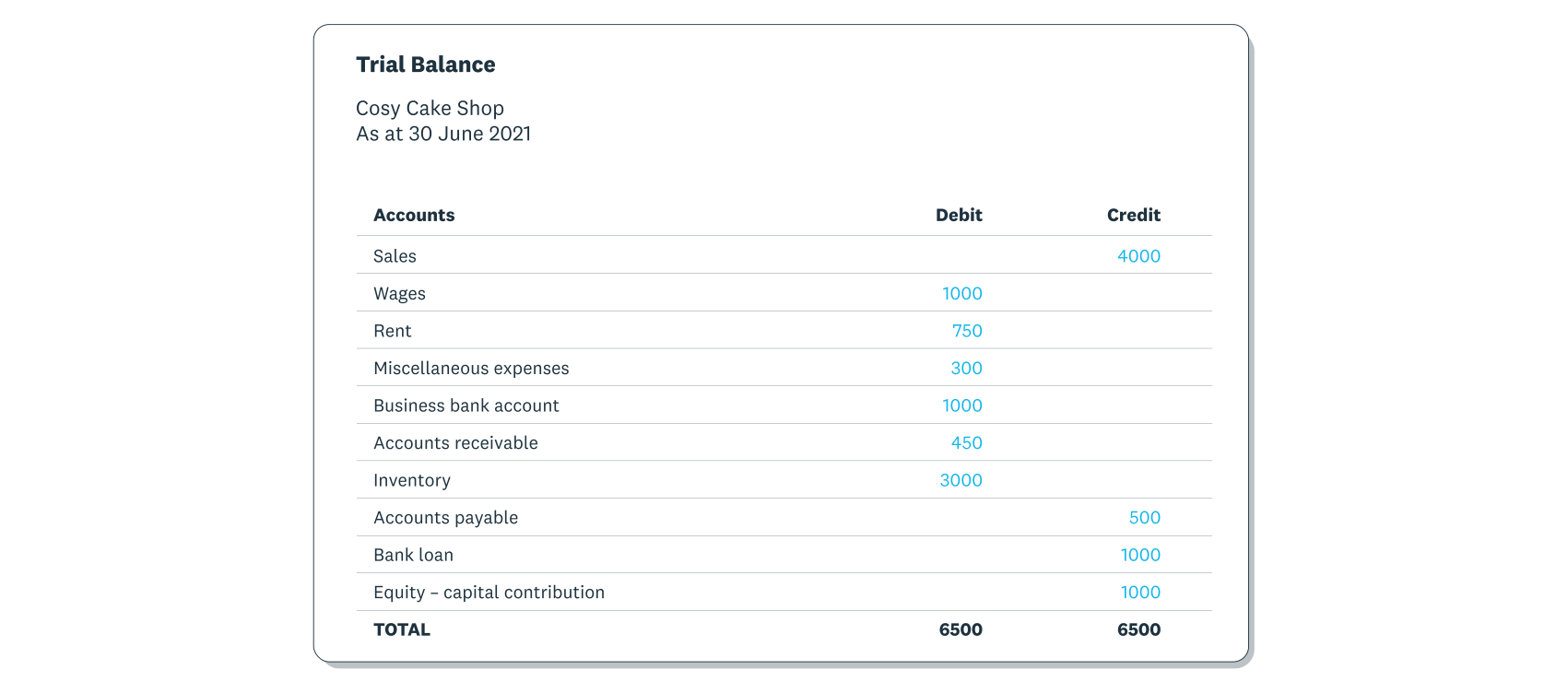
The trial balance shows the closing balances of all accounts in the general ledger at a point in time.
A trial balance has three columns: account names, debit balances, and credit balances. Here’s what goes in each:
- The account name column lists every active account from your chart of accounts
- The debit column shows assets and expenses, which normally carry debit balances
- The credit column shows liabilities, equity, and revenue, which normally carry credit balances
The debit and credit column totals must match.
Trial balance example
Here’s a worked trial balance for River Street Cafe, a fictional small business, at October 31. It includes revenue and expense accounts alongside assets, liabilities, and equity, just like a real trial balance.
The cafe’s debit balances cover its assets and expenses:
- Cash: $12,000
- Accounts receivable: $4,000
- Inventory: $3,000
- Equipment: $20,000
- Rent expense: $2,500
- Wages expense: $6,000
- Supplies expense: $1,500
- Total debits: $49,000
Its credit balances cover liabilities, equity, and revenue:
- Accounts payable: $5,000
- Loan payable: $15,000
- Owner’s equity: $17,000
- Sales revenue: $12,000
- Total credits: $49,000
Here’s how the cafe’s bookkeeper put it together:
- Pull the 11 closing balances from the general ledger at October 31.
- Sort them into seven debit balances and four credit balances.
- Total each side: debits come to $49,000 and credits come to $49,000.
- Compare the totals: they match, so the ledger passes its basic accuracy check.
If wages were keyed as $600 instead of $6,000, debits would total $43,600: a $5,400 gap that’s divisible by 9, pointing to a digit error.
Why does a trial balance matter for your business?
A trial balance matters because it’s your first line of defense against accounting errors. It confirms your books are mathematically correct before you prepare financial statements or share numbers outside your business.
Here are the key benefits for your business:
- Catches double-entry errors before financial statements are produced
- Simplifies your month-end and year-end close
- Gives you a complete ledger snapshot for audits or tax preparation
- Helps you stay compliant with accounting standards
- Builds confidence that your numbers reflect your true financial position
Running a trial balance regularly means fewer surprises at year-end and less time spent correcting errors under deadline pressure.
What are the limitations of a trial balance?
A trial balance only checks that debits and credits are mathematically equal, so some errors can still sit inside a balanced report. Knowing which ones helps you decide what else to review.
Watch for these mistakes, which leave both columns equal:
- Wrong-account postings: an expense posted to the wrong category still balances, but your reports will be inaccurate.
- Missing transactions: if a transaction was never recorded, the trial balance has no way to flag it.
- Compensating errors: overstating one account by $500 and understating another by $500 leaves the totals unchanged.
- Errors of principle: recording a capital expense as a revenue expense balances, but the classification is wrong.
A balanced trial balance confirms the math. Reviewing individual entries and reconciling your accounts catches the rest.
Types of trial balances
There are three types of trial balances, each prepared at a different stage of your accounting process. Here’s when each one fits:
- Unadjusted trial balance: prepared before any adjustments
- Adjusted trial balance: prepared after adjusting entries are posted
- Post-closing trial balance: prepared after closing entries are posted
Each type uses the same format and has its own job in your month-end or year-end close.
Unadjusted trial balance
An unadjusted trial balance is your first draft, pulled straight from your general ledger. It reflects the day-to-day transactions you’ve recorded and reveals obvious errors early.
You or your accountant then review it and make any needed adjustments. These may include deferrals, like recognizing income only when it’s earned, and depreciation, which spreads an asset’s cost over several years.
Accruals are another common adjustment, such as adding unpaid bills for the period. Adjusting these figures gives you a more accurate view of your financial position.
Adjusted trial balance
An adjusted trial balance is prepared after you post your adjusting entries and before you create financial statements. It summarizes the final balance of every account for the period.
You or your accountant then use it as the basis for your financial reports.
Post-closing trial balance
A post-closing trial balance is prepared after you finalize your financial statements and close your temporary accounts. Revenue, expense, and dividend accounts reset to zero, and their balances move into your business’s retained earnings.
This final check confirms your remaining permanent accounts still balance. It also gives you a clean split between the old accounting period and the new one.
How to prepare a trial balance
You prepare a trial balance by listing your ledger balances, sorting them into debits and credits, and comparing the totals. Follow these six steps:
- List all your general ledger accounts and their final balances for the period.
- Place all accounts with a debit balance, like assets and expenses, in the debit column.
- Place all accounts with a credit balance, like liabilities, equity, and revenue, in the credit column.
- Add up all the numbers in the debit column to get a total.
- Add up all the numbers in the credit column to get a total.
- Compare the two totals. If they match, your ledger is balanced; if they differ, review your entries to find the error.
Common trial balance errors
The most common trial balance errors come from mistyped, missing, or misfiled entries. Even small ones can distort your financial statements and lead to poor business decisions, so watch for these:
- Transcription errors: data entry mistakes like typing $5,000 instead of $500
- Transposition errors: swapped digits, like entering $540 instead of $450
- Omission errors: leaving transactions out of your accounts entirely
- Misclassification errors: recording transactions under the wrong account category
How to correct trial balance errors
To correct an unbalanced trial balance, work through the difference in order. Try these fixes:
- Double-check your work: review the numbers, take a break, then check again with fresh eyes
- Verify source data: confirm ledger figures are correct before entering them into your trial balance
- Test the difference: if it’s divisible by 9, look for transposed digits
- Use accounting software: tools like Xero reduce data entry errors and automate calculations, giving you more time for accuracy checks
The divisible-by-9 test is a handy shortcut. Entering $540 when the correct figure is $450 creates a $90 difference, which is divisible by 9. Spotting this pattern can save you hours of searching.
If you can’t locate the error right away, consider using a suspense account. This is a temporary holding account where you park the unresolved difference while you keep investigating. It keeps the rest of your ledger clean and your reporting on track until you correct the mistake.
Trial balance vs. balance sheet
A trial balance is an internal check on your ledger, while a balance sheet is a formal financial statement for people outside your business. You use them at different points in your accounting process.
A trial balance is an internal bookkeeping worksheet. It lists every general ledger account to confirm total debits equal total credits before you create official reports.
A balance sheet is a formal financial statement. It summarizes your assets, liabilities, and equity at a set date for lenders, investors, and other outside parties.
The role of trial balances in financial statements
Trial balances are the foundation for your financial statements and audits. They verify that your general ledger balances accurately reflect your business’s financial position.
Here’s how the process works:
- Check that debit and credit totals match.
- Investigate and correct any discrepancies you find.
- Use the corrected trial balance to build your financial statements.
The adjusted trial balance feeds directly into your core reports. Revenue and expense balances flow into your income statement, which shows your profit or loss for the period.
Asset, liability, and equity balances populate the balance sheet. Having a solid accounting system in place makes this process much smoother.
Auditors also rely on trial balances to verify your financial records. According to the Public Company Accounting Oversight Board, inappropriate journal entries often have unique identifying characteristics.
These may include entries made to unusual accounts, entries with little description, or entries containing round numbers. You can find more information on Financial Accounting Standards Board (FASB) accounting standards.
Streamline your trial balance process with Xero
An accurate trial balance helps you make smarter business decisions and makes year-end reporting simpler. With tools that automate bookkeeping, you spend less time on manual checks and more time growing your business.
Xero makes it easy to run financial reports, including your trial balance, whenever you need them. Automated bank feeds bring in your transactions, and JAX helps reconcile them, so your numbers stay up to date. Sign up today and get one month free to see how it works.
FAQs on trial balances
Here are answers to common questions about trial balances.
What is a trial balance used for?
A trial balance is used as a quick accuracy check during your accounting close. Running one at each period end helps you avoid costly corrections later.
Can accounting software generate a trial balance automatically?
Yes. Most accounting software, including Xero, generates a trial balance on demand from your general ledger data, so you skip manual totals and calculation errors.
Do small businesses need a trial balance for tax filing?
You don’t submit a trial balance with your tax return. It confirms your books balance before you or your accountant prepare the statements that support your filing.
What does it mean if a trial balance doesn’t balance?
An unbalanced trial balance means there’s a recording error somewhere, such as swapped digits or an amount posted to the wrong column. Find and fix it before you prepare financial statements, even if the rest of your books look right.
What is the difference between a trial balance and an income statement?
A trial balance lists every general ledger account with its debit or credit balance to verify your books. An income statement shows only revenue and expenses to report your profit or loss over a specific period.
How often should a business prepare a trial balance?
Most businesses prepare a trial balance at month-end, quarter-end, and year-end as part of their regular accounting close. You can also run one any time for a quick check, especially when reviewing your budget.
Disclaimer
Xero does not provide accounting, tax, business or legal advice. This guide has been provided for information purposes only. You should consult your own professional advisors for advice directly relating to your business or before taking action in relation to any of the content provided.