What is a balance sheet?
Learn what a balance sheet is, how to read one, and why it matters for your small business.
Published Thursday 23 July 2026
Table of contents
Key takeaways
- A balance sheet is a financial statement that shows what your business owns, what it owes, and what's left over for you as the owner at a specific point in time
- The balance sheet equation is Assets = Liabilities + Owner's Equity, and both sides must always be equal
- Reviewing your balance sheet regularly helps you track financial health, plan for growth, and prepare for loan applications
- Accounting software can generate a balance sheet automatically so you spend less time on spreadsheets and more time running your business
What is a balance sheet?
A balance sheet is 1 of the 3 main financial statements every business uses to understand its finances. It gives you a snapshot of your business's financial position at a specific date, rather than over a period of time.
You might also hear it called a "statement of financial position." Whatever the name, it answers 3 straightforward questions: What does your business own? What does it owe? And what's the value left over for you?
The balance sheet is built on a simple formula known as the accounting equation: Assets = Liabilities + Owner's Equity. Every balance sheet must balance, meaning the total value of your assets always equals the combined total of your liabilities and owner's equity.
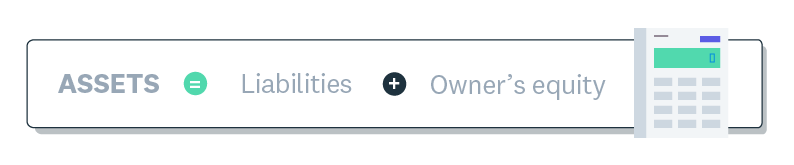
The accounting equation
Most businesses prepare a balance sheet at the end of each month, quarter, or financial year. Lenders, investors, and potential buyers often ask to see your balance sheet before making decisions about your business.
Why is a balance sheet important?
Your balance sheet is a key tool for making informed decisions about your business. It shows whether your business has enough resources to cover its debts and fund future growth.
Here are some of the main reasons your balance sheet matters:
- It reveals your financial health at a glance, showing whether your assets outweigh your liabilities
- Banks and lenders review your balance sheet when you apply for a loan or line of credit
- Comparing balance sheets from different periods helps you track how your business is growing or where it might be struggling
- It helps you identify trends, like rising debt or shrinking cash reserves, so you can take action early
Without a balance sheet, you're relying on guesswork to understand your financial position. Regularly reviewing this statement puts you in control of your business finances.
Components of a balance sheet
Every balance sheet is divided into 3 main sections: assets, liabilities, and owner's equity. Understanding what goes into each section helps you make sense of the numbers.
Assets
Assets are everything your business owns that has financial value. They're typically listed in order of liquidity, meaning how quickly they can be converted into cash.
Assets are split into 2 categories:
- Current assets: cash, accounts receivable, inventory, and prepaid expenses that you expect to use or convert to cash within 12 months
- Non-current assets: long-term items like equipment, vehicles, property, and intellectual property that your business holds for more than 12 months
Liabilities
Liabilities are the debts and obligations your business owes to others. Like assets, they're split by time frame.
- Current liabilities: debts due within 12 months, such as accounts payable, credit card balances, short-term loans, and taxes owed
- Non-current liabilities: long-term obligations like business loans, mortgages, and lease agreements extending beyond 12 months
Owner's equity
Owner's equity (also called net assets or stockholders' equity for corporations) represents the value left in your business after subtracting liabilities from assets. It's your ownership stake.
Owner's equity typically includes:
- Capital contributions: money you've invested in the business
- Retained earnings: profits the business has earned and kept rather than distributing
- Drawings or distributions: money taken out of the business by the owner, which reduces equity
The balance sheet equation
The balance sheet equation is the foundation of double-entry accounting. It ensures that every transaction is recorded on both sides of the equation, keeping your books balanced.
The formula is:
Assets = Liabilities + Owner's Equity
Here's a simple example. Say your business has $150,000 in total assets, including cash, equipment, and inventory. You owe $60,000 in loans and accounts payable. Your owner's equity would be:
$150,000 (Assets) - $60,000 (Liabilities) = $90,000 (Owner's Equity)
To check: $60,000 + $90,000 = $150,000. Both sides balance. If the 2 sides don't match, there's an error somewhere in your records that needs investigating.
How to read a balance sheet
Knowing what's on your balance sheet is 1 thing. Knowing how to interpret it is what helps you make better decisions for your business.
Start by looking at the big picture. Are your total assets growing over time? Are your liabilities increasing faster than your assets? These trends tell you whether your business is heading in the right direction.
A few financial ratios can give you deeper insight:
- Current ratio: divide your current assets by your current liabilities. A result above 1 means you have enough short-term assets to cover short-term debts. For example, $80,000 in current assets divided by $40,000 in current liabilities gives you a current ratio of 2
- Debt-to-equity ratio: divide your total liabilities by owner's equity. A lower number generally means your business relies less on borrowed money
- Working capital: subtract current liabilities from current assets. A positive number means you have enough cash and liquid assets to cover upcoming bills
Compare your balance sheet from quarter to quarter or year to year. Spotting changes early, like a drop in cash or a rise in debt, gives you time to adjust before small problems grow.
Balance sheet example
Here's what a simplified balance sheet might look like for a small business as of December 31, 2025.
Assets
- Cash: $25,000
- Accounts receivable: $15,000
- Inventory: $10,000
- Equipment: $30,000
- Total assets: $80,000
Liabilities
- Accounts payable: $8,000
- Short-term loan: $12,000
- Long-term loan: $20,000
- Total liabilities: $40,000
Owner's equity
- Capital contributions: $25,000
- Retained earnings: $15,000
- Total owner's equity: $40,000
Total liabilities + owner's equity: $80,000
Both sides equal $80,000, which confirms the balance sheet is correct. In this example, the business has a current ratio of 2.5 ($50,000 in current assets divided by $20,000 in current liabilities), suggesting a healthy short-term financial position.
Balance sheet vs. income statement
The balance sheet and the income statement (also called a profit and loss statement) are both essential financial reports, but they serve different purposes.
Your balance sheet shows your financial position at a single point in time. It tells you what your business owns and owes right now. Your income statement, on the other hand, covers a period of time and shows how much revenue your business earned and how much it spent.
Think of it this way: the income statement tells you how your business performed over the last month or year, while the balance sheet tells you where things stand today. Together, they give you a complete picture of your business's financial health.
Simplify your balance sheet reporting with Xero
Creating a balance sheet from scratch takes time, especially if you're working with spreadsheets. Xero's accounting software generates your balance sheet automatically using your up-to-date financial data.
Because Xero connects to your bank, your transactions are imported and can be matched to your records efficiently. That means your balance sheet can give you a clearer picture of your financial position, with less manual data entry. You can run a balance sheet report anytime and customize it to show the details that matter most to your business.
Ready to spend less time on bookkeeping and more time growing your business? Get one month free.
FAQs on balance sheets
Here are some frequently asked questions about balance sheets.
What is the balance sheet formula?
The balance sheet formula is Assets = Liabilities + Owner's Equity. This equation must always balance, meaning your total assets equal the sum of what you owe and what you own.
How often should you prepare a balance sheet?
Most small businesses prepare a balance sheet monthly, quarterly, or at the end of the financial year. Preparing one more often gives you a clearer view of your financial position over time.
What is the difference between a balance sheet and a profit and loss statement?
A balance sheet shows your financial position at a specific date, while a profit and loss statement shows your revenue and expenses over a period. The balance sheet focuses on what you own and owe; the profit and loss statement focuses on what you earned and spent.
Who needs to prepare a balance sheet?
Any business that wants to understand its financial health should prepare a balance sheet. Lenders, investors, and tax authorities may also request one when reviewing your business finances.
What happens if a balance sheet doesn't balance?
If your balance sheet doesn't balance, it means there's an error in your records. Common causes include missed transactions, incorrect entries, or data that hasn't been reconciled. Reviewing your accounts or using accounting software can help you find and fix the issue.
Handy resources
Advisor directory
You can search for experts in our advisor directory
Xero Small Business Guides
Discover resources to help you do better business
Financial reporting
Keep track of your performance with accounting reports
Disclaimer
This glossary is for small business owners. The definitions are written with their requirements in mind. More detailed definitions can be found in accounting textbooks or from an accounting professional. Xero does not provide accounting, tax, business or legal advice.