What is accumulated depreciation? How to calculate and record it
Learn what accumulated depreciation is, how to calculate and record it, and how it affects your financial statements.

Written by Jotika Teli—Certified Public Accountant with 24 years of experience. Read Jotika's full bio
Published Tuesday 6 October 2026
Table of contents
Key takeaways
- Accumulated depreciation is the running total of depreciation recorded on an asset since purchase. Subtract it from cost to get net book value.
- It’s a contra asset account with a normal credit balance. You credit it each period and debit it when you sell or retire the asset.
- You can spread an asset’s cost evenly with straight-line or front-load it with accelerated methods. The IRS generally requires the Modified Accelerated Cost Recovery System (MACRS) for tax.
- Depreciation cuts taxable income without cash leaving your business. Property acquired and placed in service after January 19, 2025 can qualify for 100% bonus depreciation.
What is accumulated depreciation?
Accumulated depreciation is the total depreciation you’ve recorded on an asset since you bought it. To see what the asset is worth on your books, use this formula: asset cost − accumulated depreciation = net book value.
Think of it like a car’s odometer. Each year of use adds to the reading, and it keeps climbing until you sell the asset or it’s fully depreciated.
Here are two examples:
- You buy office furniture for $5,000 and record $1,000 of depreciation each year. After three years, the total is $3,000 and book value is $2,000.
- You buy machinery for $25,000 and record $2,500 of depreciation each year. After six years, the total is $15,000 and book value is $10,000.
Depreciation vs accumulated depreciation
Depreciation spreads the cost of a tangible asset over its useful life as the asset wears out through use and age. Accumulated depreciation adds up every one of those charges since the purchase date.
Here’s how the two compare:
- Depreciation expense appears on your income statement, while the running total appears on your balance sheet
- Depreciation expense covers one period, while the running total covers every period since you bought the asset
- Depreciation expense starts fresh each year, while the running total grows until you sell or fully depreciate the asset
- Depreciation expense reduces net income, while the running total reduces the asset’s book value
Is accumulated depreciation an asset or a liability?
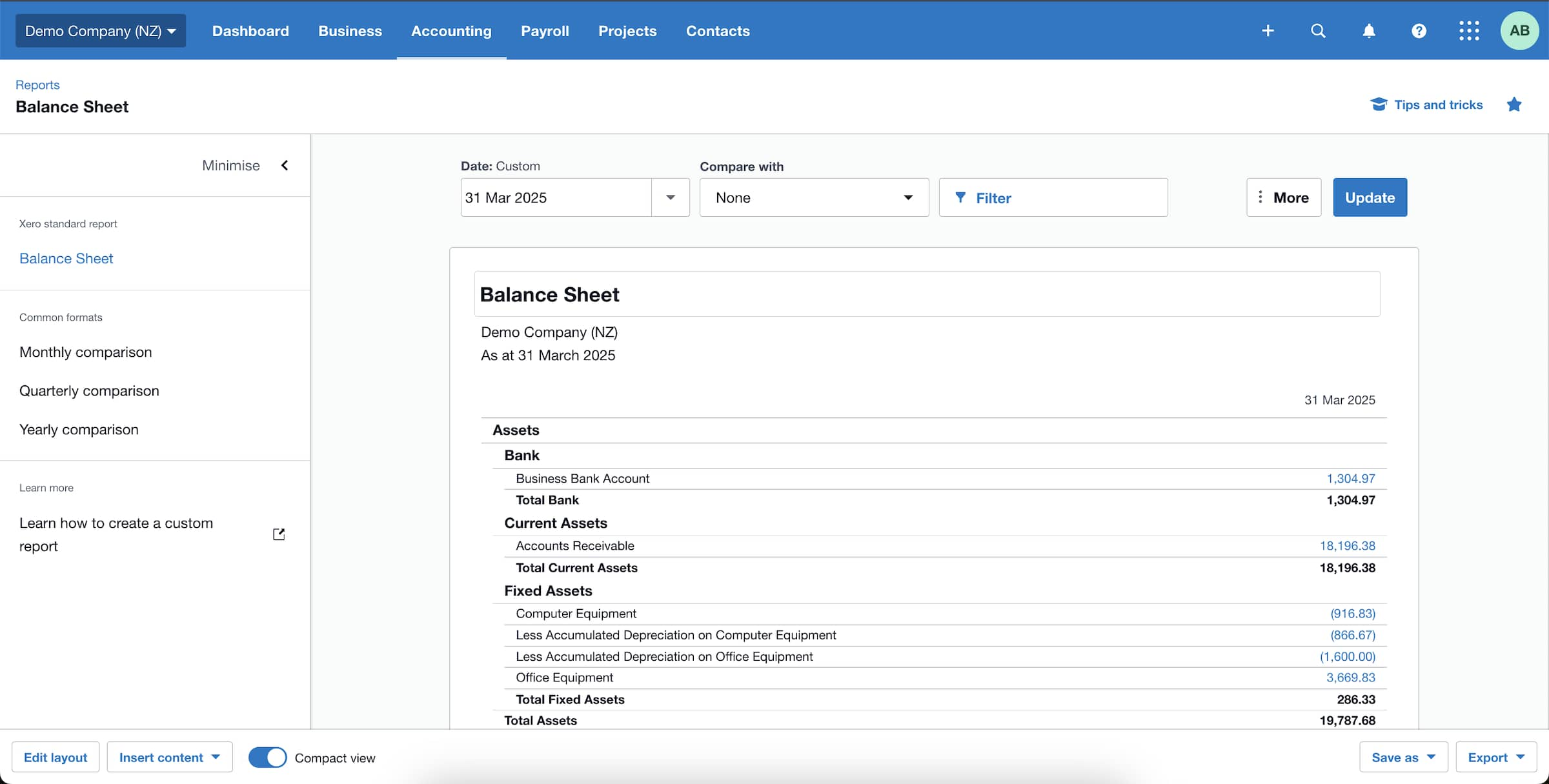
Accumulated depreciation is a contra asset account. It sits directly below the asset it offsets on your balance sheet and carries a credit balance that reduces that asset’s cost.
A true asset brings future economic benefit, and liabilities are money you owe. A contra asset does neither; it records how much of an asset’s cost you’ve already used up.
Is accumulated depreciation a debit or credit?
Accumulated depreciation is a credit. As a contra asset account, it has a normal credit balance that increases with credits and decreases with debits.
Fixed asset accounts carry debit balances, so a credit balance beside them lowers their value while keeping the original cost on record. Under double-entry bookkeeping, you credit the contra account each period and only debit it when you sell or retire the asset.
How does accumulated depreciation affect financial statements?
Accumulated depreciation touches all three core financial statements. Picture a $10,000 delivery van with a five-year useful life and a $1,000 salvage value.
Using straight-line depreciation, the annual expense is $1,800: ($10,000 − $1,000) ÷ 5.
Accumulated depreciation on the balance sheet
At the end of year one, your balance sheet shows the van’s $10,000 cost, less $1,800 of accumulated depreciation, for a net book value of $8,200.
By the end of year three, the total reaches $5,400 and net book value falls to $4,600.
Net book value rarely matches market value, which is what a buyer would pay today. Even so, lenders often use it in ratios such as fixed asset turnover, which compares your sales with your fixed assets.
Depreciation expense on the income statement
The yearly charge that feeds the running total shows up on your income statement as an operating expense. For the van, that’s $1,800 a year.
As a non-cash expense, it lowers your reported profit and your taxable income without any money leaving your account.
Depreciation on the cash flow statement
Because depreciation is a non-cash expense, you add it back to net income in the operating activities section of the cash flow statement. Adding back the $1,800 leaves operating cash flow unchanged.
The $10,000 you actually spent on the van appears under investing activities in the year you bought it.
Tax savings from depreciation
Because depreciation lowers taxable income, it saves you tax. At a 22% tax rate, the van’s $1,800 annual depreciation saves you $396 a year ($1,800 × 0.22).
Over five years, that adds up to $1,980 ($396 × 5). Accelerated methods and 100% bonus depreciation let you claim those tax deductions sooner.
How to calculate accumulated depreciation
You calculate accumulated depreciation by working out each period’s depreciation and adding the results together. Follow these steps for any asset:
- Identify the asset’s original cost
- Estimate its salvage value and useful life
- Choose one of the depreciation methods below
- Calculate the annual depreciation expense
- Add up the depreciation for each period to date
The method you pick in step three changes how quickly the total builds, as these examples show.
Straight-line depreciation method
The straight-line method is the simplest and most widely used approach. It spreads the depreciable cost evenly across the asset’s useful life.
The formula is: annual depreciation = (asset cost − salvage value) ÷ useful life. For a $1,000 asset with a three-year life and a $100 salvage value, that’s $300 a year ($900 ÷ 3):
- After year one, the total is $300 and book value is $700
- After year two, the total is $600 and book value is $400
- After year three, the total is $900 and book value is $100, the salvage value
Declining balance method
The declining balance method applies a fixed rate to the asset’s remaining book value each year. That puts more expense in the early years and less later on.
The formula is: annual depreciation = book value at the start of the year × depreciation rate. The rate is typically 1 ÷ useful life, so a $10,000 asset with a three-year life uses 33.33%:
- In year one, depreciation is $3,333 ($10,000 × 33.33%), leaving a book value of $6,667
- In year two, depreciation is $2,222 ($6,667 × 33.33%), leaving a book value of $4,445
- In year three, depreciation is $1,482 ($4,445 × 33.33%), leaving a book value of $2,963
The total after three years is $7,037. Because this method won’t land on salvage value by itself, you may need to adjust the final year.
Double-declining balance method
The double-declining balance (DDB) method doubles the straight-line rate. It suits assets that lose most of their value early, such as vehicles or technology.
The formula is: annual depreciation = book value at the start of the year × (2 ÷ useful life). For a $10,000 asset with a three-year life and $1,000 salvage value, the DDB rate is 66.67%:
- In year one, depreciation is $6,667 ($10,000 × 66.67%), and book value drops to $3,333
- In year two, depreciation is $2,222 ($3,333 × 66.67%), and book value drops to $1,111
- In year three, depreciation is capped at $111 ($1,111 − $1,000), and book value drops to $1,000
Sum-of-the-years’-digits method
The sum-of-the-years’-digits (SYD) method assigns a larger share of depreciable cost to earlier years, with a gentler decline than DDB. The formula is: annual depreciation = (remaining useful life ÷ sum of the years’ digits) × depreciable amount.
For the same $10,000 asset, the digits add up to 6 (1 + 2 + 3) and the depreciable amount is $9,000:
- In year one, depreciation is $4,500 (3 ÷ 6 × $9,000), so book value is $5,500
- In year two, depreciation is $3,000 (2 ÷ 6 × $9,000), so book value is $2,500
- In year three, depreciation is $1,500 (1 ÷ 6 × $9,000), so book value is $1,000
Units of production method
The units of production method ties depreciation to how much you use an asset, such as miles driven or machine hours. The formula is: depreciation per unit = (asset cost − salvage value) ÷ total estimated units.
Say the $10,000 van, with its $1,000 salvage value, should last 100,000 miles. The rate is $0.09 per mile ($9,000 ÷ 100,000):
- In year one, you drive 22,000 miles, so depreciation is $1,980 and book value is $8,020
- In year two, you drive 18,000 miles, so depreciation is $1,620 and book value is $6,400
After two years, the total is $3,600, and busier years would add more.
Modified Accelerated Cost Recovery System (MACRS)
For US federal tax purposes, the IRS generally requires MACRS for tangible property placed in service after 1986. Each asset gets a property class with a set recovery period, such as five years for vehicles or seven years for office furniture.
You don’t estimate salvage value under MACRS. Instead, you multiply the asset’s cost by each year’s percentage in the IRS tables for its class and convention.
Current tax law also allows 100% bonus depreciation. The One Big Beautiful Bill Act, signed in July 2025, made it permanent for qualified property acquired and placed in service after January 19, 2025.
In January 2026, the IRS issued interim guidance on the deduction in Notice 2026-11. Separately, Section 179 lets you expense up to $2,560,000 of qualifying property for tax years beginning in 2026, as covered in IRS Publication 946.
That limit shrinks once your qualifying purchases for the year exceed $4,090,000. MACRS rules can get complex, so confirm property classes and bonus eligibility with a tax professional.
How to record accumulated depreciation with a journal entry
You record depreciation with an adjusting journal entry at the end of each accounting period. For the delivery van, the yearly entry looks like this:
- Debit depreciation expense $1,800
- Credit accumulated depreciation $1,800
The debit adds $1,800 of expense to your income statement, and the credit raises the contra asset balance. The van’s own account stays at its $10,000 cost the whole time.
After three yearly entries, the contra account holds a $5,400 credit balance.
What happens to accumulated depreciation when you sell or retire an asset
When an asset leaves your business, you remove its cost and its accumulated depreciation, then record any gain or loss.
Recording a gain or loss on sale
Say you sell the van at the end of year three for $5,000. Its book value is $4,600 ($10,000 − $5,400), so you have a $400 gain ($5,000 − $4,600). The entry is:
- Debit cash $5,000
- Debit accumulated depreciation $5,400
- Credit delivery van $10,000
- Credit gain on sale of asset $400
Both sides total $10,400. If you’d sold the van for $4,000 instead, you’d debit a $600 loss rather than crediting a gain.
Fully depreciated assets still in use
An asset is fully depreciated once its book value reaches salvage value. If you keep using it, stop recording depreciation but leave both balances on the books until you sell or retire it.
Changes to useful life or salvage value
If your estimate of useful life or salvage value changes, you apply the change going forward. Past years stay as recorded, and you spread the remaining book value over the new estimate.
For example, the van’s book value is $4,600 after year three. If you now expect three more years of use instead of two, you’d depreciate $1,200 a year: ($4,600 − $1,000) ÷ 3.
Book vs tax depreciation
Your accounting books and your tax return often use different methods. Books prepared under generally accepted accounting principles (GAAP) often use straight-line, while your federal return uses MACRS and, where eligible, bonus depreciation.
If the van qualified for 100% bonus depreciation, you could deduct $10,000 on your return in year one while your books show $1,800. These temporary differences reverse over the asset’s life or when you sell it.
That’s why many businesses keep two depreciation schedules, one for the books and one for taxes.
Why businesses use depreciation
Depreciation gives you a truer view of profit and a lower tax bill. Recording it consistently helps you:
- match each asset’s cost to the periods it helps you earn revenue, as the matching principle requires
- lower your taxable income, with accelerated methods moving deductions into early years
- show lenders and investors what your assets are realistically worth
- plan replacements by knowing when an asset’s book value will reach zero
- comply with GAAP and IRS depreciation rules for qualifying business assets
Common misconceptions about accumulated depreciation
These four misunderstandings can skew your reporting and decisions:
- Its credit balance makes accumulated depreciation look like a liability. It’s actually a contra asset that lowers your fixed assets’ book value.
- Depreciation can seem to drain cash, yet recording it moves no money. The tax it saves helps you keep more cash.
- Some owners treat depreciation as optional. GAAP and IRS rules require it for qualifying assets, and skipping it misstates your finances.
- A zero book value can make an asset look worthless, though it may still run and resell. Value lost beyond normal wear is called impairment.
Track depreciation and manage your assets with Xero
As you buy more assets, updating depreciation schedules by hand eats into your time. Xero accounting software lets you manage and track your fixed assets in one place, with automated depreciation calculations and clear reporting.
With book values up to date, you’ll head into tax time and lender conversations prepared. Sign up for Xero today and get one month free.
FAQs on accumulated depreciation
Here are quick answers to other common questions about accumulated depreciation.
Is accumulated depreciation a current liability?
No. It sits with your noncurrent assets as a contra account, while current liabilities are debts due within 12 months, such as supplier bills.
What is the difference between depreciation and amortization?
Depreciation applies to tangible assets like vehicles and equipment, while amortization applies to intangible assets like patents and software licenses. Both spread an asset’s cost over its useful life.
Can accumulated depreciation exceed the asset’s cost?
No. Depreciation stops once book value reaches salvage value, so the total can at most equal the asset’s cost when salvage value is zero.
Does land have accumulated depreciation?
No. Land doesn’t wear out or get used up, so when you buy a property, you depreciate only the building’s share of the price.
Where do you find accumulated depreciation on a balance sheet?
Look in the noncurrent assets section, under property, plant and equipment. Some balance sheets show only the net figure and list the accumulated total in the notes.
Disclaimer
Xero does not provide accounting, tax, business or legal advice. This guide has been provided for information purposes only. You should consult your own professional advisors for advice directly relating to your business or before taking action in relation to any of the content provided.