Liquidity vs solvency: differences and ratios explained
Learn how liquidity and solvency differ, which ratios to track, and how to strengthen both for your small business.

Written by Lena Hanna—Trusted CPA Guidance on Accounting and Tax. Read Lena's full bio
Published Wednesday 6 May 2026
Table of contents
Key takeaways
- Liquidity measures your ability to pay short-term bills as they come due, while solvency reflects whether your total assets outweigh your total debts over the long term. Both are essential for a healthy small business.
- Common liquidity ratios include the current ratio, quick ratio, and cash ratio. For solvency, the debt-to-asset ratio and equity ratio give you a clear picture of long-term financial stability.
- Tracking both metrics together helps you spot problems early, secure better loan terms, and make confident decisions about growth. A business can look profitable on paper yet still face cash crunches or unsustainable debt loads.
- Simple steps such as tightening payment terms, reducing unnecessary debt, and reviewing your ratios each quarter can improve both liquidity and solvency over time.
What does liquidity mean in business?
Liquidity is a measure of how quickly and easily your business can convert assets into cash to cover short-term obligations. If you can pay your bills on time without scrambling for funds, your business is considered liquid.
How liquid are your assets?
Not all assets are created equal when it comes to liquidity. Cash in a bank account is the most liquid asset you can hold because it's ready to spend immediately.
Accounts receivable and inventory are moderately liquid because they can typically be turned into cash within a few weeks or months. Physical assets such as property, equipment, and vehicles are the least liquid because selling them takes time and often involves a discount.
Understanding where your assets fall on this spectrum helps you gauge how prepared your business is to handle unexpected expenses or slow revenue periods.
Liquidity ratios and metrics
Several ratios can help you measure your business's liquidity, each offering a slightly different perspective. Liquidity ratios compare what you own against what you owe in the short term.
- Current ratio: Divide your current assets by your current liabilities. A result above 1.0 means you have more short-term assets than short-term debts. For example, a current ratio of 2.0 means you have $2 in current assets for every $1 in current liabilities.
- Quick ratio: Also called the acid-test ratio, this strips out inventory from your current assets before dividing by current liabilities. It gives a stricter view of liquidity because inventory can be harder to sell quickly.
- Cash ratio: This is the most conservative measure. It divides only your cash and cash equivalents by current liabilities, showing whether you could settle debts right now with cash on hand.
- Days sales outstanding (DSO): This metric tracks the average number of days it takes to collect payment after a sale. A lower DSO means you're converting receivables into cash faster, which strengthens your liquidity position.
How does liquidity affect business growth?
Strong liquidity gives you the flexibility to act on opportunities quickly. When a supplier offers a bulk discount or a promising hire becomes available, having accessible cash lets you move without delay.
On the other hand, poor liquidity can force you into costly short-term borrowing or cause you to miss payment deadlines. Late payments can damage supplier relationships, trigger penalty fees, and limit your access to credit when you need it most.
What does solvency mean in business?
Solvency refers to your business's ability to meet its long-term financial obligations. A solvent business owns more than it owes when you look at the full balance sheet, including long-term debt such as business loans and mortgages.
What factors affect your solvency?
Your solvency depends on the balance between total assets and total liabilities. Taking on large amounts of debt, such as equipment financing or commercial property loans, increases your liabilities and can weaken solvency if asset values don't keep pace.
Revenue consistency also plays a role. A business with steady income can service its debts more reliably than one with unpredictable cash flows. Retained earnings, the profits you reinvest rather than withdraw, build equity over time and strengthen your solvency position.
What is solvency vs profitability?
Profitability measures whether your business earns more than it spends over a given period. Solvency, by contrast, looks at whether your total assets can cover your total debts.
A business can be profitable in a given quarter yet still be insolvent if it carries more total debt than the value of its assets. Conversely, a business might report a loss in a slow period but remain solvent because its assets far exceed its liabilities. Both metrics matter, but they answer different questions about your financial health.
How does solvency affect your business growth?
Lenders and investors look closely at solvency when deciding whether to extend credit or funding. A strong solvency position signals that your business can handle additional debt responsibly, making it easier to secure financing for expansion.
Poor solvency limits your options. If your debts outweigh your assets, lenders may decline your applications or charge higher interest rates. In severe cases, insolvency can lead to bankruptcy proceedings.
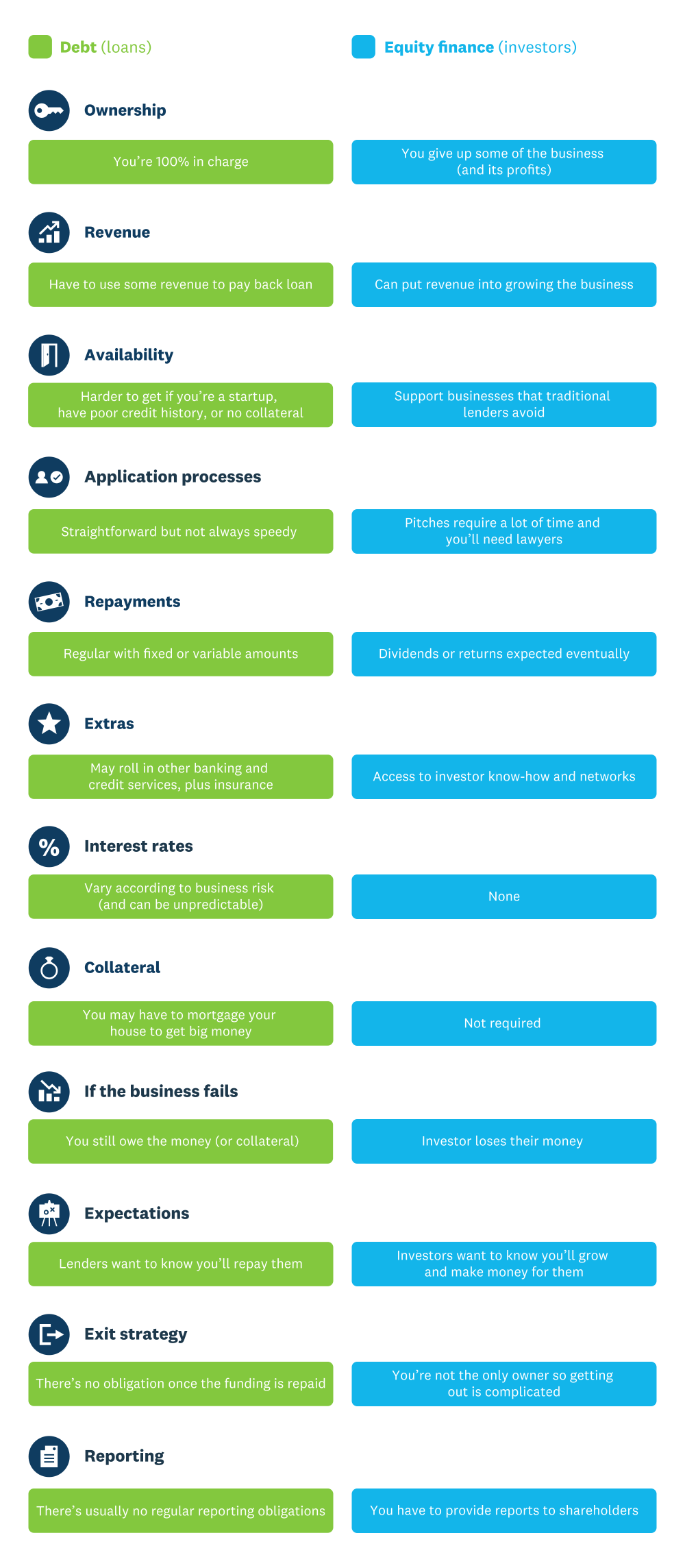
Key differences between liquidity and solvency
While liquidity and solvency both relate to financial health, they focus on different aspects of your business. Here's how they compare.
- Time horizon: Liquidity focuses on the short term, typically the next 12 months. Solvency takes a long-term view of your overall financial position.
- What each measures: Liquidity measures your ability to pay bills and expenses as they come due. Solvency measures whether your total assets exceed your total liabilities.
- Key ratios: Liquidity is assessed using the current ratio, quick ratio, and cash ratio. Solvency is assessed using the debt-to-asset ratio, debt-to-equity ratio, and equity ratio.
- Key question each answers: Liquidity asks, "Can you pay your bills this month?" Solvency asks, "Can your business sustain its debts over the long run?"
How to measure solvency and liquidity in your business
Applying simple formulas to your own numbers gives you a clear snapshot of where your business stands. The following examples walk through the most common calculations for each.
Solvency ratio formula
The debt-to-asset ratio is one of the simplest solvency measures. You calculate it by dividing total liabilities by total assets.
For example, Martha runs a small cafe. Her total assets, including equipment, inventory, and cash, are worth $200,000. Her total liabilities, including a business loan and supplier accounts, amount to $75,000.
Martha's debt-to-asset ratio: $75,000 / $200,000 = 0.375
This means 37.5% of Martha's assets are financed by debt. A ratio below 0.5 is generally considered healthy, so Martha's cafe is in a strong solvency position. The lower the ratio, the less reliant your business is on borrowed money.
Liquidity ratio formula
The current ratio (also known as the working capital ratio) is the most widely used liquidity measure. You calculate it by dividing current assets by current liabilities.
For example, Sadiq owns a sports shop. His current assets, including cash, inventory, and receivables, total $80,000. His current liabilities, including supplier invoices and a short-term loan payment, total $40,000.
Sadiq's current ratio: $80,000 / $40,000 = 2.0
A current ratio of 2.0 means Sadiq has $2 in short-term assets for every $1 in short-term debt. A ratio above 1.0 suggests a business can meet its immediate obligations, and Sadiq's shop is well positioned.
What to consider when using financial ratios
Financial ratios are most useful when you put them in context. A single number on its own doesn't tell the full story of your business's health.
Compare within your industry
Healthy ratios vary significantly across industries. A retail business might operate comfortably with a current ratio of 1.5, while a construction firm may need a ratio closer to 2.0 because of longer project cycles. Look up industry benchmarks from trade associations or your accountant to understand what "good" looks like for your specific sector.
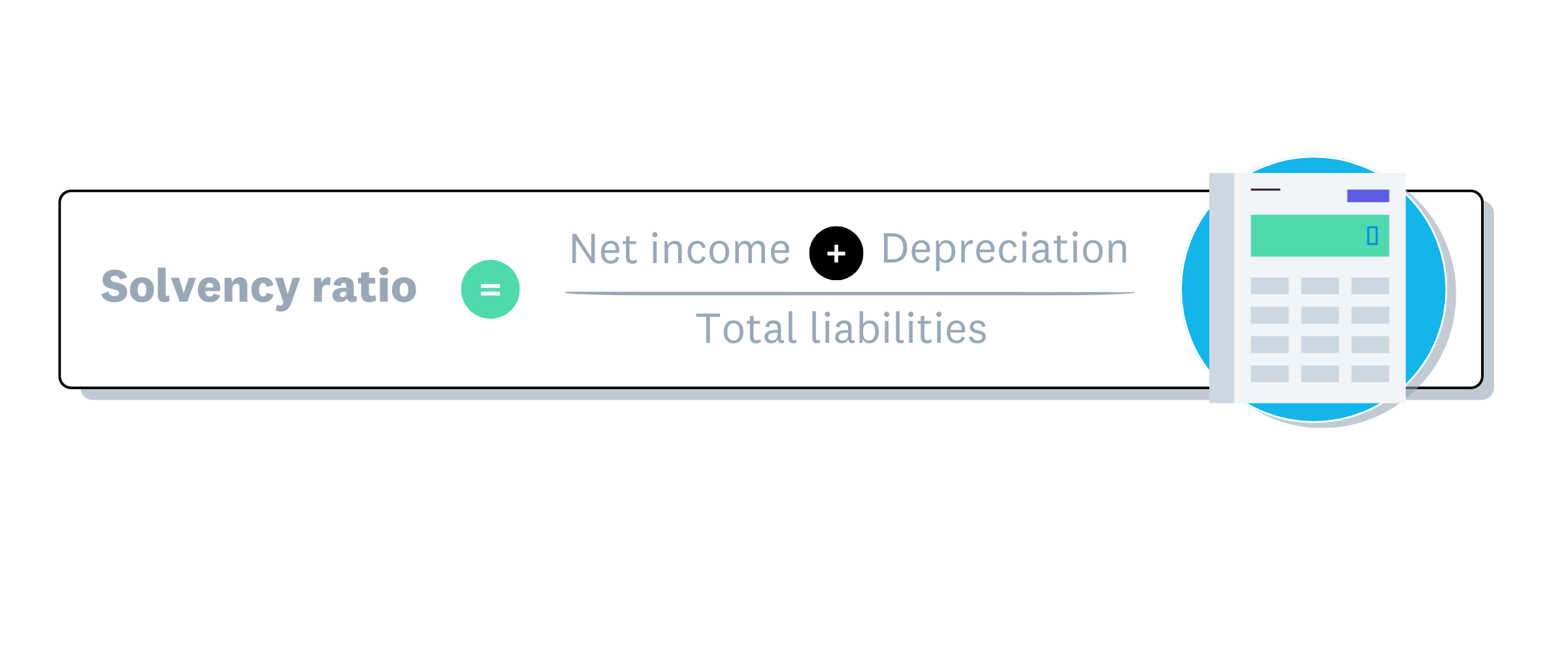
Solvency ratio formula
Track trends over time
A single quarterly snapshot can be misleading, especially for seasonal businesses. Instead, track your ratios over several quarters or years to identify patterns. A gradually declining current ratio, for instance, could signal that liabilities are growing faster than assets, even if the current number still looks acceptable.
Analyze liquidity and solvency together
Looking at one metric in isolation can give you a false sense of security. A business might have strong liquidity because it recently took on a large loan (plenty of cash right now), but that same loan weakens its solvency. Cross-analyzing both ratios gives you a more complete picture of financial health and helps you catch problems before they become serious.
Why solvency and liquidity matter for your small business
Keeping an eye on both solvency and liquidity helps you make smarter financial decisions and avoid preventable crises. Each metric protects a different aspect of your business.
Why solvency matters:
- Lenders review your solvency ratios when evaluating loan applications. A strong position increases your chances of approval and better interest rates.
- Maintaining solvency protects your business from the risk of bankruptcy or forced asset sales.
- Healthy solvency gives potential investors and partners confidence in your long-term viability.
- It allows you to take on strategic debt for growth without overextending your balance sheet.
Why liquidity matters:
- Sufficient liquidity means you can pay employees, suppliers, and rent on time every month.
- It gives you the freedom to act on time-sensitive opportunities, such as bulk purchase discounts or hiring key talent.
- Healthy liquidity reduces your dependence on expensive short-term borrowing like credit lines or merchant cash advances.
- It provides a buffer against unexpected costs, from equipment repairs to slow sales periods.

Neglecting either metric can have serious consequences. Poor liquidity can lead to missed payments, damaged credit scores, and strained supplier relationships. Poor solvency can result in an inability to secure financing, forced asset liquidation, or in extreme cases, business closure.
Tips to improve your financial solvency and liquidity
Small, consistent actions can strengthen both your solvency and liquidity over time. Here are practical steps you can start taking today.
To improve solvency:
- Pay down high-interest debt first. Reducing your total liabilities directly improves your debt-to-asset ratio and frees up cash that would otherwise go toward interest payments. Review your debts and create a plan to manage them strategically.
- Reinvest profits back into the business. Retained earnings build equity, which strengthens your balance sheet and improves solvency ratios over time.
- Avoid taking on new debt unless it directly supports revenue growth. Each new liability shifts your solvency ratio, so weigh the return against the added obligation before committing.
To improve liquidity:
- Tighten your payment terms. Shortening your invoicing cycles from 60 days to 30 days, or offering small early-payment discounts, brings cash in faster.
- Make it easy for customers to pay. Accepting multiple payment methods, including online and mobile options, removes friction and speeds up collections.
- Review your inventory regularly. Excess stock ties up cash that could be used elsewhere. Identify slow-moving items and adjust your ordering to match actual demand.
- Build and manage your cash flow with a rolling forecast. Projecting your inflows and outflows for the next three to six months helps you spot potential shortfalls early and take action before they become urgent.
Track your solvency and liquidity with Xero
Staying on top of your solvency and liquidity doesn't have to mean hours spent with spreadsheets. With the right accounting software, you can run financial reports that show your current ratios, track trends over time, and flag potential issues before they grow.
Xero gives you a real-time view of your cash flow, balance sheet, and key financial metrics in one place. Automated bank feeds and reporting tools make it straightforward to monitor your liquidity and solvency without manual data entry.
FAQs on liquidity and solvency
Below are answers to frequently asked questions about liquidity and solvency that can help you better understand these financial concepts.
What does it mean to provide liquidity?
Providing liquidity means making funds available so that transactions can happen smoothly. In a business context, this could mean ensuring enough cash is on hand to pay suppliers or meet payroll.
Can a business have good solvency but poor liquidity?
Yes. A business could own valuable property that makes its total assets exceed total debts (strong solvency), yet struggle to pay bills because those assets can't be converted to cash quickly.
What is a good solvency ratio for a small business?
A debt-to-asset ratio below 0.5 is generally considered healthy, meaning less than half of your assets are financed by debt. Acceptable ratios vary by industry, so compare yours to relevant benchmarks.
How do liquidity and solvency affect loan applications?
Lenders evaluate both metrics during the application process. Strong liquidity reassures them you can make repayments on time, while strong solvency shows your business can sustain debt over the long term.
What happens if your business has poor solvency or liquidity?
Poor liquidity can cause missed payments and strained supplier relationships. Poor solvency can lead to difficulty securing credit and, in severe cases, bankruptcy.