Liabilities
Learn what liabilities are, the types that affect your business, and how to manage them.
Published Thursday 23 July 2026
Table of contents
Key takeaways
- Liabilities are debts or obligations your business owes to others, and they appear on your balance sheet alongside assets and equity.
- Current liabilities are due within 12 months, while non-current liabilities extend beyond a year. Contingent liabilities depend on future events.
- The difference between liabilities, assets, and expenses is fundamental to making smarter financial decisions for your business.
- Regular liability tracking keeps your business financially healthy and supports long-term growth.
What are liabilities?
Liabilities are financial obligations your business owes to others. They include any debts, loans, or amounts you're required to pay in the future.
In accounting, liabilities are one of three core elements on your balance sheet. The basic accounting equation ties them all together: Assets = Liabilities + Equity. This means everything your business owns (assets) is funded by what you owe (liabilities) or what you've invested (equity).
For small businesses, liabilities aren't necessarily a bad thing. Taking on a business loan to buy equipment or fund growth is common. What matters is understanding what you owe, when it's due, and whether your business can comfortably meet those obligations.
Types of liabilities
Liabilities fall into three main categories based on when they're due and how certain they are. Knowing which types apply to your business helps you prioritize payments and plan your cash flow.
Current liabilities
Current liabilities are debts due within 12 months. These are your short-term obligations that need attention in the near future.
Common current liabilities for small businesses include:
- Accounts payable: money you owe suppliers for goods or services already received
- Wages payable: salaries and wages you owe employees for work already completed
- Short-term loans: any business loans or credit lines due within one year
- Income taxes payable: federal, state, or local taxes your business owes
- Sales tax payable: sales tax collected from customers that you haven't yet remitted
- Unearned revenue: payments received from customers for products or services you haven't delivered yet
Non-current liabilities
Non-current liabilities, also called long-term liabilities, are debts due beyond 12 months. These typically involve larger sums of money and longer repayment periods.
Examples of non-current liabilities include:
- Long-term business loans: loans with repayment terms extending past one year
- Mortgages: loans used to finance commercial property or real estate
- Bonds payable: debt securities issued by your business to raise capital
- Deferred tax liabilities: taxes owed in the future due to timing differences between accounting and tax rules
- Pension obligations: long-term commitments to employee retirement plans
Contingent liabilities
Contingent liabilities are potential obligations that may or may not become actual debts. They depend on the outcome of a future event, like a lawsuit or warranty claim.
For example, if a customer files a lawsuit against your business, the potential payout is a contingent liability. You don't owe anything yet, but you might in the future. Product warranties work the same way: you may need to cover repair or replacement costs, but only if a customer makes a claim.
Businesses typically disclose contingent liabilities in their financial statements without recording them as actual debts. However, if the outcome becomes probable and the amount is estimable, you'd record it as a real liability according to generally accepted accounting principles (GAAP).
Examples of liabilities in business
Seeing how liabilities work in practice makes them easier to understand. Here's what they might look like for a small business.
Imagine you run a landscaping company. At the end of the quarter, your balance sheet shows these liabilities:
- $8,500 in accounts payable to your equipment supplier
- $3,200 in wages payable to your crew for the last two weeks
- $1,800 in sales tax collected but not yet remitted
- $45,000 remaining on a five-year truck loan
- $120,000 on a commercial property mortgage
Your current liabilities total $13,500 (accounts payable + wages + sales tax). Your non-current liabilities total $165,000 (truck loan + mortgage). Together, your total liabilities are $178,500.
This number on its own doesn't tell you much. But compare it to your total assets. If your business owns $250,000 in assets, you have $71,500 in equity ($250,000 - $178,500). That means you own about 29% of your business outright, with the rest funded by debt.
Liabilities vs. assets
Assets are what your business owns. Liabilities are what your business owes. They sit on opposite sides of the accounting equation, but they're closely connected.
Assets include things like cash, inventory, equipment, and property. Liabilities include loans, unpaid bills, and other debts. The difference between total assets and total liabilities equals your equity, or the net worth of your business.
Some assets and liabilities are directly related. For instance, when you take out a $50,000 loan to buy a delivery van, you gain a $50,000 asset (the van) and a $50,000 liability (the loan). Over time, the asset may lose value through depreciation while you pay down the liability.
Keeping your assets higher than your liabilities is essential. If liabilities exceed assets, your business has negative equity, which can signal financial trouble to lenders and investors.
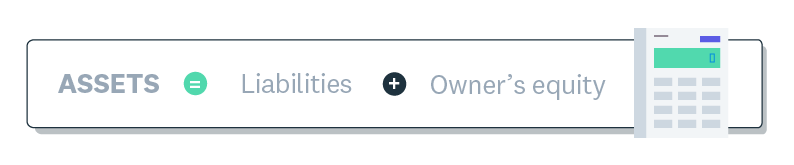
The accounting equation
Liabilities vs. expenses
Liabilities and expenses both involve money going out, but they represent different things. An expense is a cost your business incurs to generate revenue during a specific period. A liability is an obligation to pay someone in the future. Understanding this distinction is fundamental to reading your financial statements and setting a business budget.
Expenses show up on your income statement (also called a profit and loss statement). Liabilities appear on your balance sheet. This distinction matters for understanding your overall financial health.
Here's a practical example. Say you buy a company car for $30,000 with a five-year loan. The loan balance is a liability on your balance sheet.
The monthly interest you pay on that loan is an expense on your income statement. The depreciation of the car over its useful life is also an expense.
Some items can start as one and become the other. When you receive a utility bill but haven't paid it yet, the unpaid amount is a liability (accounts payable). Once you pay it, it becomes an expense. Understanding how debits and credits work helps you record transactions in the right place on your financial statements.
How to manage business liabilities
Keeping your liabilities under control is key to running a financially stable business. Here are practical steps to stay on top of what you owe.
Start by calculating your debt-to-asset ratio. Divide your total liabilities by your total assets. A ratio under 0.5 means less than half your assets are funded by debt, which is generally considered healthy for small businesses.
Pay close attention to your current liabilities. These are due soonest and affect your day-to-day cash flow. Make sure you have enough cash or liquid assets to cover them. If your current liabilities consistently exceed your current assets, your business may struggle to meet short-term obligations.
Consider these strategies for keeping liabilities manageable:
- Negotiate longer payment terms with suppliers to improve cash flow timing
- Refinance high-interest debt when lower rates are available
- Build a cash reserve to avoid taking on unnecessary short-term debt
- Review your liabilities monthly so nothing catches you off guard
- Separate personal and business debts to keep your financial picture clear
If your debt-to-asset ratio climbs above 0.6, or you're regularly struggling to pay bills on time, consider speaking with an accountant or financial advisor. They can help you restructure debt and build a plan to reduce your liabilities over time.
Track your business liabilities with Xero
Staying on top of your liabilities starts with having clear visibility into what you owe and when it's due. Xero's cloud accounting software gives you real-time access to your balance sheet, so you can see your current and long-term liabilities at a glance.
With automated bank feeds and smart reconciliation, you can track accounts payable, loan balances, and other obligations without manual data entry. Customizable reports help you monitor your debt-to-asset ratio and spot trends before they become problems. Take the next step and get started today.
Related terms
These accounting terms are closely connected to liabilities and worth understanding alongside them.
Learn more about liabilities
These guides cover related topics that can help you manage your business finances.
Handy resources
Advisor directory
You can search for experts in our advisor directory
Xero Small Business Guides
Discover resources to help you do better business
Financial reporting
Keep track of your performance with accounting reports
Disclaimer
This glossary is for small business owners. The definitions are written with their requirements in mind. More detailed definitions can be found in accounting textbooks or from an accounting professional. Xero does not provide accounting, tax, business or legal advice.