How to calculate operating profit
Learn the operating profit formula and how to calculate it step by step for your small business.
Published Thursday 23 July 2026
Table of contents

How to calculate operating profit
Key takeaways
- Operating profit measures how much money your business earns from its core operations, after subtracting cost of goods sold (COGS), operating expenses, and depreciation and amortization. It excludes interest, taxes, and non-operating income.
- The formula is straightforward: Operating Profit = Revenue - COGS - Operating Expenses - Depreciation and Amortization. You can find most of these figures on your income statement.
- Operating profit margin, calculated as (Operating Profit / Revenue) x 100, lets you compare your operational efficiency against industry benchmarks and track performance over time.
- Tracking operating profit regularly helps you spot trends, identify where to cut costs, and make confident decisions about pricing, staffing, and growth.
What is operating profit?
Understanding your operating profit gives you a clear view of how well your business performs at its core. It's one of the most useful profit metrics on your income statement.

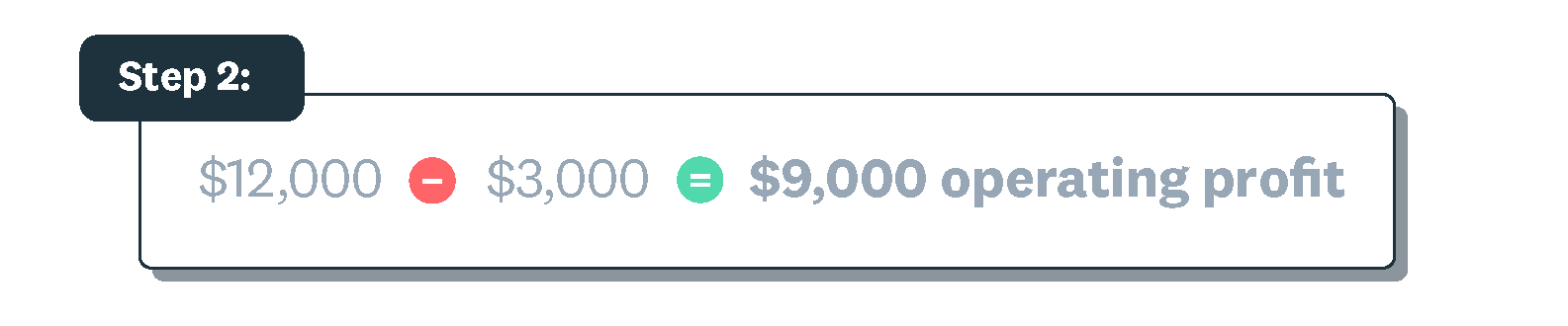
Operating profit is the amount of money your business earns from its day-to-day operations after subtracting all the costs directly tied to running the business. These costs include cost of goods sold (COGS), operating expenses like rent and wages, and depreciation and amortization (D&A).
Unlike net income, operating profit doesn't include interest payments, taxes, or one-off gains and losses. This makes it a focused measure of how efficiently your business generates profit from its regular activities. You may also hear it called earnings before interest and taxes (EBIT), though the 2 terms can differ slightly depending on how non-operating items are treated.
The operating profit formula
Once you understand what goes into operating profit, the formula itself is simple to apply. Here's the standard formula you can use.
Handy resources
Advisor directory
You can search for experts in our advisor directory
How to manage your finances and cash flow
Learn about money management for your small business
Financial reporting
Keep track of your performance with accounting reports
Operating Profit = Revenue - COGS - Operating Expenses - Depreciation and Amortization
You can also calculate it starting from gross profit:
Operating Profit = Gross Profit - Operating Expenses - Depreciation and Amortization
Operating expenses typically include costs like:
- Rent and utilities
- Salaries and wages
- Marketing and advertising
- Insurance premiums
- Office supplies and software subscriptions
Certain costs are excluded from the operating profit calculation because they don't relate to core business operations:
- Interest payments on loans
- Income taxes
- Investment income or losses
- Gains or losses from selling assets
- Lawsuit settlements
- Foreign exchange gains or losses
How to calculate operating profit step by step
Calculating operating profit takes just a few steps. Follow this process using figures from your income statement.
- Start with your total revenue. This is the total amount your business earned from sales before any deductions. For example, if you run a bakery and sold $250,000 worth of goods over the year, that's your revenue.
- Subtract cost of goods sold (COGS). COGS includes the direct costs of producing your goods or services, such as raw materials and direct labor. The result is your gross profit.
- Subtract operating expenses. These are the day-to-day costs of running your business that aren't tied directly to production, such as rent, utilities, marketing, and administrative salaries.
- Subtract depreciation and amortization. Depreciation accounts for the gradual loss in value of physical assets like equipment. Amortization does the same for intangible assets like patents or software licenses.
- The result is your operating profit. This figure shows how much your core business activities earned before interest and taxes.
Operating profit example
Seeing the formula in action makes it easier to understand. Here's a worked example using realistic numbers for a small bakery business.
Suppose your bakery had the following figures for the year:
- Revenue: $250,000
- COGS (flour, sugar, packaging, direct labor): $95,000
- Operating expenses (rent, utilities, marketing, admin salaries): $85,000
- Depreciation and amortization (ovens, display cases, point-of-sale software): $10,000
Using the formula:
Operating Profit = $250,000 - $95,000 - $85,000 - $10,000 = $60,000
This means your bakery earned $60,000 from its core operations before accounting for interest payments or taxes. Your operating profit margin would be ($60,000 / $250,000) x 100 = 24%.
Now imagine the following year your revenue grows to $300,000, but your COGS rises to $120,000, operating expenses climb to $100,000, and D&A stays at $10,000. Your new operating profit would be $300,000 - $120,000 - $100,000 - $10,000 = $70,000, with a margin of about 23.3%. Revenue went up, but your margin dipped slightly, which signals that costs grew faster than sales.
Why operating profit matters for your business
Knowing your operating profit helps you make smarter decisions about pricing, spending, and growth. It's more than just a number on your financial statements.
Operating profit shows how efficiently your business turns revenue into profit through its core activities. Because it strips out interest and taxes, it gives you a clearer picture of operational performance than net income alone.
If you're applying for a loan or seeking investors, lenders and investors often look at operating profit to assess whether your business can generate enough income to cover its obligations. A strong operating profit signals a well-managed operation.
Tracking operating profit over time also helps you spot trends. If your operating profit is shrinking while revenue stays flat, that's a sign your costs may be creeping up. Comparing your operating profit margin to industry benchmarks shows how you stack up against competitors.
Operating profit vs. other profit types
Your income statement includes several profit metrics, and each one tells a different story. Understanding the differences helps you use the right figure for the right purpose.
Operating profit vs. gross profit
Gross profit only subtracts COGS from revenue. It shows how much you earn after covering the direct costs of producing your goods or services.
Operating profit goes further by also subtracting operating expenses and D&A. A healthy gross profit paired with a low operating profit suggests your overhead costs may be too high relative to your sales.
Operating profit vs. net income
Net income is your bottom line after all expenses, including interest, taxes, and non-operating items. It reflects your total profitability.
Operating profit is a better measure of operational efficiency because it focuses only on your core business. 2 businesses with the same operating profit could have very different net incomes depending on their debt levels and tax situations.
Operating profit vs. EBIT
Earnings before interest and taxes (EBIT) is often used interchangeably with operating profit, and in most small business contexts, the 2 figures are the same.
The difference arises when a business has non-operating income or expenses, such as investment gains. EBIT may include those items, while operating profit strictly covers earnings from core operations. For most small businesses, the distinction is minimal.
Operating profit vs. EBITDA
Earnings before interest, taxes, depreciation, and amortization (EBITDA) adds back depreciation and amortization to operating profit. This gives a view of cash-based operational performance.
EBITDA can be useful for comparing businesses with different capital structures or depreciation schedules. However, it can overstate profitability for asset-heavy businesses because it ignores the real cost of replacing equipment and assets over time.
What is operating profit margin?
While operating profit tells you how much you earned, operating profit margin tells you how efficiently you earned it. It expresses your operating profit as a percentage of revenue.
The formula is:
Operating Profit Margin = (Operating Profit / Revenue) x 100
For example, if your operating profit is $60,000 and your revenue is $250,000, your operating profit margin is 24%. This means you keep 24 cents of every dollar in revenue as operating profit.
Margins are more useful than raw dollar amounts when comparing performance across time periods or against other businesses. A business with $1 million in revenue and $100,000 in operating profit (10% margin) is less operationally efficient than one with $500,000 in revenue and $100,000 in operating profit (20% margin).
Common mistakes when calculating operating profit
Getting your operating profit right depends on including the correct costs and excluding the wrong ones. Here are common errors to watch for.
- Including interest expenses or tax payments in the calculation. These are non-operating costs and should be excluded.
- Forgetting depreciation and amortization. D&A is a real operating cost, even though it doesn't involve a cash outflow each period. Leaving it out inflates your operating profit.
- Counting one-off or non-recurring items. Gains from selling property, lawsuit settlements, or insurance payouts aren't part of your regular operations and shouldn't be included.
- Mixing up operating profit with net income. Net income includes everything; operating profit is a subset. Using net income when you need operating profit can lead to misleading comparisons.
- Inconsistent categorization of expenses. If you classify a cost as an operating expense one quarter and a non-operating expense the next, your operating profit figures won't be comparable over time.
Tips for improving your operating profit
Once you know your operating profit, you can take steps to improve it. Focus on the areas that have the biggest impact on your bottom line.
- Review your pricing strategy. Even small price increases can boost revenue without adding costs, as long as they don't drive away customers. Test adjustments and measure the impact.
- Negotiate with suppliers. Reducing your COGS directly improves operating profit. Look for bulk discounts, alternative suppliers, or renegotiated terms.
- Cut unnecessary operating expenses. Audit your recurring costs for subscriptions, services, or contracts you no longer need. Switching to more cost-effective tools can free up cash.
- Automate repetitive tasks. Using accounting software to handle invoicing, bank reconciliation, and expense tracking saves time and reduces manual errors.
- Monitor your numbers regularly. Reviewing your operating profit monthly rather than quarterly or annually helps you catch cost increases early and adjust before they eat into your margins.
Track your operating profit with Xero
Staying on top of your operating profit doesn't have to mean hours spent in spreadsheets. With the right tools, you can track your income, expenses, and profitability in real time.
Xero's cloud-based accounting software gives you a clear view of your financial performance with customizable reports, automated bank feeds, and real-time dashboards. You can pull up your profit and loss statement in seconds, spot cost trends, and share your numbers with your accountant or bookkeeper instantly. Get one month free.
FAQs on operating profit
Here are some frequently asked questions about operating profit.
What does operating profit tell you?
Operating profit tells you how much money your business earns from its core activities after covering all operating costs. It's a direct measure of how efficiently you run your day-to-day operations, without the influence of financing decisions or tax obligations.
Is operating profit the same as EBIT?
For most small businesses, operating profit and EBIT are effectively the same. The difference only matters if your business has significant non-operating income or expenses, such as investment gains, which EBIT may include but operating profit does not.
What is excluded from operating profit?
Operating profit excludes interest payments, income taxes, investment income, gains or losses from asset sales, and other non-operating items. It focuses strictly on earnings from your regular business activities.
What is operating profit margin?
Operating profit margin is your operating profit expressed as a percentage of revenue, calculated as (Operating Profit / Revenue) x 100. It shows how many cents of each revenue dollar you retain as operating profit after covering all operating costs.
Is operating profit the same as net operating income?
Net operating income (NOI) is a term used mainly in real estate to describe income from property operations. While the concept is similar, operating profit is the broader term used across all industries to describe earnings from core business operations before interest and taxes.
Handy resources
Advisor directory
You can search for experts in our advisor directory
Income statement template
Download an income statement template to help track your profitability
Financial reporting
Keep track of your performance with accounting reports
Disclaimer
This glossary is for small business owners. The definitions are written with their requirements in mind. More detailed definitions can be found in accounting textbooks or from an accounting professional. Xero does not provide accounting, tax, business or legal advice.