Florida sales tax: 2026 county rates and how to calculate tax
Florida sales tax is 6% plus a county surtax of up to 2%. Here’s how to calculate it and file on time.

Written by Kari Brummond—Content Writer, Accountant, IRS Enrolled Agent. Read Kari's full bio
Published Tuesday 6 October 2026
Table of contents
Key takeaways
- Florida’s state sales tax rate is 6%, and counties add a surtax of 0.5% to 2%. Combined rates range from 6% to 8%, with the surtax capped at the first $5,000 of a single tangible item.
- If your retail sales to Florida customers exceed $100,000 in the previous calendar year, you must register for a sales tax permit. This applies even without a physical location in the state.
- Common exemptions include unprepared groceries, prescription medications, and most professional services. You can also accept exemption certificates from qualifying buyers like government agencies and nonprofits.
- File your sales tax returns by the 20th of the month following each reporting period. Late or missed filings can result in penalties of up to 50% of the tax owed, plus interest.
How much is sales tax in Florida?
Florida’s statewide sales tax rate is 6%. Counties can add a discretionary surtax on top, so the total rate you charge depends on where the sale happens.
Florida is a destination-based sales tax state. This means you collect tax based on the buyer’s location rather than your business location. If you ship goods to a customer in a different county, you charge the rate for their county.
Here are the key rates to know:
- The standard state rate is 6% on most taxable goods and services
- County discretionary surtaxes sit between 0.5% and 2%, depending on the county
- Combined rates run between 6% and 8% across all Florida counties
- Electricity is taxed at 6.95%
- New mobile homes are taxed at 3%
The county surtax has a cap. It only applies to the first $5,000 of a single tangible personal property item. Anything above $5,000 on that item is taxed at the 6% state rate only.
Services and rentals of real property aren’t subject to the $5,000 surtax cap. Check the Florida Department of Revenue for the full list of rates and special categories.
Florida local sales tax by county
Each Florida county sets its own discretionary surtax rate, and these rates can change every year. Verify the current rate for any county where you do business.
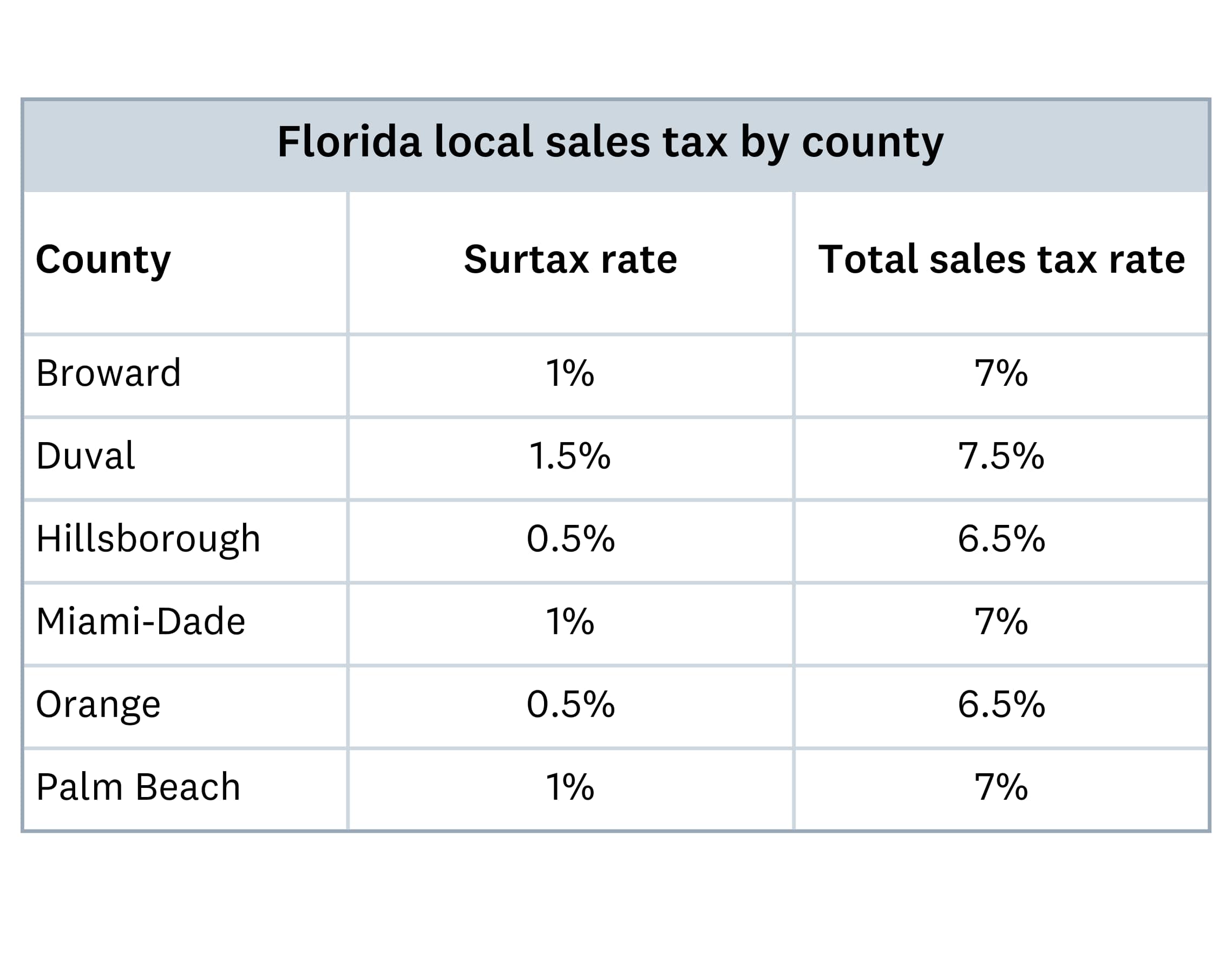
Here are the 2026 surtax and combined rates for some of Florida’s most populated counties:
- Miami-Dade County has a 1% surtax, for a combined rate of 7%
- Broward County has a 1% surtax, for a combined rate of 7%
- Hillsborough County has a 1.5% surtax, for a combined rate of 7.5%
- Orange County has a 0.5% surtax, for a combined rate of 6.5%
- Palm Beach County has a 0.5% surtax, for a combined rate of 6.5%
- Duval County has a 1.5% surtax, for a combined rate of 7.5%
- Pinellas County has a 1% surtax, for a combined rate of 7%
Citrus and Collier counties levy no surtax, so sales there are taxed at the 6% state rate. Hamilton County has the highest combined rate in Florida at 8%, which includes a 2% surtax.
Palm Beach County’s surtax dropped from 1% to 0.5% on January 1, 2026, which brought its combined rate down from 7% to 6.5%. The change is set out in Florida Department of Revenue Tax Information Publication 25A01-15.
Surtax rates change on January 1 each year. You can find the latest county-by-county rates on the Florida Department of Revenue surtax rate page.
How to calculate Florida sales tax
Working out sales tax in Florida comes down to knowing where the buyer takes delivery and applying the right rate. Follow these steps for each taxable sale:
- Confirm the county where your customer takes delivery, because Florida charges tax based on the delivery address. If you ship an order, use the county on the shipping address.
- Find the combined rate by adding the 6% state rate to that county’s discretionary surtax. In Miami-Dade County, for example, the 1% surtax brings the combined rate to 7%.
- Check whether any single item costs more than $5,000, because the county surtax only applies to the first $5,000 of each tangible item. The 6% state rate still applies to the full price.
- Multiply the price by the rate and work the tax out to the third decimal place. Using Florida’s bracket rule, round up if the third decimal is greater than 4, and round down if it’s 4 or less.
- Add the tax to the item price to get the total your customer pays. Then record the sale, the tax, and the delivery county so your return shows tax by county.
For example, tax that works out to $1.254 rounds down to $1.25. Tax that works out to $1.255 rounds up to $1.26.
Florida sales tax calculation examples
These examples use 2026 rates and follow the steps above.
Say you sell a $100 item to a customer in Miami-Dade County, where the combined rate is 7%. The tax is $7.00, so your customer pays $107.00.
Now say you sell a $250 item for delivery in Palm Beach County, where the combined rate is 6.5% from January 1, 2026. That’s $15.00 in state tax plus $1.25 in surtax, so the tax is $16.25 and the total is $266.25.
Finally, say you sell a $7,000 appliance in a county with a 1% surtax. The 6% state tax on the full $7,000 is $420, and the 1% surtax on the first $5,000 is $50. Your total tax is $470.
Download a Florida sales tax worksheet
A worksheet helps you apply these steps the same way for every sale and keeps a clear record for filing. You can
download the Florida sales tax worksheet and add one row per item.
For each sale, the worksheet tracks the:
- sale date and invoice number
- delivery county and surtax rate
- item price and whether it’s taxable
- exemption or resale certificate number, if the sale is exempt
- surtax-eligible amount, capped at $5,000 per item
- state tax, surtax, and total tax
What’s taxable in Florida?
Florida taxes most tangible personal property sold at retail. This includes items like furniture, electronics, clothing (with some exceptions), and household goods. Knowing what is and isn’t taxable helps you charge the correct amount.
Here are the main categories:
- Tangible personal property is generally taxable. This covers physical goods like equipment, supplies, and retail merchandise.
- Most services aren’t taxable, including legal, accounting, and consulting work. Commercial cleaning, pest control, security services, and nonresidential building repairs are taxable.
- Software as a service (SaaS) and digital goods are generally not taxable when delivered electronically. Software on physical media like a disc or USB drive is taxable.
- Shipping and delivery charges are taxable when bundled into the sale price and the buyer has no pickup option. They’re exempt when separately stated and the buyer can pick up the goods.
Sales tax exemptions in Florida
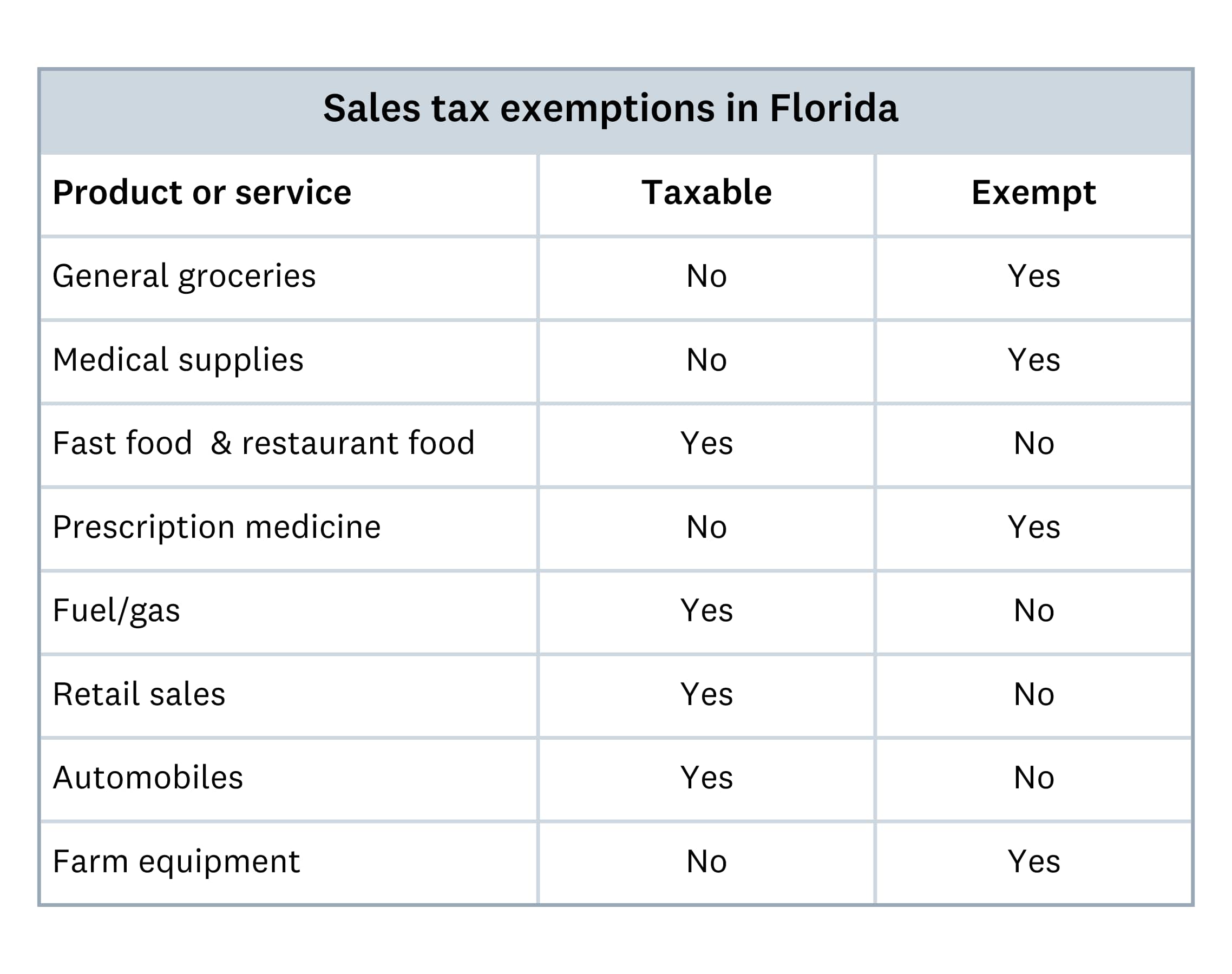
Florida exempts several categories of goods and transactions from sales tax. If you sell exempt items, you don’t need to collect tax on those sales.
Common exempt items include:
- unprepared groceries and food for home consumption
- prescription medications
- durable medical equipment and prosthetic devices
- children’s clothing for ages 5 and under (during certain sales tax holidays)
- seeds, fertilizers, and agricultural supplies used for farming
Certain buyers are also exempt from paying sales tax. These include federal and state government agencies, qualifying nonprofit organizations, and schools. To sell tax-free to these buyers, you need to collect a valid Florida exemption certificate.
Follow these steps to accept an exemption certificate from a buyer:
- Verify the buyer has a valid Florida Consumer’s Certificate of Exemption or a valid resale certificate.
- Keep a copy of the certificate on file with the transaction record.
- Maintain these records for at least five years in case of an audit.
Collecting and keeping a valid certificate protects you from being held responsible for the tax. The Florida Department of Revenue provides exemption certificate forms and instructions on its website.
Who needs to collect Florida sales tax?
If you sell taxable goods or services to Florida customers, you likely need to collect sales tax. The requirement depends on whether you have nexus, which is a connection to the state that triggers a tax obligation.
Florida recognizes several types of nexus:
- Physical presence nexus applies if you have an office, warehouse, store, or employees in Florida
- Economic nexus applies if your retail sales to Florida customers exceed $100,000 in the previous calendar year
- Affiliate nexus applies if a Florida-based affiliate or related entity refers customers to you for compensation
- Click-through nexus applies if Florida-based referral links bring you more than $10,000 in gross sales over the preceding 12 months
If any of these apply, you must register and collect Florida sales tax. Here’s how to get started:
- Apply for a Florida sales tax permit through the Florida Department of Revenue’s online portal. There’s no fee, and you’ll receive your certificate within a few days.
- Begin collecting sales tax on the date specified on your registration certificate.
- Set up your recordkeeping system to track taxable and exempt sales by county. Accounting software can help you organize this from day one.
Your sales tax permit sits alongside other business registration requirements, which the Xero guide to Florida business licenses covers in detail.
Online sales tax rules for Florida businesses
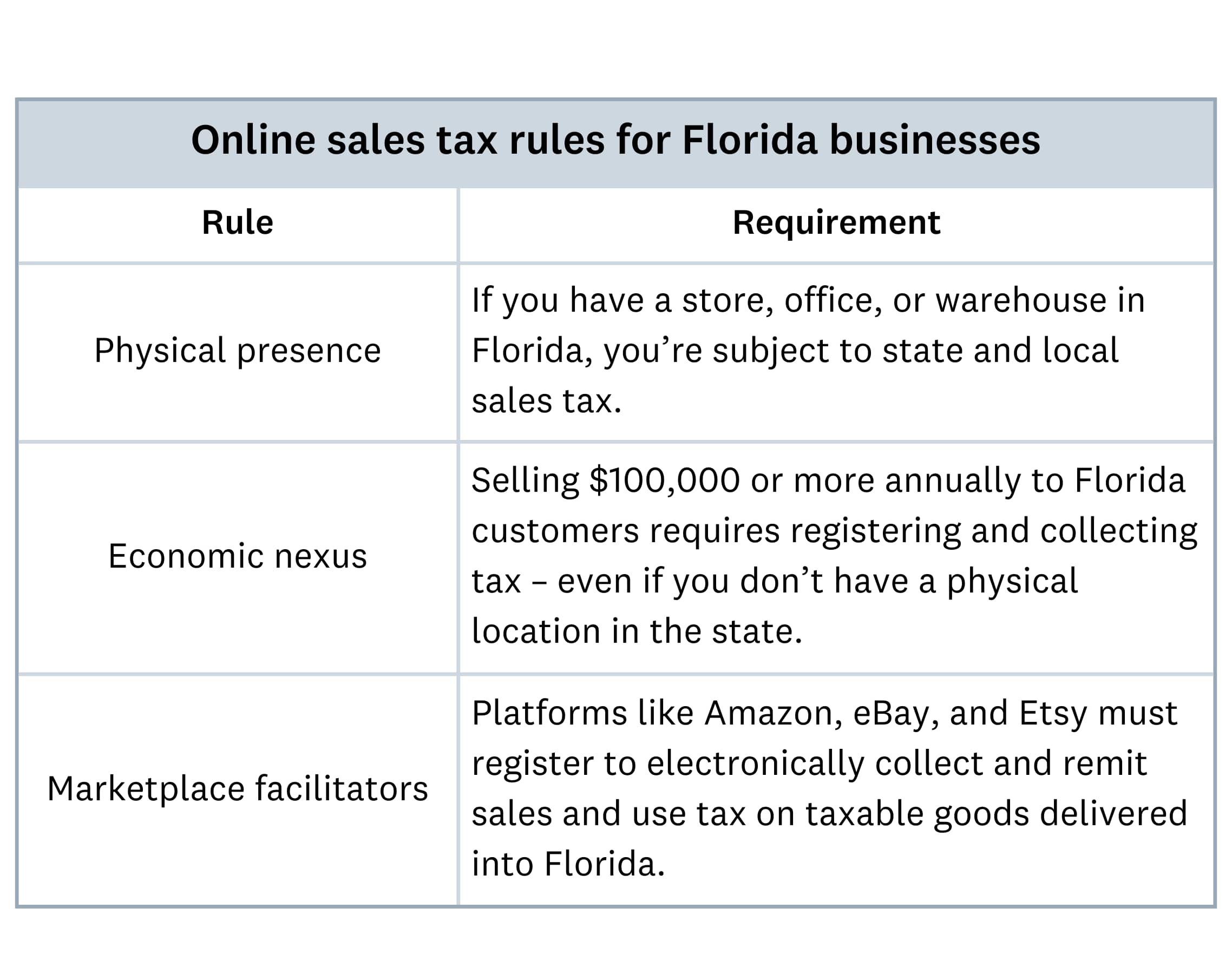
If you sell online to Florida customers, the same nexus rules apply. Florida’s Marketplace Fairness Act covers remote sellers and marketplace facilitators, and they must collect and remit sales tax once they meet the thresholds.
Remote sellers with no physical presence in Florida must collect sales tax once their Florida retail sales exceed $100,000 in the previous calendar year. This covers sales through your own website, social media, or any other online channel.
Marketplace facilitators like Amazon, Etsy, and eBay collect and remit sales tax for third-party sellers. If you sell through one of these platforms, the marketplace handles the tax for those sales. You’re still responsible for collecting tax on sales made through your own channels.
Florida uses destination-based sourcing. When you ship to a Florida customer, charge the rate for their delivery address rather than your business location’s rate.
Use tax vs. sales tax in Florida
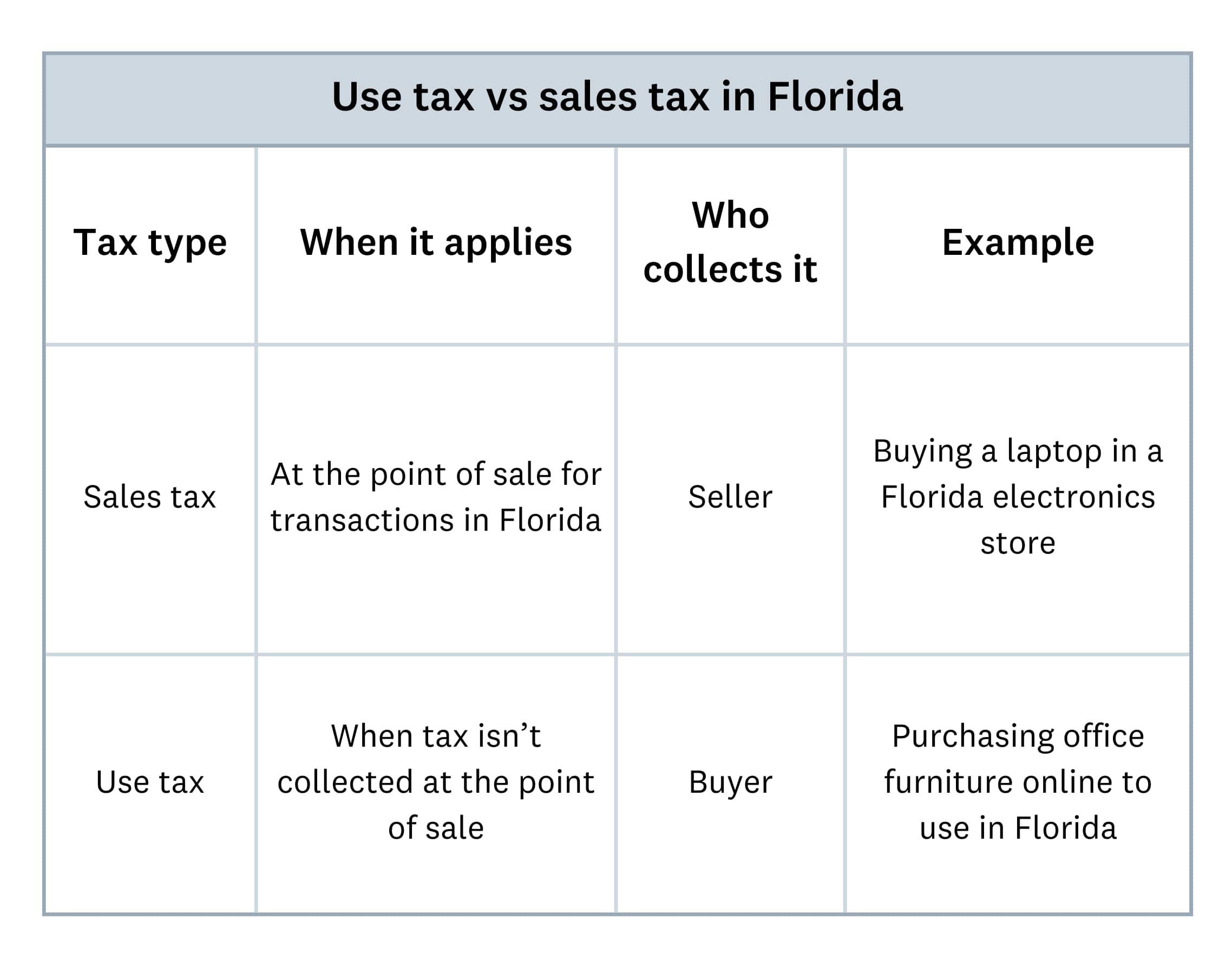
Use tax and sales tax in Florida are complementary. They cover different situations, but the rate is the same.
Sales tax is collected by the seller at the point of sale. The seller charges the customer and then remits the tax to the state.
Use tax applies when a seller doesn’t collect Florida sales tax on a taxable purchase. The buyer is responsible for reporting and paying use tax directly to the Florida Department of Revenue. Common examples include:
- buying goods online from a seller that doesn’t collect Florida sales tax
- purchasing items tax-free in another state and bringing them to Florida for use
- ordering supplies for business use from a wholesaler without paying sales tax
The use tax rate matches the sales tax rate: 6% state tax plus any applicable county surtax. If you owe use tax, report it on your Florida sales tax return or file a separate use tax return.
Tracking these purchases carefully helps you stay compliant and avoid surprises during an audit.
How to file Florida sales tax returns
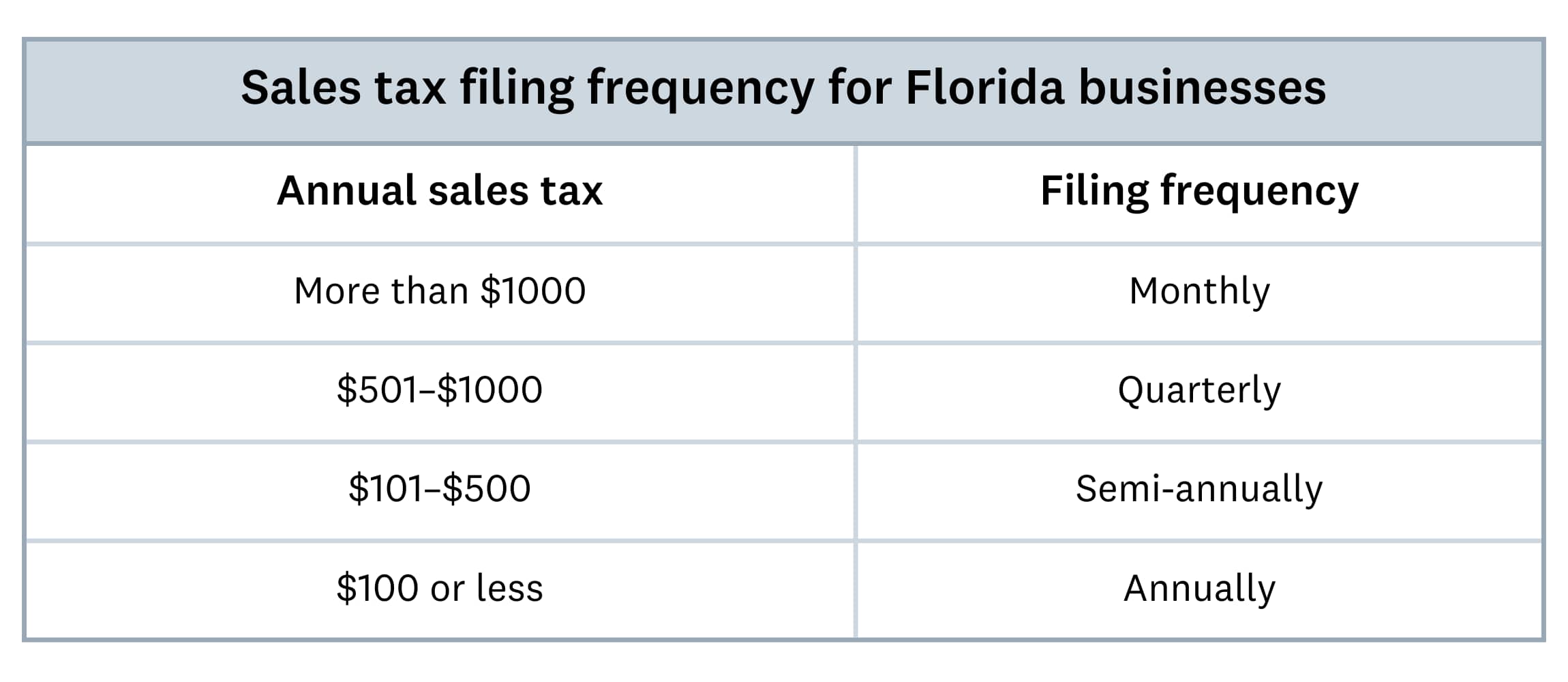
Once you’re registered to collect Florida sales tax, you need to file returns on a regular schedule. The Florida Department of Revenue assigns your filing frequency based on the amount of tax you collect.
Here’s how filing frequencies work:
- File monthly if you collect more than $1,000 in sales tax per year
- File quarterly if you collect $501 to $1,000 per year
- File semiannually if you collect $101 to $500 per year
- File annually if you collect $100 or less per year
Returns are due on the 1st of the month following each reporting period. You have until the 20th of that month to file and pay without penalty. For example, a monthly return for January is due by February 20.
Florida requires electronic filing for most businesses. You can file through the Florida Department of Revenue’s online portal.
If you file and pay on time, you qualify for a collection allowance. This equals 2.5% of the first $1,200 of tax due, up to a maximum of $30 per reporting period.
Late filing and payment come with penalties:
- A 10% penalty applies if you file late but within 30 days
- Additional penalties of up to 50% of the tax due apply for longer delays
- Interest accrues on unpaid tax from the original due date
Keeping accurate records makes filing much easier, especially when you log all your sales transactions by county. You’re required to keep these records for at least five years. Learn more about tax filing for your business in the Xero guide to filing business taxes.
Sales tax holidays in Florida
Florida offers several sales tax holidays each year. During these periods, specific items are exempt from sales tax, giving your customers a break and potentially boosting your sales.
The most common Florida sales tax holidays include:
- Back-to-School, typically in late July or early August, covering school supplies, clothing, and computers up to set price limits
- Disaster Preparedness, usually in late May or early June, covering generators, batteries, flashlights, tarps, and other emergency supplies
- Freedom Week, typically around July 4, covering recreational items like fishing gear, camping supplies, and sporting goods up to set price limits
The exact dates, eligible items, and price limits change each year, and the Florida Legislature sets these details during each session. Check the Florida Department of Revenue website for the latest dates and qualifying items before each holiday period.
If you sell items that qualify during a sales tax holiday, you don’t collect sales tax on those items for the duration of the holiday. Make sure your point-of-sale system is updated to reflect the temporary exemptions.
Recent Florida sales tax changes
Florida’s sales tax rules are updated regularly. Here are the most notable recent changes that may affect your business.
The commercial real property rental tax was repealed effective October 1, 2025. Before the repeal, commercial tenants paid a 2% state tax (plus county surtax) on rent for commercial spaces, down from 4.5% before June 1, 2024.
This tax no longer applies to lease payments made on or after October 1, 2025. If you rent commercial space in Florida, your landlord should no longer charge this tax.
County surtax rates were updated for 2026. The most notable change is Palm Beach County, which reduced its surtax from 1% to 0.5%, bringing the combined rate down from 7% to 6.5%.
Verify the current rates for any county where you make sales, since county surtax updates take effect on January 1 each year.
Simplify your Florida sales tax tracking with Xero
Staying on top of Florida sales tax takes organized records and consistent tracking. Xero can help you manage your sales records and reconcile bank transactions, so tax time is simpler. You can also track business expenses alongside your tax records in one place.
With automated bank feeds and customizable reports, you can track taxable and exempt sales across counties with less manual data entry. Xero also integrates with automated sales tax tools, so your records stay accurate as rates change.
Keep your Florida sales tax records organized and spend more time running your business when you get one month free with Xero.
FAQs on Florida sales tax
Here are answers to frequently asked questions about Florida sales tax.
Does Florida have 7% sales tax?
Florida’s statewide rate is 6%, and county surtaxes bring the combined rate to 6%–8% depending on location. Many counties, including Miami-Dade and Broward, charge 7%, while Citrus and Collier counties charge only 6%.
What items are non-taxable in Florida?
Exempt items include unprepared groceries, prescription medications, durable medical equipment, and most professional services like legal and accounting work. Prepared foods, restaurant meals, and repairs to tangible goods are generally taxable.
Is shipping taxable in Florida?
If the shipping charge is included in the sale price with no pickup option, it’s taxable. If shipping is separately stated on the invoice and the buyer can pick up the item, it’s exempt.
Is labor taxable in Florida?
Most professional services like consulting, accounting, and legal work aren’t taxable. However, labor for nonresidential cleaning, pest control, and commercial building repairs is subject to sales tax.
Are there sales tax holidays in Florida?
Yes, Florida holds several sales tax holidays each year, including Back-to-School, Disaster Preparedness, and Freedom Week. Dates and qualifying items change every year, so check with the Florida Department of Revenue before each one.
Do businesses in Florida need a sales tax permit?
Yes, any business selling taxable goods or services in Florida must register for a sales tax permit before making sales. Out-of-state businesses also need to register once their annual retail sales to Florida customers exceed $100,000.
Disclaimer
Xero does not provide accounting, tax, business or legal advice. This guide has been provided for information purposes only. You should consult your own professional advisors for advice directly relating to your business or before taking action in relation to any of the content provided.