California sales tax: rates, nexus, and how to file
California sales tax starts at 7.25% plus district taxes. Remote sellers collect it once sales top $500,000.
Get the comprehensive guide
Learn the ins and outs of California sales tax, and how to stay compliant
Written by Kari Brummond—Content Writer, Accountant, IRS Enrolled Agent. Read Kari's full bio
Published Tuesday 6 October 2026
Table of contents
Key takeaways
- You collect California sales tax if you have a physical presence there or top $500,000 in yearly California sales. Get a free seller’s permit first.
- Charge the combined rate for the delivery address. That’s the 7.25% base plus district taxes, which reach 11.25% in Lancaster and Palmdale.
- Leave separately stated shipping and exempt items, like unprepared groceries, out of the taxable amount. A simple worksheet keeps each sale’s numbers straight.
- File on the monthly, quarterly, or annual schedule the CDTFA assigns you. Late returns or payments add a 10% penalty plus interest.
What is California sales tax?
California sales tax is a consumption tax that sellers collect from buyers on retail sales of tangible goods and some services. Sales taxes are a major revenue source for states, making up about one-third of state tax collections on average.
The California Department of Tax and Fee Administration (CDTFA) runs collection and enforcement. You add the tax at checkout, then send what you’ve collected to the CDTFA with each return.
The tax has two parts: a statewide base rate and local district taxes that vary by location. That’s why a $100 lamp carries $7.25 in tax in a 7.25% area and $9.75 in Los Angeles.
California sales tax rates
Your rate depends on where the customer takes delivery, and most of California charges more than the minimum. California’s rate is built in layers, including:
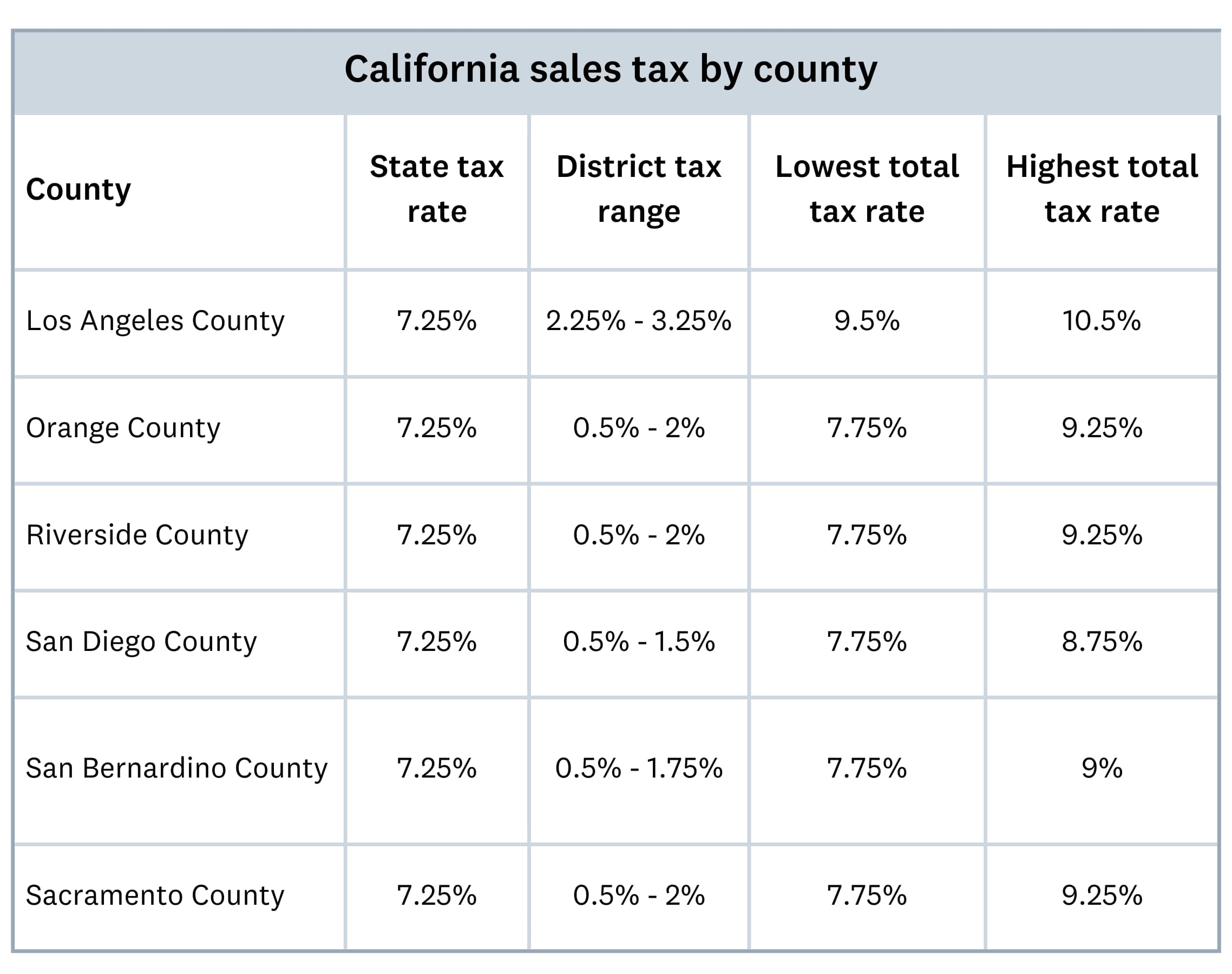
- the 7.25% statewide base rate, made up of 6% state tax and 1.25% local tax
- district taxes that counties, cities, and special districts add on top of the base
- combined rates of up to 11.25%, the rate in Lancaster and Palmdale in CDTFA’s July 2026 rate data
- city rates such as 9.75% in Los Angeles
You collect the combined rate and report both the state and district portions on your return. Rates can change at the start of any quarter. Check the CDTFA’s sales tax rates by city and county when you set prices, then again each quarter.
How to calculate sales tax in California
Sales tax in California is the taxable price multiplied by the combined rate for the delivery address. Follow these sales tax calculation steps for each sale:
- Find the combined rate for the delivery address with the CDTFA rate lookup.
- Convert the rate to a decimal by dividing it by 100, so 9.75% becomes 0.0975.
- Multiply the taxable price by that decimal.
- Round the result to the nearest cent.
- Add the tax to the price to get the total you charge.
California sales tax examples
These examples use real combined rates, so you can see how much the delivery address changes the result. Each one follows the five steps above:
- A $240 sale in a 7.25% area has $17.40 in tax ($240 × 0.0725), for a $257.40 total
- A $1,250 order delivered in Los Angeles at 9.75% has $121.875 in tax, which rounds to $121.88, for a $1,371.88 total
- A $500 order delivered in Palmdale at 11.25% has $56.25 in tax, for a $556.25 total
- An $80 item with $12 of separately stated shipping, delivered in Los Angeles, has tax on the $80 only: $7.80, for a $99.80 total
Under CDTFA Publication 100, the last example’s shipping is nontaxable because it’s separately stated and sent by common carrier or mail directly to the buyer. The charge also has to be no more than your actual cost. If you make lots of sales to different addresses, automatic sales tax applies the right rate to each one for you.
California sales tax worksheet
A worksheet keeps each sale’s numbers in one place, so your return matches your records. Copy or print the fields below and fill in one row per sale.
Record these fields for each sale:
- Delivery address
- Combined rate from the CDTFA lookup
- Taxable sale price
- Nontaxable amounts, such as separately stated shipping
- Tax due, rounded to the nearest cent
- Total charged to the customer
For the $80 example above, you’d record a 9.75% rate, $80 taxable, $12 nontaxable, $7.80 tax due, and $99.80 charged.
Filing-period tally
At the end of each filing period, add up your rows. These totals give you the figures you’ll need for your CDTFA return:
- Total sales for the period
- Nontaxable sales, including exempt items and separately stated shipping
- Taxable sales, which is total sales minus nontaxable sales
- Sales tax you collected
- Marketplace-facilitator sales, which you exclude from the tax you owe
Keep your completed worksheets with your sales records. They’re your first line of evidence if the CDTFA ever audits a return.
What’s subject to California sales tax
California taxes most retail sales of tangible personal property, which means physical goods. If you sell products, you’ll likely collect sales tax on them. Taxable items include:
- retail merchandise such as clothing, electronics, furniture, and appliances
- prepared food, including restaurant meals, hot food, and food sold with utensils
- prepackaged software sold on physical media, such as a disc
- fabrication labor that creates or changes tangible goods, such as custom manufacturing
When you sell goods and services together, tax applies to the goods portion. For example, if you charge $600 for a water heater and $200 to install it, you collect tax on the $600 heater. List the installation charge separately on the invoice to keep the $200 out of the taxable amount.
The California Tax Service Center lists taxable and exempt items in full. Check it when you add a new product line.
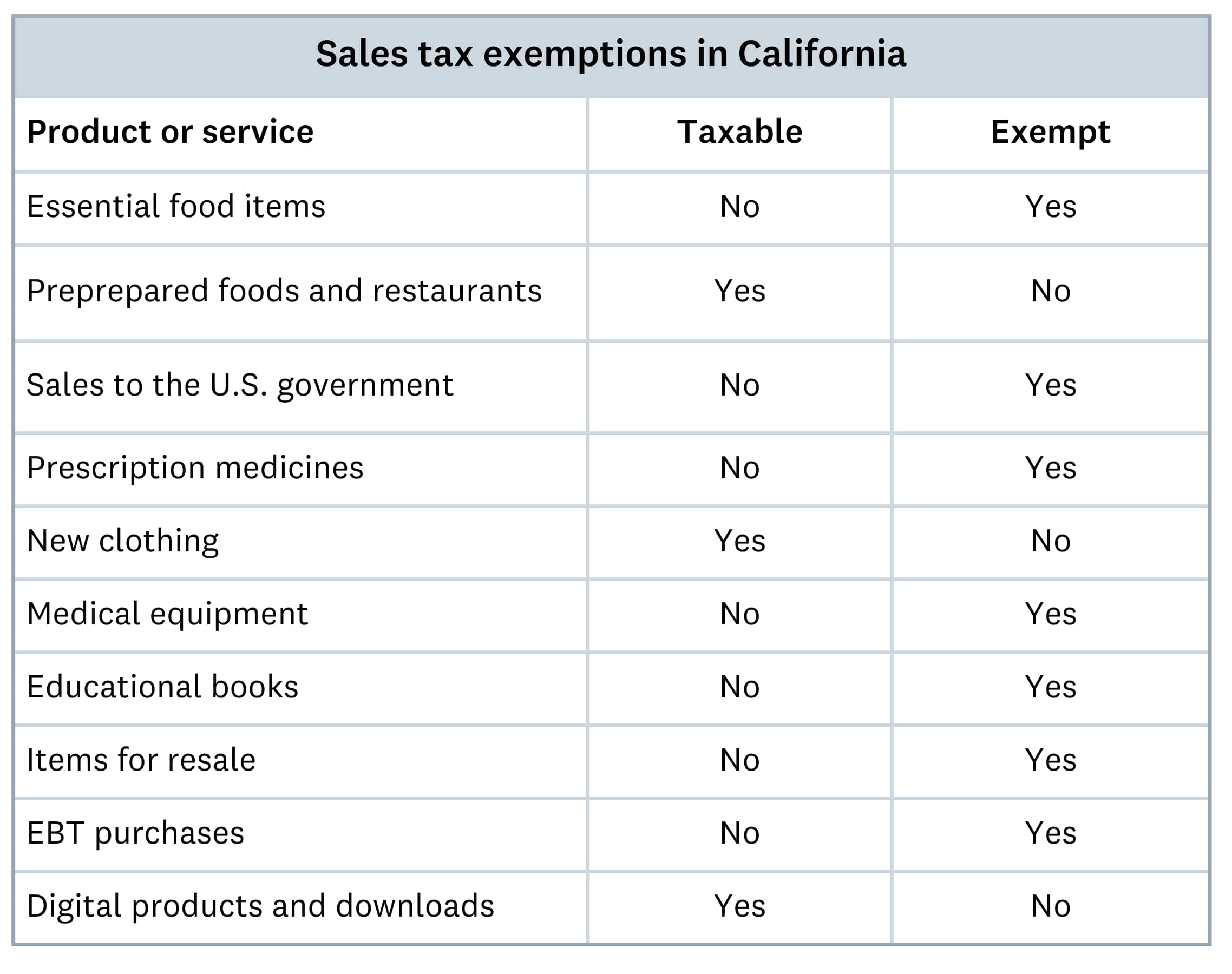
Sales tax exemptions in California
Exemptions are the goods and services you can sell without charging tax. California exempts these common categories:
- Most unprepared grocery food
- Prescription medicines
- Professional services such as consulting, legal advice, and accounting
- Most digital goods, including eBooks, online courses, streaming, and downloaded software
- Real estate sales and most leases of commercial property
- Sales to the US government
Labor splits two ways. Repair and installation labor is usually exempt, while fabrication labor that makes or alters a product is taxable. The CDTFA’s guide to taxable labor covers the edge cases.
Nonprofit status on its own doesn’t exempt an organization from California sales tax. Most nonprofits pay tax on purchases and collect it on sales, so confirm any narrow exemption with the CDTFA first.
Who needs to collect California sales tax
You need to collect California sales tax if your business has nexus, a connection to the state strong enough to create a tax obligation. Nexus comes in two types: physical nexus and economic nexus.
Physical nexus
Physical nexus comes from having a tangible presence in California. Any of these creates it:
- A store, office, or showroom
- A warehouse holding your inventory
- Employees working in the state
- Equipment or other business property, including owned or leased real estate
Economic nexus
Economic nexus applies to remote sellers with no physical presence. It follows the 2018 US Supreme Court decision in South Dakota v. Wayfair, which let states require out-of-state businesses to collect sales tax.
You have economic nexus if your sales into California exceed $500,000 in the current or prior calendar year. Picture an Oregon candle maker who sells $520,000 to California customers this year: they need a seller’s permit and must start collecting.
Marketplace facilitators such as Amazon and eBay collect and remit tax on sales made through their platforms. A US Government Accountability Office (GAO) report on remote sales found about $9.5 billion in revenue from marketplace sales across 20 surveyed states.
How to register for a California sales tax permit
A California seller’s permit lets you collect sales tax from customers, and you need one before your first taxable sale. Registration through the CDTFA website is free, though the CDTFA may ask for a security deposit.
Every business type needs a permit, including sole proprietors, corporations, and limited liability companies (LLCs). Have these details ready when you apply:
- Your Social Security number or individual taxpayer identification number (ITIN)
- Bank account details for payments and refunds
- Projected monthly sales, which set your filing frequency
- Business location details, which set your local rate
With those details in hand, the application takes four steps:
- Apply online through the CDTFA’s online services.
- Enter your business, ownership, and sales details.
- Pay the security deposit if the CDTFA asks for one.
- Display your permit at your place of business once it arrives.
California sales tax filing requirements
The CDTFA assigns your filing frequency based on the sales tax you report, or the taxable sales you expect when you register. Your schedule will be one of these:
- Monthly returns
- Quarterly returns
- Quarterly returns with prepayments
- Yearly returns
If your estimated tax liability averages $17,000 or more a month, the CDTFA can place you on quarterly prepayment after notifying you. Returns are generally due the last day of the month after each reporting period.
File and pay on time to avoid a 10% penalty plus interest on unpaid tax. Your worksheet tallies give you the totals each return asks for, so filing goes faster.
Online sales tax rules for California businesses
California requires online sellers to collect sales tax once they have nexus, whether they’re based in California or another state. According to the GAO, all 45 states with a statewide sales tax had collection rules for remote sellers as of 2021.
You must collect California sales tax if you:
- operate a store, warehouse, or office in California
- sell more than $500,000 a year to California customers
Sales through marketplace facilitators such as Amazon, eBay, or Etsy work differently. The marketplace collects and remits the tax on those sales for you.
Compliance steps for online sellers
Once you have nexus, these four steps keep you current with California requirements. They also keep penalties off your books:
- Register for a seller’s permit through the CDTFA website.
- Charge the combined rate for each delivery address, using the CDTFA lookup.
- File and pay on your assigned monthly, quarterly, or annual schedule.
- Keep detailed transaction records in case of an audit.
Use tax vs. sales tax in California
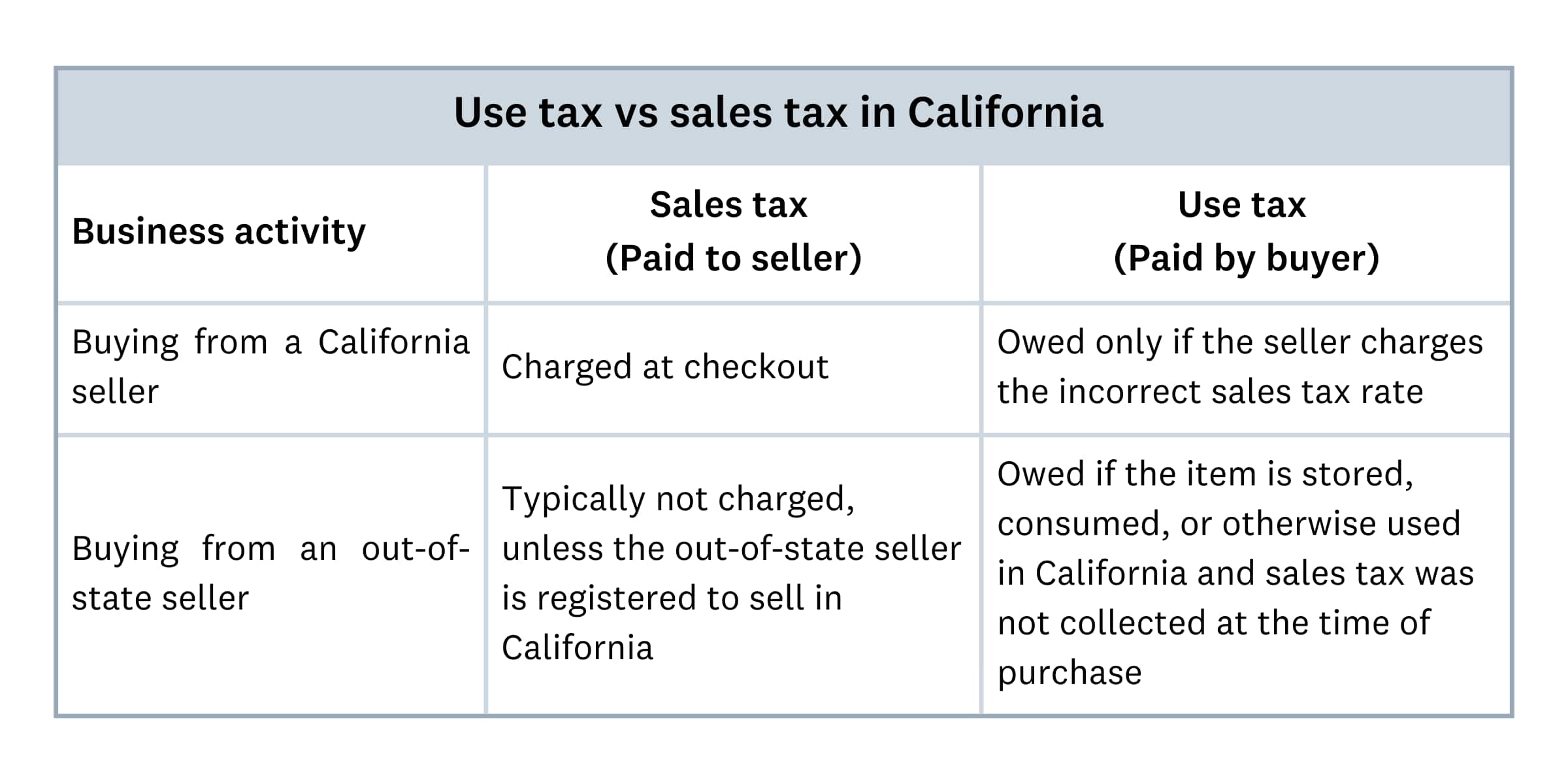
Use tax is what buyers owe when a seller didn’t collect sales tax at purchase. Both taxes use the same rate, and the difference is who pays the CDTFA:
- Sellers collect sales tax and pay it to the CDTFA
- Buyers pay use tax directly to the CDTFA
When does use tax apply?
Use tax applies when you use taxable items in California without having paid California sales tax. Say you buy a $3,000 espresso machine from an Oregon supplier that charges no tax: you owe use tax at your local rate. Common situations include:
- buying from out-of-state vendors that don’t collect California tax
- buying from sellers with no California tax obligation
- using items in California that you bought tax-free elsewhere
- importing goods directly from manufacturers or foreign suppliers
Simplify California sales tax with Xero
California sales tax gets simpler once you know the rate for each address and track every sale. Xero keeps that work in one place alongside the rest of your bookkeeping.
Xero applies sales tax to the invoices you send and shows what you owe at a glance. You spend less time on tax admin and more time on your business, so try it and get one month free.
FAQs on California sales tax
These answers cover common California sales tax questions that go beyond rates and registration.
Is sales tax 10% in California?
Only in some places, since combined rates range from the 7.25% base up to 11.25% depending on the district. If you charge a flat 10% everywhere, you’ll overcharge some customers and undercharge others.
Which California cities have the highest sales tax rates?
Lancaster and Palmdale in Los Angeles County have the highest combined rate at 11.25%, according to CDTFA’s July 2026 rate data. That’s four percentage points above the base, so a $1,000 sale there carries $112.50 in tax.
What are the penalties for not filing or paying California sales tax on time?
Beyond the 10% penalty and interest, repeated late filing can lead to audits and legal action from the CDTFA. If circumstances outside your control caused the delay, you can ask the CDTFA for penalty relief.
How does California sales tax apply to shipping charges?
Shipping becomes taxable when you fold it into the item price instead of listing it separately. Delivery in your own vehicles can also be taxable, depending on when ownership passes to the customer.
Does California charge sales tax on vehicle purchases?
Yes, California charges sales or use tax on vehicles at the rate for the address where you register them. A dealer usually collects it, and for private-party purchases you pay use tax to the Department of Motor Vehicles (DMV) at registration.
Does California offer sales tax holidays?
California doesn’t hold sales tax holidays, so the same rates apply all year. That differs from states like Texas, which exempt set items on specific weekends.
Disclaimer
Xero does not provide accounting, tax, business or legal advice. This guide has been provided for information purposes only. You should consult your own professional advisors for advice directly relating to your business or before taking action in relation to any of the content provided.