Texas sales tax: rates, exemptions, and filing rules
Texas sales tax is 6.25% statewide and up to 8.25% with local taxes. Here’s how to calculate, collect, and file it.

Written by Kari Brummond—Content Writer, Accountant, IRS Enrolled Agent. Read Kari's full bio
Published Tuesday 6 October 2026
Table of contents
Key takeaways
- Texas charges a 6.25% state sales tax, and local jurisdictions can add up to 2%, for a combined maximum of 8.25%
- To calculate the tax, multiply the taxable price, including taxable shipping, by the combined rate for the delivery location and round to the nearest cent
- Register for a Texas sales tax permit before your first taxable sale; remote sellers need one once their Texas revenue tops $500,000 in the previous 12 months
- File and pay on time, keep accurate sales records, and pay use tax on taxable purchases where no Texas sales tax was collected
What is Texas sales tax?
Texas sales tax is a consumption tax on the sale, lease, or rental of most goods and some services in the state. Nationally, sales tax is an important revenue source for states, making up about one-third of their total tax collections on average, according to the U.S. Government Accountability Office (GAO).
As a business owner, you collect the tax from customers at the point of sale and pass it on to the Texas Comptroller. Think of it as holding your customer’s tax money until it’s due to the state. Once you know how the tax works, you can price products correctly and stay compliant.
Texas sales tax rates
Texas sales tax is 6.25% at the state level, and local taxes can raise the combined rate to 8.25%. These are the figures you need to know:
- A 6.25% state rate on most retail sales, leases, rentals, and taxable services
- Up to 2% in local taxes from cities, counties, transit authorities, and special purpose districts
- A combined maximum rate of 8.25%
- A collection requirement for remote sellers with more than $500,000 in Texas revenue in the previous 12 months
Many of the state’s largest cities charge the full 8.25% combined rate. These include:
- Houston
- Dallas
- Austin
- San Antonio
- Fort Worth
- El Paso
To confirm the rate for any address, use the Texas Comptroller’s rate locator linked in the steps below.
.1744351186849.png)
How to calculate Texas sales tax
To calculate Texas sales tax, multiply the sale price by the combined rate: sales tax = sale price × combined rate. The same method works for calculating sales tax in other states; only the rate changes.
Follow these steps for each sale:
- Find the combined rate for the delivery location using the Texas Comptroller’s rate locator.
- Convert the rate to a decimal by dividing it by 100, so 8.25% becomes 0.0825.
- Multiply the decimal rate by the taxable price, including any taxable shipping charges.
- Round the result to the nearest cent.
- Add the tax to the price to get the total your customer pays.
For example, say you sell an $80 item to a customer in an area with the 8.25% maximum rate. Multiply $80 by 0.0825 to get $6.60 in tax, so the customer pays $86.60 in total.
As a second illustration, say you make a $250 sale where only the 6.25% state rate and a 1% local rate apply. That’s a combined rate of 7.25%. Multiplying $250 by 0.0725 gives $18.125, which rounds to $18.13, so the total comes to $268.13.
Texas sales tax worksheet
A downloadable worksheet helps you record each sale and total the tax for your filing period. Use it alongside the steps above so every figure on your return traces back to a sale.
The worksheet captures these fields for each sale:
- Sale date
- Delivery address
- Taxable sale amount
- Taxable shipping charges
- Combined tax rate
- Sales tax due
- Running total for the filing period
If you track sales in accounting software, you can pull most of these figures straight from your records.
Who needs to collect Texas sales tax?
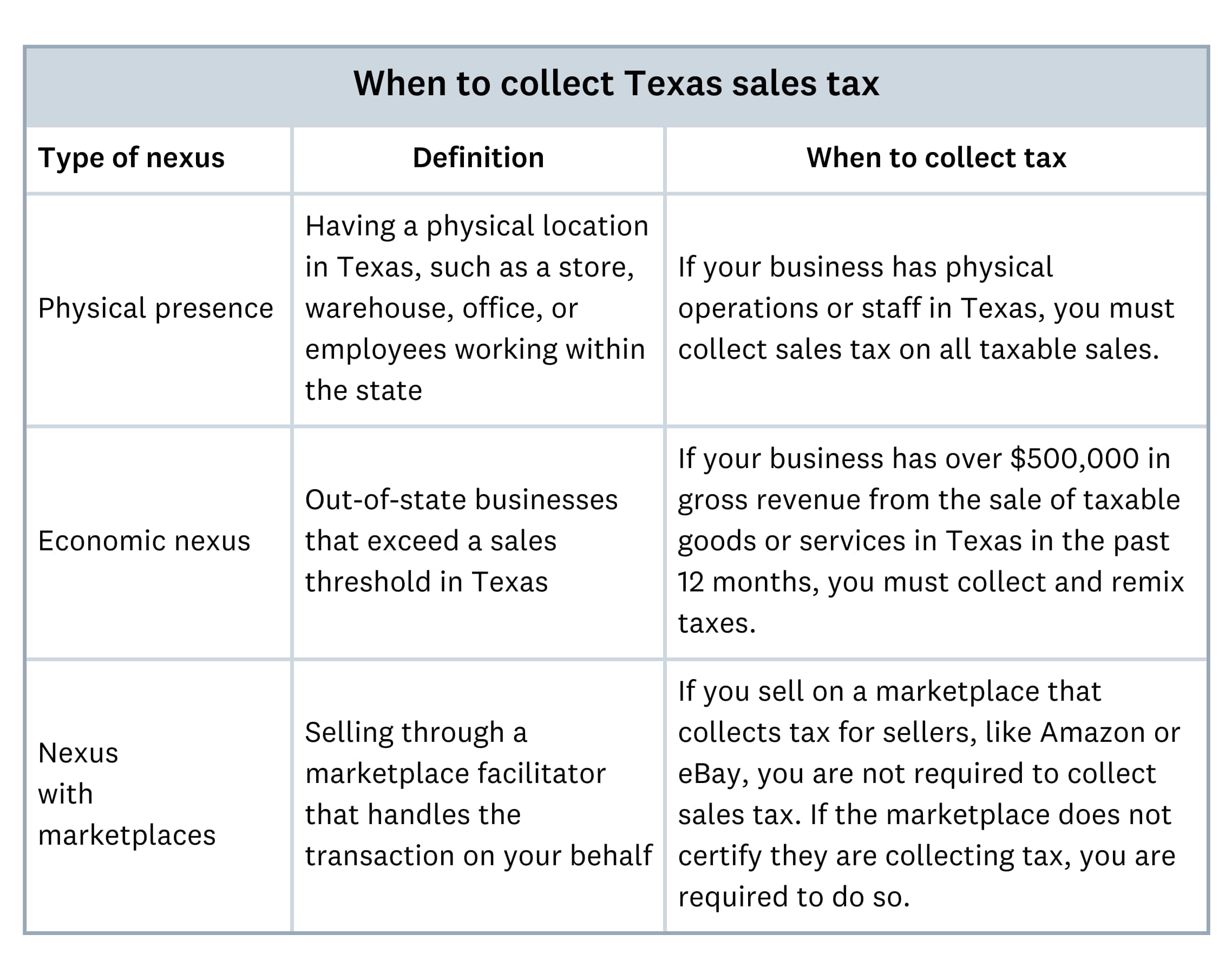
You must collect Texas sales tax if you sell taxable goods or services and have a physical presence, or nexus, in the state. Physical presence includes an office, storefront, warehouse, or employees based in Texas.
Out-of-state businesses may also need to collect the tax if they meet the state’s economic nexus threshold of $500,000 in Texas revenue. Once you pass it, you register and collect the tax just like a local business.
How to register for a Texas sales tax permit
A Texas sales tax permit lets you legally collect sales tax from customers, and you need it before your first taxable sale. Follow these steps to get your permit:
- Gather your Social Security number or Employer Identification Number (EIN), business entity details, and ownership information.
- Look up your North American Industry Classification System (NAICS) code.
- Complete the sales tax permit application on the Texas Comptroller’s eSystems website.
- Receive your permit and assigned filing frequency once the Comptroller approves your application.
What’s taxable in Texas?
Texas applies sales tax to the sale, lease, or rental of most tangible personal property. That includes everyday items like furniture, clothing, electronics, and business equipment.
Some services are taxable too, including data processing and amusement services, along with some repair and remodeling work. Review what you sell to confirm which items need tax added at checkout.
Sales tax exemptions in Texas
Exemptions are items and services you don’t charge tax on. Knowing them helps you charge customers the right amount and avoid over-collecting.
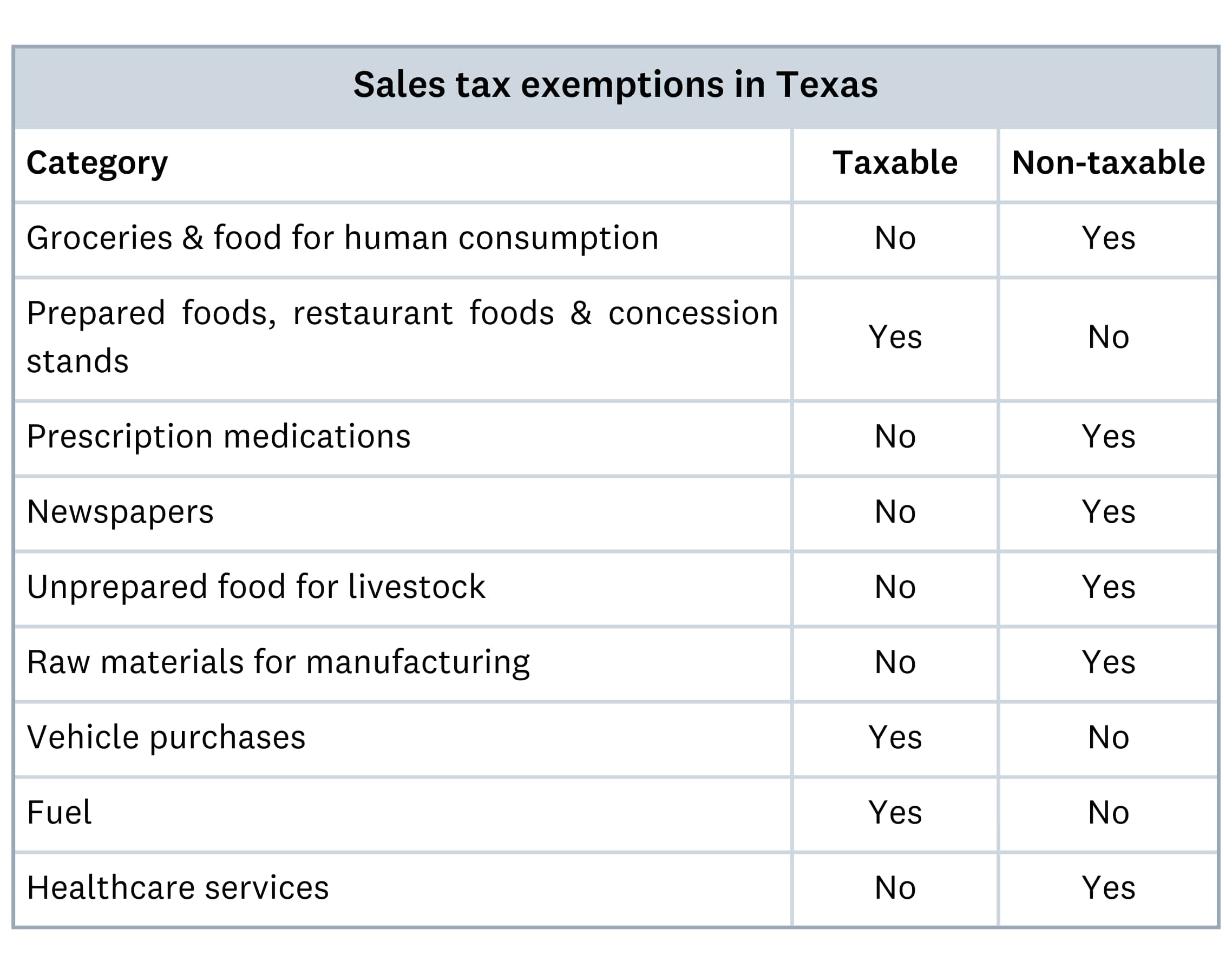
Common exemptions include:
- groceries, such as meat, fruits, vegetables, and other unprepared foods
- prescription drugs and certain medical devices
- professional services, such as legal advice and medical consultations
- items used directly in manufacturing processes
Filing schedules and due dates
Your filing frequency depends on how much state sales tax you collect. The Texas Comptroller assigns your schedule when you register.
You’ll file:
- monthly, if you owe $1,500 or more in state tax per quarter
- quarterly, if you owe less than $1,500 in state tax per quarter
- annually, if you owe less than $1,000 in state tax per year
Returns are due on the 20th day of the month after each reporting period. For a monthly filer, that means a January return is due February 20.
Use tax vs. sales tax in Texas
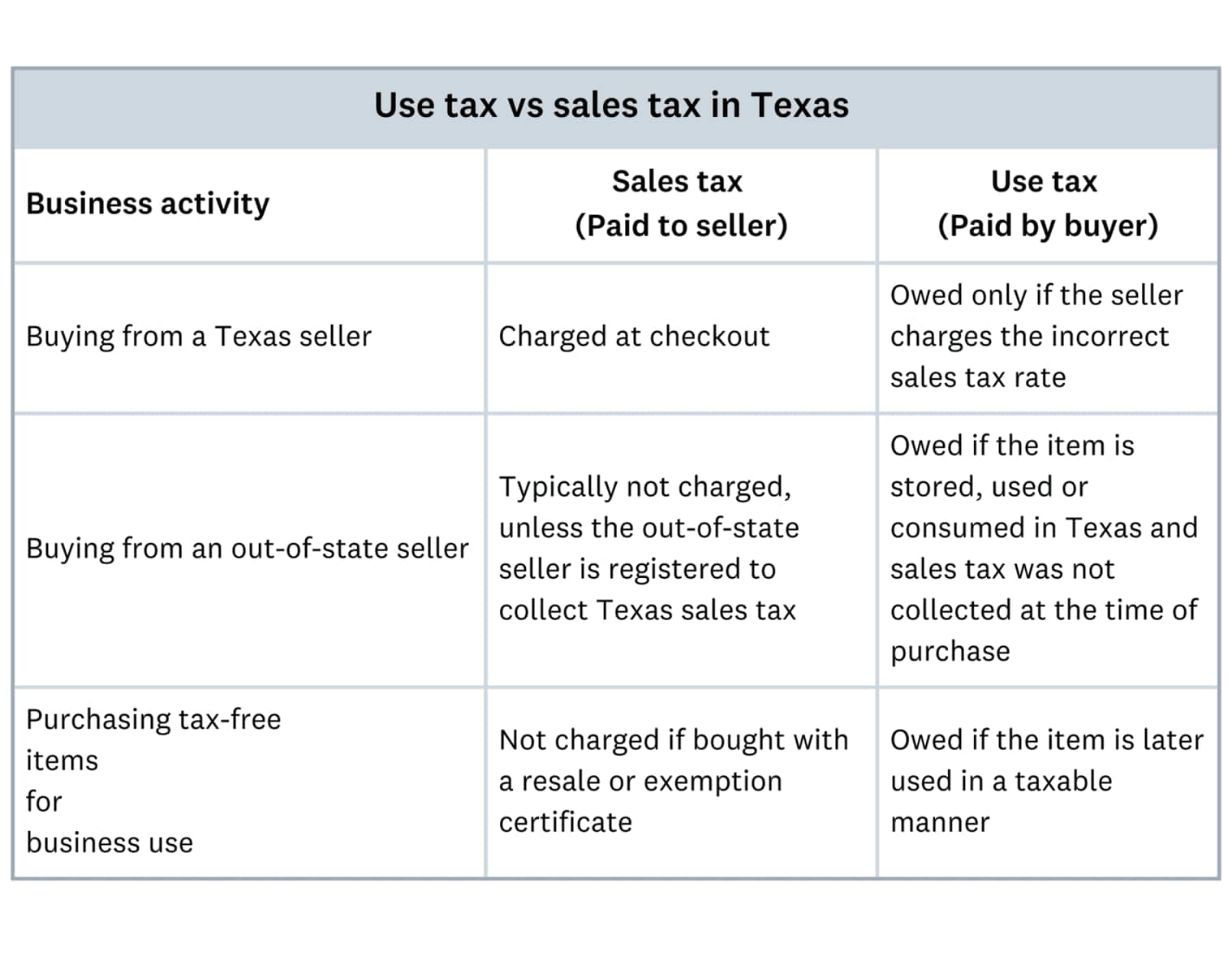
Use tax is what you owe when you buy taxable items without paying sales tax at purchase. It has the same rate as sales tax, but you pay it directly to the Texas Comptroller.
The two taxes differ in these ways:
- Sales tax is collected by the seller at the point of sale
- Use tax is paid by the buyer when no sales tax was collected
- Both taxes use the same rates: 6.25% state plus local taxes
- Use tax goes straight from the buyer to the Texas Comptroller
Use tax applies to:
- out-of-state purchases where Texas sales tax isn’t collected
- online purchases from sellers who don’t collect sales tax
- tax-free purchases that are used in Texas
- taxable items bought in another country or state and brought to Texas
Say you buy equipment while traveling in one of the states with no sales tax and bring it back to Texas. You’d report and pay use tax on it to the Texas Comptroller.
The same applies if you buy office equipment online from a seller that doesn’t charge sales tax. In Texas, marketplace providers like Amazon or eBay generally collect and remit the tax for their sellers, so check your receipt first.
Online sales tax rules for Texas businesses
Since the 2018 South Dakota v. Wayfair Supreme Court decision, states can require sellers to collect sales tax without a physical presence. The GAO estimated that nationwide remote sales tax collections reached about $30 billion in 2021.
In Texas, the remote seller rules include:
- a threshold of $500,000 in Texas revenue in the previous 12 months
- an effective date of October 1, 2019
- the 6.25% state rate plus any local taxes
- coverage for remote sellers and online marketplaces that meet the threshold
Penalties for non-compliance
Each late report carries a $50 penalty, even when no tax is due. If you pay 1–30 days late, you owe a 5% penalty on the tax due, rising to 10% if you pay more than 30 days late. Interest is charged on past-due tax starting 61 days after the due date.
The Texas Comptroller can audit your business and impose penalties for repeated non-compliance. When you file and pay on time, you keep these costs off your books.
Building sales tax into your regular tax preparation routine makes each deadline easier to meet.
Manage your Texas sales tax with Xero
Texas sales tax is simpler to manage with your rates, sales, and filing dates in one place. Xero gives you a real-time view of your finances so you can track what you owe and file on time.
Spend less time on sales tax admin and more on your business: get one month free and see how Xero helps you stay compliant.
FAQs on Texas sales tax
Here are answers to common questions about Texas sales tax.
Is labor subject to sales tax in Texas?
It depends on the work: installing or creating a taxable product is taxable, while professional services like legal advice are exempt. Repair and remodeling of nonresidential property can be taxable, so check the Comptroller’s guidance on taxable services for your situation.
Does Texas charge sales tax on vehicle purchases?
Yes, Texas charges a 6.25% motor vehicle sales tax on purchases from dealerships and private sellers, and local sales taxes don’t apply. If you buy from a private seller, you pay the tax to your county tax assessor-collector when you title and register the vehicle.
How does Texas sales tax apply to shipping and delivery charges?
Shipping and delivery charges follow the item’s tax status, so they’re taxable when the item is taxable and exempt when it’s exempt. That holds whether you bundle shipping into the price or list it separately.
Does Texas offer sales tax holidays?
Yes: April covers emergency supplies, May covers Energy Star appliances, and August covers back-to-school items priced under $100. Check the Texas Comptroller’s sales tax holiday information for exact dates and eligible items.
Do nonprofit organizations have to pay Texas sales tax?
Most nonprofits pay sales tax unless they qualify for exemption and get a Texas sales tax exemption certificate from the Comptroller. Even with exempt status, some purchases and sales can still be taxable, depending on your activities.
Is there a sales tax on real estate transactions in Texas?
No, Texas doesn’t charge sales tax on real estate sales, and real property rentals and leases are generally exempt too. You may still pay property taxes, recording fees, and title charges, but Texas has no documentary transfer tax.
, but Texas has no documentary transfer tax.
Disclaimer
Xero does not provide accounting, tax, business or legal advice. This guide has been provided for information purposes only. You should consult your own professional advisors for advice directly relating to your business or before taking action in relation to any of the content provided.