What is gross profit margin? Formula, examples, and tips
Learn how to calculate gross profit margin, what counts as a good margin, and how to improve yours.
Written by Lena Hanna—Trusted CPA Guidance on Accounting and Tax. Read Lena's full bio
Published Tuesday 12 May 2026
Table of contents
Key takeaways
- Gross profit margin shows the percentage of revenue left after subtracting the cost of goods sold (COGS). Calculate it with: Gross Profit Margin = (Revenue – COGS) ÷ Revenue × 100.
- COGS includes all direct costs tied to producing your product or service, such as materials, direct labor, and shipping. It doesn't include rent, marketing, or administrative expenses.
- A "good" margin depends on your industry. Service businesses typically aim for 50–70%, while product-based businesses often land between 20–40%.
- You can improve your margins by adjusting prices, reducing COGS, focusing on high-margin offerings, negotiating better supplier terms, and streamlining operations.
What is gross profit margin?
Gross profit margin is the percentage of revenue remaining after subtracting the cost of goods sold (COGS). It's one of the most important financial metrics for any small business owner to understand.
This number tells you how efficiently your business turns revenue into profit before accounting for overhead costs like rent, salaries, and marketing. The higher your gross profit margin, the more money you keep from each dollar of sales.
Tracking your gross profit margin regularly helps you spot trends, make smarter pricing decisions, and plan for growth. Here's what it reveals about your business:
- Cash flow visibility: how much money is available to cover operating expenses
- Performance tracking: whether your production or service delivery is becoming more or less efficient over time
- Problem detection: early warning signs that costs are rising or pricing needs adjustment
- Growth planning: whether you have enough margin to invest in expanding your business and increase profits
Gross profit margin formula
The gross profit margin formula is:
Gross Profit Margin = (Revenue – COGS) ÷ Revenue × 100

Before you can calculate your gross profit margin, you need to find your gross profit first. The formula for that is:
Gross Profit = Revenue – COGS
Once you have your gross profit, divide it by your total revenue and multiply by 100. The result is your gross profit margin as a percentage.
How to calculate gross profit margin
Calculating your gross profit margin takes just a few steps. You'll need two numbers from your income statement: total revenue and cost of goods sold.
Understanding cost of goods sold
Your cost of goods sold includes every direct expense tied to producing your product or delivering your service. Getting this number right is essential for an accurate margin calculation.
Costs that count as COGS include:
- Raw materials and supplies
- Direct labor (wages for employees who make products or deliver services)
- Shipping and freight for materials
- Manufacturing overhead directly tied to production
Costs that don't count as COGS include:
- Rent and utilities for your office
- Marketing and advertising
- Administrative salaries
- Insurance and legal fees
What counts as revenue
Revenue in this formula means your net revenue, not your gross sales total. To find net revenue, start with your total sales and subtract returns, allowances, and discounts.
For example, if your business made $50,000 in gross sales but had $2,000 in returns and $1,000 in discounts, your net revenue would be $47,000. Using net revenue gives you a more accurate picture of your true earning power.
Gross profit margin calculation
Follow these 3 steps to calculate your gross profit margin:
- Find your gross profit by subtracting COGS from your net revenue: Gross Profit = Revenue – COGS
- Divide your gross profit by your net revenue: Gross Profit ÷ Revenue
- Multiply the result by 100 to get a percentage: (Gross Profit ÷ Revenue) × 100
Gross profit margin formula explained
Here's how each part of the formula works:
- Start with your total net revenue for the period you're measuring.
- Subtract your total COGS from that revenue to get your gross profit in dollars.
- Divide the gross profit by the revenue. This gives you a decimal, like 0.45.
- Multiply that decimal by 100 to convert it to a percentage. In this case, 45%.
Gross profit margin example calculation
Let's say you run a cleaning business. In one month, you earn $20,000 in revenue. Your COGS, including cleaning supplies, employee wages, and equipment costs, totals $8,000.
First, calculate your gross profit:

$20,000 – $8,000 = $12,000
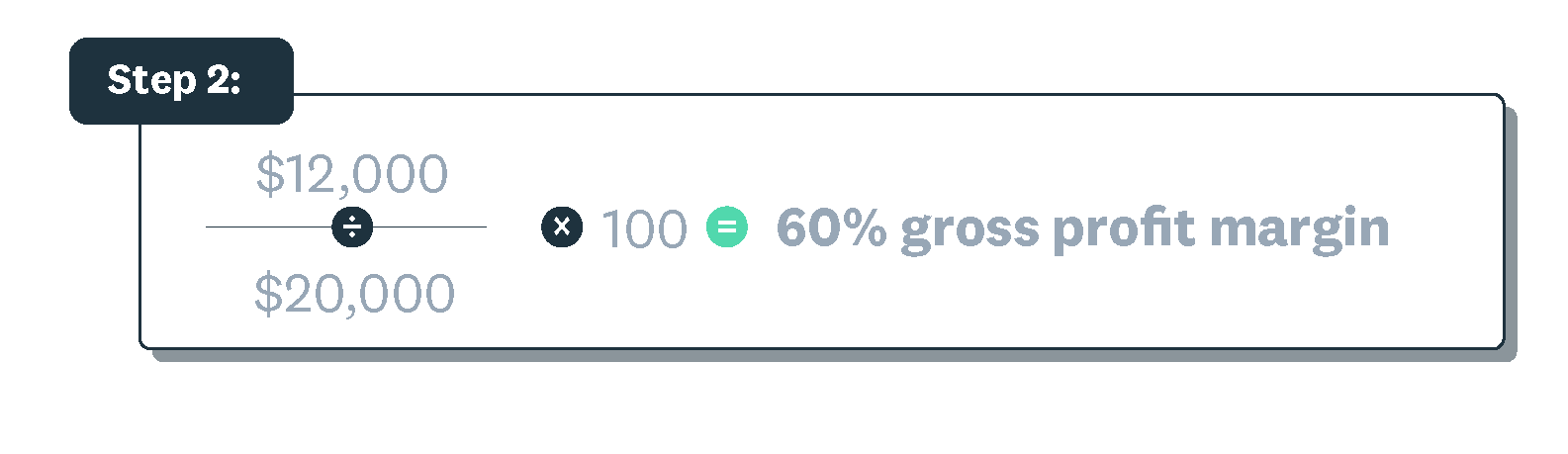
Next, calculate your gross profit margin:
$12,000 ÷ $20,000 × 100 = 60%
A 60% gross profit margin means you keep 60 cents of every dollar earned after covering your direct costs. That's a healthy margin for a service business.
Avoid common calculation mistakes
Getting your gross profit margin right means avoiding a few common pitfalls that can throw off your numbers:
- Missing direct costs: forgetting to include all COGS items, like shipping or subcontractor fees, which makes your margin look artificially high
- Including operating expenses: accidentally adding overhead costs like rent or marketing into your COGS, which deflates your margin
- Inconsistent tracking: using different methods to categorize costs from month to month, making it impossible to compare margins accurately
- Timing errors: recording costs and revenue in different periods, which skews your margin for both periods
What is a good gross profit margin?
There's no single "good" number that applies to every business. As a general guideline, service-based businesses typically aim for 50–70%, while product-based businesses often fall between 20–40%.
Your ideal profit margin depends on several factors:
- Industry standards: what's typical for businesses like yours
- Business model: whether you sell products, services, or a mix
- Market competition: how much pricing pressure you face from competitors
- Business maturity: newer businesses often have lower margins as they scale
Factors affecting your margins
Several factors influence where your gross profit margin lands. Your industry plays the biggest role, since some sectors simply have higher production costs than others.
Your geographic region matters too. Labor costs, supplier availability, and local market conditions all affect your COGS. The type of business you run, whether it's product-heavy or service-oriented, shapes your cost structure. And the level of competition in your market can limit how much you're able to charge.
Industry benchmarks for gross profit margin
Comparing your margin to industry averages gives you a useful reality check. Here are some common benchmarks based on data from sources like NYU Stern's industry margin dataset:
- Software companies: 70–80%+
- Financial services: 60–70%
- Manufacturing: 25–35%
- Grocery stores: 20–25%
These ranges shift over time, so it's worth checking updated benchmarks at least once a year. If your margin falls well below your industry average, that's a signal to dig into your costs and pricing.
Benchmarking your gross profit margin
Follow these 5 steps to benchmark your gross profit margin effectively:
- Calculate your current gross profit margin using your most recent financial data.
- Identify your industry category and find published benchmark data from sources like NYU Stern, IBISWorld, or trade associations.
- Compare your margin to the industry average, noting whether you fall above, below, or in line.
- Analyze the gap. If you're below average, identify whether the issue is pricing, costs, or product mix.
- Set a target margin and create a plan to close the gap over a specific time frame.
When to reassess your gross profit margin
Review your gross profit margin at least quarterly, and ideally every month. You should also reassess whenever you make significant changes to your pricing, switch suppliers, or launch new products or services.
Using accounting software makes it easier to track your margins in real time, so you can catch problems before they become costly.
Gross profit margin vs. gross profit
Gross profit and gross profit margin are related but tell you different things. Gross profit is a dollar amount. Gross profit margin is a percentage.
For example, imagine your business earns $100,000 in revenue with $60,000 in COGS. Your gross profit is $40,000. Your gross profit margin is 40%.
The percentage is more useful for comparisons. A business with $40,000 in gross profit might sound impressive, but if it earned $500,000 in revenue, its margin is only 8%. The margin gives you context that the dollar figure alone can't provide.
Analyzing gross profit margin for business insights
Your gross profit margin is more than a single number. It's a tool for making better business decisions when you measure profitability over time and in context. Here are some ways to use it:
- Compare margins across different products or services to find your most profitable offerings
- Track monthly or quarterly trends to spot seasonal patterns
- Evaluate the impact of price changes on your profitability
- Identify when rising costs are eating into your margins
- Assess whether new product lines are performing as expected
Interpreting gross profit margin trends
A rising gross profit margin over time is a positive sign. It means you're becoming more efficient at turning revenue into profit. This could reflect better pricing, lower costs, or a shift toward higher-margin products.
A declining margin is a red flag. It might mean your costs are increasing faster than your revenue, or that you've lowered prices without reducing expenses. Look at both revenue and COGS trends to pinpoint the cause.
Factors affecting gross profit margin
External forces can push your margins up or down, even when your internal operations stay the same. Keep an eye on these factors:
- Customer demand: shifts in what your customers want can affect which products sell and at what price
- Supplier costs: increases in raw materials or wholesale prices directly raise your COGS
- Customer spending patterns: during economic downturns, customers may trade down to cheaper options, putting pressure on your revenue
Gross profit margin compared with other metrics
Gross profit margin is just one piece of the profitability puzzle. Comparing it with other margin metrics gives you a fuller picture of your business's financial health.
Gross profit margin vs. operating profit margin
While gross profit margin only accounts for COGS, operating profit margins go further. Operating profit margin subtracts all operating expenses, including rent, salaries, marketing, and utilities, from your revenue.
If your gross profit margin is healthy but your operating profit margin is thin, your overhead costs may be too high. This comparison helps you figure out whether to focus on production costs or operating expenses.
Gross profit margin vs. net profit margin
Net profit margin is the most comprehensive profitability metric. It accounts for every expense your business incurs, including taxes, interest, and one-time costs. You can calculate net profit margin using a similar formula.
Your net profit margin will always be lower than your gross profit margin. The gap between the two tells you how much of your gross profit is being consumed by non-production costs.
How to use each metric
Each margin metric answers a different question about your business. Here's when to use each one:
- Gross profit margin: to evaluate your production efficiency and pricing strategy
- Operating profit margin: to assess how well you're managing day-to-day operating costs
- Net profit margin: to understand your overall profitability after every expense is accounted for
5 ways to improve your gross profit margin
If your gross profit margin isn't where you'd like it to be, there are practical steps you can take to move the needle.
1. Adjust your prices
Sometimes the simplest fix is a price increase. Review your pricing regularly to make sure it reflects your current costs and the value you deliver. This is one of the most direct ways to increase revenue. Even small adjustments can have a big impact on your margins.
Before raising prices, research what competitors charge and consider the perceived value of your product or service. A well-justified price increase is easier for customers to accept.
2. Reduce your cost of goods sold
Look for ways to lower your direct production costs without sacrificing quality. This might mean finding more affordable suppliers, buying materials in bulk, or reducing waste in your production process.
Track your COGS closely each month to identify where the biggest expenses are. Even a small reduction in your largest cost category can meaningfully boost your margin.
3. Focus on high-margin products or services
Not all your offerings contribute equally to your bottom line. Analyze which products or services carry the highest margins, then prioritize them in your sales and marketing efforts.
Consider phasing out low-margin items that take up significant time or resources. Shifting your product mix toward higher-margin offerings is one of the fastest ways to improve your overall gross profit margin.
4. Negotiate better supplier terms
Building strong relationships with your suppliers can open the door to better pricing. Ask about bulk discounts, early payment incentives, or long-term contract pricing.
Don't be afraid to shop around and get quotes from multiple suppliers. Even if you stick with your current vendor, having competitive quotes gives you leverage in negotiations.
5. Streamline your operations
Operational efficiency directly affects your COGS. Improving your inventory management helps you avoid overstocking, reduce storage costs, and minimize waste.
Look for opportunities to automate repetitive tasks. Whether it's invoicing, order processing, or inventory tracking, automation reduces labor costs and frees your team to focus on higher-value work.
Track your gross profit margin with Xero
Keeping a close eye on your gross profit margin is easier when your financial data is organized and up to date. Xero's reporting and analytics tools give you real-time visibility into your margins, so you can spot trends and make informed decisions quickly.
With Xero, you can pull profit and loss reports, track COGS, and monitor your margins all in one place. Get one month free and see how Xero helps you stay on top of the financial metrics that matter most to your business.
FAQs on gross profit margin
Here are answers to frequently asked questions about gross profit margin.
What is a gross profit margin ratio?
A gross profit margin ratio is another way of expressing your gross profit margin. It shows the relationship between your gross profit and your revenue as a percentage. You can learn more about how different profit margin ratios work together to measure business performance.
What is the difference between gross margin and markup?
Gross margin and markup both measure profitability, but from different angles. Gross margin shows profit as a percentage of revenue. Markup shows profit as a percentage of cost. For example, if a product costs $60 and sells for $100, the gross margin is 40% but the markup is about 67%.
Can your gross profit margin be negative?
Yes, your gross profit margin can be negative. This happens when your COGS exceeds your revenue, meaning you're spending more to produce your goods or services than you're earning from selling them. A negative margin is a serious warning sign that you need to adjust your pricing or reduce your direct costs immediately.
How often should you check your gross profit margin?
Monthly reviews work best for most small businesses. During each review, compare your current margin to the same period last year, check whether any COGS line items have shifted, and note how pricing changes affected the result. Tying margin reviews to your regular bookkeeping cycle helps make them a habit rather than an afterthought.
Can you have high revenue but a low gross profit margin?
Yes, this is more common than you might think. High revenue with a low gross profit margin means your COGS are eating up most of your sales. This often happens in industries with thin margins, like retail or food service, or when a business is underpricing its products relative to production costs.
Xero does not provide accounting, tax, business or legal advice. This guide has been provided for information purposes only. You should consult your own professional advisors for advice directly relating to your business or before taking action in relation to any of the content provided.
Disclaimer
Xero does not provide accounting, tax, business or legal advice. This guide has been provided for information purposes only. You should consult your own professional advisors for advice directly relating to your business or before taking action in relation to any of the content provided.