What is profit?
Learn what profit is, how to calculate it, and why it matters for your small business.
Published Thursday 23 July 2026
Table of contents
Key takeaways
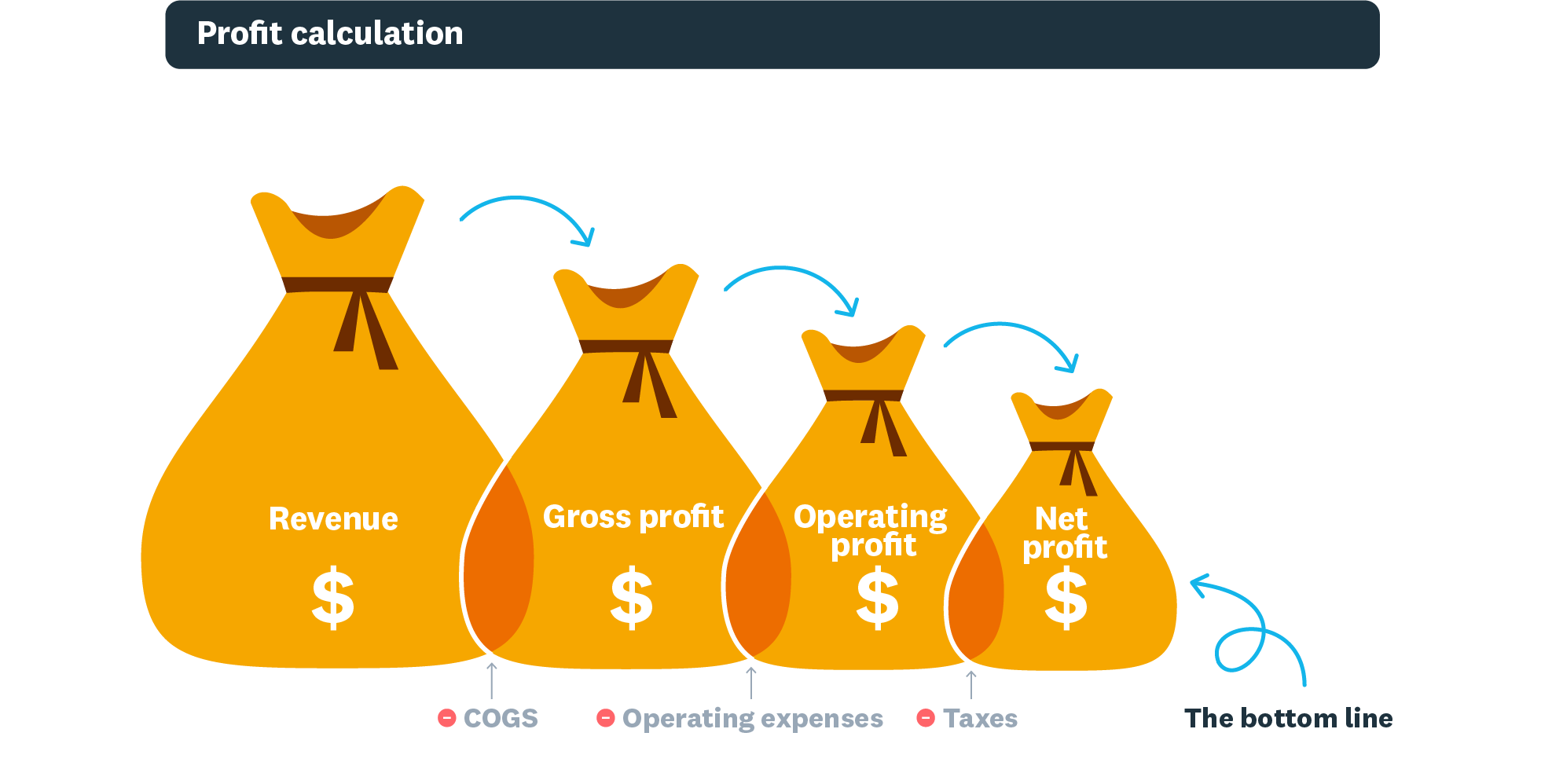
There are three types of profit. Net profit is what you get to keep.
- Profit is the money left after you subtract all expenses from your total revenue, and it's the clearest measure of whether your business is financially sustainable
- There are 3 main types of profit: gross profit, operating profit, and net profit, each giving you a different view of your business performance
- Tracking profit regularly helps you make smarter decisions about pricing, spending, and growth
- You can improve profit by increasing revenue, reducing costs, or both, and Xero accounting software makes it easier to stay on top of your numbers
What is profit?
Profit is the amount of money your business earns after subtracting all costs and expenses from total revenue. In simple terms, profit equals revenue minus expenses. It's the financial gain that remains once you've paid for everything it takes to run your business.
For small business owners, profit is one of the most important numbers to track. It tells you whether your business is earning more than it spends. Without it, you can't sustain operations, reinvest in growth, or build a cushion for slower periods.
Revenue is the total amount of money coming in, while profit is what's left after costs. Understanding this difference is key to making informed financial decisions.
Types of profit
There are 3 main types of profit, and each one gives you a different perspective on your business finances. Tracking all 3 helps you pinpoint where your money goes and where you can improve.
Gross profit
Gross profit is your revenue minus the cost of goods sold (COGS), which covers the direct costs of producing your products or delivering your services.
The formula is: Gross profit = Revenue - Cost of goods sold.
Gross profit shows how efficiently you produce or source what you sell. If it's low relative to revenue, your production costs may be too high or your pricing may need adjusting.
Operating profit
Operating profit is your gross profit minus operating expenses like rent, utilities, salaries, marketing, and other day-to-day costs.
The formula is: Operating profit = Gross profit - Operating expenses.
Operating profit is also known as earnings before interest and taxes (EBIT). It shows how well your core business operations perform, separate from financing or tax decisions.
Net profit
Net profit is what remains after you subtract all expenses from your total revenue, including operating costs, interest, taxes, and any other charges.
The formula is: Net profit = Total revenue - Total expenses (including COGS, operating expenses, interest, and taxes).
Net profit gives you the most complete picture of your financial health, showing exactly how much your business earned during a given period.
How to calculate profit
Calculating profit doesn't need to be complicated, and understanding your financial statements can help. Follow these steps to work out your business profit for any given period.
- Add up your total revenue. Include all income from sales of products or services during the period.
- Calculate your cost of goods sold. Include all direct costs tied to producing or delivering what you sell.
- Subtract COGS from revenue to get gross profit. This shows how much you earned after covering production costs.
- Add up your operating expenses. Include rent, utilities, payroll, insurance, marketing, and other overhead.
- Subtract operating expenses from gross profit to get operating profit. This reflects earnings from core business activities.
- Subtract interest and taxes to get net profit. This is your final bottom-line number.
Here's a quick example. Say your business earned $100,000 in revenue last quarter, with $40,000 in COGS, giving you a gross profit of $60,000. Operating expenses of $35,000 leave an operating profit of $25,000.
After subtracting $3,000 in interest and $5,000 in taxes, your net profit is $17,000.
Profit vs. revenue
Revenue is the total money your business brings in from sales before any expenses are deducted. Profit is what's left after all costs are paid.
A business can have strong revenue and still lose money if expenses exceed income. For example, a company earning $500,000 in annual revenue but spending $520,000 on costs would have a net loss of $20,000.
It's also worth understanding the difference between profit and cash flow. Profit is an accounting measure based on recorded revenue and expenses, while cash flow tracks actual money moving in and out of your bank account. You can show a profit on paper but still face cash shortages if customers pay late or you have large upfront costs.
Why profit matters for your small business
Profit is the foundation of a sustainable business. Without it, you can't cover your obligations or invest in growth.
Here's why tracking profit matters:
- It shows whether your business model is working and helps you spot problems early
- It gives you the resources to reinvest in equipment, inventory, hiring, or marketing
- It helps you make confident decisions about pricing, expansion, and cost management
- It makes your business more attractive to lenders and investors
- It gives you a buffer for slow seasons, unexpected expenses, or economic downturns
Regular profit reviews help you stay in control of your finances instead of reacting to problems after they've grown. Learn more about how to measure profitability effectively.
How to increase your profit
There are 2 main ways to increase profit: bring in more revenue or reduce your expenses. The best results come from working on both at the same time.
To increase your revenue, consider these approaches:
- Raise your prices if the market supports it and your value proposition is strong
- Upsell or cross-sell to existing customers who already trust your business
- Expand into new markets, channels, or product lines
- Improve your marketing to attract more customers at a lower acquisition cost
To reduce your expenses, look at these areas:
- Negotiate better rates with suppliers or switch to more cost-effective options
- Automate repetitive tasks to save time and reduce labor costs
- Review your subscriptions and overhead for anything you no longer need
- Improve inventory management to reduce waste and holding costs
Even modest gains in pricing or efficiency can significantly boost your bottom line over time. For more strategies, see this guide on how to increase profits.
Profit margin explained
Profit margin is your profit expressed as a percentage of revenue. It shows how much of every dollar earned turns into profit, making it easier to compare performance over time or against industry benchmarks.
There are 3 main types of profit margin, matching the 3 types of profit:
- Gross profit margin = (Gross profit / Revenue) x 100
- Operating profit margin = (Operating profit / Revenue) x 100
- Net profit margin = (Net profit / Revenue) x 100
Using the earlier example, with $100,000 in revenue and $17,000 in net profit, your net profit margin is 17%. That means you kept 17 cents of every dollar earned.
Profit margins vary widely by industry. According to data compiled by NYU Stern, average net profit margins range from under 5% in retail and food services to over 20% in software and financial services. Comparing your margins to industry benchmarks helps you set realistic goals.
Track your profit with Xero
Staying on top of your profit doesn't have to mean hours of manual work. Xero accounting software connects to your bank, helps track income and expenses in real time, and generates profit and loss reports so you can see exactly where your business stands.
With Xero, you can monitor gross profit, operating profit, and net profit from a single dashboard. Automated bank feeds and smart categorization help reduce manual work, so you spend less time in the books and more time growing your business. Get one month free.
FAQs on profit
Here are some frequently asked questions about profit.
What is a good profit margin for a small business?
A good net profit margin for a small business typically falls between 7% and 10%, though this varies by industry. Service-based businesses often achieve higher margins than retail or manufacturing businesses because they have lower direct costs.
What is the difference between gross profit and net profit?
Gross profit is your revenue minus the cost of goods sold, showing how efficiently you produce or source your products. Net profit subtracts all remaining expenses, including operating costs, interest, and taxes, to show your true bottom-line earnings.
How often should you measure profit?
Review your profit at least monthly to catch trends and address issues early. Many small business owners also find it helpful to compare profit quarterly and annually to spot seasonal patterns and track long-term growth.
Can a business have revenue but no profit?
Yes. A business brings in revenue whenever it makes a sale, but if total expenses exceed that revenue, the result is a net loss. This is common for startups and businesses going through periods of heavy investment or expansion.
What is the corporate tax rate on business profits?
The federal corporate tax rate in the United States is 21%. However, many small businesses operate as pass-through entities, such as sole proprietorships or S corporations, where profits are taxed at the owner's individual income tax rate instead.
Handy resources
Advisor directory
You can search for experts in our advisor directory
How to manage your finances and cash flow
Learn about money management for your small business
Financial reporting
Keep track of your performance with accounting reports
Disclaimer
This glossary is for small business owners. The definitions are written with their requirements in mind. More detailed definitions can be found in accounting textbooks or from an accounting professional. Xero does not provide accounting, tax, business or legal advice.