What is accumulated depreciation? How to calculate it
Learn what accumulated depreciation is, how to calculate it, and how it affects your financial statements.

Written by Jotika Teli—Certified Public Accountant with 24 years of experience. Read Jotika's full bio
Published Tuesday 9 June 2026
Table of contents
Key takeaways
- Accumulated depreciation is the running total of depreciation expense recorded for an asset since purchase, reducing its original cost on your balance sheet to show current book value.
- Contra asset account: Accumulated depreciation isn't a liability or a true asset. It's a contra asset that offsets the original cost of your fixed assets, giving lenders and investors an accurate picture of what those assets are worth today.
- You can calculate depreciation using straight-line, declining balance, double-declining balance, sum-of-the-years'-digits, or the Modified Accelerated Cost Recovery System (MACRS) required by the IRS for tax purposes.
- Depreciation reduces your taxable income without affecting cash flow, and the IRS now allows 100% bonus depreciation for qualifying property under the One Big Beautiful Bill Act of 2025.
What is accumulated depreciation?
Accumulated depreciation is the total amount of depreciation expense recorded for an asset since you purchased it. This running total reduces the asset's original cost on your balance sheet to reflect its current book value.
Tracking accumulated depreciation helps you see what your assets are actually worth after years of wear and tear. The formula is straightforward: asset cost minus accumulated depreciation equals book value.
Here are two examples of how accumulated depreciation works:
- Office furniture: You buy furniture for $5,000 with $1,000 in depreciation each year. After three years, accumulated depreciation totals $3,000, leaving a book value of $2,000.
- Machinery: You purchase equipment for $25,000 with $2,500 in depreciation each year. After six years, accumulated depreciation totals $15,000, leaving a book value of $10,000.
Depreciation vs accumulated depreciation
Depreciation is the process of spreading the cost of a tangible asset over its useful life. It represents the periodic expense your business records to account for an asset losing value through use, age, or obsolescence.
Accumulated depreciation is the total of all depreciation expenses recorded for that asset from the date of purchase to the current reporting period.
The key difference: depreciation is a single-period expense on your income statement, while accumulated depreciation is a cumulative balance on your balance sheet that grows each period as you add the latest depreciation charge.
Is accumulated depreciation an asset or a liability?
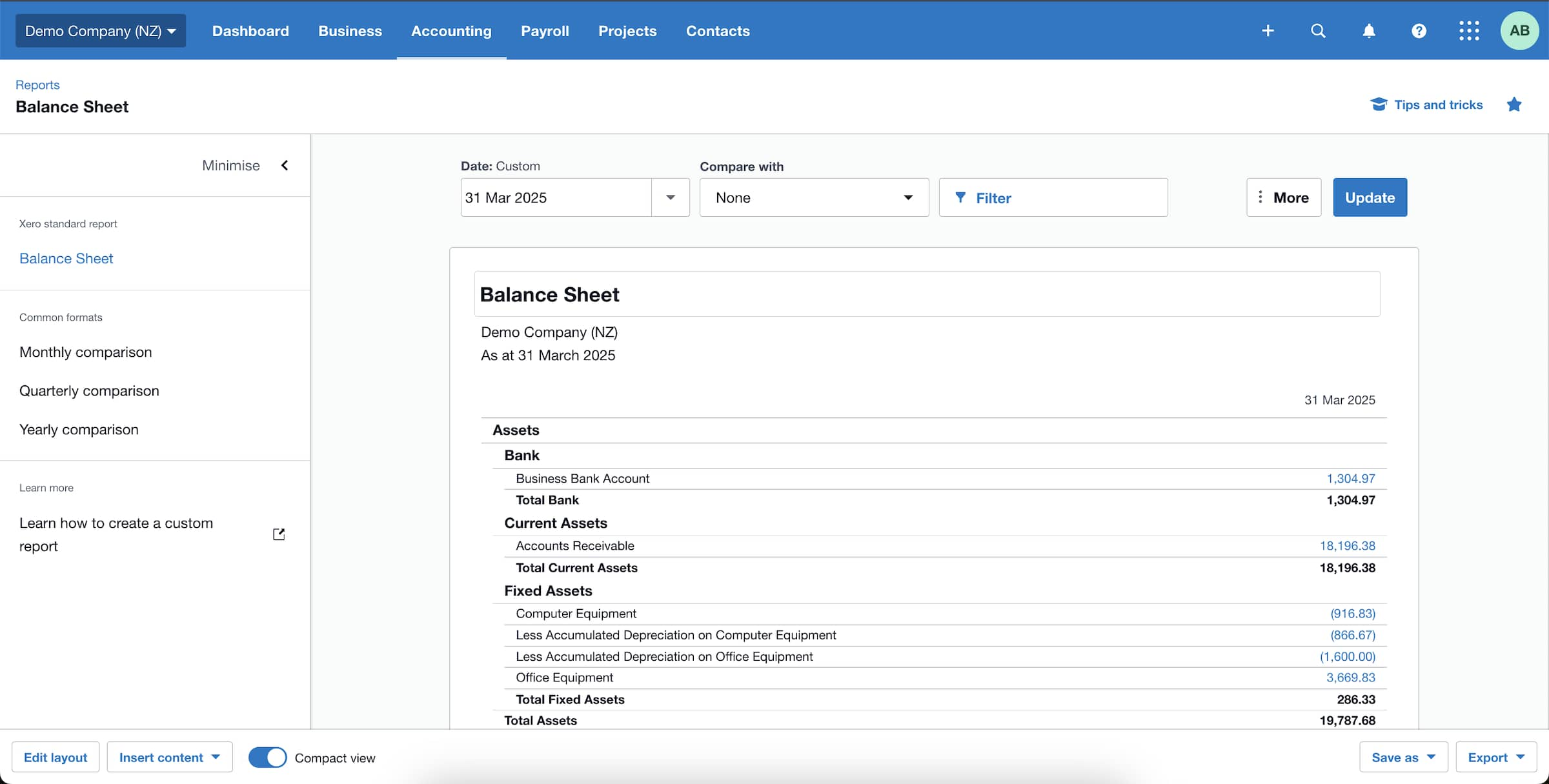
Accumulated depreciation is neither an asset nor a liability. It's classified as a contra asset account, which means it appears on the asset side of the balance sheet but carries a credit balance that offsets the original cost of the related asset.
Here's what that means in practice:
- Not a liability: You don't owe money or have an obligation to repay anyone. Liabilities represent debts; accumulated depreciation does not.
- Not an asset: It doesn't provide future economic benefits on its own. Instead, it reduces the reported value of an existing asset.
- Contra asset: It sits directly below the asset it offsets, reducing the original cost to show the asset's net book value.
How does accumulated depreciation affect financial statements?
Accumulated depreciation touches all three core financial statements. To see exactly how, consider a $10,000 delivery van with a five-year useful life and a $1,000 salvage value. Using straight-line depreciation, the annual depreciation expense is $1,800: ($10,000 − $1,000) ÷ 5.
Accumulated depreciation on the balance sheet
On the balance sheet, accumulated depreciation appears directly below the asset's original cost, reducing it to its net book value.
For the delivery van at the end of year one:
- Delivery van (cost): $10,000
- Less accumulated depreciation: ($1,800)
- Net book value: $8,200
By the end of year three, accumulated depreciation reaches $5,400, bringing the net book value down to $4,600. This gives lenders and investors a realistic view of what your assets are worth today rather than what you originally paid.
Accumulated depreciation on the income statement
On the income statement, depreciation appears as an operating expense that reduces your net income for the period.
Each year, you record $1,800 in depreciation expense for the delivery van. As a non-cash expense, it lowers your reported profit without requiring any actual cash outflow. This reduction in net income also lowers your taxable income, which directly affects how much you owe in taxes.
Accumulated depreciation on the cash flow statement
Because depreciation is a non-cash expense, it gets added back to net income in the operating activities section of the cash flow statement.
Your cash flow statement would show:
- Net income: Reduced by the $1,800 depreciation expense.
- Add back depreciation: +$1,800 (non-cash adjustment).
- Net effect on operating cash flow: Zero direct impact.
The original $10,000 cash outflow for the van was recorded under investing activities when you purchased it.
Tax savings from depreciation
Depreciation creates tax savings by reducing your taxable income each year, even though no cash leaves your business.
For the delivery van example, here's how to calculate the annual tax benefit at a 22% tax rate:
- Annual depreciation expense: $1,800
- Tax rate: 22%
- Annual tax savings: $1,800 × 0.22 = $396
- Total tax savings over five years: $396 × 5 = $1,980
Over the van's useful life, depreciation saves your business $1,980 in taxes. Businesses that use accelerated methods or take advantage of 100% bonus depreciation (discussed in the MACRS section below) can realize those tax deductions even sooner.
Why businesses use depreciation
Depreciation isn't just an accounting requirement. It serves several practical purposes that help you run your business more effectively.
- Matching principle: Depreciation allocates the cost of an asset to the same periods that benefit from its use. If a piece of equipment helps generate revenue over five years, spreading the cost over those same five years gives a more accurate picture of profitability each period.
- Tax benefits: Depreciation expense reduces your taxable income, which lowers your tax bill. The IRS allows you to claim depreciation on qualifying business assets, and accelerated methods let you front-load deductions to save more in the early years of ownership.
- Accurate asset valuation: Recording depreciation ensures your balance sheet reflects what your assets are realistically worth, not just what you paid for them. This helps lenders, investors, and partners evaluate your financial health.
- Capital budgeting: Tracking how assets lose value over time helps you plan for replacements and upgrades before equipment fails or becomes obsolete. Knowing when an asset's book value will reach zero lets you budget for the next purchase.
- Regulatory compliance: Generally Accepted Accounting Principles (GAAP) and IRS rules require businesses to depreciate qualifying assets rather than deducting the full cost in the year of purchase. Following these rules keeps your financial reporting accurate and your tax filings compliant.
How to calculate accumulated depreciation
Several methods exist for calculating depreciation, each spreading the cost of an asset across its useful life in a different pattern. The method you choose affects how much depreciation expense you record each year and how quickly accumulated depreciation builds.
Straight-line depreciation method
The straight-line method is the simplest and most commonly used approach. It spreads the depreciable cost evenly over the asset's useful life.
Formula: Annual depreciation = (asset cost − salvage value) ÷ useful life
Example: You purchase an asset for $1,000 with a useful life of three years and a salvage value of $100.
- Depreciable amount: $1,000 − $100 = $900
- Annual depreciation: $900 ÷ 3 = $300 per year
Accumulated depreciation by year:
- Year 1: $300 accumulated, book value $700
- Year 2: $600 accumulated, book value $400
- Year 3: $900 accumulated, book value $100 (salvage value)
Declining balance method
The declining balance method applies a fixed depreciation rate to the asset's remaining book value each year. This front-loads more expense in the early years and less in later years.
Formula: Annual depreciation = book value at beginning of year × depreciation rate
The depreciation rate is typically calculated as 1 ÷ useful life. For a three-year asset, that's 33.33%.
Example: You purchase an asset for $10,000 with a three-year useful life and a 33.33% depreciation rate.
- Year 1: $10,000 × 33.33% = $3,333 depreciation, book value $6,667
- Year 2: $6,667 × 33.33% = $2,222 depreciation, book value $4,445
- Year 3: $4,445 × 33.33% = $1,482 depreciation, book value $2,963
Note that the declining balance method doesn't automatically depreciate the asset down to its salvage value. You may need to switch to straight-line in the final years or adjust the last period's expense to avoid depreciating below salvage value.
Double-declining balance method
The double-declining balance (DDB) method is an accelerated approach that doubles the straight-line rate. It's useful when assets lose most of their value in the first few years, such as vehicles or technology.
Formula: Annual depreciation = book value at beginning of year × (2 ÷ useful life)
Example: You purchase an asset for $10,000 with a three-year useful life and a $1,000 salvage value. The DDB rate is 2 ÷ 3 = 66.67%.
- Year 1: $10,000 × 66.67% = $6,667 depreciation, book value $3,333
- Year 2: $3,333 × 66.67% = $2,222 depreciation, book value $1,111
- Year 3: $1,111 − $1,000 = $111 depreciation, book value $1,000 (salvage value)
In year three, you depreciate only the amount needed to bring the book value down to salvage value rather than applying the full 66.67% rate.
Sum-of-the-years'-digits method
The sum-of-the-years'-digits (SYD) method is another accelerated approach that assigns a higher fraction of depreciable cost to earlier years. It provides a more gradual decline than double-declining balance.
Formula: Annual depreciation = (remaining useful life ÷ sum of the years' digits) × depreciable amount
Example: You purchase an asset for $10,000 with a three-year useful life and a $1,000 salvage value. The sum of the years' digits is 1 + 2 + 3 = 6. The depreciable amount is $10,000 − $1,000 = $9,000.
- Year 1: (3 ÷ 6) × $9,000 = $4,500 depreciation, book value $5,500
- Year 2: (2 ÷ 6) × $9,000 = $3,000 depreciation, book value $2,500
- Year 3: (1 ÷ 6) × $9,000 = $1,500 depreciation, book value $1,000 (salvage value)
Modified Accelerated Cost Recovery System (MACRS)
For US federal tax purposes, the IRS generally requires businesses to use the Modified Accelerated Cost Recovery System (MACRS) for tangible property placed in service after 1986. MACRS assigns each asset to a property class with a predetermined recovery period, such as five years for vehicles or seven years for office furniture.
Under MACRS, you don't estimate salvage value. Instead, the IRS provides depreciation percentage tables based on the asset's property class and the applicable convention (half-year, mid-quarter, or mid-month). You simply multiply your asset's cost by the percentage for each year.
A significant benefit under current tax law is 100% bonus depreciation. The One Big Beautiful Bill Act, signed in 2025, permanently restored the ability to deduct 100% of the cost of qualifying property in the year it's placed in service. This means you could potentially deduct the full cost of an eligible asset in year one rather than spreading it across multiple years.
MACRS rules can be complex, so consult a tax professional for details on property classes, conventions, and bonus depreciation eligibility.
Common misconceptions about accumulated depreciation
Several misunderstandings about accumulated depreciation can lead to confusion in financial reporting and decision-making. Here are the most common ones.
- "Accumulated depreciation is a liability." It's not. Although it carries a credit balance, accumulated depreciation is a contra asset account, not a liability. It reduces the book value of your fixed assets on the balance sheet. A liability represents money you owe; accumulated depreciation is simply an accounting entry that reflects value consumed over time.
- "Depreciation reduces cash flow." Depreciation is a non-cash expense. No money leaves your bank account when you record it. In fact, because depreciation lowers your taxable income, it indirectly preserves cash by reducing your tax bill.
- "Recording depreciation is optional." Under GAAP and IRS rules, depreciation of qualifying business assets isn't optional. Failing to record it misrepresents your financial position and can result in compliance issues with tax authorities.
- "A fully depreciated asset is worthless." A book value of zero doesn't mean the asset has no market value or no useful function. Many fully depreciated assets, such as machinery or vehicles, continue to operate effectively and may still have resale value. If an asset has genuinely lost value beyond normal depreciation, that's a separate concept known as impairment.
Track depreciation and manage your assets with Xero
As your business acquires more assets, tracking depreciation schedules, adjusting entries, and calculating accumulated depreciation gets increasingly complex. Xero accounting software simplifies these tasks by letting you manage and track your fixed assets in one place, with automated depreciation calculations and clear reporting.
FAQs on accumulated depreciation
Here are answers to frequently asked questions about accumulated depreciation.
How does accumulated depreciation affect cash flow?
Accumulated depreciation doesn't affect cash flow directly because it's a non-cash expense. No money leaves your business when you record it. However, depreciation reduces your taxable income, which lowers your tax bill and indirectly keeps more cash in your business.
What happens to an asset's accumulated depreciation when you sell it?
When you sell an asset, you remove both the asset's original cost and its accumulated depreciation from the balance sheet. You then compare the asset's book value (cost minus accumulated depreciation) to the sale price to determine whether you have a gain or a loss on the disposal.
Do I record accumulated depreciation as a debit or a credit?
You record accumulated depreciation as a credit on the balance sheet. Because it's a contra asset account, it carries a credit balance that offsets the debit balance of the related asset. Each period, you debit depreciation expense on the income statement and credit accumulated depreciation on the balance sheet.
Is accumulated depreciation a current liability?
No. Accumulated depreciation is a contra asset account, not a current liability. Current liabilities are debts due within 12 months. Accumulated depreciation reduces an asset's book value over time; it isn't an amount you owe or need to repay.
What is the difference between depreciation and amortization?
Depreciation applies to tangible assets like vehicles, equipment, and buildings, while amortization applies to intangible assets like patents, trademarks, and software licenses. Both spread the cost of an asset over its useful life, but they apply to different categories of business assets.
Disclaimer
Xero does not provide accounting, tax, business or legal advice. This guide has been provided for information purposes only. You should consult your own professional advisors for advice directly relating to your business or before taking action in relation to any of the content provided.
Get one month free
Sign up to any Xero plan, and we will give you the first month free.