Section 179 deduction: Equipment purchase tax benefits
Section 179 reduces business taxes by letting you deduct the full cost of qualifying assets in the year of purchase.

Written by Kari Brummond—Content Writer, Accountant, IRS Enrolled Agent. Read Kari's full bio
Published March 18 2026
Table of contents
Key takeaways
- Section 179 lets you write off the full cost of qualifying assets instead of depreciating them over time.
- As of 2025, you can claim up to $2.5 million in Section 179 deductions. The deduction starts to phase out if you have over $4 million in Section 179 purchases.
- If an asset is for personal and business use, you can only use Section 179 if business use is more than half – if it drops below half in a future year, you may need to repay some of the deduction to the IRS.
- Your deduction cannot exceed your taxable business income, and vehicles may be subject to limits.
What is a Section 179 deduction?
Section 179 of the Internal Revenue Code is a law that lets businesses write off the full cost of qualifying equipment or capital assets instead of depreciating them slowly over time.
Say a business buys a computer for $10,000 – it can deduct $2000 every year for five years, or it can use the Section 179 deduction to claim the entire $10,000 expense in the year the asset was put into service.
You claim the deduction for the year you put the asset into service, which is typically (but not always) the same year you purchase the asset. For example, if you buy Section 179 property in December 2025 but don't put it into service until January 2026, you should claim the deduction on your 2026 tax return.
IRS Publication 946 has more info about the Section 179 deduction.
Who qualifies for Section 179
Any business that buys qualifying Section 179 equipment can qualify for the deduction if:
- the deduction doesn't create a loss
- the total Section 179 property put into service for the year is under a certain threshold
Which business entities can claim Section 179?
All types of business entities can claim the Section 179 deduction, including sole proprietorships, partnerships, and corporations.
What’s the business income limit?
Businesses cannot generate a loss with Section 179 write-offs. In other words, the Section 179 deduction is limited to the business's income minus expenses and other depreciation.
What kinds of property qualify for Section 179?
Most tangible personal property bought for business purposes qualifies for Section 179 depreciation, including:
- computers
- office equipment and furniture
- machinery
- livestock
- certain improvements to non-residential real property – for example, adding an HVAC system or a new roof to a commercial building.
Specialized work vehicles (like ambulances, hearses, or delivery trucks) qualify for the full Section 179 deduction, while deductions for passenger vehicles are limited (see below).
This tax deduction doesn’t apply to intangible property (for example, copyrights or goodwill), real estate, or property received as a gift or inheritance.
Section179.org has more details on the Section 179 deduction.
How the Section 179 deduction works
The Section 179 business equipment tax deduction lets you write off the full cost of a capital asset in the year it was put into service, rather than slowly over time. Here's how it works.
Check annual limits and phase-out thresholds
As of tax year 2025, the maximum Section 179 deduction is $2.5 million, but it starts to phase out if you have over $4 million in Section 179 purchases. These numbers are indexed to inflation. In 2026, the maximum deduction is $2,560,000, and the phase out starts at $4,090,000.
For example, say you spend $2.5 million on qualifying Section 179 property during the year. You can expense that full amount as long as it doesn't create a business loss. But you don't have to claim the full amount – instead, you could choose to use the IRS Section 179 rules on a $1 million purchase and depreciate the other $1.5 million slowly over time.
But if you go over the threshold, you must reduce the deduction. For example, if you purchase $5 million in Section 179 equipment, you're $1 million over the $4 million threshold, which directly reduces your eligible deduction. So now, you can only claim a $1.5 million 179 write-off instead of the full $2.5 million.
Calculate the business-use percentage
Property must be used for business purposes more than 50% of the time to qualify for the Section 179 deduction. If you run a car repair shop and you buy diagnostic equipment that's used solely for business purchases, it qualifies for the deduction as long as you meet the other criteria.
But say you run a life coaching business and buy a computer that use 40% of the time for business and 60% of the time for personal use. The computer does not qualify for the 179 deduction because you use it less than half the time for business. However, if you used the computer 51% of the time for business, it would qualify for the Section 179 write off – but not the full purchase price, only 51% of the cost.
Section 179 vs bonus depreciation
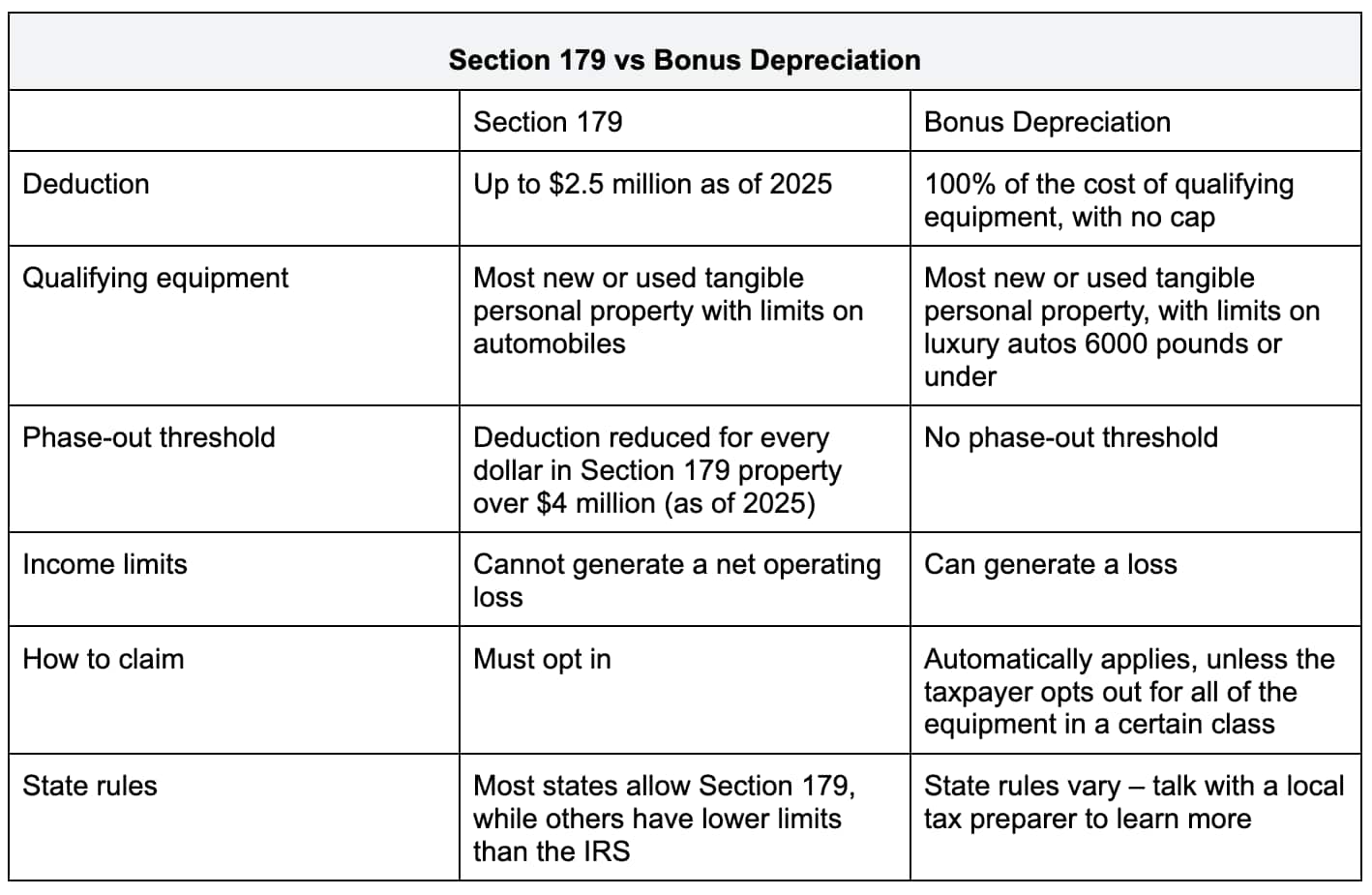
Bonus depreciation also lets you write off the cost of qualifying equipment in the year of purchase. It can be used in conjunction with, or instead of, Section 179.
For example, a single business return may claim Section 179 on certain assets and bonus depreciation on others. A business may also use Section 179 to write off the cost of a vehicle up to the annual limit, and then use bonus depreciation to deduct the remaining cost.
What if you do not qualify for Section 179?
If you don't qualify, consider looking into bonus depreciation. Otherwise, write off the expense over time. For example, real estate doesn't qualify for Section 179, so your only option is to depreciate it over time.
File Form 4562 to elect Section 179
Use Form 4562 to claim the Section 179 business equipment tax deduction and attach it to your tax return.
Here are the forms to use according to your business type.
- Form 1040 (Individual Income Tax Return): used by sole proprietors who file a Schedule C for business income, Schedule E for real estate income, or Schedule F for farm or ranch income
- Form 1065 (U.S. Return of Partnership Income)
- Form 1120 (U.S. Corporate Income Tax Return)
- Form 1120-S (U.S. Income Tax Return for an S Corporation)
Form 4562 also calculates straight-line depreciation (when you claim depreciation in equal installments over several years) and bonus depreciation. In this case, the total depreciation deduction flows to your business return and is subtracted from business income.
Learn more about Form 4562 from the IRS.
Avoid recapture if business use drops below 50%
If business use of the property drops to 50% or below, you have to "recapture" (repay to the IRS) some of the deduction. This means that you retroactively lose some of the deduction and report it as income on your tax return.
For instance, say you claim a $10,000 179 deduction for equipment you’ve used 60% in business on your 2025 tax return. If business use drops to 40% in 2026, you'll retroactively reduce the $10,000 deduction and increase your income during the current year.
Vehicles are eligible for Section 179
Vehicles are eligible, but they have the following Section 179 deduction limitations:
- passenger cars under 6000 pounds: $12,400
- heavy SUVs, trucks, and vans over 6000 and up to 14,000 pounds: $31,300
- specialized vehicles or vehicles over 14,000: up to 100% of purchase price, subject to Section 179 limitations
Vehicles over 6000 pounds are eligible for 100% bonus depreciation, which you can claim on its own or after the Section 179 limit. Vehicles under 6000 pounds are subject to luxury vehicle limitations, which only allow you to claim up to $8000 in bonus depreciation, or a total deduction of $20,400, if you combine Section 179 and bonus depreciation rules.
You can only use Section 179 or bonus depreciation if you claim actual expenses instead of mileage. Read the IRS’s Publication 463 for more details on claiming vehicle expenses.
Simplify Section 179 with Xero
Xero accounting software makes it easy to claim all Section 179 deductions you’re entitled to. With Xero’s automatic calculations, you’ll know exactly what you’ve spent on capital assets during the year, and your profit before depreciation. That means accurate Section 179 deductions every time!
Xero lets you track capital assets, expenses, depreciation, and more, with all kinds of automations and integrations to meet your business's financial needs.
FAQs on the Section 179 deduction
Here are answers to common questions on the Section 179 deduction.
What’s the downside to the Section 179 deduction?
Claiming the full deduction in the year of purchase means you can't claim any depreciation for that asset in future years. To optimize tax benefits, you could use Section 179 to reduce your taxable income in years where income is high. But if you expect to have a higher income in future years, you might want to skip the Section 179 deduction and depreciate the asset slowly over time.
Can I write off 100% of a 6000-lb vehicle?
No. But if the vehicle is over 6000 pounds, you can use Section 179 to write off up to $31,300 for tax year 2025 and use bonus depreciation to write off its remaining cost.
Does off-the-shelf software qualify for Section 179?
Yes – off-the-shelf software can qualify for Section 179, as long as it meets the other requirements, such as being placed in business use during the tax year and not generating a loss. You cannot use Section 179 on custom-designed software or off-the-shelf software that's been substantially modified.
Can I claim Section 179 on leased equipment?
No. Instead, you claim the cost of the lease as a business expense.
Does Section 179 apply to rental property?
You cannot claim Section 179 deductions on commercial or residential real estate. But you can use this deduction on certain qualifying upgrades to non-residential property, like roofs, HVAC systems, and security systems. You can also use Section 179 on qualifying property you’ve bought for your rental – for example, lawn maintenance equipment, appliances, and furniture.
Can I amend a return to claim Section 179?
Possibly – but only if you file the return on time and amend it within 6 months. Otherwise, you generally cannot amend returns to make changes to depreciation because the IRS considers this a change in accounting methods, which is not allowed.
Can I split Section 179 across several assets?
Yes, you can claim the Section 179 deduction over several different assets. It's not limited to a single asset.
Disclaimer
Xero does not provide accounting, tax, business or legal advice. This guide has been provided for information purposes only. You should consult your own professional advisors for advice directly relating to your business or before taking action in relation to any of the content provided.