Missouri sales tax guide: rates, nexus, exemptions, and filing
Learn Missouri sales tax rates, nexus rules, exemptions, filing deadlines, and how to stay compliant.

Written by Lena Hanna—Trusted CPA Guidance on Accounting and Tax. Read Lena's full bio
Published Wednesday 27 May 2026
Table of contents
Key takeaways
- Missouri's base state sales tax rate is 4.225%, but combined rates with local taxes can exceed 10% depending on where your business operates.
- Remote sellers and marketplace facilitators must collect Missouri sales tax once they exceed $100,000 in gross receipts from taxable sales in the state, under Senate Bill 153 effective January 1, 2023.
- Several categories of goods are exempt or taxed at reduced rates, including qualifying groceries at 1.225%, prescription drugs, agricultural supplies, and manufacturing equipment.
- Filing frequency depends on your monthly tax liability, and all businesses must file returns even in months with zero sales.
How much is sales tax in Missouri?
Missouri charges a statewide base sales tax rate of 4.225% on most taxable purchases. On top of that, counties, cities, and special taxing districts add their own rates, which means the total you collect depends on where the sale happens.
Combined rates across the state can exceed 10% in some areas. According to the Tax Foundation's 2026 data, the average combined state and local rate in Missouri is 8.44%.
Your total rate is made up of four possible layers: the state rate, county rate, city rate, and any special district rates. These local rates update quarterly, so it's worth checking the Missouri Department of Revenue rate tables regularly to make sure you're collecting the right amount.
Missouri sales tax by county
Every sale in Missouri starts with the 4.225% state rate, and each county and city layers on its own additional taxes. The differences across the state can be significant, so knowing your exact location matters.
Here are the combined sales tax rates for some of Missouri's largest cities:
- Kansas City: approximately 9.975%
- St. Louis: approximately 9.679%
- Springfield: approximately 7.725%
- Columbia: approximately 8.475%
- Independence: approximately 7.975%
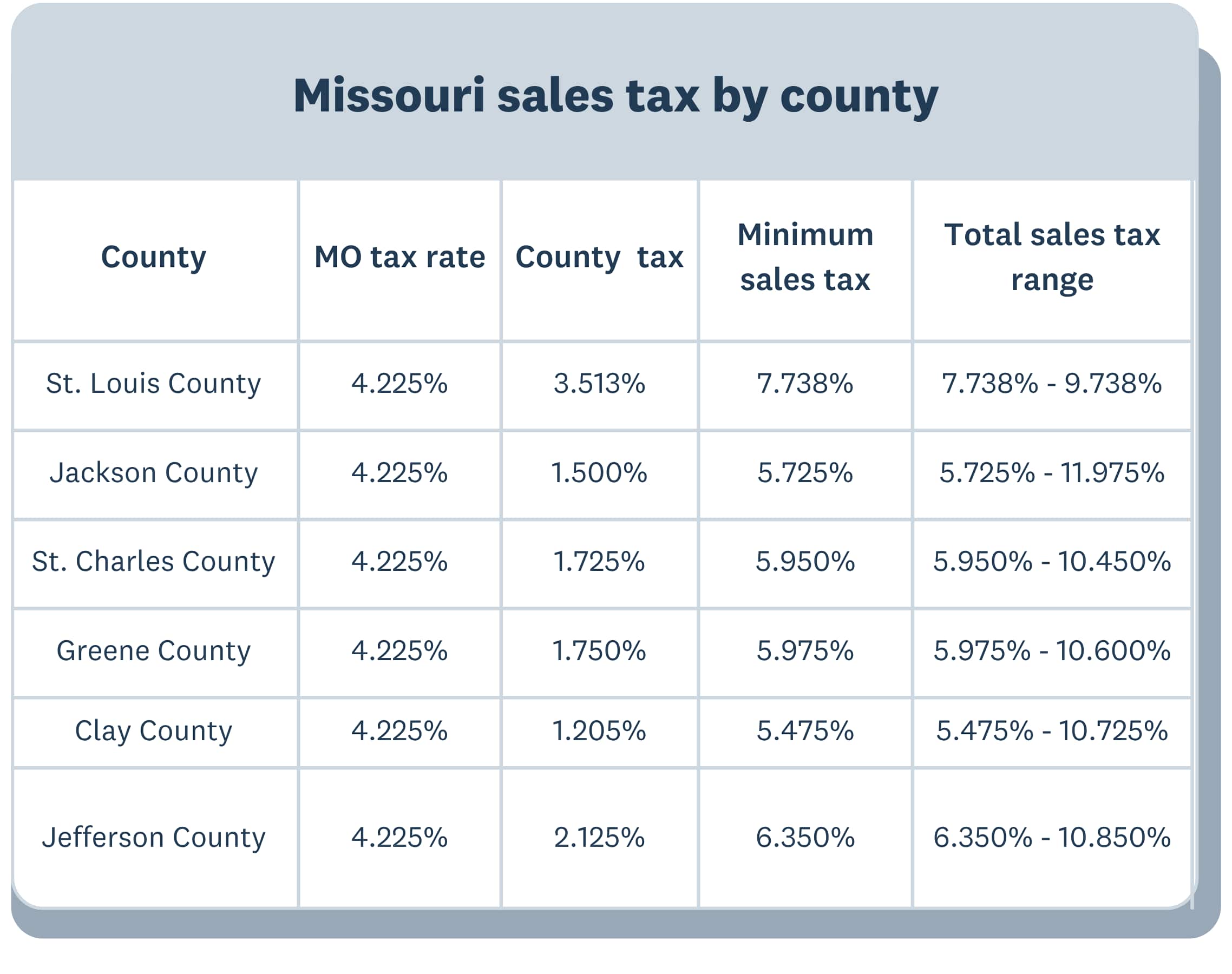
Some locations also fall within Community Improvement Districts (CIDs) or Neighborhood Improvement Districts (NIDs), which add extra sales tax on top of the standard combined rate. You can look up the exact rate for any Missouri address using the Missouri Department of Revenue's online tools.
How to calculate Missouri sales tax
Calculating Missouri sales tax is straightforward once you know the total combined rate for your selling location. The basic formula is: purchase price multiplied by the total tax rate equals the sales tax amount.
For example, say your business is in Savannah, Missouri, where the combined rate is 9.425%. That breaks down to 4.225% state, 2.2% county, 0.5% special district, and 2.5% city. On a $100 purchase, the sales tax would be $9.43, making the total $109.43.
Always use your full business address to determine the correct rate, not just your ZIP code. ZIP codes can span multiple tax jurisdictions, so relying on them alone can lead to collecting the wrong amount. For a quick rate check, visit the Missouri Department of Revenue's sales and use tax page.
What is subject to sales tax in Missouri?
Missouri taxes most tangible personal property at the full combined rate. Services, on the other hand, are mostly not taxed, with a few notable exceptions.
Here's how Missouri treats some common categories:
- Tangible goods: generally taxable at the full combined rate
- Most services: not taxed, except for fabrication labor, telecommunications, prepared food service, and admissions or entertainment
- Groceries: qualifying grocery items (those eligible for Supplemental Nutrition Assistance Program (SNAP) benefits) are taxed at a reduced state rate of 1.225%, while prepared food is taxed at the full rate
- Software as a Service (SaaS) and digital goods: not taxable in Missouri
- Clothing: taxable at the full rate, except during the annual Back-to-School sales tax holiday
Sales tax exemptions in Missouri
Missouri offers several exemptions and reduced rates that can affect what you collect from customers. If you sell any of these items, you'll need to apply the correct rate or exemption at the point of sale.
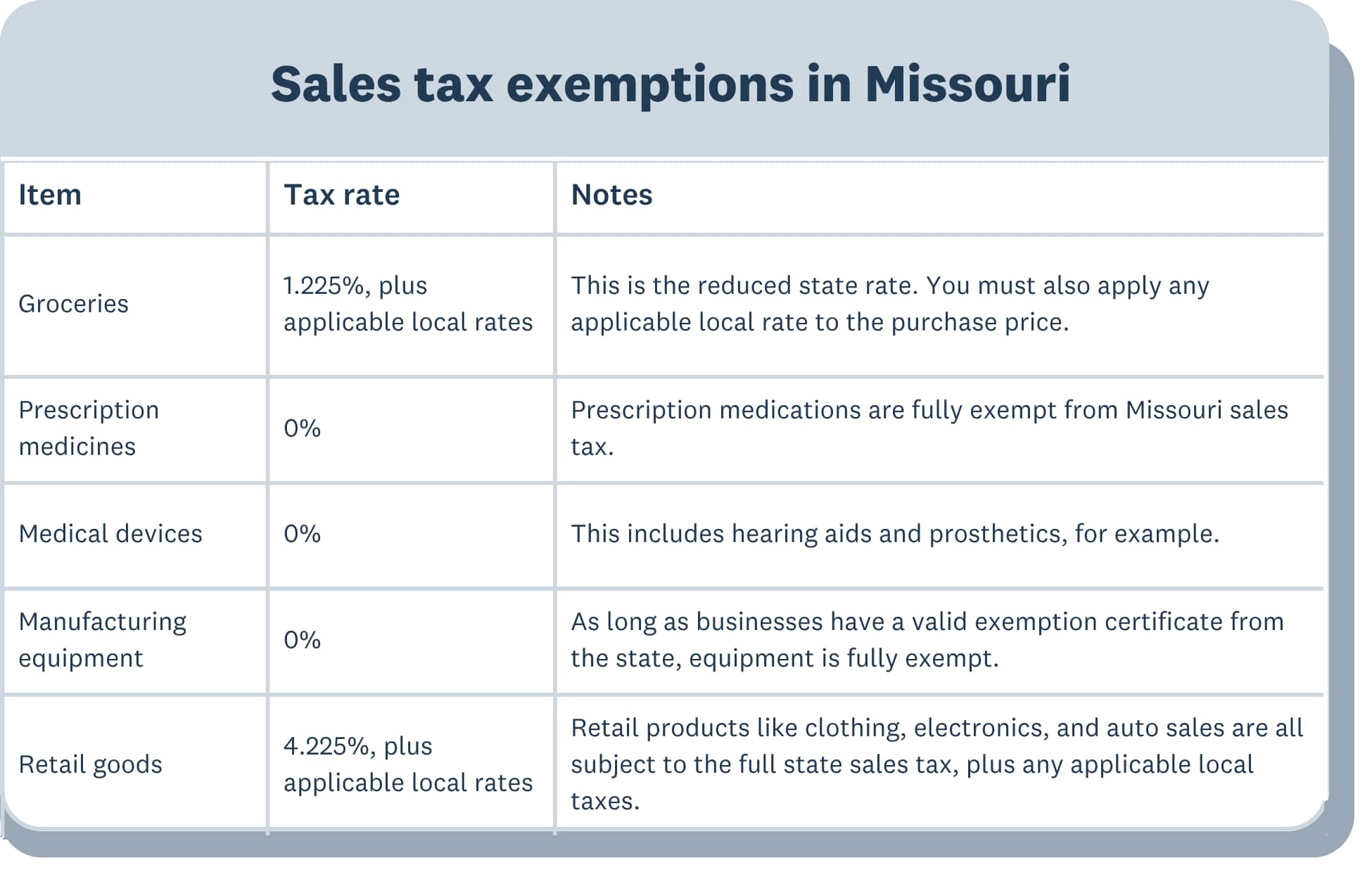
Common exemptions and reduced-rate items include:
- Qualifying groceries: taxed at a reduced state rate (see the taxable goods section above for the full breakdown)
- Prescription drugs: fully exempt from state and local sales tax
- Prescribed medical equipment: exempt when prescribed by a licensed professional
- Agricultural supplies: seeds, fertilizer, and farm equipment qualify for exemption
- Manufacturing equipment: exempt from state and local tax since January 1, 2023
- Broadband equipment: exempt from state and local tax since January 1, 2026
- Resale purchases: exempt when the buyer provides a completed Missouri Resale Exemption Certificate (Form 149)
Nonprofits with valid exemption certificates are also exempt from sales tax on qualifying purchases. For a full list of exemptions, visit the Missouri DOR sales and use tax exemptions guide.
Sales tax nexus in Missouri
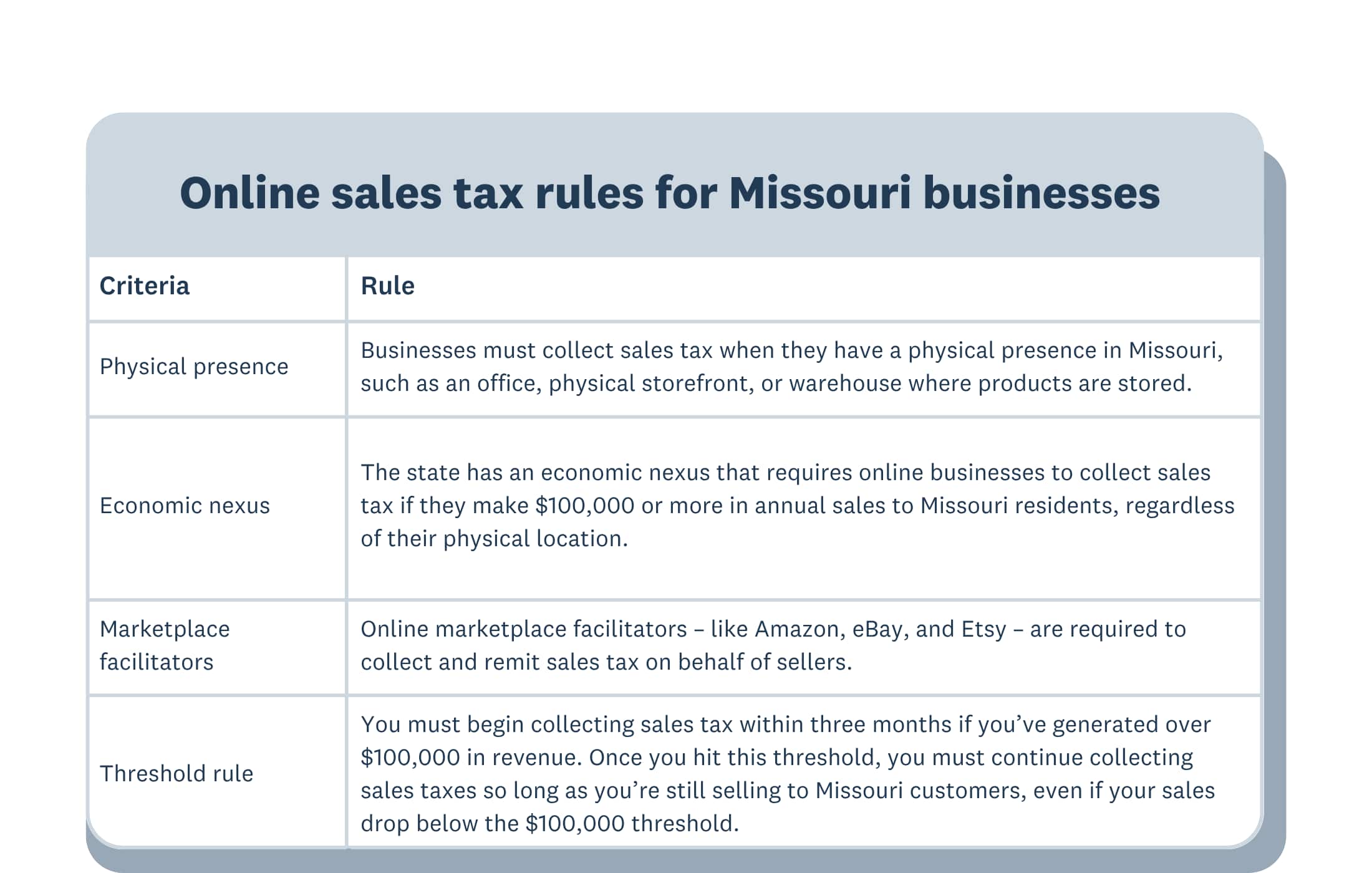
Before you're required to collect Missouri sales tax, your business needs to have nexus in the state. Nexus is the connection between your business and Missouri that triggers a tax collection obligation.
Physical nexus applies if you have a physical presence in Missouri, such as an office, warehouse, employees, inventory, or agents operating in the state.
Economic nexus applies to remote sellers. Under Senate Bill 153, effective January 1, 2023, any business with more than $100,000 in gross receipts from taxable sales into Missouri must register and collect sales tax. There is no separate transaction count threshold; it's based on revenue only. You must register within three months of exceeding the threshold.
Marketplace facilitators that exceed $100,000 in gross receipts are required to collect and remit sales tax on behalf of their sellers. Missouri uses origin-based sourcing for in-state sellers and destination-based sourcing for remote sellers. For more details, see the Missouri remote seller and marketplace facilitator FAQ on the Department of Revenue website.
How to register for a Missouri sales tax license
Once you've established nexus in Missouri, you need to register for a sales tax license before you start collecting tax. Missouri doesn't charge a registration fee.
You can register online through the MyTax Missouri portal or by submitting Form 2643 by mail. To complete your registration, you'll need your Federal Employer Identification Number (FEIN), business structure details, physical address, and estimated monthly sales.
After registration, you'll receive your Missouri sales tax license and can begin collecting tax on taxable sales.
Missouri sales tax filing and due dates
How often you file depends on the amount of state sales tax you collect each month. Missouri assigns your filing frequency based on your average monthly tax liability.
- Monthly filing: required if your state tax averages more than $500 per month
- Quarterly filing: required if your state tax averages $500 or less per month
- Annual filing: allowed if your state tax averages less than $200 per quarter
Returns are due on the last day of the month following the reporting period. If that day falls on a weekend or holiday, the deadline moves to the next business day. You must file a return for every period, even if you had zero sales.
Businesses with three or more locations are required to file electronically. Missouri also offers a 2% timely payment allowance on returns filed and paid by the due date. File your returns through the MyTax Missouri portal.
Missouri sales tax penalties
Missing a filing deadline or operating without a license can result in serious penalties. Missouri's Department of Revenue enforces compliance through financial penalties and, in severe cases, criminal prosecution.
Here's what you could face for noncompliance:
- Late filing: 5% of the tax due for each month the return is late, up to a maximum of 25%
- Operating without a license: $500 penalty for the first day, plus $100 for each additional day, up to $10,000
- Unpaid balances: interest accrues on any outstanding tax from the original due date
- Continued noncompliance: your sales tax license can be revoked until you resolve all outstanding obligations
- Willful evasion: civil penalties up to 100% of the tax owed, plus possible criminal prosecution
Use tax vs sales tax in Missouri
Missouri's use tax works as a companion to its sales tax. It applies when you purchase taxable items but don't pay Missouri sales tax at the time of the transaction. The use tax rate mirrors the sales tax rate: 4.225% at the state level, plus any applicable local rates.

Common situations where use tax applies include purchases from out-of-state retailers who don't collect Missouri sales tax, online purchases from sellers without a Missouri collection obligation, business equipment bought from out-of-state vendors, and wholesale items you take for personal or business use instead of reselling.
You can report and pay use tax by filing a Missouri use tax return with the Department of Revenue. Using sales tax software can help you track these obligations automatically.
Online sales tax rules for Missouri businesses
If your online business meets Missouri's $100,000 economic nexus threshold, here are the steps to stay compliant:
- Register for a Missouri sales tax license through the MyTax Missouri portal.
- Collect the full combined sales tax rate based on the buyer's delivery address.
- File sales tax returns on the schedule assigned by the Department of Revenue.
- Keep detailed records of all Missouri transactions, including tax collected and remitted.
Missouri sales tax holidays
Missouri offers two annual sales tax holidays when certain purchases are exempt from state and local sales tax. All retailers in the state are required to participate.
The Back-to-School sales tax holiday runs from August 7 through 9, 2026. During this period, the following items are exempt:
- Clothing: items priced under $100
- School supplies: items priced under $50
- Computers and peripherals: items priced under $1,500
- Software: items priced under $350
The Show-Me-Green sales tax holiday runs from April 19 through 25, 2026, covering Energy Star certified appliances priced under $1,500. For full details and qualifying items, visit the Missouri DOR sales tax holidays page.
Manage your Missouri sales tax with Xero
Keeping up with Missouri's layered sales tax rates, quarterly rate changes, and filing deadlines takes time you could spend running your business. Xero's cloud accounting software tracks your sales data in real time, organizes transactions by tax category, and keeps your records ready when it's time to file.
Whether you're filing monthly, quarterly, or annually, Xero gives you a clear picture of what you owe and when it's due. Try Xero today and get started today.
FAQs on Missouri sales tax
Here are answers to frequently asked questions about Missouri sales tax.
Do businesses in Missouri need a sales tax permit?
Yes, and your license must be displayed at your place of business. Register at no cost through the MyTax Missouri portal before your first taxable sale.
How often do businesses need to file sales tax returns in Missouri?
Missouri assigns your schedule based on how much state tax you collect, and you can check your current frequency through the MyTax Missouri portal. If your sales volume changes significantly, the Department of Revenue may reassign you to a different filing schedule at the start of the next period.
Is labor subject to sales tax in Missouri?
Most labor in Missouri is not taxable, but fabrication labor (creating a new product for a customer) is an exception. Repair labor is generally exempt as long as it's listed separately on the invoice.
Does Missouri charge sales tax on vehicle purchases?
Yes. Motor vehicle purchases in Missouri are subject to a state sales tax of 4.225% plus applicable local taxes. The tax is typically collected by the Department of Revenue when you title and register the vehicle, not at the dealership.
Are digital goods and software subject to sales tax in Missouri?
No. Prewritten software on physical media (like a CD or USB) is taxable, but digitally delivered software, SaaS subscriptions, and other digital goods are not taxable under current Missouri law.
How does Missouri's sales tax apply to shipping and delivery charges?
Shipping and delivery charges are generally not taxable in Missouri when they're separately stated on the invoice. If shipping is bundled into the price of the product without being listed separately, it becomes part of the taxable sale price.
Disclaimer
Xero does not provide accounting, tax, business or legal advice. This guide has been provided for information purposes only. You should consult your own professional advisors for advice directly relating to your business or before taking action in relation to any of the content provided.