Margin of safety formula: calculate it step by step
Learn how the margin of safety formula helps you measure risk and plan a stronger financial buffer.
Written by Shaun Quarton—Accounting & Finance Content Writer and Growth Marketer. Read Shaun's full bio
Written by Shaun Quarton—Accounting & Finance Content Writer and Growth Marketer. Read Shaun's full bio
Published Tuesday 21 April 2026
Table of contents
Key takeaways
- Calculate your margin of safety by subtracting break-even sales from current sales, then dividing by current sales to get a percentage that shows how far sales can drop before your business starts losing money.
- Aim for a margin of safety of 20% or more as a general benchmark for financial health, and take immediate action on pricing, costs, or sales strategy if your margin falls below 10%.
- Use your margin of safety to guide key business decisions, including setting realistic sales targets, adjusting pricing, controlling costs, and evaluating whether new products are worth launching.
- Recalculate your margin of safety monthly or quarterly, and any time a significant change occurs in your business, such as a price increase, a new major expense, or a shift in sales trends.
Key takeaways
- Calculate your margin of safety by subtracting break-even sales from current sales. Then divide by current sales to get a percentage showing how far sales can drop before losses begin.
- A higher margin of safety indicates lower risk, while a lower margin means you're operating closer to break-even with less flexibility to handle market changes or cost increases.
- Use your margin of safety percentage to make informed decisions about pricing strategies, cost control measures, and sales targets. It helps you understand exactly how much room you have before reaching break-even.
- Monitor your margin of safety regularly through monthly or quarterly calculations, especially when experiencing significant business changes like price adjustments, new expenses, or shifting sales patterns.
Understanding this metric starts with knowing what it means.
What is the margin of safety?
Margin of safety is the percentage by which your current sales exceed your break-even point. It measures how far sales can drop before your business starts losing money.
This financial buffer protects against demand drops or cost increases. A wider margin means better protection for your business.
The importance of the margin of safety for your small business
Margin of safety measures your business's financial risk tolerance. It shows exactly how much sales can drop before you start losing money.
Your margin of safety level determines your risk exposure:
- High margin of safety: lower risk of falling below break-even if sales decline, giving your business more flexibility to handle market shifts
- Low margin of safety: higher risk, because you are operating close to break-even with less flexibility
Consider how an external shock, like a jump in supplier prices, would affect your business. This increase in variable costs pushes up your break-even point, eating into your margin of safety.
A shrinking margin leaves your business exposed to further cost increases or falling sales. Your margin of safety also supports smarter financial decisions across your business.
Now let's look at how to calculate this important metric.
What is the margin of safety formula?
The margin of safety formula calculates the percentage buffer between your current sales and break-even point:
(Current sales - break-even sales) ÷ current sales = Margin of safety
Each component means:
- Current sales: the total revenue from selling goods and services over a specific period
- Break-even sales: the exact revenue amount needed to cover all fixed and variable costs, where your business makes zero profit or loss
Quick example: A business has current sales of $50,000 and needs $30,000 in sales to break even.
Margin of safety = ($50,000 – $30,000) / $50,000 = 0.4 (40%)
This means sales could drop by 40% before the business hits its break-even point. Any further sales drop would result in a loss.
Follow these three steps to determine your business's safety margin.
How to calculate margin of safety
Calculate your margin of safety in three steps to find the exact percentage buffer protecting your business from losses.
1. Find your current sales
Start by identifying your current sales using either actual figures or forecasted amounts. You can find current sales figures in your existing sales tools, while forecasting takes some analysis and planning.
- Historical data: analyze past sales trends and seasonal patterns from your POS system, eCommerce platform, or accounting software like Xero
- Market research: study your target market, industry trends, and competitor performance
- Qualitative forecasting: gather insights from your sales team or industry experts
- Quantitative forecasting: use statistical methods to analyze historical and market data for accurate predictions
The best approach depends on your business type and the data available to you.
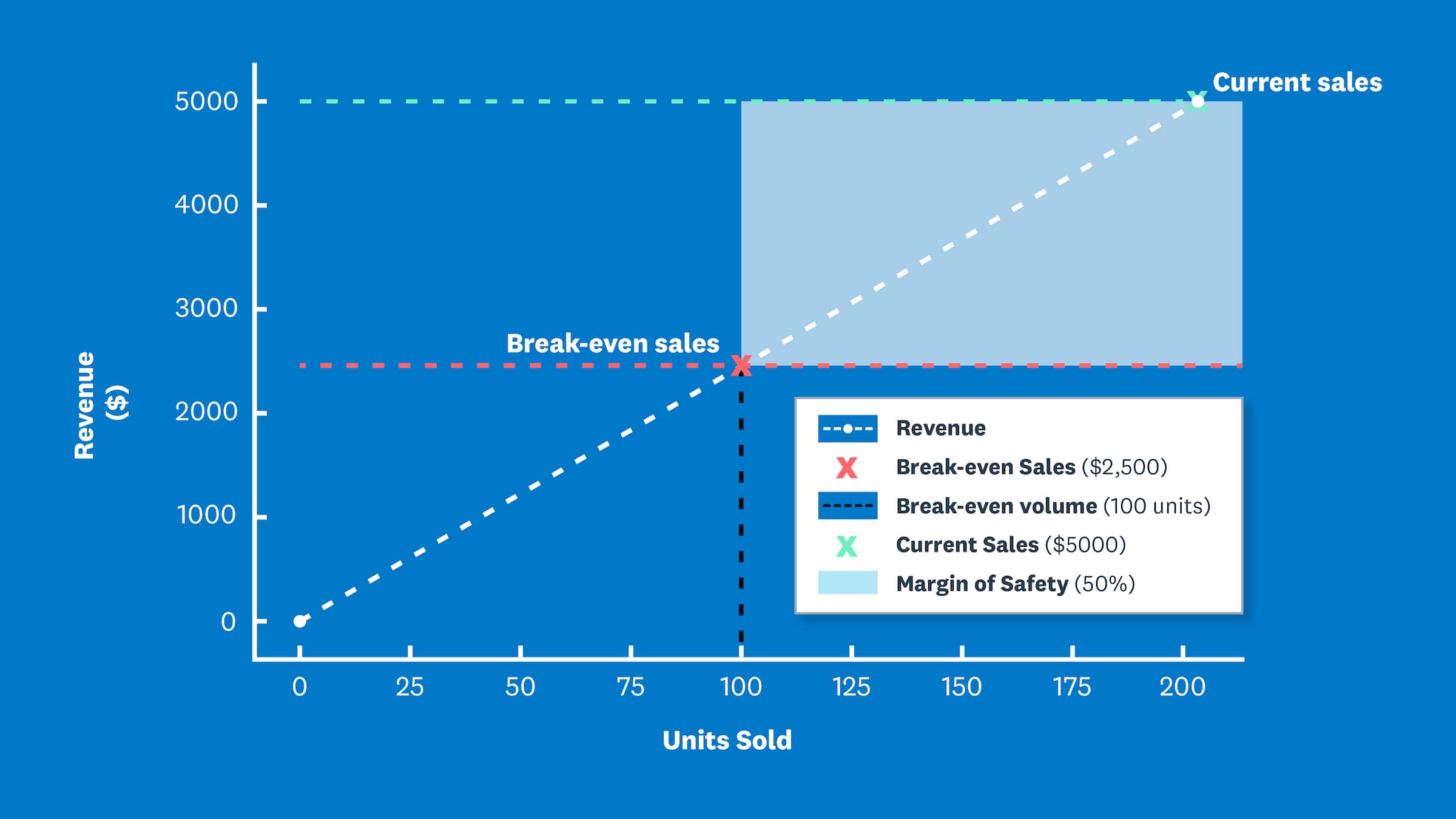
Example: A craft business uses a point-of-sale (POS) system to track monthly sales. Last month, sales were $5,000. This figure carries through to the remaining steps of the calculation.
Next, you need to determine your break-even point.
2. Calculate your break-even sales revenue point
Break-even sales revenue is the exact dollar amount needed to cover all business costs. Use this formula to find yours:
Fixed costs ÷ ((Sales price – Variable cost) ÷ Sales price) = Break-even sales
The formula components include:
- Fixed costs: expenses that remain constant regardless of sales volume, such as salaries, rent, and insurance
- Variable costs: expenses that change with sales volume, such as raw materials, sales commissions, and shipping
Learn more about variable costs and how they differ from fixed costs, or ask your accountant to help you distinguish between them.
For the craft business example:
- fixed costs of $2,000
- variable costs of $5 per unit
- sales price of $25 per unit
Calculation: 2,000 ÷ ((25 – 5) ÷ 25) = 2,000 ÷ 0.8 = $2,500
With a sales price of $25, you need revenue of $2,500 (100 sales units) to break even.
Now you can apply the formula to find your margin of safety.
3. Apply the margin of safety formula
Apply the margin of safety formula to calculate your financial buffer percentage:
(Current sales – Break-even sales) ÷ Current sales = Margin of safety
The result shows the exact percentage your sales can drop before your business starts losing money.
Apply the formula to the craft business example, where current sales are $5,000 and break-even sales are $2,500:
($5,000 – $2,500) ÷ $5,000 = 0.5 = 50%
The craft business has a 50% margin of safety, meaning sales could fall by half before reaching the break-even point.
Understanding what constitutes a good margin helps you assess your business health.
What is a good margin of safety percentage?
A higher margin of safety is always better because it means your business has a larger cushion to absorb unexpected challenges.
Target benchmark: Many businesses aim for a margin of safety of 20% or more. A percentage in this range generally indicates a healthy buffer between your sales and your break-even point. However, what's considered "good" can vary by industry and business model.
Warning threshold: A margin of safety below 10% means you have very little room for sales to fall before you start making a loss. If your margin is low, it might be time to look at your pricing, costs, or sales strategy.
This metric provides valuable insights across multiple areas of your business.
How the margin of safety supports your business decisions
Margin of safety supports critical business decisions:
- Performance targets: calculate clear break-even points to set achievable sales targets that maintain profitability
- Pricing strategy: monitor shrinking margins to adjust pricing so each sale covers costs adequately
- Cost control: identify when low margins signal the need to reduce expenses and protect your financial buffer
- Product evaluation: assess how new product costs impact your margin of safety before launching
Combining margin of safety with other financial metrics gives you a more complete picture.
Other metrics work with the margin of safety in your accounting analysis
Margin of safety works best when combined with other financial metrics for comprehensive business insights.
Cost-volume-profit (CVP) analysis paired with margin of safety gives you a complete view of profitability and risk. Together, these metrics help you plan more effectively than using margin of safety alone.
The right tools can simplify these calculations and save you valuable time.
Master your margin of safety with Xero
Manually calculating margin of safety wastes time tracking figures, updating spreadsheets, and piecing together reports.
Xero can help you access financial data needed to calculate metrics such as break-even sales and margin of safety, depending on how you configure reports and analyze data. You can calculate faster and make confident decisions without manual spreadsheet work.
Get 90% off for 6 months and streamline how you analyze finances today.
Common questions about this metric are answered below.
FAQs on margin of safety
Still have questions about margin of safety? Here are answers to common concerns.
How often should I calculate my margin of safety?
Calculate your margin of safety monthly or quarterly as a regular practice. Recalculate anytime there's a significant change in your business, like a price increase, a new major expense, or a shift in sales trends.
What if my margin of safety is negative?
A negative margin of safety means your current sales are below your break-even point, and your business is operating at a loss. Take immediate action by finding ways to increase sales or reduce costs.
Can my margin of safety be too high?
A high margin of safety signals financial health, but an extremely high margin could suggest you're being too conservative. It might indicate missed opportunities for growth, such as reinvesting profits into marketing, product development, or expanding your team.
How does seasonality affect my margin of safety?
For seasonal businesses, margin of safety naturally fluctuates, running higher during peak seasons and lower during off-seasons. Calculate it for different periods to understand your financial risk throughout the year and plan accordingly for slower months.
Disclaimer
Xero does not provide accounting, tax, business or legal advice. This guide has been provided for information purposes only. You should consult your own professional advisors for advice directly relating to your business or before taking action in relation to any of the content provided.
Get 90% off for 6 months
Get 90% off for 6 months on any Xero plan.