Break-even point formula: how to calculate it
Learn the break-even point formulas and how to use them to set smarter sales targets for your business.
November 2023 | Published by Xero
Published Thursday 23 July 2026
Table of contents
Key takeaways
- The break-even point is the level of sales where your total revenue equals your total costs, meaning your business is no longer operating at a loss. Knowing this number helps you set realistic sales targets and make smarter pricing decisions.
- There are 2 main break-even formulas: the revenue formula tells you the dollar amount of sales you need, while the volume formula tells you the number of units you need to sell. Both rely on your fixed costs, variable costs, and selling price.
- Contribution margin, which is the selling price minus variable costs per unit, is the key building block of every break-even calculation. A higher contribution margin means you reach profitability with fewer sales.
- Break-even analysis isn't a 1-time exercise. You can use it to evaluate new product ideas, prepare for investor conversations, stress-test pricing changes, and set monthly sales goals that keep your business on track.
What is the break-even point?
The break-even point (BEP) is the moment when your total revenue exactly covers your total costs. At this point, your business isn't making a profit, but it's no longer losing money either.
Think of it as a financial milestone. Every dollar you earn below the break-even point goes toward covering costs. Every dollar you earn above it is profit. For small business owners, knowing your BEP gives you a clear target to aim for each month, quarter, or year.
Break-even analysis is the process of calculating this point using your costs and pricing. It's one of the most practical tools in business planning because it turns abstract financial data into a specific, actionable number that directly ties into your profitability.
Why break-even analysis matters
Understanding your break-even point gives you a foundation for some of the most important decisions in your business. Without it, you're setting prices, hiring staff, and planning growth without knowing the minimum sales you need to stay afloat.
Here are some of the ways break-even analysis helps your business:
- Smarter pricing: you can see exactly how a price change affects the number of sales you need to cover costs
- Realistic sales targets: instead of guessing, you can set monthly or quarterly goals based on actual cost data
- Investor readiness: lenders and investors want to know when your business will become profitable, and break-even analysis gives them a clear answer
- Cost awareness: the process forces you to categorize and examine every cost in your business, which often reveals opportunities to cut spending
- Risk assessment: before launching a new product or entering a new market, you can calculate whether projected sales will cover the added costs
Key components of a break-even calculation
Before you can calculate your break-even point, you need to understand the 4 building blocks of the formula. Each one plays a specific role in the calculation.
Fixed costs are expenses that stay the same regardless of how much you sell. Rent, insurance premiums, loan repayments, and salaried wages are common examples. These costs don't change whether you sell 10 units or 10,000.
Variable costs are expenses that rise or fall with your sales volume. Raw materials, packaging, shipping fees, and hourly contractor wages are typical variable costs. The more you produce or sell, the higher these costs go.
Selling price is the amount you charge customers for each unit of your product or service. If you sell multiple products at different prices, you can use a weighted average for a combined break-even calculation.
Contribution margin is the difference between your selling price and your variable cost per unit. It represents how much each sale contributes toward covering your fixed costs. Once your total contribution margin equals your total fixed costs, you've reached the break-even point.
Break-even point formulas
There are 2 main break-even formulas, plus a supporting formula for contribution margin. Each one answers a slightly different question about your business.
Revenue break-even point formula
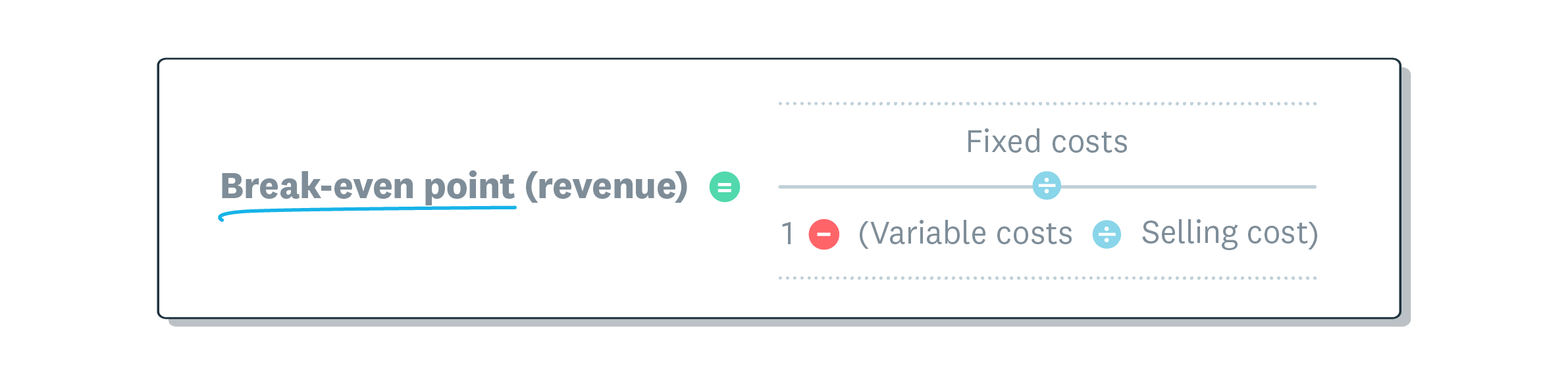
The revenue formula tells you the total dollar amount of sales you need to cover all your costs. It's often the easier formula to use because it gives you a single monetary target.
Break-even point (revenue) = Fixed costs / (1 - (Variable costs per unit / Selling price per unit))
The result is the minimum revenue your business needs to generate before it starts earning a profit. If your monthly fixed costs are $6,000, your variable cost per unit is $2, and your selling price is $7, your revenue break-even point would be $8,400.
Volume break-even point formula
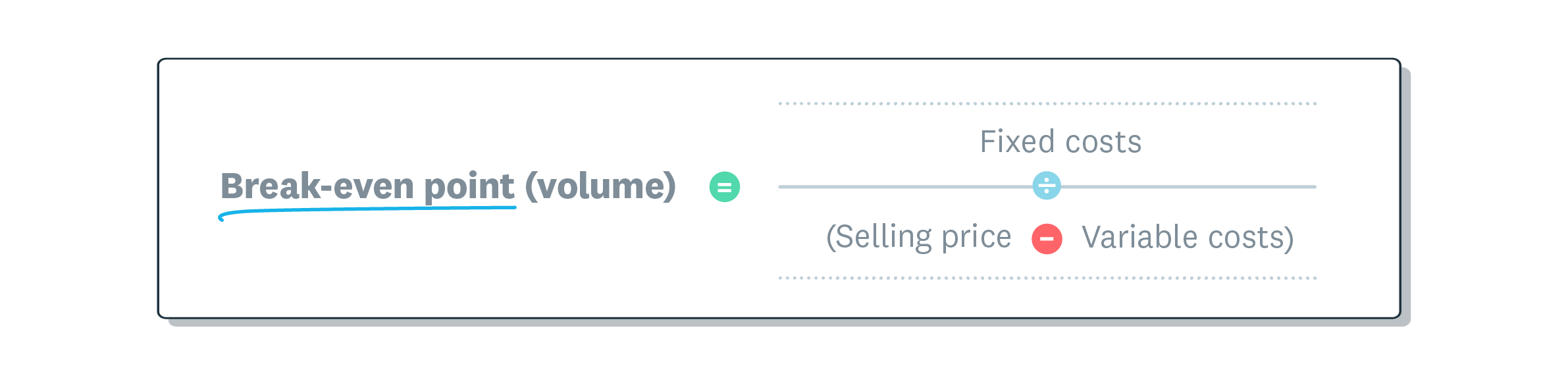
The volume formula tells you the number of units you need to sell to cover your costs. It's especially useful for product-based businesses where you can track individual sales.
Break-even point (units) = Fixed costs / (Selling price per unit - Variable costs per unit)
This formula works well when you sell a single product or service at a consistent price. If you sell multiple products at different prices, you'll need to calculate a weighted average or run separate calculations for each product line.
Contribution margin formula
Contribution margin is a key input in both break-even formulas. It tells you how much each unit sold contributes toward covering your fixed costs.
Contribution margin per unit = Selling price per unit - Variable costs per unit
You can also express contribution margin as a ratio, which is useful for the revenue break-even formula. Learn more about the contribution margin ratio and how it supports pricing decisions.
Contribution margin ratio = Contribution margin per unit / Selling price per unit
A higher contribution margin means each sale covers more of your fixed costs, so you reach the break-even point faster. If your contribution margin is low, you'll need a higher volume of sales to become profitable.
How to calculate the break-even point step by step
Calculating your break-even point doesn't require advanced math. Follow these 5 steps to find your number.
1. Add up your fixed costs
List every expense that stays the same each month, regardless of sales. Include rent, insurance, loan payments, salaried wages, software subscriptions, and any other recurring costs. Add them together to get your total monthly fixed costs.
2. Determine your variable cost per unit
Identify the costs that change with each sale. For a product business, this might include raw materials, packaging, and shipping. For a service business, it could be hourly contractor rates or per-project supplies. Divide your total variable costs by the number of units to get the cost per unit.
3. Set your selling price per unit
Confirm the price you charge for each unit of your product or service. If your prices vary, use a weighted average based on your typical sales mix.
4. Calculate your contribution margin
Subtract your variable cost per unit from your selling price per unit. This is your contribution margin, the amount each sale puts toward covering your fixed costs.
5. Apply the break-even formula
For the volume break-even point, divide your total fixed costs by the contribution margin per unit. For the revenue break-even point, divide your total fixed costs by the contribution margin ratio. The result is your break-even target.
Break-even calculation examples
Seeing the formulas in action makes them easier to understand. Here are 2 worked examples for different types of businesses.
Break-even example for a product-based business
A kombucha brewery has fixed monthly costs of $6,000 for rent, utilities, insurance, and advertising. Their variable costs are $2 per bottle for packaging, ingredients, and labor. They sell their product for $7 per bottle.
Revenue break-even point:
Revenue required = Fixed costs / (1 - (Variable costs / Selling price))
= $6,000 / (1 - ($2 / $7))
= $6,000 / (1 - 0.286)
= $6,000 / 0.714
= $8,403
To break even, the kombucha brewery needs to bring in $8,403 in monthly revenue.
Volume break-even point:
Volume required = Fixed costs / (Selling price - Variable costs)
= $6,000 / ($7 - $2)
= $6,000 / $5
= 1,200
To break even, the kombucha brewery needs to sell 1,200 bottles per month.
Break-even example for a service-based business
A graphic designer has fixed monthly costs of $2,700 for utilities, hardware leases, software subscriptions, and advertising. Their variable costs are $35 per hour to hire a contractor. Clients are charged $75 per hour.
Revenue break-even point:
Revenue required = Fixed costs / (1 - (Variable costs / Selling price))
= $2,700 / (1 - ($35 / $75))
= $2,700 / (1 - 0.467)
= $2,700 / 0.533
= $5,066
To break even, the graphic designer needs to earn $5,066 in monthly revenue.
Volume break-even point:
Volume required = Fixed costs / (Selling price - Variable costs)
= $2,700 / ($75 - $35)
= $2,700 / $40
= 67.5
To break even, the graphic designer needs to bill 67.5 hours per month. In practice, that means billing at least 68 hours to start earning a profit.
How to use break-even analysis in your business
Your break-even point isn't just a number to calculate once and forget. It's a planning tool you can return to whenever your business faces a financial decision.
Here are some practical ways to put break-even analysis to work:
- Set prices with confidence: run the formula with different price points to see how each one affects the number of sales you need. This helps you find a price that covers costs without driving away customers.
- Create monthly sales targets: divide your annual break-even point by 12 to set a minimum monthly revenue goal. Share this target with your sales team so everyone knows the baseline.
- Evaluate new products or services: before investing in a new offering, estimate its fixed costs, variable costs, and expected selling price. If the break-even point is unrealistically high, you may want to rethink the idea.
- Prepare for investor meetings: showing potential investors your break-even analysis demonstrates that you understand your cost structure and have a clear path to profitability.
- Stress-test your business: recalculate your break-even point if a major cost changes, such as a rent increase or a supplier raising prices. This tells you how much additional revenue you'll need to stay profitable. You can also calculate your margin of safety to see how far sales can drop before you hit the break-even point.
Manage your finances with confidence
Calculating your break-even point is a great first step toward understanding your business finances. But keeping track of costs, revenue, and profitability on an ongoing basis is just as important.
Xero's cloud accounting software helps you monitor your income and expenses in real time, so you always know where your business stands. With automated bank feeds, invoicing, and financial reports, you can spend less time on bookkeeping and more time growing your business. Get one month free.
FAQs on break-even point
Here are answers to some common questions about break-even point calculations.
What is the difference between break-even point in units and break-even point in revenue?
Break-even point in units tells you how many individual products or service hours you need to sell. Break-even point in revenue tells you the total dollar amount of sales required. Both use the same underlying data but answer different questions.
What is the contribution margin, and why does it matter?
Contribution margin is the amount left over from each sale after subtracting variable costs. It matters because it's the portion of each sale that goes toward paying off your fixed costs, and it's the core input in every break-even formula.
How do you calculate the break-even point for a business with multiple products?
You can calculate a weighted average selling price and weighted average variable cost based on your typical sales mix. Then plug those weighted averages into the standard break-even formula to get a combined break-even point.
What are the limitations of break-even analysis?
Break-even analysis assumes that costs and prices stay constant, which rarely happens in practice. It also doesn't account for factors like market demand, competition, or seasonal changes in sales volume.
How can break-even analysis help with pricing decisions?
By running the formula at different price points, you can see exactly how a price increase or decrease changes the number of sales needed to break even. This helps you find a price that balances profitability with customer demand.
Handy resources
Advisor directory
You can search for experts in our advisor directory
How to increase revenue
Find out how businesses grow their sales income.
Stay on top of your numbers with Xero
Accounting software tracks your performance while you sleep.
Disclaimer
This glossary is for small business owners. The definitions are written with their requirements in mind. More detailed definitions can be found in accounting textbooks or from an accounting professional. Xero does not provide accounting, tax, business or legal advice.