California sales tax: rates, nexus, and how to file
Learn California sales tax rates, key rules, and how to stay compliant with confidence.
Get the comprehensive guide
Learn the ins and outs of California sales tax, and how to stay compliant
Written by Kari Brummond—Content Writer, Accountant, IRS Enrolled Agent. Read Kari's full bio
Published Thursday 16 April 2026
Table of contents
Key takeaways
- Recognize whether you need to collect California sales tax by checking if you have a physical presence in the state or exceed $500,000 in yearly California sales, then register for a free seller's permit through the CDTFA website before making any taxable sales.
- Calculate the correct sales tax rate for your location by combining California's 7.25% base rate with any local district taxes using the CDTFA lookup tool, since rates can exceed 10% in some cities.
- File your sales tax returns on the schedule the CDTFA assigns you (monthly, quarterly, or annually based on how much tax you collect) and pay on time to avoid a 10% penalty plus daily interest on unpaid amounts.
- Understand which goods and services are taxable before you start selling, since most physical goods are taxable while unprepared groceries, prescription medications, professional services, and most digital goods are exempt.
What is California sales tax?
California sales tax is a consumption tax that sellers collect from buyers on retail sales of tangible goods and some services. It serves as a critical revenue source, making up an average of about one-third of states' total tax collections nationwide. Sellers collect the tax at the point of sale and remit it to the state.
The process works like this:
- Sellers collect: Add sales tax to the purchase price at checkout
- Buyers pay: The tax amount as part of their total purchase
- State receives: Sellers remit collected taxes to the CDTFA
California sales tax has two components: a statewide base rate and local district taxes that vary by location. The California Department of Tax and Fee Administration (CDTFA) oversees collection and enforcement.
California sales tax rates by county
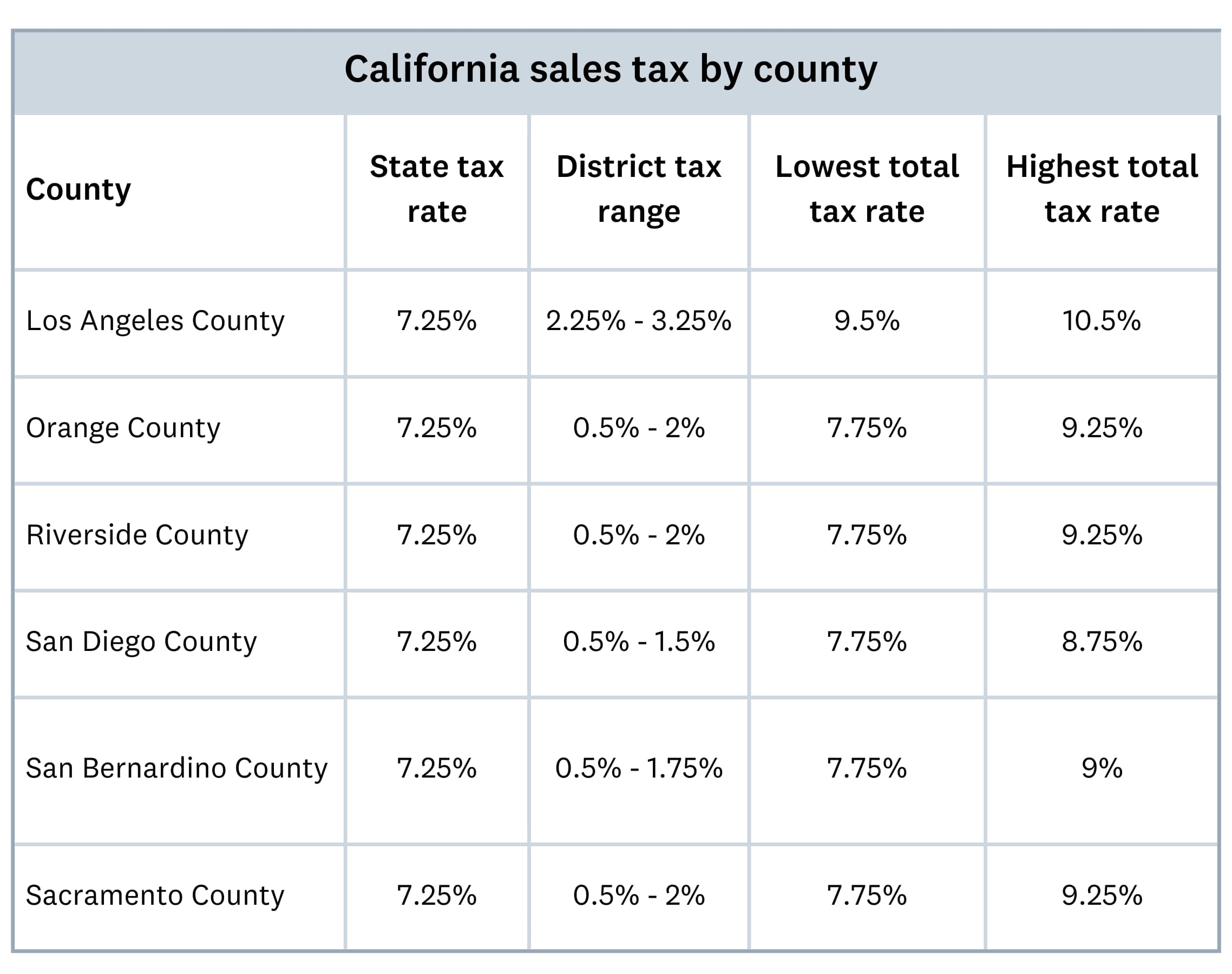
California's minimum sales tax rate is 7.25%, but most locations charge more. Local district taxes can push total rates above 10% in some cities.
The rate includes:
- Base statewide rate: 7.25% minimum (6% state + 1.25% local)
- Additional district taxes: 0.1% to 2% in some areas
- Maximum possible rate: over 10% in certain jurisdictions
You must collect the combined rate for your location and report both state and local portions to the CDTFA.
Charging the correct rate helps you avoid:
- Undercollection penalties: Fines and interest on unpaid amounts
- Audit risks: Increased scrutiny from tax authorities
- Customer disputes: Refund requests from overcharging
The CDTFA provides an up-to-date breakdown of sales tax rates and fees by county and city. Use the official lookup tool to find the local rate for your business location.
How to calculate sales tax in California
California sales tax calculation formula: tax rate × item price = sales tax amount. Add this to your product price for the total customer cost.
Follow these steps to calculate it:
- Convert the rate to a decimal: Divide by 100 (7.25% ÷ 100 = 0.0725).
- Multiply by the item price: Calculate 0.0725 × $15.95 = $1.16 sales tax.
- Add to the item price: Calculate $15.95 + $1.16 = $17.11 total cost.
For accurate local rates, use the CDTFA lookup tool or automated tax calculation software.
What's subject to California sales tax
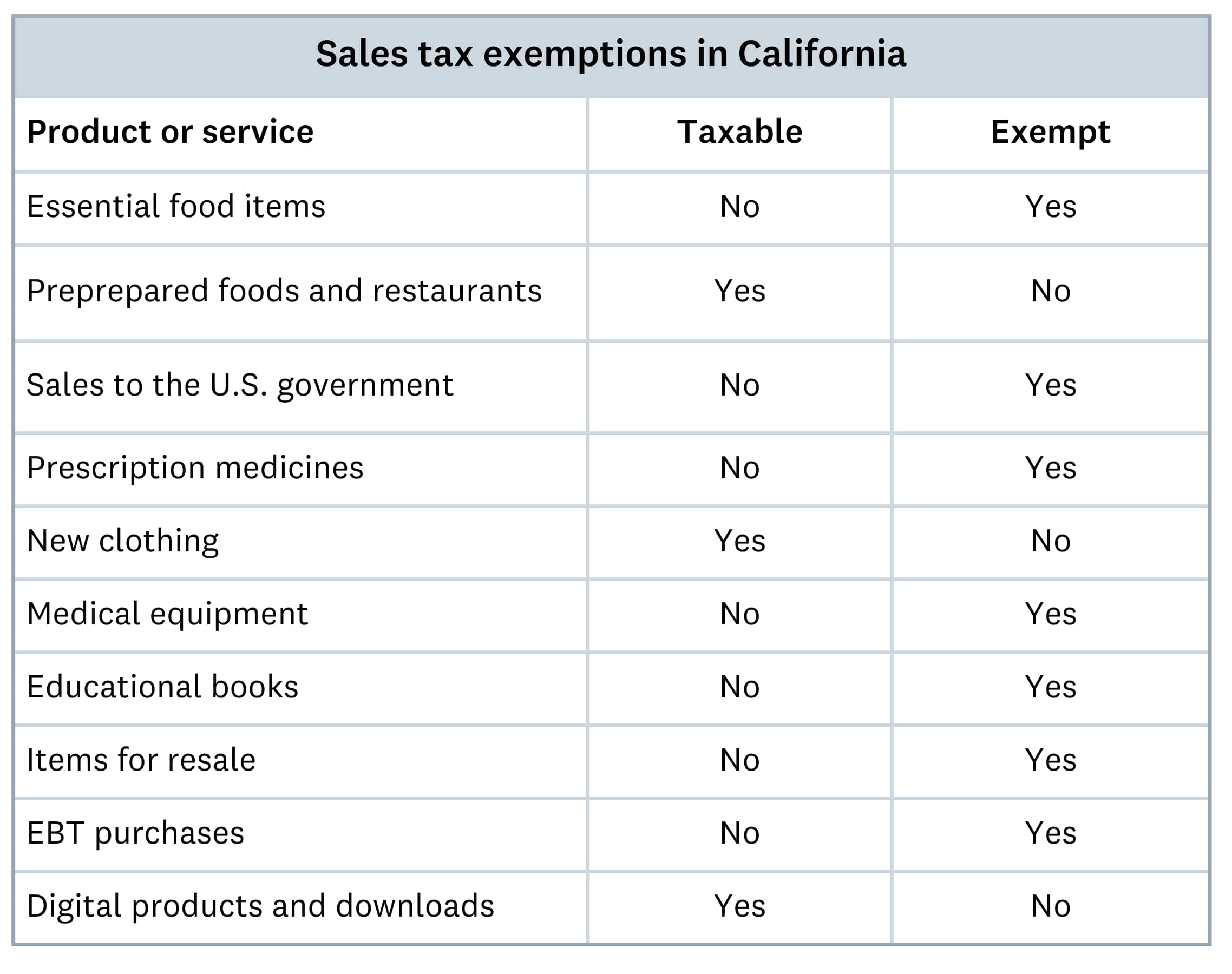
California taxes most retail sales of tangible personal property. If you sell physical goods, you likely need to collect sales tax.
Taxable items include:
- Retail merchandise: Clothing, electronics, furniture, appliances
- Prepared food: Restaurant meals, hot prepared foods, food sold with utensils
- Prepackaged software: Downloaded or physical media
- Fabrication labor: Work that creates or modifies tangible goods (car repairs, custom manufacturing)
Some items have special rules:
- Groceries: Most unprepared food is exempt
- Mixed transactions: When selling goods and services together, tax applies to the tangible goods portion
- Digital products: California doesn't tax most purely digital goods (eBooks, streaming)
Check the California Tax Service Center for a complete list of taxable and exempt items.
Sales tax exemptions in California
Sales tax exemptions are categories of products and services you don't need to charge tax on. California exempts certain items while taxing most tangible goods.
Common exemptions:
- Unprepared food: Most grocery items
- Prescription medications: Drugs prescribed by a doctor
- Professional services: Consulting, legal advice, accounting
- Government services: Services provided by government agencies
Find a full list of nontaxable items on the California Tax Service Center website.
Who needs to collect California sales tax
You need to collect California sales tax if you have nexus in the state. Nexus means a significant connection that creates a tax obligation. There are two types: physical nexus and economic nexus.
Physical nexus
Physical nexus exists when your business has a tangible presence in California. This includes:
- Retail locations: Stores, offices, or showrooms
- Warehouses: Inventory storage facilities
- Employees: Staff working in California
- Property: Equipment or other business assets in the state
Economic nexus
Economic nexus applies to remote sellers without a physical presence. This follows the landmark 2018 U.S. Supreme Court decision, South Dakota v. Wayfair. The ruling held that states could require out-of-state businesses to collect sales taxes even without a physical store or warehouse.
You have economic nexus if you exceed $500,000 in California sales during the current or prior calendar year.
Once you reach this threshold, you must register for a seller's permit and begin collecting sales tax. Marketplace facilitators like Amazon and eBay collect and remit tax on sales made through their platforms. This drives a massive portion of revenue attributable to marketplace sales, totaling around $9.5 billion across 20 surveyed states.
How to register for a California sales tax permit
A California seller's permit allows you to collect sales tax from customers. You need one before making taxable sales in the state.
You can register for free through the CDTFA website, though you may need to provide a security deposit. This applies to all business types, including sole proprietors, corporations, and LLCs.
You'll need to provide:
- Social security number or ITIN: For identity verification
- Bank account details: For tax payments and refunds
- Projected monthly sales: To determine your filing frequency
- Business location information: To calculate your local tax rate
California sales tax filing requirements
Your filing frequency depends on how much sales tax you collect. The CDTFA assigns your schedule based on expected sales volume.
The thresholds are:
- Monthly filing: Collect more than $1,000 per month in sales tax.
- Quarterly filing: Collect between $601 and $1,000 per month.
- Annual filing: Collect $600 or less per year.
File and pay on time to avoid a 10% penalty plus interest on unpaid tax. Keep detailed records of all sales transactions for accurate filing.
Online sales tax rules for California businesses
California requires online sellers to collect sales tax if they have nexus in the state. This applies whether you're based in California or selling remotely. All 45 states with a statewide sales tax have now adopted requirements governing sales tax collection by remote sellers based on economic presence.
You must collect California sales tax if you:
- Operate a physical location in California, such as a store, warehouse, or office
- Exceed $500,000 in yearly sales to California customers
- Sell through marketplace facilitators like Amazon, eBay, or Etsy (which collect and remit tax on your behalf)
Follow these steps to stay compliant as an online seller.
Compliance steps for online sellers
Following these steps helps you avoid penalties and stay current with California tax requirements.
- Register for a seller's permit through the CDTFA website.
- Collect the correct combined rate using the CDTFA lookup tool (7.25% base plus local district taxes).
- File and pay on your assigned schedule (monthly, quarterly, or annually).
- Keep detailed transaction records for potential audits.
Use tax vs. sales tax in California
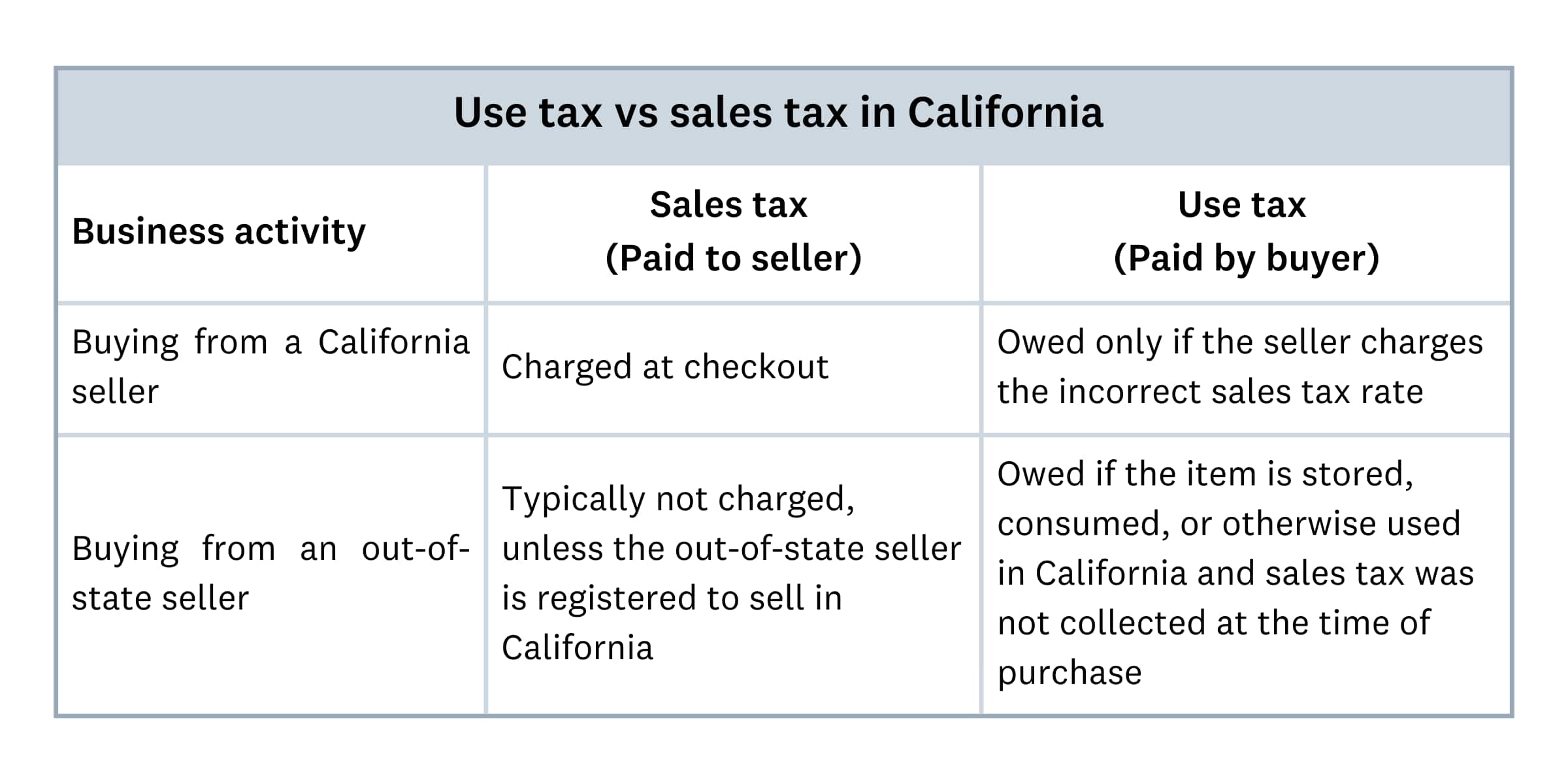
Use tax is what buyers owe when sales tax wasn't collected at purchase. Sales tax is what sellers collect and remit to the state. Both use the same rate.
Key differences:
- Sales tax: The seller collects and pays to the CDTFA
- Use tax: The buyer pays directly to the CDTFA
- Rate: Both tax types use the same rate
Understanding when use tax applies helps you stay compliant.
When does use tax apply?
Use tax applies when you purchase taxable items without paying California sales tax. Common situations include:
- Buying from out-of-state vendors who don't collect California tax
- Purchasing from sellers without California tax obligations
- Using items in California that were purchased tax-free elsewhere
- Importing goods directly from manufacturers or foreign suppliers
Simplify your California sales tax management with Xero
California's sales tax rates, filing deadlines, and rules can be complex. Xero accounting software simplifies sales tax so you can file returns with confidence.
Xero helps by:
- Automatic rate calculation: Applies the correct rate on your invoices
- Tax tracking: Shows what you owe at a glance
- Centralized finances: Connects your business data in one place
Spend less time on bookkeeping and more time running your business. Try Xero accounting software to manage sales tax easily and get one month free.
FAQs on California sales tax
Find answers to common California sales tax questions below.
Is sales tax 10% in California?
No, California doesn't have a flat 10% sales tax rate. The minimum statewide rate is 7.25%, but local district taxes can push combined rates above 10% in some cities. Use the CDTFA lookup tool to find your exact rate.
Which California cities have the highest sales tax rates?
Several California cities have combined rates of 10.25% to 10.75%, primarily in Alameda County and parts of Southern California. Rates change as local districts adjust their taxes, so check the CDTFA website for current rate rankings.
What are the penalties for not filing or paying California sales tax on time?
Late filing or payment triggers a 10% penalty on the unpaid tax amount, plus interest that accrues daily. The CDTFA may also conduct audits and take legal action for repeated non-compliance. File on time to avoid these penalties.
Is labor subject to sales tax in California?
It depends on the type of labor. California taxes physical labor that creates or modifies tangible goods (car repairs, furniture assembly, appliance installation). California doesn't tax professional services like consulting, healthcare, and legal advice. See the CDTFA website for details.
Do nonprofit organizations have to pay California sales tax?
Yes, most nonprofits must pay sales tax unless they have CDTFA tax-exempt status. Exempt organizations include charities, religious organizations, veterans' groups, educational institutions, and cultural groups like libraries and museums. Check with the CDTFA to confirm your exemption status.
Is there a sales tax on real estate transactions in California?
No, California doesn't charge sales tax on real estate sales. California generally doesn't charge sales tax on leases of commercial real property either. However, leasing or owning property in California may create nexus for a retailer and affect tax collection obligations on taxable sales.
Does California charge sales tax on vehicle purchases?
Yes, California charges sales or use tax on vehicle purchases at the applicable rate for the vehicle's registration location. The dealer typically collects the tax, or you pay it through DMV/CDTFA when registering the vehicle.
How does California's sales tax apply to shipping and delivery charges?
Separately stated shipping charges aren't taxable. However, shipping is taxable when bundled into the item price. It's also taxable when the seller doesn't offer customer-arranged shipping. Read more on the CDTFA website.
Are digital goods and software subject to California sales tax?
California doesn't tax most digital goods, including eBooks, online courses, and streaming services. However, California taxes prepackaged software (downloaded or on physical media).
Does California offer sales tax holidays?
No, California doesn't offer sales tax holidays. Unlike some other states, California doesn't temporarily exempt items from sales tax.
Get one month free
Sign up to any Xero plan, and we will give you the first month free.
Disclaimer
Xero does not provide accounting, tax, business or legal advice. This guide has been provided for information purposes only. You should consult your own professional advisors for advice directly relating to your business or before taking action in relation to any of the content provided.