California business license: how to apply and costs
Learn what licenses your California business needs, how to apply, and what they cost.
.1742870730063.png)
Written by Jotika Teli—Certified Public Accountant with 24 years of experience. Read Jotika's full bio
Published Friday 5 June 2026
Table of contents
Key takeaways
- California has no single statewide business license. Most businesses need a local license from their city or county plus any industry-specific state permits.
- Register your business structure and get an Employer Identification Number (EIN) from the IRS before applying for any licenses. Most applications require these documents.
- Budget $50 to $500 or more for licensing costs and allow 2 to 4 weeks for processing. Professional licenses can take up to 12 weeks due to background checks and credential verification.
- Operating without required licenses can result in fines of up to $15,000, jail time, or forced business closure. Track renewal dates and set reminders 30 to 60 days before expiration.
What is a California business license?
A California business license is official permission from a local government. It allows you to operate legally within a specific city or county. Unlike some states, California does not issue a single statewide business license.
Instead, business licensing in California works across 3 levels: local, state, and federal. Your city or county issues a general business license. State agencies issue industry-specific permits. Certain regulated industries also require federal licenses.
The specific licenses and permits you need depend on your business type, location, and activities. A freelance graphic designer in Los Angeles needs different permits than a restaurant owner in San Francisco. A licensed contractor in San Diego has yet another set of requirements.
Why you need a license to operate your California business
Operating without a license puts your business at risk. California cities and counties actively enforce licensing requirements and can impose serious consequences if you don't comply.
Regulatory compliance is a real challenge for small businesses. A Q4 2024 MetLife and U.S. Chamber of Commerce survey found that 51% say it negatively impacts their growth. That makes it all the more important to get licensing right from the start.
Here's what you risk by operating without a proper license:
- Fines and penalties: cities and counties can impose fees ranging from a few hundred dollars to thousands for operating unlicensed. Unlicensed contractors, for example, face fines of $5,000 to $15,000 per violation under California Business and Professions Code.
- Criminal charges: in some cases, operating without a required license is a misdemeanor. Unlicensed contracting can carry up to 6 months in county jail.
- Business closure: authorities may force you to stop operations until you're properly licensed, costing you revenue and customer trust.
- Future license problems: past violations can make it harder to get approved for licenses later. Some agencies may deny applications from repeat offenders.
Get all required licenses and permits before you open for business. The cost and effort to get licensed upfront is far less than the penalties for getting caught without one.
Types of business licenses in California
The licenses you need depend on your industry, location, and business activities. Here are the most common types of business licenses in California.
General business licenses
A general business license grants permission to operate within a specific city or county. Most California businesses need one regardless of industry.
Your local government issues this license based on your business location. Fees and requirements vary by jurisdiction. Here's more on getting a business license.
Seller's permits
A seller's permit authorizes you to collect sales tax on taxable goods and services in California. You need one if you sell products at retail or wholesale, or conduct any taxable sales.
The California Department of Tax and Fee Administration (CDTFA) issues seller's permits at no cost. You can apply online through the CDTFA website.
Professional and industry-specific licenses
Professional and industry-specific licenses are required for regulated professions with strict standards and laws that protect consumers. State agencies issue these licenses to verify you meet qualifications for your field.
Industries that typically require professional licenses include:
- Healthcare: doctors, nurses, therapists, and other medical professionals
- Construction: contractors and specialized tradespeople licensed through the Contractors State License Board (CSLB)
- Cosmetology: hairstylists, estheticians, and nail technicians
- Legal services: attorneys and paralegals
- Real estate: agents, brokers, and appraisers
- Transportation: commercial drivers and vehicle operators. Learn more about how to start a transportation business.
The California Department of Consumer Affairs (DCA) and the CSLB issue most professional licenses. Renewal is typically required annually or every 2 years.
Home-based business permits
If you run a business from your home, you likely need a home occupation permit. This comes on top of your general business license. Many California cities require this permit to confirm your home business complies with local zoning laws.
Home occupation permits typically cover rules around signage, customer visits, noise levels, and parking. Fees range from $0 to $150 depending on your city. Check with your local planning or zoning department to find out what your city requires.
Federal licenses and permits
Some businesses need federal licenses or permits on top of state and local requirements. Federal licensing applies to activities regulated by federal agencies, regardless of where your business is located.
Industries that commonly require federal licenses include:
- Alcohol production or sales (Alcohol and Tobacco Tax and Trade Bureau)
- Firearms manufacturing or sales (Bureau of Alcohol, Tobacco, Firearms, and Explosives)
- Commercial fishing (National Oceanic and Atmospheric Administration)
- Broadcasting (Federal Communications Commission)
- Transportation and logistics (Department of Transportation)
Visit the U.S. Small Business Administration for a full list of federal licenses and the agencies that issue them. More information from California's government is also available on registering for the right licenses.
How to get a California business license
Getting a California business license involves choosing your business structure, registering with the state, and applying for local permits. The process is straightforward, but allow several weeks for processing.
Follow these steps to get your California business license:
1. Choose your business structure and name
Your business structure determines your tax obligations, personal liability, and operational requirements. Choose the structure that fits your situation before applying for licenses.
Common California business structures include:
- Sole proprietorship: a single-owner business where you're personally liable for all debts
- Partnership: a shared-ownership structure between 2 or more people, available as general or limited
- Limited liability company (LLC): a flexible structure that protects personal assets from business debts. An LLC with 2 or more members is classified as a partnership for federal tax by default. It must file separately to be treated as a corporation.
- Corporation: a separate legal entity that provides the strongest liability protection but requires more formalities
Not sure whether to set up as an LLC or sole proprietorship? Compare the two structures to find the right fit for your situation.
2. Register your business and get an EIN
Register your business with the appropriate agencies before applying for local licenses. Requirements depend on your business structure.
- File with the California Secretary of State: register LLCs, corporations, and partnerships online through bizfile California. Sole proprietors only need to file if using a fictitious business name.
- File a fictitious business name (DBA) statement: file this with your county clerk's office. You'll need this if you're operating under a different name. This applies when your trading name differs from your legal or registered entity name. Filing fees are typically $10 to $100 depending on your county.
- Get an Employer Identification Number (EIN): apply for free through the IRS website. You need an EIN if you have employees or operate as a corporation or partnership. It also helps you keep business and personal finances separate. Have your information ready before beginning, as the application expires after 15 minutes of inactivity.
3. Apply for the general business license
Apply for your general business license through your city or county clerk's office. Most jurisdictions offer online applications, though some require in-person visits.
Here's what the application typically requires:
- Business information: name, address, contact details, and ownership structure
- Business description: type of products or services you'll offer
- Zoning verification: confirmation that your location is zoned for your business type
- Fee payment: license fees vary by location, typically $50 to $150
Check local regulations through the California Office of the Small Business Advocate (CalOSBA) or contact your city clerk's office directly. Processing usually takes 1 to 4 weeks.
4. Apply for any extra permits you need
Additional permits may be required depending on your business type, location, and activities. Check which apply to you before opening.
Common additional permits include:
- Seller's permit: required if you sell taxable goods or services and need to collect sales tax
- Health permit: required for restaurants, food trucks, salons, and personal care businesses
- Alcohol license: required if you sell beer, wine, or spirits
- Building permit: required for construction, renovations, or significant modifications to commercial spaces
- Fire safety permit: required for businesses with specific fire hazards or occupancy requirements
- Environmental permit: required for activities that may affect air, water, or land quality
Use the CalGOLD tool to identify all permits required for your specific business.
5. Renew your licenses to stay compliant
Renew your licenses before they expire to avoid penalties and business interruptions. Most California business licenses require annual renewal, though some are valid for 2 years.
Tips for staying compliant:
- Track renewal dates: set calendar reminders 30 to 60 days before each license expires.
- Budget for fees: renewal fees are typically similar to initial application costs.
- Update your information: report any changes to your business name, address, or ownership.
- Check for new requirements: regulations change, so verify current requirements at each renewal.
Late renewals often incur penalty fees, and operating with an expired license can result in fines or forced closure.
What California business licenses cost
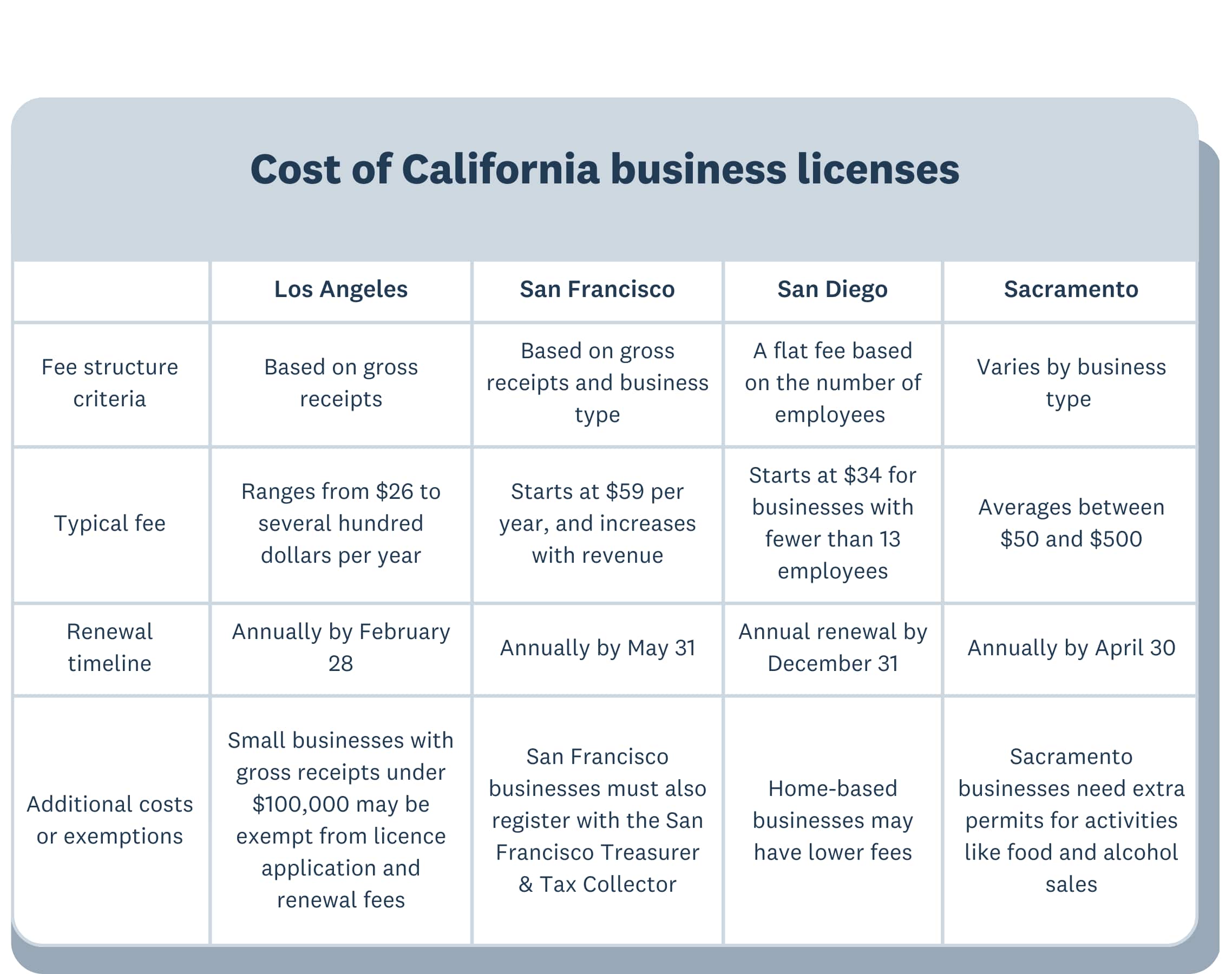
California business license costs range from $50 to $500 or more, depending on your city, county, and business type. Fees are set at the local level, so costs vary significantly by location.
Here's what to expect for general business license fees in some major California cities:
- Los Angeles: fees start at around $100 for most small businesses, with additional taxes based on gross receipts
- San Francisco: the annual business registration fee is $47 to $45,150 depending on gross receipts
- San Diego: fees range from approximately $34 to $75 for a basic business tax certificate
- Oakland: business license taxes are based on gross receipts, starting at around $60 for the smallest businesses
- Santa Ana: general business license fees start at approximately $70
Beyond the general license, budget for any additional permits your business needs:
- Seller's permit: free from the CDTFA, though a security deposit may be required
- Home occupation permit: $0 to $150 depending on your city
- Professional licenses: $100 to $500 or more, depending on the profession and licensing board
- Health permits: $100 to $1,000 or more for food-related businesses
Beyond these direct fees, compliance costs tend to hit small businesses harder. A Q4 2024 MetLife and U.S. Chamber of Commerce survey backs this up. It found that 69% of small businesses spend more per employee on compliance than larger competitors.
Check with your local government for exact fees. A home-based sole proprietor might spend as little as $50 to $200 total. A restaurant or construction business could spend $1,000 or more across all required permits.
Simplify your California business finances with Xero
Once your California business licenses are in place, keeping your finances organized is the next step. Tracking license fees, renewal costs, and permit expenses across multiple agencies can get complicated quickly.
Xero accounting software helps you stay on top of your business finances from day one. Track expenses, send invoices, reconcile bank transactions, and run reports to see exactly where your money is going. With everything in one place, you can focus on running your business instead of managing paperwork. Get one month free.
FAQs on California business licenses
Here are answers to common questions about getting a California business license.
Do I need a business license in California?
Yes, most businesses in California need a local business license from their city or county, regardless of industry. Some businesses also need industry-specific licenses from state agencies. The specific licenses you need depend on your business type, location, and activities.
What is the difference between an LLC and a business license?
An LLC (limited liability company) is a legal business structure that protects your personal assets from business debts. A business license is a local government permit. It gives you permission to operate in a specific city or county. You typically need both: form your LLC first, then apply for the required business licenses.
Do I need a business license to sell online in California?
Yes. If your business is based in California, you generally need a local business license from your city or county. This applies even if you only sell online. You'll also need a seller's permit from the CDTFA if you sell taxable goods. The rules apply based on where your business is located, not where your customers are.
Do home-based businesses need a license in California?
Yes, home-based businesses typically need a general business license from their city or county plus a home occupation permit. The home occupation permit confirms your business complies with local zoning regulations around things like signage, customer visits, and parking. Fees for home occupation permits range from $0 to $150.
What are the penalties for operating without a business license in California?
Penalties vary by city and industry but can include fines, criminal misdemeanor charges, and forced business closure. Unlicensed contractors, for example, can face fines of $5,000 to $15,000 and up to 6 months in jail. Past violations can also make it harder to get approved for licenses in the future.
How long does it take to get a California business license?
Most general business licenses take 1 to 4 weeks to process. Professional licenses can take up to 12 weeks due to background checks and credential verification. Plan ahead and apply early so you're ready to operate by your target launch date.
Disclaimer
Xero does not provide accounting, tax, business or legal advice. This guide has been provided for information purposes only. You should consult your own professional advisors for advice directly relating to your business or before taking action in relation to any of the content provided.