Cash vs accrual accounting: what's the difference?
Learn how cash and accrual accounting differ, and how to choose the right method for your business.
Published Thursday 23 July 2026
Table of contents
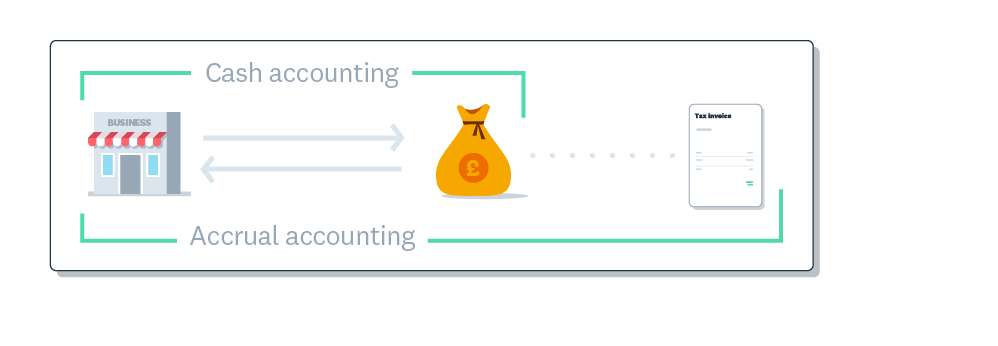
Cash accounting focuses only on cash changing hands, not outstanding bills or invoices.
Key takeaways
- Cash basis accounting records income when money lands in your account and expenses when you pay them, so it follows the actual movement of cash.
- Accrual accounting records income when you earn or invoice it and expenses when you incur them, even if no money has changed hands yet.
- The core difference is timing, which affects how your profit looks month to month and how clearly you can see money that's owed to you.
- Your choice often depends on your business size, whether you sell on credit, and what HMRC and any lenders expect from you.
What is cash basis accounting?
Cash basis accounting is a method that records income when money is received and expenses when money is paid. It follows the flow of cash in and out of your business, and nothing else.
Under this method, an unpaid invoice you've sent doesn't count as income until your customer pays it. A bill you've received doesn't count as an expense until you settle it.
That keeps things simple, because your books reflect what's actually in your bank account. Many sole traders and smaller businesses find it an easy way to start, and it maps closely to how you already think about your small business accounting.
What is accrual accounting?
Accrual accounting is a method that records income when it's earned or invoiced and expenses when they're incurred, regardless of when the cash moves. It matches income and costs to the period they relate to, not the moment money changes hands.
So if you invoice a customer in March for work you've finished, you record that income in March even if they pay you in May. If you receive a supplier bill in March, you record that expense in March even if you pay it later.
This gives you a fuller picture of what you've earned and what you owe. It also captures your accounts receivable, the money customers owe you but haven't paid yet.
Cash vs accrual accounting: the main difference
The main difference between cash and accrual accounting is timing: cash accounting records money when it moves, and accrual records it when it's earned or owed. That single distinction shapes how your profit and your outstanding money show up in your books.
The gap matters most when customers take time to pay. According to Xero Small Business Insights, UK small businesses waited an average of 29 days to be paid in the March 2026 quarter, with invoices settled 8.2 days late on top of that.
Under cash accounting, that outstanding money isn't on your books until it lands in your account. Under accrual accounting, you record it the moment you raise the invoice, so you can see what you're owed and keep a closer eye on how you manage your cash flow.
Cash vs accrual accounting example
A short worked example shows how each method treats the same sale. Say you invoice a customer £2,000 on 15 March, and they pay you on 20 April.
Under cash basis accounting, you record the £2,000 as income on 20 April, the day the payment reaches your account. Nothing appears in your March figures, because no money had moved yet.
Under accrual accounting, you record the £2,000 as income on 15 March, the day you raised the invoice. The sale sits in your March figures, and the unpaid amount shows as money owed to you until it's settled in April.
Advantages and disadvantages of cash basis accounting
Cash basis accounting suits many smaller businesses that want a straightforward view of their money. Here's how the benefits and drawbacks stack up.
The main advantages centre on simplicity and cash visibility:
- Track income and expenses in line with your actual bank balance
- Spend less time on bookkeeping, since you only record money that has moved
- Avoid paying tax on income you haven't received yet
- Get started with minimal accounting knowledge
The disadvantages tend to show up as your business grows or sells on credit:
- Miss the bigger picture of money owed to you and bills you still have to pay
- Distort your profit when large payments land in a different month from the work
- Struggle to plan ahead without visibility of outstanding invoices
- Fall short of what many lenders and investors expect to see
Advantages and disadvantages of accrual accounting
Accrual accounting gives a more complete view of performance, though it asks a bit more of you. The benefits and drawbacks break down as follows.
The main advantages centre on accuracy and planning:
- See a truer picture of profit by matching income and costs to the right period
- Track money owed to you and bills you owe in one view
- Plan and forecast with more confidence as you scale
- Meet the expectations of lenders, investors and HMRC where accrual is required
The disadvantages mostly relate to complexity:
- Manage more moving parts, since you record income and expenses before cash moves
- Watch cash flow closely, because a healthy profit can hide a tight bank balance
- Spend more time on record keeping without the right tools
How to choose the right method for your business
The right method depends on how your business runs today and where you want it to go. A few practical factors can help you decide.
Weigh these points against how you operate:
- Business size: smaller, simpler businesses often find cash basis easier to manage
- Selling on credit: accrual gives clearer visibility if you invoice customers and wait to be paid
- Growth plans: accrual scales better as your income and costs get more complex
- Lender or investor needs: many expect accrual accounts before they'll back you
If you're unsure which way to lean, it helps to understand the wider basis of accounting and talk it through with your accountant or bookkeeper.
Cash and accrual accounting for UK tax
Your accounting method also affects how you report to HMRC, and the UK has specific rules worth knowing. Keep the following in mind, and check your own position with HMRC or an adviser.
HMRC lets many unincorporated businesses use the cash basis, and it's the default for most sole traders and partnerships, according to HMRC's cash basis guidance. Traditional (accrual) accounting is used by limited companies and in cases where lenders or HMRC require it.
For VAT, the VAT Cash Accounting Scheme lets eligible businesses with turnover up to £1.35 million account for VAT when they're paid rather than when they invoice. This can ease pressure on cash flow while you wait for customers to settle up.
HMRC also requires digital record keeping under Making Tax Digital. According to HMRC guidance, Making Tax Digital for Income Tax is mandatory from 6 April 2026 for sole traders and landlords with qualifying income above £50,000.
Simplify your accounting method with Xero
Whichever method you pick, the right tools make it easier to keep accurate books and stay on top of what's owed. Xero accounting software brings your bank feeds, invoices and reports together in one place and helps you save time on manual admin.
You can track income and expenses on either a cash or accrual basis, watch your cash flow in real time, and get set up with support from onboarding specialists in your first 90 days, and you can get one month free.
FAQs on cash vs accrual accounting
Here are answers to some frequently asked questions about cash vs accrual accounting to help you decide what works for your business.
What is the main difference between cash and accrual accounting?
The difference is when you record income and expenses. Cash accounting logs them when money moves, while accrual logs them when income is earned or a cost is incurred.
Which method is better for a small business?
Cash basis often suits smaller businesses that don't sell much on credit and want a simple view of their bank balance. Accrual tends to fit businesses that invoice customers, hold stock, or plan to grow.
Can I switch between cash and accrual accounting?
You can change method, but you'll need to adjust your records so income and expenses aren't counted twice or missed in the switch. Check the current HMRC rules or speak to your accountant before you move.
Does HMRC let me use cash basis accounting?
HMRC allows the cash basis for many unincorporated businesses, and it's the default for most sole traders and partnerships. Limited companies generally use traditional accrual accounting instead.
Handy resources
Advisor directory
You can search for experts in our advisor directory
Xero Small Business Guides
Discover resources to help you do better business
Financial reporting
Keep track of your performance with accounting reports
Disclaimer
This glossary is for small business owners. The definitions are written with their requirements in mind. More detailed definitions can be found in accounting textbooks or from an accounting professional. Xero does not provide accounting, tax, business or legal advice.