Owner's equity: what it is and how to calculate it
Learn what owner's equity is, how to calculate it, and how to grow it over time.

Written by Jotika Teli—Certified Public Accountant with 24 years of experience. Read Jotika's full bio
Published Monday 15 June 2026
Table of contents
Key takeaways
- Owner's equity is the amount left after subtracting your total liabilities from your total assets, giving you a snapshot of your business's true net worth.
- You can calculate it with a simple formula (Assets - Liabilities = Owner's equity) and track changes over time using a statement of owner's equity.
- Owner's equity on your balance sheet reflects book value based on historical cost, which is different from the market value a buyer might pay for your business.
- You can grow your equity by increasing profitability, reinvesting earnings, reducing debt, and limiting owner withdrawals.
What is owner's equity?
Owner's equity is the amount left after subtracting what your business owes from what it owns. It represents your business's net worth or book value at any point in time.
Think of it as your personal stake in the business. If you sold every asset and paid off every debt, owner's equity is what you'd have left. It's one of the clearest indicators of your business's financial health, and it changes as your business earns profits, takes on debt, or distributes money to owners.
This differs from market value, which reflects what a buyer would actually pay for your business. Owner's equity is based on the numbers in your accounting records, not external market conditions.
How to calculate owner's equity (or net worth)
Owner's equity equals your total business assets minus your total business liabilities. This relationship is part of the fundamental accounting equation. Here's the formula:
Assets - Liabilities = Owner's equity
Add up everything your business owns, subtract everything it owes, and the remainder is your equity. Let's walk through a worked example to see how this plays out.

Owner's equity formula in action
Say you run a small bakery. Here's how you'd calculate your owner's equity:
- Add up your total assets: $50,000 (cash) + $20,000 (equipment) + $10,000 (inventory) + $5,000 (accounts receivable) = $85,000
- Add up your total liabilities: $25,000 (business loan) + $5,000 (accounts payable) + $3,000 (credit card balance) = $33,000
- Subtract liabilities from assets: $85,000 - $33,000 = $52,000
Your owner's equity is $52,000. That's your ownership stake in the bakery based on your books right now.
What's included in owner's equity?
Owner's equity is driven by 2 main components: assets and liabilities. Understanding what falls into each category helps you see exactly where your equity comes from.
Assets
Assets are everything your business owns that has value. Common examples include:
- Cash and bank accounts: money available for operations
- Accounts receivable: money customers owe you
- Inventory: products ready for sale
- Equipment and real estate: physical property and machinery
- Intangible assets: patents, trademarks, and intellectual property
Liabilities
Liabilities are what your business owes to others. This technically includes any obligation to transfer assets or a variable number of shares, as defined in the FASB Conceptual Framework. Common examples include:
- Loans: money borrowed from banks or lenders
- Accounts payable: bills owed to suppliers
- Payroll obligations: wages owed to employees
- Tax obligations: amounts owed to tax authorities
Examples of owner's equity
Seeing owner's equity in real-world scenarios makes the concept easier to grasp. Here are 2 examples showing how it works for personal assets and a small business.
Personal example of owner's equity
If you own a house worth $300,000 with a $120,000 mortgage, here's your equity:
- Asset: $300,000 (house value)
- Liability: $120,000 (mortgage debt)
- Your equity: $180,000 ($300,000 - $120,000)
Business example of owner's equity
Now picture a repair shop. The owner wants to know their equity position.
- Total assets: $700,000 ($600,000 garage + $50,000 machinery + $50,000 inventory)
- Total liabilities: $300,000 (premises loan)
- Owner's equity: $400,000 ($700,000 - $300,000)
As the business grows and pays down debt, the owner's equity increases. If the shop earns $80,000 in net profit and the owner withdraws $30,000, equity rises to $450,000 by year's end.
Owner's equity vs. market value
Owner's equity and market value both measure what your business is worth, but they approach the question differently. It's important to understand the distinction, especially if you're considering selling your business or bringing in investors.
Owner's equity is based on your balance sheet. It uses historical cost, meaning assets are recorded at the price you originally paid for them. You can see this by reviewing your balance sheet. If you bought equipment for $20,000 3 years ago, that's roughly what shows up on your books (minus depreciation).
Market value, on the other hand, reflects what a buyer would actually pay for your business today. It considers factors that don't appear on a balance sheet:
- Brand recognition: customer loyalty and reputation
- Future earning potential: projected revenue and growth
- Intellectual property: proprietary processes, software, or patents
- Market conditions: demand in your industry
Understanding your business's solvency and liquidity alongside equity gives you a fuller picture of financial health. A profitable business with a strong brand could have a market value much higher than its book equity. Conversely, a business with lots of assets but declining sales might have a market value below its equity figure. When you're planning for the long term, it helps to understand both numbers and what each one tells you.
Where to find owner's equity
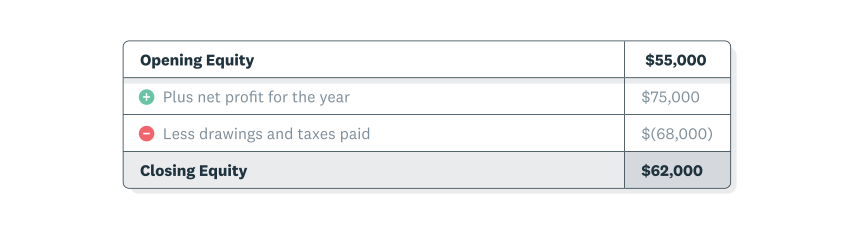
Statement shows closing equity is equal to the opening equity plus the year’s net profit, minus owner withdrawals and taxes.
You can find your owner's equity figure in 2 key financial reports. Both give you valuable information, but they show your equity from different angles.
- Balance sheet: lists your equity in the equity section, below assets and liabilities. It shows your equity at a single point in time.
- Statement of owner's equity: shows how your equity changed during a specific period, including the effects of profits, losses, investments, and withdrawals.
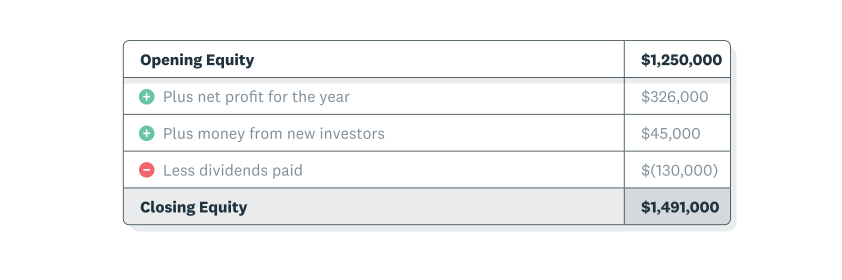
Statement shows closing equity is equal to the opening equity plus the year’s net profit and money introduced, minus owner withdrawals and taxes.
What is a statement of owner's equity?
A statement of owner's equity tracks changes in your business ownership value over a specific period. It connects your other financial statements by showing how profits and losses affect your ownership stake.
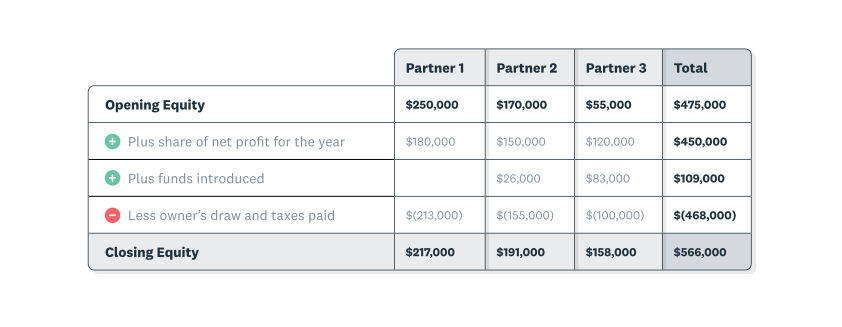
Statement shows closing equity is equal to the opening equity plus the year’s net profit and money introduced, minus owner withdrawals and taxes.
The statement takes net income from your income statement and shows how it increases the equity reported on your balance sheet. It's 1 of 4 essential financial statements:
- Income statement: shows revenue and expenses
- Balance sheet: lists assets, liabilities, and equity
- Cash flow statement: tracks money in and out
- Statement of owner's equity: shows equity changes
How to use the statement of owner's equity
Most small business owners focus on the income statement and balance sheet for day-to-day decisions. The statement of owner's equity is most useful when you're assessing long-term business growth, preparing for a loan application, or planning an exit strategy.
Here's what a basic statement includes:
- Opening equity: the previous period's ending balance
- Plus net income: profits earned during the period
- Plus new capital introduced: any additional money you've invested
- Minus owner withdrawals: money taken out for personal use
- Minus taxes: tax payments during the period
- Equals closing equity: your new ownership value
Example of statement of owner's equity for a sole proprietor
Imagine you're a freelance consultant. At the start of the year, your equity was $40,000. During the year, you earned $60,000 in net profit, withdrew $35,000 for personal expenses, and paid $10,000 in taxes.
Your closing equity: $40,000 + $60,000 - $35,000 - $10,000 = $55,000. Your ownership stake grew by $15,000 over the year.
Example of statement of owner's equity for a general partnership
In a partnership, each partner has their own equity account. Say 2 partners each started the year with $50,000 in equity. The business earned $100,000 in net profit (split equally), Partner A withdrew $20,000, and Partner B introduced $10,000 in new capital and withdrew $25,000.
Partner A's closing equity: $50,000 + $50,000 - $20,000 = $80,000. Partner B's closing equity: $50,000 + $50,000 + $10,000 - $25,000 = $85,000. Total partnership equity went from $100,000 to $165,000.
How to increase owner's equity
Growing your owner's equity strengthens your business's financial position and gives you more flexibility. Whether you're looking to qualify for a loan, attract investors, or simply build long-term wealth, there are a few proven strategies.
1. Increase profitability
The most direct way to grow equity is to earn more profit. You can do this by increasing revenue, reducing expenses, or both. Look at your profit margins and identify where you can improve efficiency or raise prices without losing customers.
2. Reinvest earnings back into the business
Instead of withdrawing all your profits, reinvest a portion into the business. Retained earnings directly increase your equity and fund growth without taking on new debt. Even reinvesting a small percentage each quarter adds up over time.
3. Reduce liabilities
Paying down debt lowers your liabilities, which automatically increases your equity. Focus on high-interest loans first, and consider refinancing if better rates are available. Reducing your accounts payable balance also helps.
4. Limit owner withdrawals
Every dollar you withdraw decreases your equity. Setting a consistent, sustainable draw amount (rather than taking money out whenever you need it) protects your equity position. Build a personal budget so you can plan withdrawals without undermining business growth.
Track your business equity with confidence
Understanding your owner's equity helps you assess your business's financial health, especially during periods of uncertainty. According to Xero Small Business Insights, US small business sales growth averaged just 2.4% year-over-year in 2025, roughly half the long-term average of 5.5%. With conditions like these, keeping a close eye on your equity position can help you spot financial shifts early and respond with confidence.
Xero makes it easy to track your assets and liabilities in real time, giving you a clear view of your net worth whenever you need it. You can also use our free balance sheet template to get started. Focus on growing your business, not crunching numbers. Get one month free and take control of your finances today.
FAQs on owner's equity
Here are answers to some common questions about owner's equity.
Is owner's equity an asset?
No, owner's equity isn't an asset. It's a separate category on your balance sheet that represents the residual interest in your business after subtracting liabilities from assets. Think of it this way: assets are what your business owns, liabilities are what it owes, and equity is what's left over for you.
Is shareholder's equity the same thing as owner's equity?
Yes, they describe the same concept with different names. Sole proprietorships and partnerships use "owner's equity," while corporations use "shareholder's equity" or "stockholder's equity." Both measure the ownership value in the business and represent an equity interest as defined in the FASB Conceptual Framework.
How do I prepare a statement of owner's equity?
Start with your opening equity from the previous period's ending balance. Add net income and any additional investments, then subtract losses and owner withdrawals. The result is your closing equity, which shows whether your ownership stake grew or shrank during the period.
Can owner's equity be negative?
Yes, owner's equity can be negative when your total liabilities exceed your total assets. According to Xero Small Business Insights, US small business sales growth dropped to just +0.9% year-over-year in Q4 2025, a sharp slowdown that could pressure equity positions for businesses carrying significant debt. If your equity turns negative, you may need to reduce debt, increase revenue, or inject additional capital.
Is owner's equity the same as profit?
No, they're different. Profit (or net income) measures how much money your business earned during a specific period after expenses. Owner's equity measures your total ownership stake at a point in time. Profit increases your equity, but equity also includes your original investment and any additional capital you've added.
Do all transactions affect owner's equity?
Most business transactions affect owner's equity either directly or indirectly. Revenue and owner investments increase your equity, while expenses and owner withdrawals decrease it. Equity is reduced when the liability to owners is incurred, not just when the liability is settled, as noted in the FASB Conceptual Framework.
Disclaimer
Xero does not provide accounting, tax, business or legal advice. This guide has been provided for information purposes only. You should consult your own professional advisors for advice directly relating to your business or before taking action in relation to any of the content provided.