Owner’s equity: What it is, how to calculate and track it
Learn how owner’s equity tracks your stake, affects cash flow and funding, and shapes smarter business decisions.

Written by Lena Hanna—Trusted CPA Guidance on Accounting and Tax. Read Lena's full bio
Published Tuesday 20 January 2026
Table of contents
Key takeaways
- Calculate owner's equity by subtracting your total business liabilities from your total business assets to determine your company's true net worth at any point in time.
- Track changes in your ownership value using a statement of owner's equity, which shows how profits, losses, investments, and withdrawals affect your business equity over a specific period.
- Recognize that owner's equity appears on your balance sheet in the equity section and connects your other financial statements by showing how net income impacts your ownership value.
- Monitor your owner's equity regularly to assess your business's financial health and make informed decisions about growth, investments, and operational changes.
What is owner's equity?
Owner's equity is your business's net worth, or the dollar amount left after subtracting what you owe from what you own. It shows your business's book value at any point in time.
This differs from market value, which depends on what a buyer would actually pay for your business.
How to calculate owner's equity (or net worth)
Owner's equity equals your total business assets minus your total business liabilities. Use this simple calculation:
Assets - liabilities = owner's equity
Add up everything your business owns, subtract everything it owes, and the remainder is your equity.
Owner's equity formula

Use this simple formula to work out your owner's equity at any point in time.
What's included in owner's equity?
When you calculate owner's equity, you first identify all your assets and liabilities, then apply the formula.
Assets
Assets are everything your business owns that has value. This includes tangible items like equipment, real estate, inventory, and cash in the bank. It also covers money owed to you by customers (accounts receivable) and intangible assets like brand value or intellectual property.
Assets include everything your business owns:
- Cash and bank accounts: Money available for operations
- Accounts receivable: Money customers owe you
- Inventory: Products ready for sale
- Equipment and real estate: Physical property and machinery
- Intangible assets: Brand value, patents, and intellectual property
Liabilities
Liabilities are what your business owes to others. This includes loans from banks, money owed to suppliers for goods or services, unpaid wages to employees, and taxes due to the government.
Liabilities include everything your business owes:
- Loans: Money borrowed from banks or lenders
- Accounts payable: Bills owed to suppliers
- Payroll obligations: Wages owed to employees
- Tax obligations: Amounts owed to tax authorities
Examples of owner's equity
Personal example of owner's equity
If you own a house worth $300,000 with a $120,000 mortgage:
- Asset: $300,000 (house value)
- Liability: $120,000 (mortgage debt)
- Your equity: $180,000 ($300,000 - $120,000)
Business example of owner's equity
A repair shop calculates its owner's equity:
- Total assets: $700,000 ($600,000 garage + $50,000 machinery + $50,000 inventory)
- Total liabilities: $300,000 (premises loan)
- Owner's equity: $400,000 ($700,000 - $300,000)
Where to find owner's equity
Owner's equity appears in two key financial reports:
- Balance sheet: Listed in the equity section, below assets and liabilities
- Statement of owner's equity: Shows how your equity changed during a specific period
What is a statement of owner's equity?
A statement of owner's equity tracks changes in your business ownership value over time. It's one of four essential financial statements:
- Income statement: Shows revenue and expenses
- Balance sheet: Lists assets, liabilities, and equity
- Cash flow statement: Tracks money in and out
- Statement of owner's equity: Shows equity changes
The statement of owner's equity connects your other financial statements by showing how profits and losses impact your business ownership value.
It takes net income from your income statement and shows how it increases the equity reported on your balance sheet.
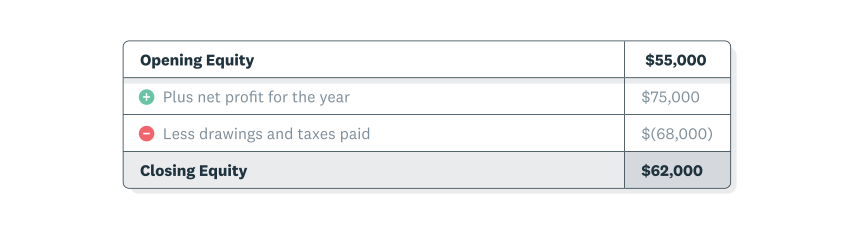
Statement shows closing equity is equal to the opening equity plus the year’s net profit, minus owner withdrawals and taxes.
Statement shows closing equity is equal to the opening equity plus the year's net profit, minus owner withdrawals and taxes.
Example of statement of owner's equity for sole proprietor
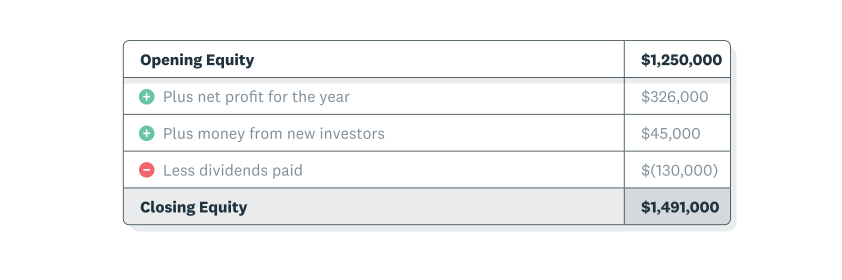
Statement shows closing equity is equal to the opening equity plus the year’s net profit and money introduced, minus owner withdrawals and taxes.
Statement shows closing equity is equal to the opening equity plus the year's net profit and money introduced, minus owner withdrawals and taxes.
Example of statement of owner's equity for a general partnership
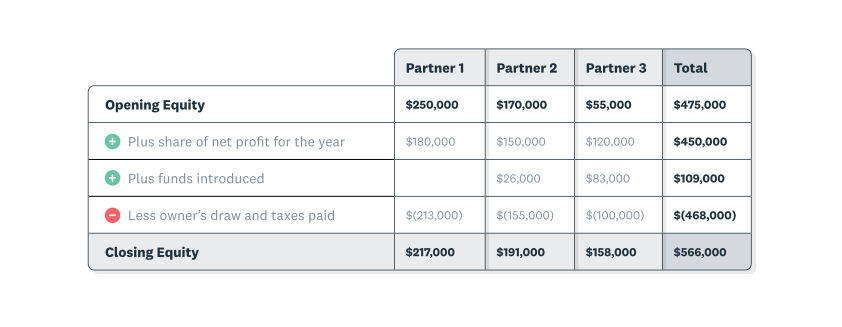
Statement shows closing equity is equal to the opening equity plus the year’s net profit and money introduced, minus owner withdrawals and taxes.
Statement shows closing equity equals the opening equity plus the year's net profit and new capital introduced, minus owner withdrawals and taxes.
How the statement of owner's equity is used
Most small business owners focus on these statements for day-to-day decisions:
- Income statement: Shows if you're profitable
- Balance sheet: Shows your financial position
- Statement of owner's equity: Tracks ownership changes but offers limited operational insights
Track your business equity with confidence
Understanding your owner's equity is key to knowing your business's financial health. You can manage it without complicated spreadsheets. Xero makes it easy to track your assets and liabilities in real time, giving you a clear view of your net worth whenever you need it.
Focus on growing your business, not on crunching numbers. See how Xero can simplify your accounting and give you the confidence to make smarter decisions. Get one month free and take control of your finances today.
FAQs on owner's equity
Is shareholder's equity the same thing as owner's equity?
Yes, shareholder's equity and owner's equity are the same concept with different names:
- Sole proprietorships and partnerships: Use "owner's equity"
- Corporations: Use "shareholder's equity" or "stockholder's equity"
Both measure the same thing: the ownership value in the business.
How do I prepare a statement of owner's equity?
Calculate your owner's equity statement by tracking changes in business worth over a specific period:
- Start with opening equity: Previous period's ending balance
- Add increases: Net income and additional investments
- Subtract decreases: Losses and owner withdrawals
- Calculate closing equity: Your new ownership value
This requires accurate balance sheet data to ensure correct calculations.
Do all transactions affect the owner's equity?
Yes, most business transactions affect owner's equity either directly or indirectly:
Transactions that increase equity:
- Sales revenue: Adds to cash or accounts receivable
- Investment: Owner adds money to the business
Transactions that decrease equity:
- Expenses: Reduce cash or increase liabilities
- Owner withdrawals: Remove money from the business
Disclaimer
Xero does not provide accounting, tax, business or legal advice. This guide has been provided for information purposes only. You should consult your own professional advisors for advice directly relating to your business or before taking action in relation to any of the content provided.
Get one month free
Sign up to any Xero plan, and we will give you the first month free.