How to calculate net profit margin
Learn the net profit margin formula and how to use it to measure your business's profitability.
Published Thursday 23 July 2026
Table of contents

How to calculate net profit margin
Key takeaways


- Net profit margin measures the percentage of revenue that remains as profit after all expenses, taxes, and interest have been deducted. It's 1 of the clearest indicators of your business's overall financial health.
- To calculate net profit margin, divide your net income by your total revenue, then multiply by 100. You can find both figures on your profit and loss statement.
- A net profit margin above 10% is generally considered healthy for most small businesses, though benchmarks vary significantly by industry.
- You can improve your net profit margin by increasing revenue, reducing operating costs, renegotiating supplier terms, or adjusting your pricing strategy.
What is net profit margin?
Net profit margin is a financial metric that shows the percentage of revenue your business keeps as profit after paying all expenses. It accounts for every cost involved in running your business, including the cost of goods sold (COGS), operating expenses, interest, and taxes.
This metric tells you how efficiently your business turns revenue into actual profit. A higher net profit margin means you're keeping more of every dollar you earn, while a lower margin signals that expenses are eating into your earnings.
Handy resources
Advisor directory
You can search for experts in our advisor directory
Income statement template
Download Xero’s income statement template to show how much money your business is making
Financial reporting
Keep track of your performance with accounting reports
Disclaimer
This glossary is for small business owners. The definitions are written with their requirements in mind. More detailed definitions can be found in accounting textbooks or from an accounting professional. Xero does not provide accounting, tax, business or legal advice.
For small business owners, tracking net profit margin regularly helps you spot trends, compare your performance against industry benchmarks, and make informed decisions about pricing, spending, and growth. For a broader view of all profit margin types, including gross and operating margins, see our full guide.
Net profit margin formula
The net profit margin formula is straightforward. Once you have your net income and total revenue figures, you can calculate it in seconds.
Net profit margin = (net income / revenue) x 100
Net income is your total revenue minus all expenses, including COGS, operating expenses, interest, and taxes. You'll find both figures on your profit and loss (P&L) statement. If you need help reading your financial reports, see our guide to financial statements. The result is expressed as a percentage.
How to calculate net profit margin
Calculating net profit margin takes just a few steps. Here's how to work through it using figures from your financial statements.
1. Calculate your total revenue
Start by finding your total revenue for the period you want to analyze. Revenue is the total amount of money your business earned from sales before any deductions. You'll find this at the top of your P&L statement, sometimes listed as "total sales" or "gross revenue."
2. Subtract all expenses to find net income
Deduct every business expense from your total revenue. This includes COGS, operating expenses (such as rent, utilities, and payroll), interest on loans, and taxes. The figure you're left with is your net income, sometimes called "net profit" or "the bottom line."
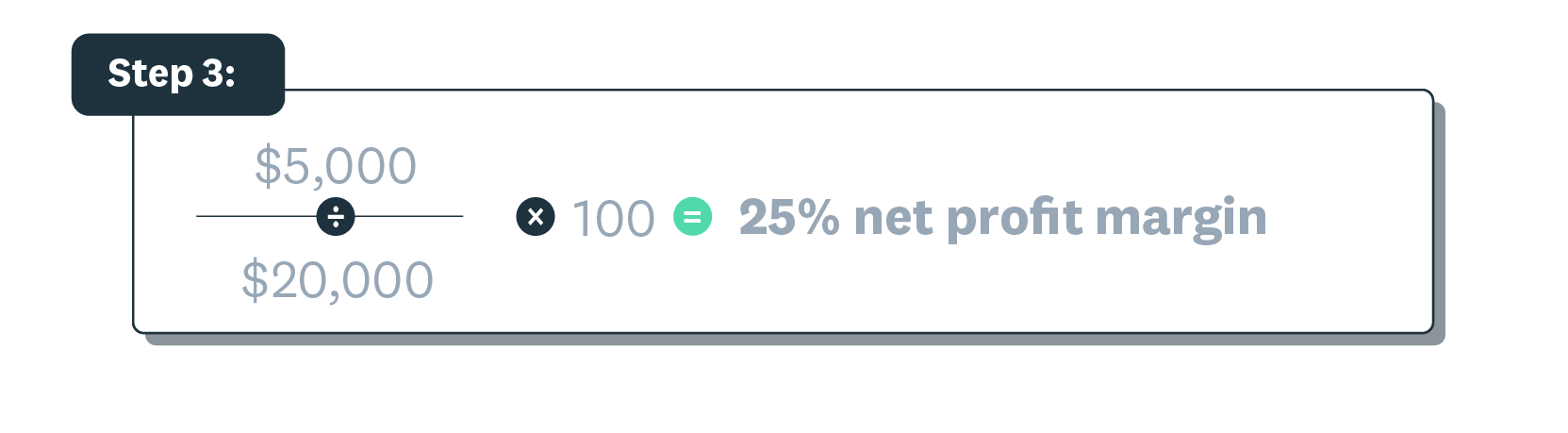
3. Divide net income by revenue
Take your net income and divide it by your total revenue. This gives you a decimal that represents the proportion of revenue you kept as profit.
4. Multiply by 100
Multiply the result by 100 to convert it into a percentage. This percentage is your net profit margin.
Net profit margin example
Seeing the formula in action makes it easier to understand. Here's a realistic example for a small business.
Say you run a boutique retail store. Over the past quarter, your total revenue was $120,000. Your expenses for the same period broke down as follows:
- Cost of goods sold: $48,000
- Operating expenses (rent, utilities, payroll, marketing): $42,000
- Interest on a business loan: $2,000
- Taxes: $7,000
Your total expenses come to $99,000, leaving you with a net income of $21,000.
Using the formula: ($21,000 / $120,000) x 100 = 17.5%
Your net profit margin is 17.5%. That means you kept $0.175 of every dollar earned as profit after covering all costs. For a retail business, that's a strong result.
What is a good net profit margin?
What counts as a "good" net profit margin depends on your industry, business model, and stage of growth. However, a commonly used rule of thumb can help you gauge where you stand.
- 5% net profit margin is considered low but acceptable for some high-volume industries like grocery or retail.
- 10% is generally seen as healthy for most small businesses.
- 20% or above is considered strong and suggests your business is managing costs effectively.
Industry averages vary widely. Service-based businesses like consulting or accounting firms often see higher margins because they have lower material costs. Retail, food service, and manufacturing tend to operate on thinner margins due to higher COGS and overhead. Research from sources like NYU Stern publishes industry-specific margin benchmarks that can give you a more precise comparison.
Rather than fixating on a single number, focus on tracking your net profit margin over time. A consistent upward trend matters more than hitting an arbitrary target in any single period.
Net profit margin vs gross profit margin
Net profit margin and gross profit margin both measure profitability, but they account for different costs. Understanding the distinction helps you pinpoint where your money is going.
Gross profit margin only subtracts the cost of goods sold from revenue. It shows how efficiently you produce or source your products. The formula is: (revenue - COGS) / revenue x 100.
Net profit margin goes further by subtracting all expenses, including operating costs, interest, and taxes. It gives you the complete picture of your business's profitability after every cost has been accounted for.
For example, if your gross profit margin is healthy but your net profit margin is low, that signals your operating expenses, debt payments, or taxes are cutting into your profits. Tracking both metrics together helps you identify exactly where to focus your attention.
Factors that affect net profit margin
Several factors can push your net profit margin up or pull it down. Understanding these helps you stay in control of your profitability.
- Revenue changes: a drop in sales directly reduces your margin, even if expenses stay the same. Seasonal fluctuations, customer churn, or pricing changes all play a role.
- Cost of goods sold: rising supplier costs or material prices eat into your margin. Negotiating better terms or finding alternative suppliers can help.
- Operating expenses: rent increases, new hires, or higher utility bills all add up. Regularly reviewing your overhead helps you catch unnecessary spending. Our guide to managing finances and cash flow can help you stay on top of these costs.
- Taxes: your tax burden can shift based on revenue changes, deductions, and regulatory updates. Working with an accountant helps you stay on top of tax obligations.
- Debt and interest: loan repayments and interest charges reduce your net income. Refinancing at a lower rate or paying down debt faster can ease the pressure.
How to improve your net profit margin
Improving your net profit margin comes down to either earning more revenue or spending less to generate it. Here are practical steps you can take.
- Review your pricing: if your costs have risen, your prices may need to reflect that. Even small price adjustments can have a meaningful impact on your margin over time.
- Cut unnecessary expenses: audit your recurring costs and cancel subscriptions, services, or tools you no longer use. Look for areas where you can reduce spending without affecting quality. For more ideas, check out these cost-saving strategies.
- Negotiate with suppliers: ask for bulk discounts, early payment discounts, or more favorable payment terms. Stronger supplier relationships often lead to better pricing.
- Increase sales volume: attracting new customers or encouraging repeat purchases boosts revenue without proportionally increasing your fixed costs.
- Automate repetitive tasks: manual bookkeeping, invoicing, and bank reconciliation take up time and introduce errors. Using Xero Accounting Software to automate these tasks frees you up to focus on growing your business.
- Monitor your numbers regularly: checking your net profit margin monthly or quarterly helps you catch problems early and adjust before they compound.
Track your net profit margin with Xero
Keeping a close eye on your net profit margin is easier when your financial data is accurate and up to date. Xero's reporting tools let you pull profit and loss reports in real time, so you can track your margins without manual calculations or spreadsheets.
With automated bank feeds, expense tracking, and customizable reports, you can spot margin trends as they happen and make faster, more confident decisions about your business. Get one month free.
FAQs on net profit margin
Here are answers to frequently asked questions about net profit margin.
What is the difference between net and gross profit margin?
Gross profit margin only accounts for the cost of goods sold, while net profit margin deducts all expenses, including operating costs, interest, and taxes. Net profit margin gives you a more complete view of your business's profitability.
Can net profit margin be negative?
Yes, a negative net profit margin means your total expenses exceed your revenue, resulting in a net loss. This can happen during periods of heavy investment, seasonal slowdowns, or unexpected costs.
How often should you calculate net profit margin?
You should calculate net profit margin at least quarterly, though monthly tracking gives you more timely insight. Regular monitoring helps you spot trends and address issues before they grow.
What expenses are included in net profit margin?
Net profit margin includes all business expenses: cost of goods sold, operating expenses like rent and payroll, interest on debt, and taxes. It reflects your total profitability after every cost has been paid.