Bookkeeping vs accounting: what's the difference?
Learn what sets bookkeeping and accounting apart, plus when to hire each professional for your small business.
Published Thursday 23 July 2026
Table of contents
Key takeaways
- Bookkeepers handle daily financial record-keeping like invoicing, bank reconciliation, and expense tracking, while accountants analyze that data to provide strategic advice, tax planning, and financial forecasting.
- Consider hiring a bookkeeper when you spend more than 5 hours per week on financial tasks, and add an accountant when your annual revenue exceeds $500,000 or you need help with complex tax situations.
- Bookkeepers typically charge $20 to $50 per hour, while accountants and CPAs charge $150 to $400 per hour, so matching the right professional to your needs helps you control costs.
- Cloud accounting software like Xero can automate many routine bookkeeping tasks, freeing both bookkeepers and accountants to focus on higher-value work for your business.
What is bookkeeping?
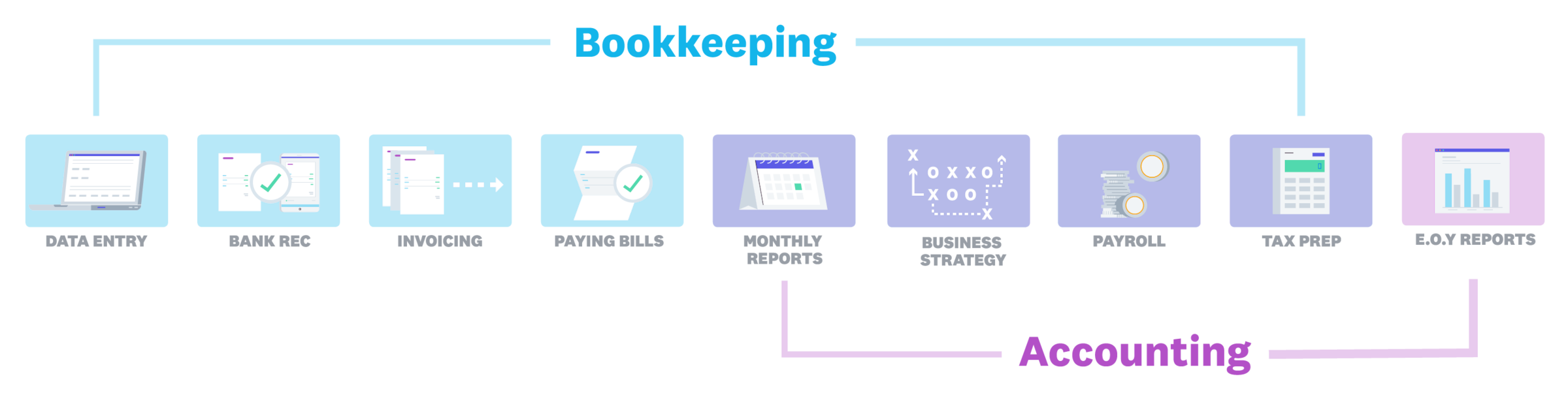
Bookkeeping is the process of recording, organizing, and maintaining your business's daily financial transactions. It's the foundation of your financial system, giving you accurate records to track how money flows in and out of your business.
A bookkeeper's day-to-day responsibilities typically include:
- Recording and categorizing all business transactions
- Managing accounts payable and accounts receivable
- Processing invoices and tracking payments
- Performing bank reconciliation to make sure your records match your bank statements
- Tracking expenses and revenue
On a monthly basis, bookkeepers also run payroll, generate financial reports, and prepare preliminary documentation for tax time. Some bookkeepers provide basic financial analysis and flag trends in your business performance, but their primary focus is keeping your records accurate and up to date.
If you're just getting started with organizing your finances, a guide to small business bookkeeping can help you understand the essentials.
What is accounting?
Accounting is the process of analyzing, interpreting, and reporting on financial data to help you make informed business decisions. While bookkeeping focuses on recording transactions, accounting uses those records to provide strategic insights about your business's financial health.
Accountants provide a range of services that go beyond record-keeping:
- Preparing official financial statements, including income statements, balance sheets, and cash flow statements
- Filing tax returns and managing tax compliance with the IRS
- Conducting profitability analysis and financial forecasting
- Advising on cash flow management, business growth, and investment decisions
Accountants also handle more complex work like audit preparation, risk assessment, and business valuation. If you're unsure what to expect from this role, learning more about what an accountant does can help you decide if it's time to bring one on board.
The distinction between compliance work and advisory work is important. Some accountants focus on ensuring your business meets tax and regulatory requirements, while others specialize in strategic planning to help you grow.
Key differences between bookkeeping and accounting
Bookkeeping and accounting are closely related, but they serve different purposes in your business. Bookkeeping is about accurately recording financial data; accounting is about using that data to guide your decisions.
Here's how the 2 roles compare across key areas:
- Scope of work: Bookkeepers handle daily data entry, transaction categorization, and basic reporting. Accountants interpret that data to produce financial statements, tax filings, and strategic advice.
- Decision-making authority: Bookkeepers organize your financial information. Accountants use it to recommend actions, such as whether to invest in new equipment or restructure debt.
- Skills and qualifications: Bookkeepers typically hold certificates or associate degrees. Accountants usually hold bachelor's degrees and professional certifications like CPA (Certified Public Accountant).
- Tools used: Both roles use accounting software for efficiency, but accountants also work with advanced financial modeling and tax preparation tools.
What can an accountant do that a bookkeeper can't?
An accountant can file tax returns, certify financial statements, represent your business in an IRS audit, and provide licensed financial advice. These tasks require professional credentials that bookkeepers don't typically hold.
Specifically, a CPA (Certified Public Accountant) is authorized to:
- Sign and file tax returns on your behalf
- Certify financial statements for lenders, investors, or regulatory bodies
- Represent you before the IRS during audits or disputes
- Provide strategic tax planning to minimize your tax liability
Bookkeepers play a critical role in keeping your financial records organized, but when it comes to tax strategy, legal compliance, and financial certification, you'll need an accountant.
How much does a bookkeeper or accountant cost?
Bookkeepers typically charge $20 to $50 per hour, while accountants and CPAs charge $150 to $400 per hour, depending on their experience and the complexity of your needs. Understanding these cost differences helps you budget for the right level of financial support.
Here's what you can expect to pay for each type of professional:
- Bookkeeper (hourly): $20 to $50 per hour, according to Bureau of Labor Statistics data and industry benchmarks
- Bookkeeper (monthly retainer): $500 to $2,500 per month for ongoing services
- Accountant or CPA (hourly): $150 to $400 per hour, depending on specialization
- Accountant (monthly retainer): $1,000 to $5,000 per month for comprehensive services
Several factors affect what you'll pay. Location matters: professionals in major metro areas tend to charge more than those in smaller markets. Business complexity also plays a role; if you operate in multiple states, manage inventory, or have international transactions, expect higher fees. The professional's years of experience and specialized certifications will also influence their rates.
For many small businesses, starting with a bookkeeper and adding an accountant for quarterly or annual tax work is the most cost-effective approach.
When to hire a bookkeeper vs an accountant
Your business stage and financial complexity determine which professional you need first. Some businesses start with a bookkeeper and add an accountant later, while others need both from the beginning.
It's time to hire a bookkeeper when you:
- Spend more than 5 hours per week on financial record-keeping
- Have regular transactions that need organizing and categorizing
- Need help with invoicing, bill payments, and bank reconciliation
- Want monthly financial reports to track your business performance
Consider hiring an accountant when you:
- Need strategic financial advice for major business decisions
- Have complex tax situations or multiple revenue streams
- Are applying for business loans and need certified financial statements
- Operate in multiple states and need help navigating different tax requirements
- Are preparing financial reports for investors
Hire both a bookkeeper and an accountant if you:
- Have annual revenue over $500,000
- Are hiring your first employees and need payroll and compliance support
- Need both daily financial management and long-term strategic planning
- Want to focus entirely on running your business instead of managing finances
If you're not sure where to start, learning how to choose the right accountant can help you evaluate your options.
How technology is changing bookkeeping and accounting
Cloud accounting software and automation are reshaping how bookkeeping and accounting work for small businesses. Tasks that once took hours of manual data entry can now happen automatically, saving you time and reducing errors.
Modern bookkeeping software can handle many routine tasks on its own:
- Automatically importing and categorizing bank transactions
- Matching invoices to payments without manual input
- Generating real-time financial reports and dashboards
- Sending automated payment reminders to customers
These tools don't replace the need for skilled professionals. Instead, they shift the bookkeeper's role from manual data entry toward reviewing, reconciling, and ensuring accuracy. Accountants benefit too, because clean, real-time data makes it easier to analyze trends, prepare tax filings, and provide timely advice.
For small business owners, this means you can handle more of your basic bookkeeping with software and bring in professionals for the tasks that require human judgment. Cloud platforms like Xero also make it simple to share access with your bookkeeper or accountant, so everyone works from the same up-to-date information.
Education and qualifications to look for
When you're hiring a bookkeeper or accountant, their qualifications tell you a lot about the level of service they can provide. Here's what to look for in each role.
For bookkeepers, relevant qualifications include:
- A certificate or associate degree in bookkeeping or accounting
- Certified Bookkeeper (CB) designation from the American Institute of Professional Bookkeepers (AIPB)
- Certified Public Bookkeeper (CPB) designation from the National Association of Certified Public Bookkeepers (NACPB)
- Proficiency in accounting software such as Xero or QuickBooks
- 1 to 3 years of practical bookkeeping experience
For accountants, look for:
- A bachelor's degree in accounting, finance, or a related field
- CPA (Certified Public Accountant) designation, which requires passing a national exam and meeting state licensing requirements
- Enrolled Agent (EA) designation for accountants who specialize in tax, authorized to represent you before the IRS
- 2 to 5 years of professional accounting experience
Higher qualifications generally mean higher fees, but they also signal broader expertise. A CPA can handle tax filings and audit representation that a bookkeeper cannot. An EA offers specialized tax knowledge that a generalist accountant may not have. Match the qualifications to the specific services your business needs.
Simplify your bookkeeping and accounting with Xero
Whether you handle your own books or work with a bookkeeper and accountant, the right software makes financial management easier. Xero accounting software automates daily bookkeeping tasks like bank reconciliation, invoicing, and expense tracking, so you can spend less time on admin and more time growing your business.
Xero also makes collaboration simple. You can invite your bookkeeper or accountant to access your account directly, so they always have the real-time data they need. With built-in reporting, tax preparation tools, and connections to hundreds of third-party apps, Xero supports both your bookkeeping and accounting needs in 1 platform. Get one month free.
FAQs on bookkeeping vs accounting
Here are some frequently asked questions about bookkeeping vs accounting to help you make the right choice for your business.
How much does a bookkeeper cost per hour?
Hourly rates vary widely based on your location and the bookkeeper's specialization; businesses in major metro areas or those needing industry-specific expertise (like construction or e-commerce) should expect to pay toward the higher end of the range. A monthly retainer often works out cheaper per hour than ad hoc billing if you need consistent weekly support.
Can a bookkeeper do my taxes?
A bookkeeper can organize your financial records and prepare preliminary tax documentation, but they're typically not authorized to file tax returns on your behalf. You'll need a CPA (Certified Public Accountant) or Enrolled Agent to file returns and represent you before the IRS.
What can an accountant do that a bookkeeper can't?
The practical difference for hiring comes down to authorization: only a CPA or Enrolled Agent can sign and file your tax returns with the IRS, so you'll need one of these professionals at least during tax season. You can verify a CPA's active license through your state board of accountancy before hiring.
Do I need both a bookkeeper and an accountant?
It depends on your business size and complexity. Many small businesses start with a bookkeeper for daily record-keeping and bring in an accountant for quarterly or annual tax work, while businesses with revenue over $500,000 or complex finances often benefit from having both on a regular basis.
Is bookkeeping harder than accounting?
They require different skills. Bookkeeping demands precision and consistency in recording daily transactions, while accounting requires advanced analytical skills to interpret financial data and provide strategic recommendations.
Can accounting software replace a bookkeeper?
Accounting software automates many routine bookkeeping tasks like transaction categorization and bank reconciliation, but it doesn't replace the judgment and oversight a skilled bookkeeper provides. Most small businesses find that software reduces the hours they need from a bookkeeper rather than eliminating the role entirely.
Handy resources
Advisor directory
You can search for experts in our advisor directory
When you should hire a bookkeeper
Find out all the things bookkeepers can do for your business
Xero dashboard
See your key information on the business dashboard
Disclaimer
This glossary is for small business owners. The definitions are written with their requirements in mind. More detailed definitions can be found in accounting textbooks or from an accounting professional. Xero does not provide accounting, tax, business or legal advice.