How to calculate New York sales tax
Work out New York sales tax step by step, with 2026 county rates, worked examples and a free worksheet.
Written by Kari Brummond—Content Writer, Accountant, IRS Enrolled Agent. Read Kari's full bio
Published Tuesday 6 October 2026
Table of contents
Key takeaways
- New York sales tax adds local rates to the 4% state rate, so your customer’s delivery address sets a combined rate of 7%–8.875%.
- Register for a Certificate of Authority at least 20 days before your first taxable sale. Then file a return every assigned period, even with no sales.
- Clothing and footwear under $110 per item skips the 4% state tax, and New York City exempts these items from local tax too.
- Out-of-state sellers must collect New York sales tax once they pass both $500,000 and more than 100 sales in the previous four sales tax quarters.
How much is sales tax in New York?
New York sales tax ranges from 7% to 8.875%, depending on where your customer takes delivery. The state charges a flat 4%, and local governments add 3%–4.875% on top.
New York City has the highest combined rate at 8.875%. Here’s how that rate breaks down:
- State tax: 4%
- City tax: 4.5%
- Metropolitan Commuter Transportation District (MCTD) surcharge: 0.375%
The MCTD surcharge also applies in Dutchess, Nassau, Orange, Putnam, Rockland, Suffolk, and Westchester counties. So if you sell a $100 item to a customer in Brooklyn, you collect $8.88 in tax and your customer pays $108.88.
New York sales tax rates by county
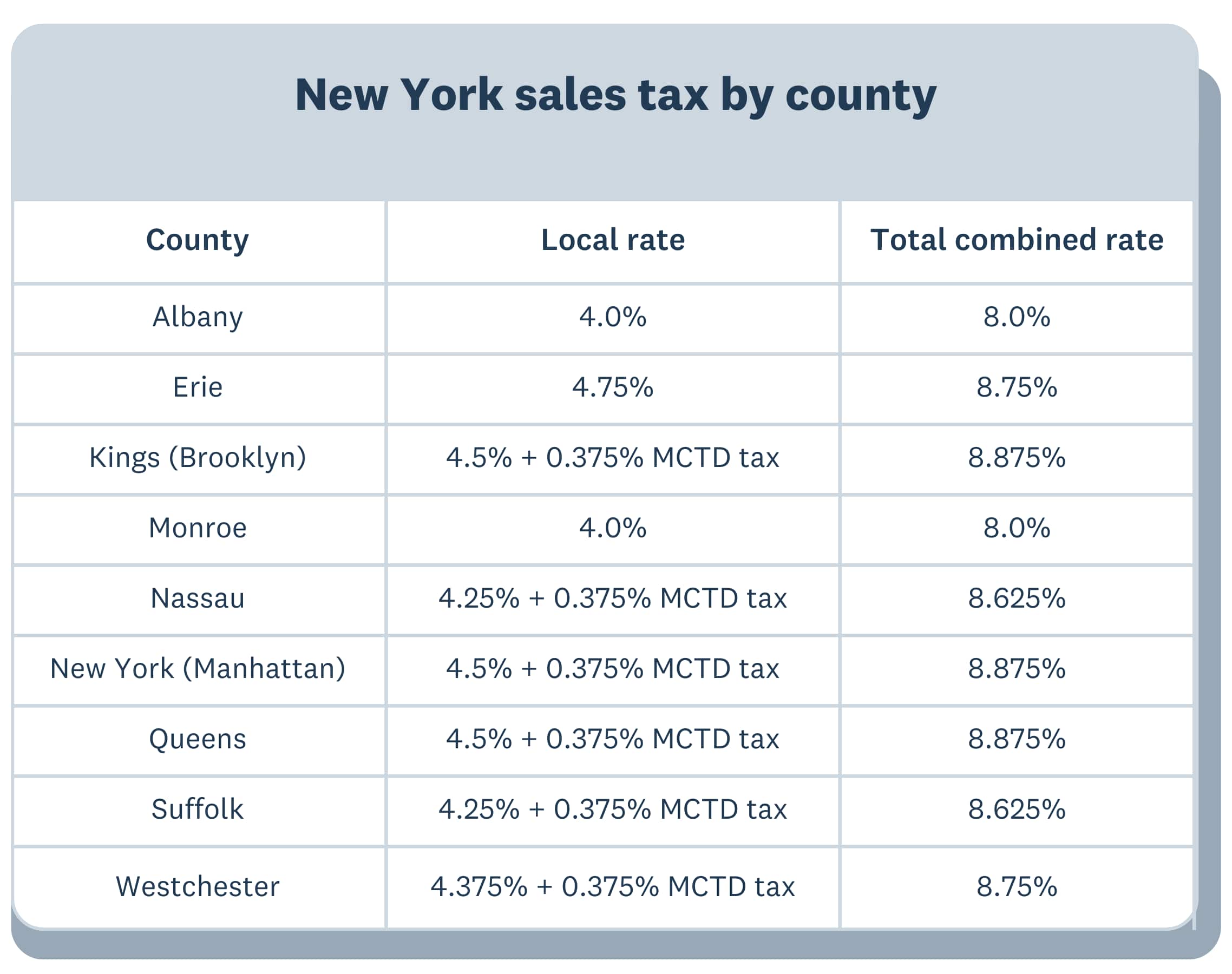
Each county rate combines the 4% state rate with local taxes that vary by location. Here are the current combined rates for the state’s largest markets:
- New York County (Manhattan): 8.875%
- Kings County (Brooklyn): 8.875%
- Queens County: 8.875%
- Bronx County: 8.875%
- Richmond County (Staten Island): 8.875%
- Nassau County: 8.625%
- Suffolk County: 8.75%
- Westchester County: 8.375% outside cities that set their own rate, such as Yonkers at 8.875%
Local rates can change during the year. Check the Department of Taxation and Finance rate publications for the latest figures in your area before you update your checkout or invoices.
How to register for New York sales tax
You need a Certificate of Authority before you can legally collect sales tax in New York. It authorizes your business to collect tax and send it to the state. Apply at least 20 days before your first taxable sale.
Follow these steps to register:
- Create an account on New York Business Express.
- Complete the sales tax vendor registration.
- Receive your Certificate of Authority and display it at your place of business.
- Note your assigned filing frequency (monthly, quarterly, or annually).
How to calculate New York sales tax
To calculate New York sales tax, add the state, local, and MCTD rates, then multiply the total by the taxable price. The method is the same one you’d use anywhere, and this general sales tax guide covers the basics.
Work through these five steps for each sale:
- Confirm the sale is taxable. Most goods and some services are taxable in New York. Exemptions, such as clothing and footwear under $110 per item, change the rate you charge.
- Find where your customer takes delivery. New York uses destination-based sourcing, so the delivery address sets the rate, even when your business is somewhere else.
- Look up the local rate for that place and add it to the 4% state rate, plus the 0.375% MCTD surcharge where it applies. The combined rates in the state’s tables already include the surcharge, so add it only once.
- Turn the combined rate into a decimal and multiply it by the taxable price. On a taxable sale, include delivery charges in that price, even when you list them separately.
- Round the tax to the nearest cent and add it to the price. Show the tax as its own line when you create your invoice, and record the rate and amount collected.
Worked New York sales tax examples
These examples apply the steps to real New York rates. Each one shows the combined rate, the tax owed, and the total your customer pays.
New York City: A $200 item delivered in Manhattan is taxed at 8.875% (4% state, 4.5% city, and 0.375% MCTD). $200 × 0.08875 = $17.75, so your customer pays $217.75.
Nassau County: A $250 item delivered in Nassau County is taxed at 8.625%. $250 × 0.08625 = $21.5625, which rounds to $21.56, so your customer pays $271.56.
Clothing under $110: An $80 shirt delivered in New York City is fully exempt from state, city, and MCTD tax, so your customer pays $80. In Nassau County, the same shirt carries the 4.25% county rate plus the MCTD surcharge. $80 × 0.04625 = $3.70, so your customer pays $83.70.
The local treatment of clothing varies by county. Publication 718-C lists which localities offer the full exemption and the rate that applies everywhere else.
New York sales tax worksheet
Use this worksheet to check any New York sale by hand. You can copy it into a spreadsheet or notebook, or download it to keep next to your register.
Fill in each line in order:
- Sale price, including delivery charges on a taxable sale: $______
- Less exempt amounts: $______
- Taxable amount (line 1 minus line 2): $______
- Delivery address and locality: ______
- State rate: 4%
- Local rate for the delivery locality: ______%
- MCTD surcharge, if the locality is in the MCTD: 0.375% or 0%
- Combined rate (lines 5 + 6 + 7): ______%
- Tax owed (line 3 × line 8, rounded to the cent): $______
- Total charged to customer (line 1 + line 9): $______
- Rate and tax recorded in your books (date): ______
If you take a combined rate straight from the state’s tables, enter it on line 8 and skip lines 5–7. That rate already includes the MCTD surcharge.
Filing and paying New York sales tax
New York assigns you a filing frequency of monthly, quarterly, or annually. You must file a return for every period, even if you had no taxable sales.
Keep these filing requirements in mind:
- Filing frequency: set by your sales volume
- Zero returns: required when you have no sales to report
- Payment method: file and pay online through your state Online Services account
- Deadlines: filing on time avoids penalties and keeps your business in good standing
Sales tax returns sit alongside your income tax and payroll filings. This overview of small business tax prep helps you plan the whole year’s deadlines.
Sales tax compliance best practices
Staying compliant with New York sales tax helps you avoid penalties and keeps your business running smoothly. These practices cover the areas where you’re most likely to catch a problem early.
Avoid common mistakes
A few errors can lead to penalties or a bill from the state. Watch for these:
- Charging the wrong rate for the customer’s location
- Missing filing deadlines, including zero-sales periods
- Making tax-exempt sales before you have an exemption certificate on file
- Mixing personal and business transactions
Keep organized records
Good documentation backs up every return you file. A regular bookkeeping routine makes these habits easier to keep:
- Store all sales receipts, invoices, and exemption certificates
- Track taxable and exempt sales separately
- Note the tax rate applied to each transaction
- Back up records digitally so you can find them fast
Prepare for audits
If the state reviews your records, you’ll want the numbers to line up. Solid accounting habits and these steps put you in a strong position:
- Reconcile sales tax collected with the amounts reported on your returns
- Review exemption certificates each year to confirm they’re current
- Keep records for at least three years
- Work with an accountant who knows New York tax rules
Use automation to reduce errors
Technology keeps your rates accurate and saves you time on every return. Try these options:
- Connect your point-of-sale system to tax calculation software
- Set up automatic rate updates for location-based changes
- Flag exempt products, such as clothing under $110, in your product list
- Track sales and run tax reports in accounting software like Xero
Sales tax exemptions in New York
Sales tax exemptions remove tax from certain purchases, which can lower costs for you and your customers. Whether an exemption applies depends on these factors:
- Item type: specific goods, such as clothing under $110
- Buyer status: nonprofits and government entities
- Transaction purpose: resale or manufacturing use
- Delivery location: local exemptions, such as the clothing exemption, vary by county
What’s taxable and what’s exempt
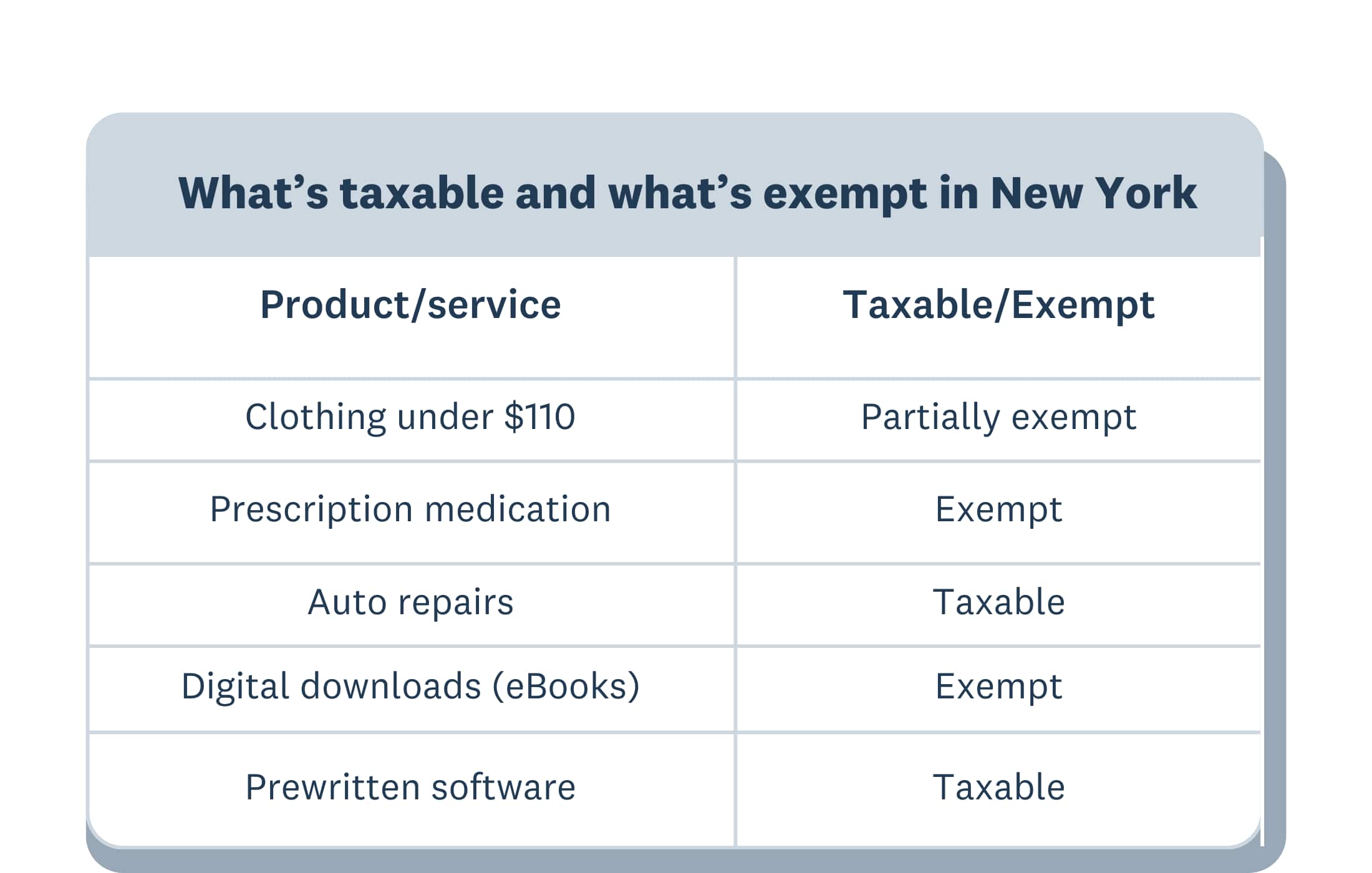
Most items fall clearly into one group or the other. Here are common examples of each:
- Taxable: most tangible personal property, prepared food, and certain services like repairs and installations
- Exempt: most groceries, prescription drugs, certain medical supplies, and clothing and footwear under $110 per item (from state tax)
Common business exemptions
Some exemptions come up often for small businesses. These are the ones you’re most likely to handle:
- Clothing under $110: exempt from the 4% state tax, though local taxes may still apply
- Professional services: consulting, legal, and accounting services aren’t taxable, while installation and repair of tangible property are
- Nonprofit purchases: qualifying 501(c)(3) organizations with proper documentation pay no sales tax
- Government purchases: sales to federal and New York State government agencies are exempt
Tax-exempt documents
Every tax-free sale needs the right exemption certificate from your customer on file. These are the forms you’ll see most often:
- Form ST-119.1 (Exempt Organization Exempt Purchase Certificate): lets qualified nonprofits buy without paying sales tax
- Form ST-120 (Resale Certificate): for businesses buying items they plan to resell
- Form ST-121 (Exempt Use Certificate): for purchases used for exempt purposes, such as certain manufacturing equipment
Ask your customer for the right form before the sale so the exemption is documented.
Use tax vs. sales tax in New York
Use tax is a companion to sales tax that applies when no sales tax was collected at purchase. The two taxes cover different situations:
- Sales tax: collected from customers at the time of purchase
- Use tax: paid by the buyer when no sales tax was collected, such as on out-of-state purchases
If you buy from an out-of-state seller who doesn’t collect New York sales tax, you owe use tax on that purchase. Businesses registered for New York sales tax generally report use tax on their sales tax returns. Individuals can report it on their New York State income tax return or directly to the Tax Department.
Online sales tax rules for New York businesses
Online sellers must collect New York sales tax on taxable sales delivered into the state, wherever the business is based. The 2018 Supreme Court decision in South Dakota v. Wayfair lets states require this from remote sellers.
Because the tax is destination-based, you charge the rate for your customer’s delivery address. Picture a candle maker in New Jersey shipping to a customer in Queens: that order carries the 8.875% New York City rate.
Key triggers for tax collection
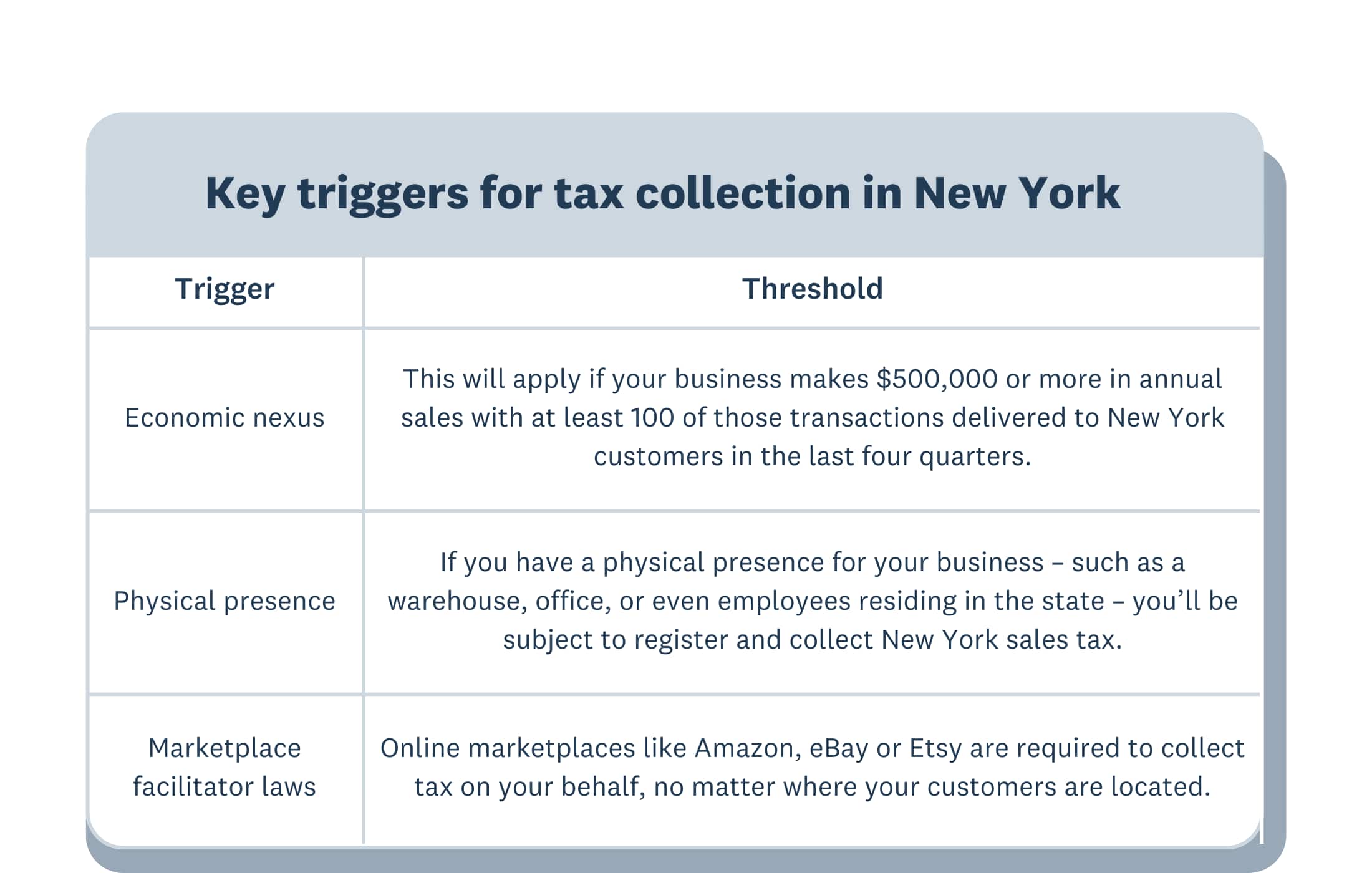
New York’s economic nexus test looks at your sales over the previous four sales tax quarters. New York’s quarters run March–May, June–August, September–November, and December–February. You must register and collect once both of these are true:
- Sales threshold: more than $500,000 in gross receipts from tangible personal property delivered into New York
- Transaction threshold: more than 100 sales of tangible personal property delivered into New York
Meeting only one threshold doesn’t trigger economic nexus. You also need to collect if you have a physical presence in New York, such as a store, office, warehouse, or employees. Marketplaces like Amazon or Etsy may collect and remit tax on sales made through them.
What your online business must do to comply
Once you meet a trigger, a few steps keep you compliant. Take them in this order:
- Register for your Certificate of Authority with the New York State Department of Taxation and Finance before you make taxable sales.
- Charge the combined state and local rate for each customer’s delivery address.
- File returns at your assigned frequency, including periods with no taxable sales.
- Keep records of taxable and exempt sales, returns, and tax collected for at least three years.
Rules for shipping and digital products
Shipping and software follow their own rules in New York. Here’s how each is treated:
- Shipping on taxable items: generally taxable, even when you list delivery charges separately on the invoice
- Shipping on exempt items: exempt, because the delivery charge follows the item
- Prewritten software: taxable whether downloaded or accessed in the cloud
- Custom software: may be exempt, depending on how it’s delivered and used
The state’s bulletin on shipping and delivery charges explains how to split one fee across taxable and exempt items. If you sell other digital products, software as a service, or subscriptions, check the state’s guidance or talk with a tax professional.
Simplify New York sales tax with Xero
Getting the rate right on every sale and keeping clean records makes each New York return quicker to file. Xero brings your sales, expenses, and tax obligations into one place, so you can see what you’ve collected and what you owe.
With Xero, you can:
- track taxable and exempt sales as you invoice
- connect sales tax automation apps like Avalara through the Xero App Store for accurate rate calculations
- let JAX, Xero’s AI financial superagent, reconcile bank transactions where there’s high confidence
- run reports that support your returns and any audit
Spend less time on sales tax admin and more time on your business when you choose a plan and get one month free.
FAQs on New York sales tax
These answers cover more New York sales tax questions small business owners often ask.
Is New York State sales tax 8%?
No, the state rate is 4%. An 8% figure is a combined state and local rate that applies in some counties, such as Albany and Monroe.
Do I need to charge New York sales tax if I sell services?
Most services aren’t taxable, because New York exempts services unless the law specifically taxes them. Taxable examples include repairing, installing, or maintaining tangible goods, plus some information services.
Can I deduct sales tax on business purchases in New York?
Sales tax on business purchases usually becomes part of the item’s cost, which you deduct with that expense. For individuals, the One Big Beautiful Bill Act lifted the federal state and local tax (SALT) cap to $40,400 for 2026, with a high-income phase-down.
Is sales tax in New York the same for in-store and online purchases?
The same rates apply, but a different location sets the rate. In-store sales use your store’s location, while shipped orders use your customer’s delivery address.
Does a New York Certificate of Authority cost anything?
Registration is free, and the state’s registration bulletin notes that certificates can’t be transferred. You’ll need a new one if you buy a business or change its legal structure.
Is clothing priced at exactly $110 exempt in New York?
No, the exemption only covers items sold for less than $110. A jacket priced at $110.00 is taxed at the full combined rate, such as 8.875% in New York City.
Disclaimer
Xero does not provide accounting, tax, business or legal advice. This guide has been provided for information purposes only. You should consult your own professional advisors for advice directly relating to your business or before taking action in relation to any of the content provided.