Recession-proof business: how to protect your small business
Practical strategies to help your small business stay resilient during economic downturns.
Written by Lena Hanna—Trusted CPA Guidance on Accounting and Tax. Read Lena's full bio
Published Tuesday 9 June 2026
Table of contents
Key takeaways
- A recession-proof business maintains steady demand for its products or services even when the economy contracts. Sectors like health care, discount retail, and repair services tend to stay resilient.
- Building a cash reserve of 6–12 months of operating expenses gives your business a financial buffer to survive prolonged downturns without making drastic cuts.
- Proactive steps like speeding up invoice payments and diversifying revenue help you respond to economic shifts before they become crises. Creating a business continuity plan and using real-time financial data strengthen your ability to act fast.
- Economic slowdowns can also create opportunities to hire talent, invest in training, and acquire competitors at lower cost.
What is a recession-proof business?
A recession-proof business is one that sustains or grows its revenue during periods of economic decline. These businesses sell products or services that people continue to need regardless of broader financial conditions.
Several characteristics set recession-resistant businesses apart. They typically meet consistent demand, operate with low overhead, maintain strong customer relationships, and adapt quickly to changing conditions. A plumbing company, for example, doesn't lose customers just because the stock market drops.
A slowdown and a full recession are not the same thing. A slowdown means reduced growth; a recession is 2 or more consecutive quarters of declining GDP. Both put pressure on small businesses, but recessions tend to last longer and cut deeper.
According to Marc Cowling, professor of economics and productivity at Oxford Brookes University, economic cycles follow a predictable rhythm. Recessions typically last about 12–18 months, followed by a 2-year recovery period and then a 4-year boom. Understanding this pattern can help you plan with more confidence.
Industries and business types that thrive in recessions
Some industries hold up better than others when the economy contracts. These sectors share a common trait: they provide essentials that people can't easily go without.
If you're exploring startup business ideas or reviewing small business ideas, consider these resilient sectors:
- health care: medical services remain in demand no matter the economic climate. Medicaid enrollment rose by 15.7% during the COVID downturn, showing that demand actually increases during recessions.
- financial services: accountants, bookkeepers, and financial advisors become more valuable when businesses and individuals need help managing tighter budgets.
- repair services: when people can't afford to replace items, they fix them instead. Auto mechanics, appliance repair technicians, and maintenance professionals tend to stay busy.
- child and elder care: working families still need reliable care for children and aging relatives, making these services consistently essential.
- discount retail: consumers trade down to budget-friendly stores during recessions, boosting sales for discount retailers.
- grocery stores: people eat at home more often when money is tight, which shifts spending from restaurants to grocery retailers.
- pet services: pet owners tend to maintain spending on veterinary care, grooming, and food even when cutting back in other areas.
IT support is another resilient sector. Businesses rely on technology to operate, and tech problems don't pause for recessions. IT service providers often see stable or growing demand.
How to recession-proof your business
You can't prevent a recession, but you can prepare your business to withstand one. These 9 steps will help you build financial resilience and stay competitive during a downturn.
1. Build a cash reserve
A healthy cash reserve is your first line of defense when revenue dips. Most small businesses maintain only 2–3 months of operating cash, but that's rarely enough to weather a full recession.
Recent data underscores the urgency. Xero Small Business Insights found that US small business sales grew just 2.4% year-over-year in 2025, roughly half the long-term average. By Q4 2025, that figure had dropped to just 0.9%. A thin cash buffer leaves little room to absorb that kind of slowdown.
Aim to set aside 6–12 months of operating expenses. That buffer gives you time to adjust your strategy without resorting to panic cuts or emergency borrowing.
Start by automating regular transfers into a dedicated savings account. Even small, consistent deposits add up over time and create a habit of financial preparedness. A small business budget can help you identify exactly how much to set aside each month.
2. Create a cash flow forecast
A cash flow forecast shows you when money is expected to come in and go out, so you can spot shortfalls before they happen. It's one of the most practical tools for navigating uncertainty.
Xero's cash flow tools can help you track projections alongside actual figures in real time. You can also use the cash flow projection template to get started quickly.
Review your forecast weekly during periods of economic stress. The earlier you identify a gap, the more options you'll have to address it. For deeper guidance, explore Xero's guide to managing finances and cash flow.
3. Speed up invoice payments
Late payments are a constant challenge for small businesses, and they get worse during downturns. Xero data shows that US invoice payment wait times leapt 11% after 2018 US-China trade tensions and 15% after the first COVID outbreak.
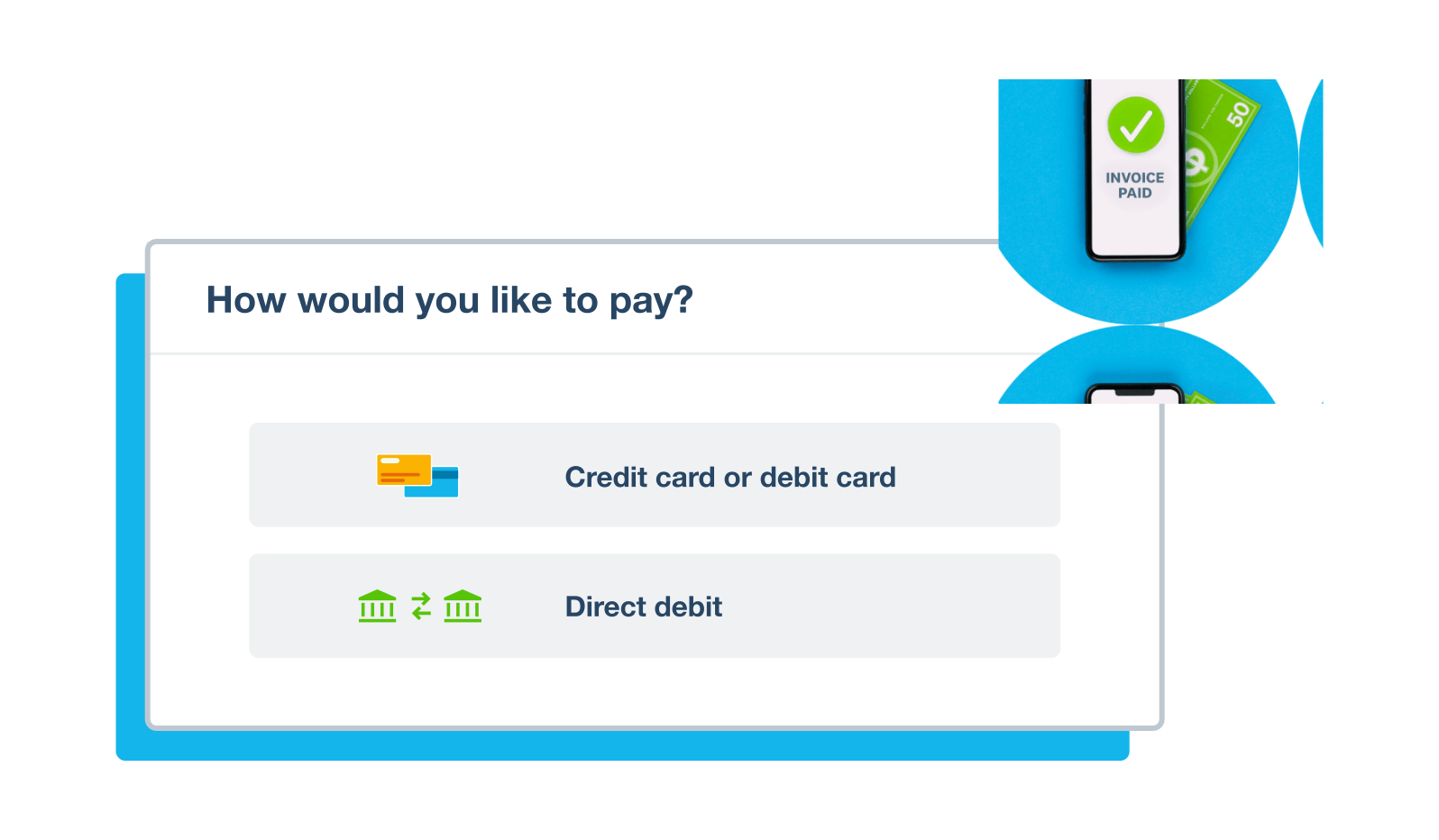
Online invoices allow customers to click straight through and pay instantly, which can reduce wait times for the vendor.
The good news is that payment times can improve. Xero Small Business Insights data shows that US small businesses waited an average of 27.9 days to be paid in Q4 2025. That's a full day below the long-term average and the shortest wait since late 2021.
Late payment times also fell to 7.8 days past due, down from 9.3 days at the start of the year. Proactive invoicing practices can accelerate that trend for your business.
Send invoices as soon as work is completed, not at the end of the month. Offer multiple online payment options to make it easy for customers to pay promptly.
Set up automated payment reminders through your invoicing software. Consistent follow-up reduces the average time between invoicing and receiving payment.
Online invoices allow customers to click straight through and pay instantly, which can reduce wait times for the vendor.
4. Cut costs without cutting capability
Reviewing your expenses during stable times helps you act decisively when conditions worsen. The goal is to trim waste without undermining your ability to serve customers.
Grant Anderson, specialist small business consultant, warns against "cutting muscle with the fat." Slashing budgets indiscriminately can damage customer service, employee morale, and your ability to recover when the economy improves.
Focus on renegotiating supplier contracts, eliminating underused subscriptions, and finding more efficient ways to deliver your core services. For more ideas, explore business cost-saving strategies.
5. Diversify your revenue streams
Relying on a single product, service, or customer segment makes your business vulnerable during downturns. Diversifying spreads risk across multiple sources of income.
Consider expanding into adjacent markets, adding complementary services, or creating digital products that generate recurring revenue. A landscaping company, for example, might add snow removal or holiday lighting to smooth out seasonal dips.
Test new offerings on a small scale before committing significant resources. Validate demand first, then scale what works. For more strategies, explore Xero's guide to increasing revenue.
6. Adjust pricing strategically
Raising prices during a recession feels counterintuitive, but lowering them across the board can erode your margins and devalue your brand. The key is to price based on the value you deliver.
Mark Koziel, President and CEO of the Association of International Certified Professional Accountants (AICPA and CIMA), emphasizes the importance of understanding your customers deeply. "Know what your customers value most," he says, "and price accordingly."
Consider introducing tiered pricing, bundling services, or offering payment plans. These approaches give customers flexibility without requiring you to discount your core offerings.
7. Secure financing before you need it
Lenders tighten their criteria during recessions, making it harder to borrow exactly when you need capital most. The time to establish credit relationships is before a downturn begins.
Build a strong relationship with your bank or credit union now. Keep your financial records organized, maintain a good credit score, and explore lines of credit that you can draw on if needed.
Koziel notes that "the businesses that survive downturns are the ones that secured their loans and credit lines when times were good." For guidance on managing existing obligations, explore Xero's guide to managing business debt.
8. Keep marketing through the downturn
Many businesses cut marketing first during a recession, which creates an opportunity for those that don't. Reduced competition for attention means your message reaches more people for less.
Koziel recommends looking for creative, low-cost options. "Think about locals packages, community partnerships, and digital campaigns that keep your name in front of customers," he suggests.
Shift your messaging to emphasize value, reliability, and the specific problems you solve. Customers during downturns respond to practical benefits, not aspirational branding.
9. Use financial data to make faster decisions
Real-time financial data lets you respond to changing conditions quickly instead of relying on month-old reports. The faster you spot a trend, the sooner you can act on it.
This matters more than headline numbers might suggest. The S&P 500 rose roughly 17% and nominal US GDP averaged 5.1% in 2025. Yet Xero Small Business Insights found that small business sales grew only 2.4% over the same period. National economic indicators don't always reflect what's happening on the ground for small businesses, which makes tracking your own data essential.
Jordan Southall puts it plainly: "The businesses that come through recessions strongest are the ones watching their data weekly, not quarterly."
An accountant or bookkeeper can help you interpret your data and spot risks you might miss on your own. Xero's business forecasting guide explains how to turn financial data into forward-looking decisions. You can also find an advisor through Xero's directory.
Build a business continuity plan
A business continuity plan maps out how your business will keep running when disruptions hit. During a recession, it helps you act quickly instead of scrambling to figure out next steps under pressure.
Start by identifying your critical functions: the activities that generate revenue and keep customers served. For most small businesses, this includes sales, customer support, core production or service delivery, and financial management. Document the key processes behind each function so anyone on your team can step in if needed.
Set clear financial triggers for action. For example, decide in advance what you'll do if revenue drops 10%, 20%, or 30%. Having predetermined responses removes the guesswork during stressful periods. Your triggers might include pausing discretionary spending, renegotiating vendor terms, or shifting to part-time staffing for non-essential roles.
Create a communication plan that covers your team, customers, and suppliers. When conditions change, the businesses that communicate early and clearly tend to keep stronger relationships. Let your customers know how you're adapting, reassure your team about the plan, and stay in regular contact with key suppliers to avoid disruptions.
Financial resilience strategies for small businesses
Financial resilience goes beyond having a cash reserve. It means structuring your finances so your business can absorb shocks, adapt to changing conditions, and recover faster.
Start with your debt. If you're carrying variable-rate loans, explore converting to fixed rates before interest costs climb. Prioritize paying down high-interest debt, and avoid taking on new obligations unless they directly support revenue. If you already have a line of credit, confirm the terms and draw limits so there are no surprises when you need it.
Review your insurance coverage at least once a year. Many small business owners carry policies that haven't been updated since they launched. Check for gaps in coverage, compare rates across providers, and confirm that your business interruption insurance reflects your current revenue. A policy that covered you 3 years ago may fall short today.
Optimize your working capital by tightening payment cycles. Understanding solvency and liquidity helps you track whether your business can meet its obligations. Negotiate shorter payment terms with customers where possible, and take advantage of early payment discounts from suppliers. Every day you shorten the gap between spending and earning strengthens your cash position.
Finally, build scenario plans for different downturn severities. Map out your finances under a mild slowdown, a moderate contraction, and a severe recession. Identify which expenses you'd cut first, which revenue streams are most at risk, and what your break-even point looks like in each scenario. This exercise turns uncertainty into a set of concrete options you can act on quickly.
How a slowdown can create opportunity
A recession isn't only a threat; it's also a window to make strategic moves that strengthen your business for the long term. While competitors pull back, you can invest in areas that pay off during the recovery.
Here are some opportunities that open up during economic slowdowns:
- reflect and plan: slower periods give you space to reassess your strategy, identify weaknesses, and set a clearer direction.
- invest in training: use the downtime to build your team's skills. Better-trained employees deliver more value when demand returns.
- fix operational problems: address inefficiencies, upgrade systems, and streamline processes that you've been putting off.
- acquire assets at lower cost: equipment, real estate, and even competitor businesses can become available at reduced prices during downturns.
- improve efficiency: tighter budgets force creativity. US public company profits nearly doubled as a share of GDP between 1996 and 2021, partly driven by recession-era efficiency gains.
Finding employees during a downturn
Recessions can also be an excellent time to hire. Talented workers who were previously unavailable may be looking for new roles, giving you access to a stronger candidate pool.
Koziel points out that downturns often lead to a "redistribution of talent." Larger companies lay off skilled workers who then become available to smaller businesses that are still hiring.
If you can't afford new full-time hires, consider bringing on contractors or part-time staff to fill critical gaps. This keeps your costs flexible while building capability.
Take control of your finances before a downturn hits
The best time to prepare for a recession is before it arrives. By building reserves and tracking cash flow, you put your business in a strong position. You can survive downturns and take advantage of the opportunities they create.
Xero accounting software can help you track your finances in real time, so you can make confident decisions when conditions change. Get one month free and start taking control of your business finances today.
FAQs on recession-proofing your business
Here are answers to frequently asked questions about recession-proofing your business.
What is a recession-proof business?
A recession-proof business provides goods or services that remain in demand during economic downturns. These businesses typically operate in essential sectors like health care, food, and repair services where customer need stays constant regardless of economic conditions.
What business does best in a recession?
Businesses that meet basic needs tend to perform best. Health care providers, grocery stores, discount retailers, and repair services consistently maintain revenue during recessions because consumers prioritize essentials over discretionary spending.
How do you recession-proof an existing small business?
Focus on managing cash flow, optimizing costs, and diversifying revenue. Build a cash reserve, speed up invoice collections, maintain relationships with your lender, and use real-time financial data to make quick decisions as conditions change.
How much cash reserve should a small business keep?
Aim for 6–12 months of operating expenses. Most small businesses hold only 2–3 months of cash, which is rarely enough to cover a full recession without emergency borrowing or drastic cuts.
What is a business continuity plan and why does it matter during a recession?
A business continuity plan outlines how your business will keep operating during disruptions, including recessions. It identifies critical functions, documents key processes, and sets predetermined responses so you can act quickly instead of making reactive decisions under pressure.
How do you build financial resilience as a small business?
Start by maintaining a healthy cash reserve, managing debt carefully, and reviewing your insurance coverage annually. Optimizing working capital and creating scenario plans for different downturn severities helps your business absorb shocks and recover faster.
Disclaimer
Xero does not provide accounting, tax, business or legal advice. This guide has been provided for information purposes only. You should consult your own professional advisors for advice directly relating to your business or before taking action in relation to any of the content provided.