Xero data shows strongest sales and jobs growth for Aussie small businesses in two years
Strong end-of-year performance provides crucial buffer for businesses navigating impact of RBA interest rate increase
Melbourne — 26 February 2026 — Australian small businesses ended 2025 with solid momentum, recording their strongest sales and employment growth in two years, according to the latest Xero Small Business Insights (XSBI) data.
The December quarter update, which analyzes anonymised and aggregated data from 520,000 Australian small businesses, shows performance in the sector continued to strengthen leading into 2026. This positive momentum could be at risk following the RBA’s latest interest rate increase in February.
December quarter at a glance:
- Sales growth rose 6.7% y/y – the best result in over two years, peaking in December with a 9.6% y/y increase
- Jobs growth rose 3.4% y/y – the strongest performance in two years
- Small businesses were paid on average in 23.9 days – the fastest recorded since XSBI started in 2017
- Wages rose just 2.0% in the quarter largely due to a holiday-impacted weak December result (+0.5% y/y), which is likely to be revised up in future releases
- Queensland had the highest sales growth in the country with a 8.3% y/y increase, followed closely by South Australia (+7.8% y/y)
- By industry, construction (+9.5% y/y), health care (+9.3% y/y), and real estate (+8.6% y/y) sales outperformed the national average
RBA decision could impact small business economy momentum
Small business sales grew 6.7% y/y in the December quarter, the largest quarterly rise since June 2023. This acceleration was particularly evident in December, which saw a 9.6% y/y surge – the largest monthly increase since early 2024, reflecting the positive impact of earlier 2025 interest rate cuts on consumer spending.
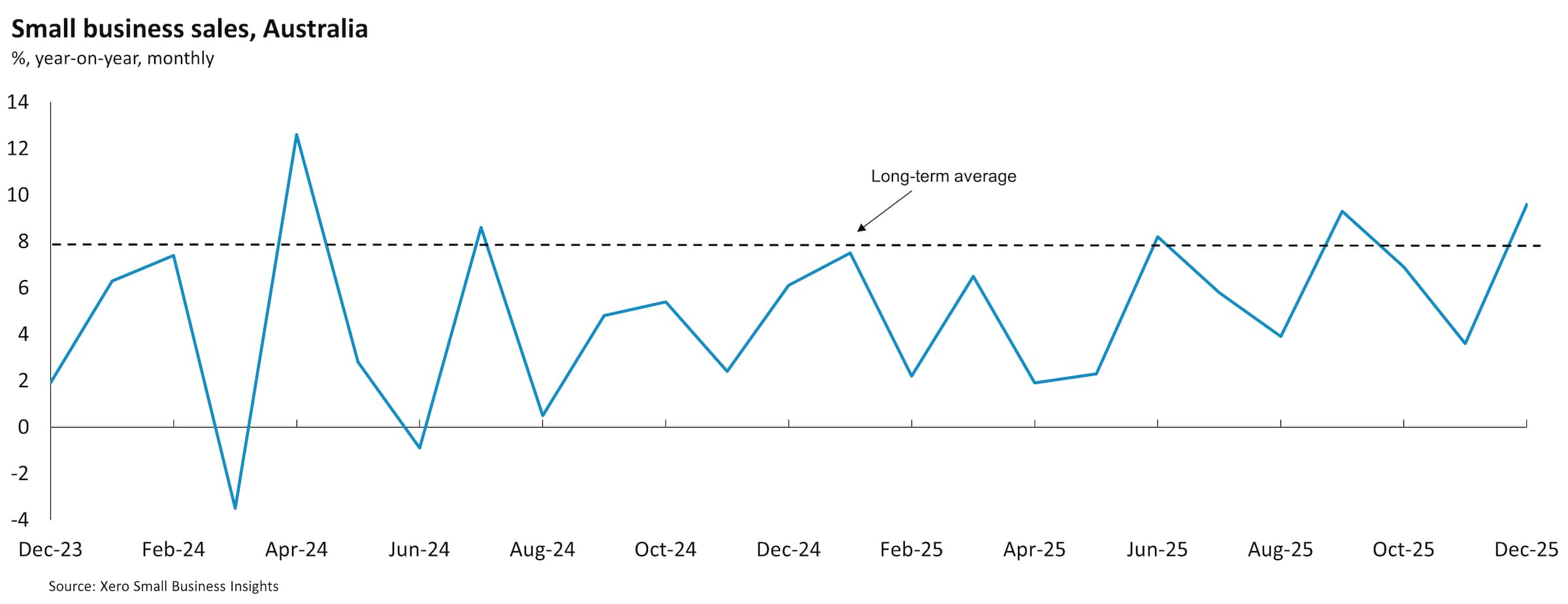
The growth flowed through to the workforce, with jobs increasing 3.4% y/y – the strongest result since late 2023.
“Small businesses worked hard to find their footing in late 2025, reaching sales and employment levels we haven’t seen in two years,” said Louise Southall, Xero Economist. “However the February cash rate hike is a reminder of the fragile environment these owners operate in. As the RBA moves to address rising inflation again, the momentum we saw in December will be tested. Small businesses will need to remain disciplined to navigate the potential impact on consumer spending over the coming months.”
Small businesses getting paid faster than ever
In the December quarter, small businesses were paid in an average of 23.9 days – the fastest quarterly payment time since the XSBI series began in January 2017.
Late payment times also saw a slight improvement, dropping to an average of 6.6 days from 6.7 days in the previous quarter.
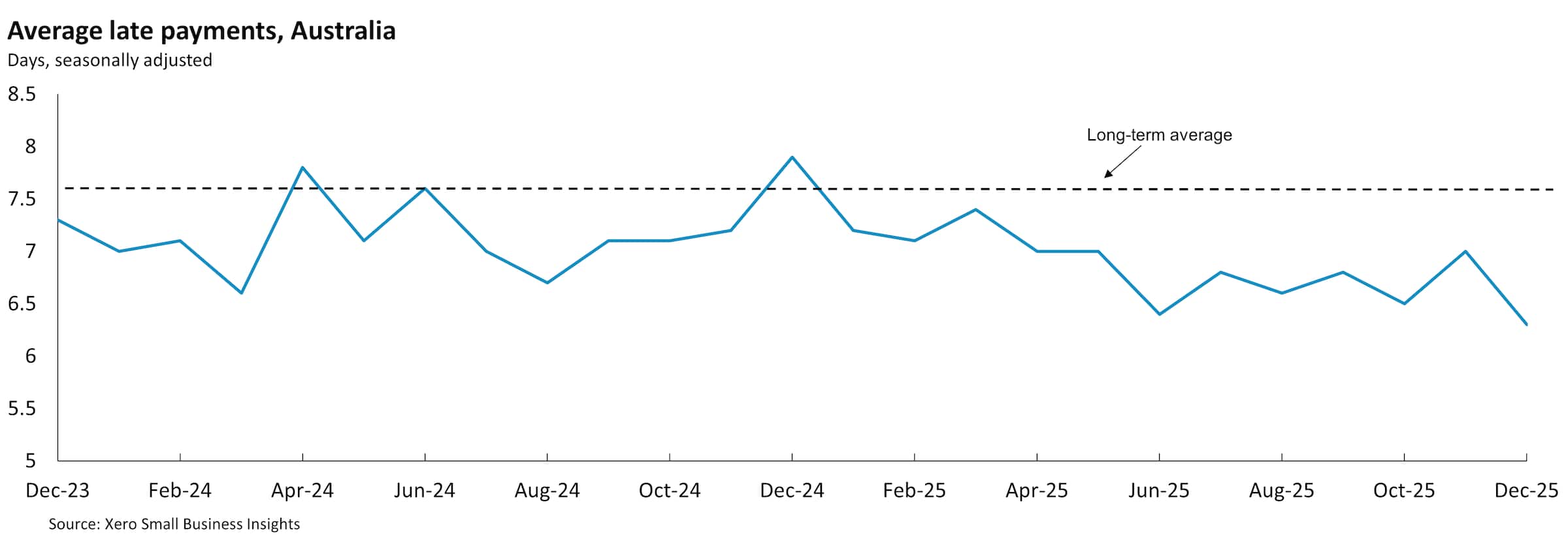
“Yes, we’re seeing the fastest payment times on record — but let’s be clear: small businesses are still being paid almost a week late. That means they’re effectively financing their larger customers and, when you’re running on tight margins, being paid six or seven days late isn’t an inconvenience — it’s the difference between investing in growth and covering payroll,” said Angad Soin, Managing Director ANZ & Global Chief Strategy Officer at Xero.
“Cash flow discipline is becoming non-negotiable. With Payday Super on the horizon, owners need real-time visibility over their cash position and the confidence to forecast ahead.”
Construction and health care trend upwards, discretionary industries stall
Construction (+9.5% y/y) and health care (+9.3% y/y) saw the strongest sales growth, however the end-of-year period was more subdued for retail (+4.7% y/y) and hospitality (+3.5% y/y), both of which were below the national average of 6.7%.
“Black Friday is fast becoming the biggest sales moment of the year, but our data shows smaller retailers aren’t necessarily winning from it. In November, sales growth slowed to just 3.3 per cent — the weakest result since April 2025, suggesting discount-driven periods are amplifying the divide between big retailers with pricing power and small businesses competing on thin margins. For many small retailers, sales events now drive volume but not always profitability.”
The construction (+5.3% y/y) and health care (+5.7% y/y) industries also led the hiring charge, signaling that owners in these sectors felt confident enough to expand their teams.
To find out more about how Xero Small Business Insights is constructed, see the methodology.
Media Contact
Xero Australia | Jess Brophy | +61 431 268 549 | jess.brophy@xero.com
About Xero
Xero is a global small business platform that helps customers supercharge their business by bringing together the most important small business tools, including accounting, payroll and payments — on one platform. Xero’s powerful platform helps customers automate routine tasks, get timely insights, and connects them with their data, their apps, and their accountant or bookkeeper so they can focus on what really matters. Trusted by millions of small businesses and accountants and bookkeepers globally, Xero makes life better for people in small business, their advisors, and communities around the world. For further information, please visit xero.com.
Related media and inquiries
For all media inquiries, please contact the Xero media team.
- Media release
Swapping 10% of spending from large to small retailers could unlock $76B for Aussie small businesses
Xero urges consumers to get behind small businesses this holiday season
- Media release
Black Friday overtakes Boxing Day, but more small businesses can’t compete with big retailers
New Xero research reveals affordability and competition are pushing small businesses to the sidelines
- Media release
Xero data shows signs of recovery for Aussie small businesses as sales rebound in September quarter
Strongest sales increase in two years suggests interest rate cuts are finally boosting consumer spending
Get one month free
Sign up to any Xero plan, and we will give you the first month free.