What is dropshipping and how does it work?
Learn what dropshipping is, how it works, and how to start a profitable dropshipping business.
Written by Jotika Teli—Certified Public Accountant with 24 years of experience. Read Jotika's full bio
Published Monday 15 June 2026
Table of contents
Key takeaways
- Dropshipping lets you sell products online without holding inventory, keeping startup costs low. Tight profit margins and fierce competition mean you'll need strong branding and smart pricing to succeed.
- Choosing reliable suppliers is the foundation of your business. Verify product quality, compare pricing across vendors, confirm shipping times, and set clear terms for returns before you commit.
- Track your finances from day 1 using accounting software that integrates with your ecommerce platform. Real-time cash flow visibility helps you make confident decisions as you scale.
- Pick a specific niche with steady demand and test products before committing. Selling unique or hard-to-find items helps you stand out in a crowded market.
What is dropshipping?
Dropshipping is an ecommerce model where you sell products online without holding any inventory. When a customer places an order on your store, you forward it to a supplier who ships the product directly to the customer.
You never touch, store, or ship the products yourself. Your role focuses on building your store, marketing products, tracking your metrics, and processing orders.
The global dropshipping market was valued at $365.67 billion in 2024 and is projected to reach $1.25 trillion by 2030, according to Grand View Research. Low startup costs make it accessible, but competition is intense and profit margins tend to be thin.
How does dropshipping work?
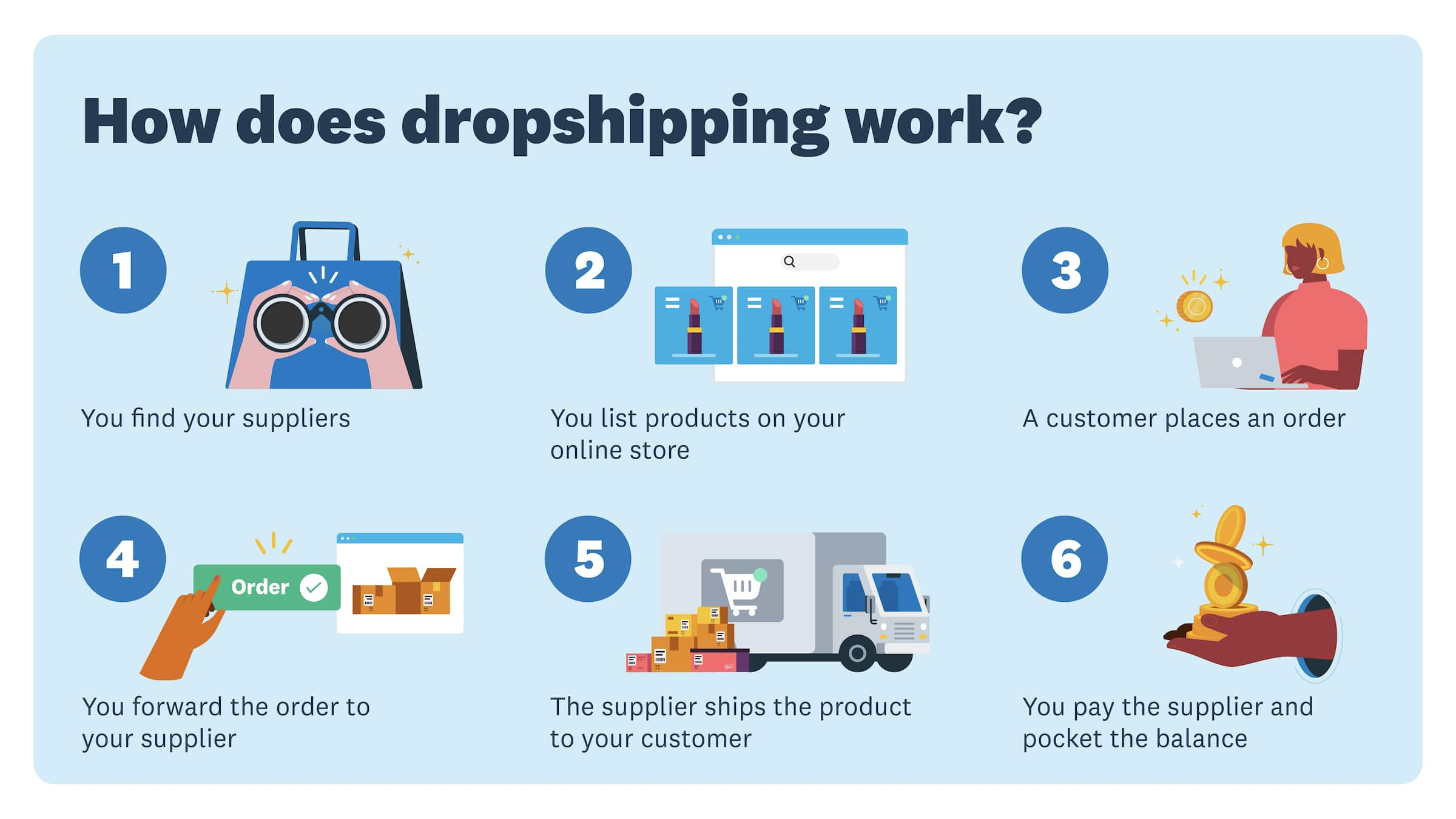
The dropshipping process follows 6 steps, from choosing a supplier to collecting your profit.
1. Find your suppliers
Your supplier is the backbone of your dropshipping business. Not all suppliers work with dropshippers, so finding the right supplier takes research.
Look for suppliers that offer:
- Quality products: verify standards before listing items in your store
- Competitive prices: compare rates across multiple suppliers to protect your margins
- Reliable shipping: confirm dispatch times and delivery consistency
- Clear terms: establish pricing, return policies, and restocking fees upfront
- White-labeling services: your branding appears on products and packaging
- Automated integration: dashboards or store integrations that streamline order processing
2. List products on your online store
Add products to your store with detailed descriptions, high-quality images, and accurate specs. Your supplier may provide these, or you can create your own branded versions.
Set your prices carefully to protect your profit margins. Factor in these costs:
- Competitive positioning: customers compare prices in seconds, so research your market
- Hidden costs: account for platform fees, transaction charges, and payment processing
- Markup strategy: factor in all costs before setting your final price
3. A customer places an order
When a customer orders from your store, payment goes directly to you. As the seller, you're responsible for managing refunds and resolving any disputes.
4. Forward the order to your supplier
Send the order details to your supplier. Include the customer's address, product specs (size, color, and so on), and any special requests.
5. The supplier ships the product
The supplier packages and ships the product directly to your customer. You don't handle any physical fulfillment.
6. Pay the supplier and pocket the balance
Pay the supplier the agreed wholesale cost plus any shipping fees. The difference between what the customer paid and your total costs is your profit.
Dropshipping pros and cons
Every business model has trade-offs. Here's what to expect with dropshipping.
Dropshipping benefits
Dropshipping offers several advantages, especially for new entrepreneurs with limited capital.
- Scalability: outsource inventory and logistics to suppliers so you can focus on growing your product range and marketing
- Location flexibility: run your business from anywhere with an internet connection, with no physical storefront or warehouse needed
- Lower startup costs: avoid large inventory investments by paying suppliers only after you make a sale
- Improved cash flow: pay suppliers after receiving customer payments, so you're not tying up funds in unsold stock. According to Xero Small Business Insights, US small business late payment times fell to 7.8 days in Q4 2025, a full day below the long-term average, suggesting cash flow conditions are improving for small businesses overall
- Lower environmental impact: reduce waste from unsold inventory and lower emissions through fewer transportation steps
Dropshipping challenges and how to manage them
Dropshipping also comes with challenges. Knowing them upfront helps you plan ahead.
- Complex shipping: multiple suppliers make it hard to give exact delivery times. Set clear expectations with customers and choose suppliers in similar regions to reduce delays.
- Lower profit margins: you can't access bulk discounts when buying items individually. Focus on increasing your profit margins through strategic pricing and niche products.
- Intense competition: low barriers to entry attract many sellers, which leads to price wars. Strong branding and exceptional customer service help you stand out.
- Supplier dependence: customers hold you responsible for quality issues, shipping delays, and poor packaging. Vet suppliers thoroughly and have backups ready.
- Branding limitations: many suppliers don't offer white-labeling, which creates a disconnect when customers receive generic packaging. Look for suppliers that support custom branding.
Is dropshipping right for you?
Dropshipping isn't the right fit for everyone. Before you commit, assess whether your situation aligns with what the model demands.
Consider these factors when deciding:
- Budget: you don't need a large upfront investment, but you'll still need funds for a domain, hosting, marketing, and potentially paid advertising to drive traffic
- Risk tolerance: profit margins are thin, and you may not see consistent income for 6 to 12 months. You should be comfortable with uncertainty early on.
- Time commitment: building a profitable store takes ongoing effort in marketing, supplier management, and customer service. It's not passive income.
- Technical comfort: you'll need to set up an online store, manage product listings, and handle integrations with suppliers and payment processors
- Comfort with supplier dependence: you won't control product quality, packaging, or shipping speed. If that lack of control concerns you, traditional retail may suit you better.
Is dropshipping legal?
Yes, dropshipping is a legal business model in the United States and most countries worldwide. There's nothing inherently unlawful about selling products you don't physically stock, as long as you follow standard business regulations.
That said, you'll need to be mindful of a few legal considerations:
- Trademark and intellectual property: don't sell counterfeit or branded products without authorization. Listing items that infringe on trademarks can result in account bans and legal action.
- Platform policies: each ecommerce platform has its own rules for dropshipping. Read the terms of service carefully before listing products to avoid violations.
- Sales tax obligations: you're responsible for collecting and remitting sales tax in states where you have a tax nexus. Requirements vary by state, so use accounting software or consult a tax professional to stay compliant.
- Business registration: register your business, obtain any required licenses, and keep accurate financial records from day 1.
Dropshipping vs traditional retail
Dropshipping and traditional retail take different approaches to selling products. Understanding the differences helps you choose the right model for your goals.
Here are the 3 main differences:
- Inventory management: dropshippers don't hold or store stock, while traditional retailers must manage and securely store inventory
- Initial investment: dropshippers avoid upfront inventory and storage costs, while traditional retailers must invest before selling
- Operational risks: dropshippers eliminate unsold stock risk but depend on suppliers for quality and shipping. Traditional retailers face unsold inventory, demand changes, and theft or damage losses.
Some product types work better for dropshipping than traditional retail:
- Niche products: test eco-friendly cleaning supplies, vegan skincare, or other specialized items without committing to large stock orders
- High-value items: sell designer bags, luxury watches, or expensive goods without upfront inventory costs or secure storage requirements
- Trendy or seasonal items: offer fashion accessories, heated blankets, or holiday ornaments while minimizing unsold stock risk
Dropshipping business models
Your business model determines how you source and fulfill products. Each model has distinct advantages depending on your goals and niche.
Wholesale dropshipping
Wholesale dropshipping means partnering with wholesalers who source and ship products directly to your customers. Wholesalers stock wide product ranges, which lets you test different items with minimal risk.
This model works well when you want variety without committing to large orders upfront.
Print-on-demand dropshipping
Print-on-demand dropshipping produces items only after customers order them. This model suits standard products with custom designs, such as t-shirts, mugs, and phone cases.
You can test designs without large print runs. Shipping times may be longer since each product is made to order.
Retail dropshipping
Retail dropshipping means sourcing products from retailers like Amazon and shipping directly to customers. You access a huge range of readily available products, but profit margins are tighter since you're buying at retail prices.
White-labeling isn't available with this model. It works best as a short-term strategy to test demand or capture price differences.
How to start a dropshipping business
Starting a dropshipping business is straightforward with the right planning. Follow these steps to launch your store.
1. Find your market niche
Choose a market segment that matches your interests and meets customer demand. Use tools like Google Trends to spot growing trends.
Search platforms like Amazon or eBay for in-demand products. Selling unique, hard-to-find items helps you stand out from competitors. Research your market before you commit.
2. Choose reliable suppliers
Look for suppliers with quality products, competitive prices, and reliable shipping. Evaluate their location, reputation, minimum order requirements, packaging quality, and dispatch times.
Platforms like Spocket, Modalyst, and DSers connect your store with proven suppliers. These tools let you:
- Browse supplier catalogs
- Import products with auto-filled descriptions and images
- Customize product details to fit your brand voice
3. Select your ecommerce platform
Your platform is the foundation of your online store. Choose one that fits your technical skills and budget.
Popular options include:
- Shopify: beginner-friendly with built-in dropshipping integrations
- WooCommerce: flexible and open-source, ideal if you're comfortable with WordPress
- BigCommerce: strong built-in features for scaling your store
- Wix: simple drag-and-drop builder for getting started quickly
4. Create your online store
Build a user-friendly store where customers can browse and purchase products easily. Focus on clear navigation and a clean design.
Make sure to:
- Pick a payment processor such as Stripe or PayPal
- Add products with detailed descriptions, clear images, and accurate specs
- Customize your site design to reflect your branding
5. Plan your marketing strategy
Effective marketing drives traffic and sales to your store. Focus on tactics that reach your target audience.
- Social media: choose platforms that match your audience, post regularly, and showcase products with tutorials and lifestyle content
- Digital advertising: run pay-per-click (PPC) campaigns on Google, Facebook, and Instagram to reach your ideal customers
- Customer reviews: offer small discounts for reviews, display positive feedback on your site, and apply suggestions to improve your service
Dropshipping tips for success
Dropshipping offers flexibility, but long-term success requires attention to detail. Apply these tips to build a sustainable business.
Know your customer
Stand out by catering to specific customer needs. Aim to be the store they think of first when they need products in your niche.
Study your audience's preferences, pain points, and buying habits. Use that insight to shape your product selection and marketing.
Be trustworthy and responsive
Answer inquiries promptly, maintain clear return policies, and handle complaints professionally. Trust drives repeat business and positive reviews.
Choose suppliers that deliver quality
Request samples, monitor customer feedback, and confirm your suppliers resolve issues quickly. You have less control over product quality, so choose partners carefully.
Stay organized with your finances
Keep accurate financial records, manage your cash flow, and stay on top of taxes from day 1. Organization keeps operations running smoothly and helps you spot profitability trends early.
This discipline is especially important in uncertain conditions. Xero Small Business Insights found that US small business sales growth averaged just 2.4% year-over-year in 2025, less than half the long-term average of 5.5%, with significant month-to-month volatility. Reliable financial tracking helps you spot trends early and respond quickly.
Automate where you can
Use tools that connect your ecommerce platform to your accounting software and supplier dashboards. Automation reduces manual admin, cuts down on errors, and frees up time to focus on growing your business.
Stay passionate and persistent
Building a profitable dropshipping store takes time. Passion keeps you motivated during slow periods. Customers notice when a store owner genuinely cares about their products.
Common dropshipping mistakes to avoid
Even experienced sellers make avoidable errors. Knowing the most common pitfalls helps you steer clear of costly setbacks.
Watch out for these mistakes:
- Ignoring your sales data: flying blind without tracking metrics leads to poor decisions. Review your sales, return rates, and customer acquisition costs regularly so you can double down on what's working and cut what isn't.
- Skipping SEO: relying solely on paid ads is expensive and unsustainable. Invest time in search engine optimization for your product pages and blog content to build organic traffic that compounds over time.
- Relying on a single supplier: if your only supplier runs out of stock or raises prices, your business grinds to a halt. Build relationships with at least 2 to 3 backup suppliers for your best-selling products.
- Neglecting customer service: slow responses and unclear return policies drive customers to competitors. Prioritize fast, helpful communication and make your policies easy to find and understand.
Streamline your dropshipping finances with Xero
Managing your finances well is essential for dropshipping success. Xero's accounting software helps you stay on top of your numbers by letting you:
- Integrate with ecommerce platforms to track sales automatically
- Forecast cash flow in real time so you always know where you stand
- Support multiple currencies for international sales
See how Xero can help you track profitability and manage your finances with confidence. When you're ready to scale, explore more tools in the Xero App Store and get started today.
FAQs on dropshipping
Here are answers to frequently asked questions about dropshipping.
Can I start dropshipping with no money?
No, starting with zero funds isn't realistic. Although startup costs are low compared to traditional retail, you'll still need money for essentials like a domain name, web hosting, and initial marketing.
How much do dropshippers make?
Earnings range from a few hundred to tens of thousands of dollars per month. Your income depends on your market niche, profit margins, competition, and how effectively you market your store.
How profitable is dropshipping really?
Profit margins typically range from 10% to 30%, depending on the product and niche. Success depends on choosing the right products, managing costs carefully, and building marketing that converts browsers into buyers.
How long does it take to start making money?
Most dropshippers make their first sale within 1 to 3 months of launching. Building consistent, sustainable income typically takes 6 to 12 months of refining your products, marketing, and operations.
Do I need to handle sales tax?
Yes, you're responsible for collecting and remitting sales tax in states where you have tax obligations. Requirements vary by state, so consult a tax professional or use accounting software like Xero to track and manage your tax responsibilities.
How is dropshipping different from affiliate marketing?
With dropshipping, you run your own store, set your own prices, and handle customer service. With affiliate marketing, you promote someone else's products and earn a commission on each sale without managing orders, returns, or customer relationships.
Disclaimer
Xero does not provide accounting, tax, business or legal advice. This guide has been provided for information purposes only. You should consult your own professional advisors for advice directly relating to your business or before taking action in relation to any of the content provided.
Get 90% off for 6 months
Get 90% off for 6 months on any Xero plan.