How to calculate marginal cost: formula and examples
Learn the marginal cost formula and how to use it for smarter pricing and production decisions.

Written by Jotika Teli—Certified Public Accountant with 24 years of experience. Read Jotika's full bio
Published Friday 5 June 2026
Table of contents
Key takeaways
- Marginal cost is the additional expense of producing one more unit, and calculating it helps you set prices, plan production, and protect your profit margins.
- The marginal cost formula is simple: divide the change in total costs by the change in quantity produced, then compare the result to your selling price.
- Marginal cost typically falls as production rises due to economies of scale, but it eventually climbs again when you hit capacity limits or need extra resources.
- Tracking your costs closely lets you spot the point where making more starts costing more, so you can scale up or pull back at the right time.
What is marginal cost?
Marginal cost tells you exactly how much it costs to produce one additional unit of your product or service. It's one of the most practical numbers in your business toolkit.
When you know your marginal cost, you can answer a critical question: is making one more unit worth it? If the cost of that extra unit is lower than what you'll sell it for, you profit. If it's higher, you lose money on every additional unit.
For small businesses, marginal cost matters because resources are limited. You can't afford to guess whether a bigger order or a new contract will actually make you money. Calculating marginal cost removes the guesswork.
This concept also connects directly to variable costs and economies of scale. As your production grows, your cost per unit often drops because you spread fixed costs over more items. But that advantage doesn't last forever, and marginal cost helps you see exactly where the tipping point sits.
What is the marginal cost formula?
The marginal cost formula gives you a straightforward way to measure how your costs shift as production changes.
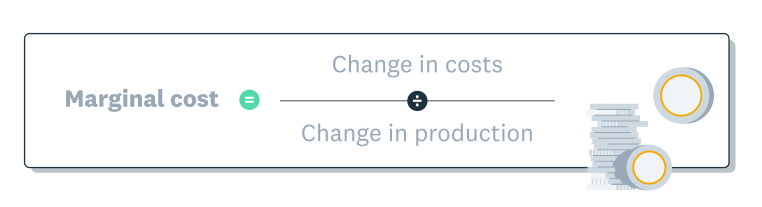
Marginal cost = change in total costs / change in quantity
Here's what each part means:
- Change in total costs: The difference between your total production costs at two output levels. This includes any increase in materials, labor, utilities, or other variable expenses.
- Change in quantity: The difference in the number of units produced between those same two output levels.
- Marginal cost (result): The cost per additional unit, which you compare to your selling price to determine whether producing more is profitable.
Say your total costs rise from $5,000 to $5,800 when you go from 100 to 120 units. Your marginal cost is $800 / 20 = $40 per unit.
How to calculate marginal cost
Calculating marginal cost takes just a few steps once you have your cost and production data ready. Let's break it down.
Understanding change in costs
The change in costs captures every additional expense tied to producing more units. This typically includes raw materials, direct labor, packaging, and any extra utility or supply costs.
Fixed costs like rent and insurance usually stay the same when you produce a few more units. So the change in costs focuses on the variable expenses that actually move when output changes. The Department of Commerce Cost Estimating Guide outlines how organizations separate fixed from variable costs when estimating production expenses.
Understanding change in quantity
The change in quantity is simply the difference between your new production level and your previous one. If you made 200 units last month and 250 this month, your change in quantity is 50.
Keep the quantity measurement consistent. If you're tracking weekly output, compare week to week. If monthly, compare month to month. Mixing time periods distorts the result.
Step-by-step calculation process
Follow these steps to calculate your marginal cost:
- Record your current total production cost. Add up every expense involved in producing your current output level, including materials, labor, and variable overhead.
- Record your current quantity produced. Note the total number of units you produced during the same period.
- Increase production and record the new totals. After producing additional units, record your new total cost and new total quantity.
- Calculate the change in costs. Subtract your original total cost from your new total cost.
- Calculate the change in quantity. Subtract your original quantity from your new quantity.
- Divide change in costs by change in quantity. The result is your marginal cost per unit.
Let's apply this with an example. Mohammed runs a bakery and currently produces 100 loaves of bread per day at a total cost of $300. He decides to increase production to 150 loaves. His new total cost rises to $400.
- Change in costs: $400 - $300 = $100
- Change in quantity: 150 - 100 = 50 loaves
- Marginal cost: $100 / 50 = $2 per loaf
Since Mohammed sells each loaf for $4.50, the $2 marginal cost means every additional loaf earns him $2.50 in profit. That's a strong signal to keep scaling up.
Now consider a larger jump. Mohammed pushes production from 150 to 250 loaves per day. His total costs rise from $400 to $680 because he needs a part-time assistant and more ingredients at higher volumes.
- Change in costs: $680 - $400 = $280
- Change in quantity: 250 - 150 = 100 loaves
- Marginal cost: $280 / 100 = $2.80 per loaf
The marginal cost per loaf increased from $2 to $2.80. Mohammed still profits at $4.50 per loaf, but the margin is thinner. This is a signal to watch costs closely before scaling further.
Marginal cost examples for small businesses
Marginal cost shows up differently depending on your industry. Here are three examples that show how the formula works in practice.
Manufacturing: custom candle maker
A candle maker produces 500 candles per month at a total cost of $2,500. She takes on a wholesale order and increases production to 700 candles. Her new total cost is $3,200.
- Change in costs: $3,200 - $2,500 = $700
- Change in quantity: 700 - 500 = 200 candles
- Marginal cost: $700 / 200 = $3.50 per candle
She sells each candle for $8. At $3.50 per additional candle, the wholesale order is profitable. The extra materials and wax cost less per unit at higher volume because her supplier offers a bulk discount.
Services: landscaping business
A landscaping company handles 40 residential jobs per month at a total cost of $12,000. The owner adds five new clients, pushing total costs to $13,250.

- Change in costs: $13,250 - $12,000 = $1,250
- Change in quantity: 45 - 40 = five jobs
- Marginal cost: $1,250 / 5 = $250 per job
Each job brings in $400 in revenue. The $250 marginal cost per job leaves a $150 margin. But the owner should watch whether adding more jobs requires hiring another crew member, which would push marginal costs up sharply.
Retail: online clothing store
An online clothing store sells 1,000 t-shirts per month at a total cost of $9,000. A social media campaign boosts demand to 1,300 shirts, raising total costs to $11,400.
- Change in costs: $11,400 - $9,000 = $2,400
- Change in quantity: 1,300 - 1,000 = 300 shirts
- Marginal cost: $2,400 / 300 = $8 per shirt
Each shirt sells for $25. The $8 marginal cost is well below the selling price, so filling the extra demand makes financial sense. However, if the store had to pay rush shipping fees or overtime to warehouse staff, that cost per shirt would climb.
What are the main components of marginal cost?
Understanding what goes into marginal cost helps you identify which expenses you can control as production changes.
Marginal cost is driven almost entirely by variable costs. These are the expenses that change in direct proportion to how much you produce. Common examples include:
- Raw materials and supplies
- Direct labor (hourly wages, overtime)
- Packaging and shipping
- Sales commissions
- Utility costs tied to production (electricity for equipment, for example)
Fixed costs, like rent, insurance, and salaried staff, don't typically factor into marginal cost. They stay the same whether you produce one more unit or 100 more. That's why marginal cost is often lower than your break-even cost per unit.
There's an important exception. When you hit a threshold that forces a new fixed expense, that cost enters the equation. Leasing a second workspace or buying another machine are common examples. These are sometimes called "step costs," and they can cause marginal cost to spike at certain output levels.
Economies of scale and marginal cost
Economies of scale explain why producing more often costs less per unit, at least up to a point.
When you increase production, you spread your fixed costs across a larger number of units. Your per-unit cost drops. At the same time, you may get bulk discounts on materials or use your labor more efficiently. This is where marginal cost falls.
Economists describe this pattern as a U-shaped curve. Marginal cost starts relatively high for your first few units, then decreases as you scale up and gain efficiencies. But eventually, it starts rising again. This happens when you hit capacity constraints: machines run at full speed, employees work overtime, or you need to source materials from more expensive suppliers.
The lowest point on the U-shaped curve is your optimal production point. It's where each additional unit costs you the least to make. Producing beyond that point means diminishing returns, where every extra unit starts eating into your margin.
For small businesses, the practical takeaway is straightforward. Growing production usually lowers costs at first. But if you keep pushing without upgrading your capacity, costs will climb and profits will shrink. Tracking marginal cost over time shows you exactly when that shift happens.
Why is marginal cost important for business planning?
Marginal cost gives you a fact-based foundation for some of your most important business decisions.
First, it sharpens your pricing. If you know each additional unit costs $6 to produce, you know any price above $6 contributes to profit. You can set competitive prices without accidentally selling at a loss.
Second, it guides production volume. Should you take on that big order? Marginal cost tells you whether the additional revenue will actually cover the additional expense. If it does, the order is worth it. If it doesn't, you can negotiate better terms or walk away.
Third, it helps you plan for growth. Understanding where marginal cost rises lets you budget for capacity investments at the right time. Investing too early wastes cash; investing too late leaves you scrambling.
In 2025, US small business sales growth averaged just 2.4% year over year. That's less than half the long-term average of 5.5%, according to Small Business Insights data. When revenue growth slows, understanding the exact cost of each additional unit helps you protect margins.
Marginal cost analysis also supports contribution margin calculations, which show how much each product contributes to covering your fixed costs and generating profit.
Marginal revenue vs marginal cost
Marginal cost and marginal revenue work as a pair. Together, they tell you whether producing one more unit makes financial sense.
Marginal revenue is the additional income you earn from selling one more unit. In most small business scenarios, this equals your selling price. If you sell handmade wallets for $45 each, your marginal revenue is $45.
Now compare that to your marginal cost. If producing one more wallet costs $18, you earn $27 in additional profit. That's a clear signal to keep producing.
But what happens if you need to discount to sell more? Say you lower the price to $30 to attract bulk buyers, and your marginal cost rises to $22 because of overtime labor. Your margin drops to $8 per wallet, which is still profitable but noticeably thinner.
The golden rule is this: keep producing as long as marginal revenue exceeds marginal cost. The moment marginal cost equals marginal revenue, you've hit the profit-maximizing point. Producing beyond that point means every additional unit loses money.
How to apply marginal cost to business decisions
Knowing your marginal cost is useful, but applying it to real decisions is where it creates value.
When to scale up
If your marginal cost is comfortably below your selling price and demand is growing, scaling up makes sense. You're earning a healthy margin on each extra unit.
Before committing, check whether your current capacity can handle the increase. If you need to hire staff, buy equipment, or lease space, factor those step costs into the calculation. According to the U.S. Small Business Administration, creating a clear financial plan before scaling helps you avoid cash flow surprises.
When to scale down
If marginal cost is approaching or exceeding your selling price, it's time to pull back. Producing at a loss erodes your cash reserves quickly.
Scaling down doesn't always mean cutting production. Sometimes it means renegotiating supplier contracts, reducing overtime, or pausing a product line while you restructure costs. The goal is to bring marginal cost back below the price point where each unit is profitable.
Handling revenue volatility
Small business revenue can shift dramatically from one month to the next. When conditions change that quickly, production decisions based on outdated cost assumptions can erode profits fast.
Review your marginal cost regularly, not just once a quarter. When revenue swings month to month, your cost assumptions should keep pace. Update your calculations whenever input costs change, demand shifts, or you adjust pricing.
Common limitations of marginal cost analysis
Marginal cost is a powerful tool, but it has real-world limitations you should keep in mind.
The formula assumes you can cleanly separate variable costs from fixed costs. In practice, some expenses blur the line. A salaried employee who works overtime when production spikes is technically a fixed cost that behaves like a variable one.
Marginal cost analysis also assumes costs change smoothly as output rises. In reality, costs often jump in steps. Hiring one more employee or ordering from a new supplier creates a sudden increase, not a gradual slope.
The formula works best over short time horizons. Over longer periods, fixed costs can shift (your lease renews at a higher rate, for example), and input prices fluctuate with market conditions. A marginal cost calculation from six months ago may not reflect your current situation.
Quality and waste also affect accuracy. If producing faster leads to more defective products, your true marginal cost is higher than the formula suggests. You need to account for rework, returns, and scrap.
Finally, marginal cost doesn't capture opportunity cost. Choosing to produce more of one product may mean producing less of another. The formula won't flag that trade-off for you.
Track your costs and make smarter decisions with Xero
Making confident production and pricing decisions starts with knowing your numbers. Xero gives you real-time visibility into your costs, revenue, and cash flow. You can spot changes as they happen, not weeks later.
With automated bank reconciliation and expense tracking, you always have up-to-date cost data at your fingertips. Customizable reports let you break down spending by category, so separating fixed and variable costs becomes straightforward. And with cash flow forecasting, you can plan ahead before scaling up or pulling back.
Whether you're tracking costs for one product or comparing your entire range, current financial data makes all the difference. See how it works for your business and get started today.
FAQs on marginal cost
Here are answers to frequently asked questions about marginal cost.
What is the difference between marginal cost and average cost?
Marginal cost measures the expense of producing one additional unit, while average cost divides your total production costs by the total number of units produced. A product with a low average cost can still have a high marginal cost if you're pushing beyond efficient capacity.
When should I use marginal cost analysis for my business?
Use it whenever you're deciding whether to accept a new order, adjust your prices, or change your production volume. It's especially useful during periods of growth or when costs are shifting, because it shows you the real financial impact of each additional unit.
How can I reduce my marginal cost?
Focus on reducing input costs by negotiating better supplier rates and look for waste or inefficiency in your production process. Buying materials in bulk and investing in staff training are two effective ways to bring per-unit costs down.
What are common mistakes when calculating marginal cost?
The most common mistake is including fixed costs that don't actually change with production. Another is using inconsistent time periods; always match your cost data and quantity data to the same production window.
How does marginal cost help with pricing decisions?
Your marginal cost sets the floor for your pricing. Any price above marginal cost generates a contribution toward your fixed costs and profit. By knowing this number, you can set prices that stay competitive while protecting your margins on every unit sold.
Disclaimer
Xero does not provide accounting, tax, business or legal advice. This guide has been provided for information purposes only. You should consult your own professional advisors for advice directly relating to your business or before taking action in relation to any of the content provided.
Get 90% off for 6 months
Get 90% off for 6 months on any Xero plan.