What is dropshipping? How it works and how to start in the UK
Learn how dropshipping works, UK legal requirements, and how to start selling online without holding stock.
Written by Lena Hanna—Trusted CPA Guidance on Accounting and Tax. Read Lena's full bio
Written by Lena Hanna—Trusted CPA Guidance on Accounting and Tax. Read Lena's full bio
Published Monday 15 June 2026
Table of contents
Key takeaways
- Dropshipping lets you sell products online without holding stock. A third-party supplier ships items directly to your customer, keeping upfront costs low and removing the need for warehouse space.
- The global dropshipping market is valued at $543.53 billion in 2026 (Grand View Research), making it one of the fastest-growing ecommerce models for entrepreneurs looking for a flexible, low-risk way to start selling.
- UK sellers must meet specific legal obligations, including business registration with HMRC, VAT compliance once turnover exceeds £90,000, and adherence to the Consumer Rights Act 2015.
- Choosing reliable suppliers and tracking your finances from day 1 are the 2 factors that most often separate successful dropshipping businesses from those that struggle.
What is dropshipping?
If you're looking for a way to sell products online without buying and storing stock upfront, dropshipping could be the right fit for you.
Dropshipping is a retail fulfilment method where you sell products through your own online store without ever holding inventory. When a customer places an order, you pass it to a third-party supplier who picks, packs, and ships the item directly to the buyer.
You don't need a warehouse, and you only pay for products after you've already made a sale. The global dropshipping market was valued at $543.53 billion in 2026, according to Grand View Research, which shows how popular this model has become for entrepreneurs seeking a low-barrier route into ecommerce.
Because you're not buying stock upfront, you can test different products and niches with minimal financial risk. Many UK-based sellers use dropshipping to run a home business with little more than a laptop and an internet connection. You can explore more online business ideas to see how dropshipping compares to other models.
How does dropshipping work?
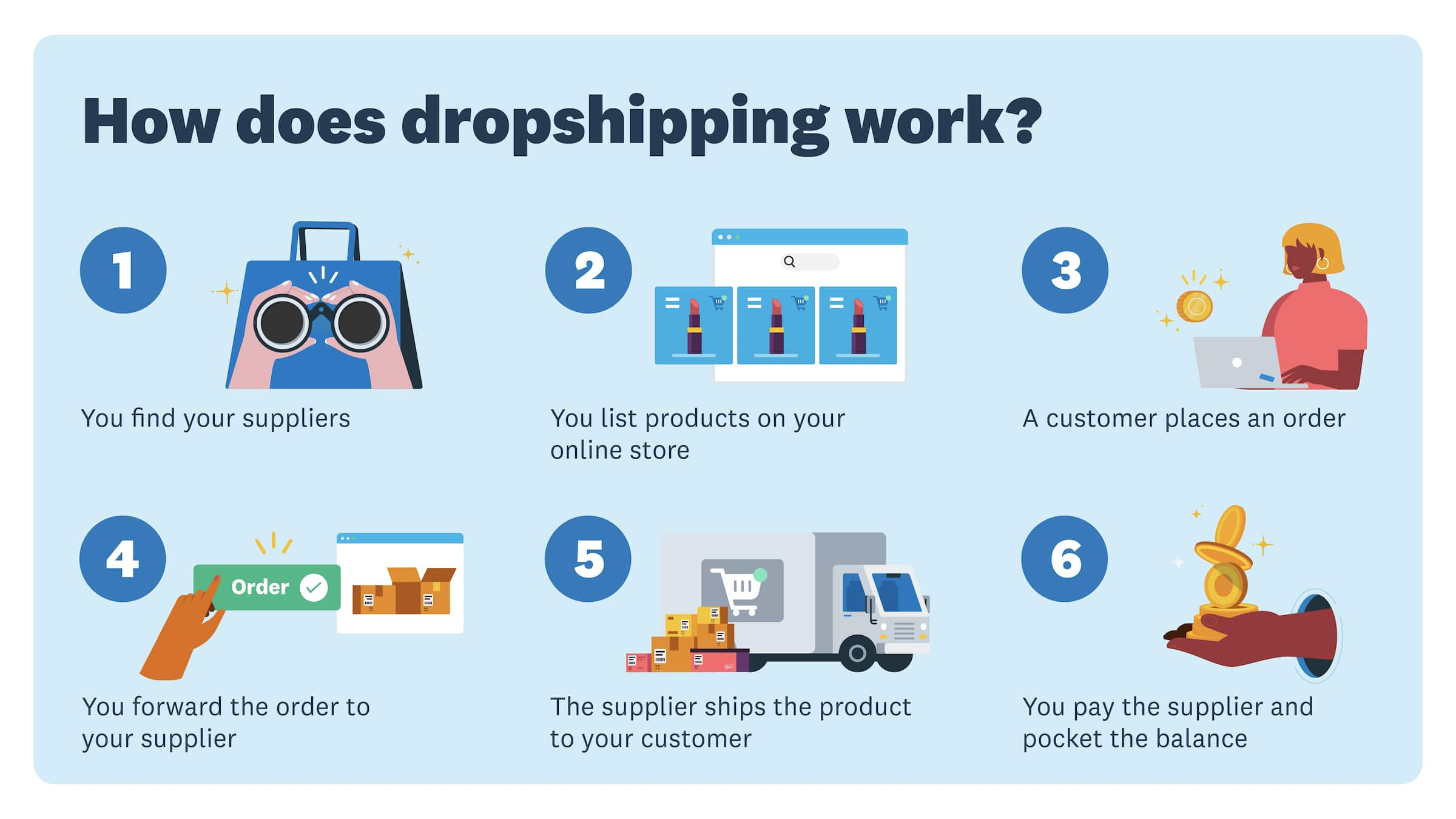
Dropshipping follows a straightforward 6-step process that keeps you focused on marketing and customer service while your supplier handles fulfilment. Here's how a typical order flows from start to finish.
1. You set up your online store
2. A customer places an order
A shopper visits your store, chooses a product, and completes the checkout. You collect the retail price from the customer at this point.
3. You forward the order to your supplier
Once you receive the order, you send the details to your dropshipping supplier. Many platforms automate this step so the order goes through instantly.
4. Your supplier picks and packs the product
The supplier locates the item in their warehouse, packages it (sometimes with your branding), and prepares it for dispatch.
5. The supplier ships the order to your customer
Your supplier sends the product directly to the customer's address. The buyer receives the parcel as if it came from your business.
6. You keep the profit margin
Your profit is the difference between the retail price the customer paid and the wholesale price you paid the supplier. You can track these margins carefully by monitoring your ecommerce metrics from day 1.
Dropshipping vs traditional retail
Understanding the differences between dropshipping and traditional retail can help you decide which model suits your goals. Both involve selling products to customers, but they differ in how you manage stock, how much you invest, and how much risk you take on.
Here are the 3 main differences.
- Inventory: with traditional retail, you buy products in bulk and store them in a warehouse or shop. With dropshipping, your supplier holds all the stock and ships items on your behalf, so you never need to manage inventory yourself.
- Upfront investment: traditional retail requires significant capital to purchase stock, rent storage space, and handle logistics. Dropshipping needs far less upfront spending because you only pay the supplier after a customer has already paid you.
- Risk: if products don't sell in a traditional model, you're left with unsold stock. Dropshipping reduces this risk because you're not committed to buying inventory before you have confirmed orders.
This distinction matters in the current UK market. In the December quarter of 2025, small retail businesses saw sales fall by 0.7% year-on-year while still increasing hiring by 3.8%, according to Xero Small Business Insights; a pattern that points to tightening margins for traditional retailers carrying stock.
Dropshipping tends to work well for niche items with a dedicated audience, high-value goods where you can earn a healthy margin, and trendy or seasonal products that benefit from quick testing. For everyday commodities with razor-thin margins, traditional wholesale may still be the better choice.
Dropshipping pros and cons
Like any business model, dropshipping comes with clear benefits and some notable drawbacks. Knowing both sides helps you make a more informed decision before you commit.
The main benefits of dropshipping include:
- Low startup costs: you don't need to buy inventory upfront, so the financial barrier to entry is much lower than traditional retail.
- Location flexibility: you can run your business from anywhere with an internet connection, making it a popular choice for people looking for flexible working.
- Wide product range: because you're not limited by warehouse space, you can offer a large catalogue of products without additional storage costs.
- Easy to scale: when order volumes increase, your supplier handles the extra fulfilment work, so scaling up doesn't require proportional investment in staff or infrastructure.
- Lower risk of dead stock: you only order products once customers have bought them, which means you're less likely to be stuck with items that don't sell.
The main drawbacks of dropshipping include:
- Lower profit margins: wholesale prices from dropshipping suppliers tend to be higher per unit than bulk purchasing, which can squeeze your margins. Typical margins fall between 15% and 30%.
- Less control over fulfilment: your supplier manages packaging, shipping speed, and product quality, so mistakes on their end reflect poorly on your brand.
- Intense competition: because the barrier to entry is low, many sellers compete on the same products, which can drive prices down.
- Shipping complexity: if you work with multiple suppliers, customers who order several items may receive separate parcels at different times, which can lead to confusion.
- Supplier accountability: if a supplier sends faulty goods or fails to deliver, resolving the issue can be difficult, especially when the supplier is based overseas.
UK legal requirements for dropshipping
Running a dropshipping business in the UK means you're subject to the same legal obligations as any other online retailer. Here's what you need to know before you start selling.
Business registration
You'll need to register your business with HMRC before you begin trading.
Most dropshippers start as a sole trader, which is the simplest option and involves registering for Self Assessment. If you want limited liability protection, you can set up a limited company through Companies House instead. Either way, you'll need to keep accurate financial records from day 1.
VAT obligations
VAT registration becomes mandatory once your taxable turnover exceeds £90,000 in a 12-month period.
Even below this threshold, you can register voluntarily, which may benefit you if your suppliers charge VAT. Keep accurate records of all transactions so you can file your VAT returns correctly. Making Tax Digital (MTD) for VAT is now in effect, so you'll need compatible software to submit returns digitally.
Consumer Rights Act 2015
As the retailer, you're legally responsible for the products you sell, even though you don't handle them physically.
Under the Consumer Rights Act 2015, goods must be of satisfactory quality, fit for purpose, and as described. Distance selling regulations also give your customers a 14-day cooling-off period during which they can cancel their order and return the product for a full refund. You're responsible for processing that refund regardless of your supplier's policies.
Product safety standards
Products you sell in the UK must meet local safety standards, and many product categories require specific conformity marking.
The UK government now accepts both UKCA (UK Conformity Assessed) and CE marking indefinitely for products sold in Great Britain. This applies to electronics, toys, cosmetics, and many other goods. If your supplier is based outside the UK, confirm that the products carry the correct marking before listing them.
Data protection under UK GDPR
If you collect customer data (names, addresses, email addresses, payment details), you must comply with the UK General Data Protection Regulation (UK GDPR).
This means having a clear privacy policy, only collecting data you genuinely need, storing it securely, and giving customers the right to access or delete their information on request.
How to choose a dropshipping supplier
Your supplier directly affects product quality, delivery speed, and customer satisfaction. Choosing the right one is one of the most important decisions you'll make when starting an ecommerce business.
When evaluating potential suppliers, consider these key criteria:
- Location: a UK-based supplier can offer faster delivery times and simpler customs processes compared to overseas alternatives.
- Reputation: check reviews, testimonials, and how long the supplier has been operating. A strong track record suggests reliability.
- Minimum orders: some suppliers require minimum order quantities. Confirm these upfront so there are no surprises once you start selling.
- Dispatch times: ask how quickly orders are processed and shipped. Slow fulfilment leads to unhappy customers and negative reviews.
- Packaging quality: if possible, order samples to check the product and packaging quality before listing items in your store.
Before you commit to a supplier, ask these questions:
- What's the average dispatch and delivery time to UK customers?
- Do you offer branded or custom packaging?
- What's your returns and refund process?
- Can you provide product safety documentation and conformity certificates?
- Do you integrate with ecommerce platforms like Shopify, WooCommerce, or Amazon?
Watch out for these red flags when assessing suppliers:
- Unrealistically low prices that suggest poor quality
- No verifiable business address or contact details
- Reluctance to provide product samples
- Consistently poor reviews mentioning late deliveries or damaged goods
- Unclear or non-existent returns policies
Once you've found a supplier you trust, it helps to know which platforms are popular with UK sellers.
Best UK dropshipping suppliers
Finding a supplier that serves UK customers reliably can save you time and reduce shipping headaches. Here are 6 platforms that UK-based dropshippers commonly use.
- Avasam: a UK-based dropshipping platform that connects you with verified suppliers and automates order processing. It integrates with major ecommerce platforms and handles fulfilment from UK warehouses, which means faster delivery times for your customers.
- CJ Dropshipping: a global supplier with UK warehouse options, offering product sourcing, branding services, and automated order fulfilment. It's popular with sellers who want a wide product range and competitive pricing.
- AliExpress: one of the largest global marketplaces for dropshipping, with millions of products at low wholesale prices. Delivery times to the UK can be longer for items shipped from overseas, so check whether your chosen seller offers UK or European warehousing.
- SaleHoo: a supplier directory that vets wholesalers and dropshipping companies before listing them. It's useful for finding trusted suppliers across multiple product categories and includes market research tools to help you identify profitable niches.
- Wholesale Central: a free supplier directory that lists UK and international wholesalers. It's a good starting point for researching suppliers, though you'll need to vet each one individually before committing.
- Printful: a print-on-demand supplier that lets you sell custom-designed products like t-shirts, hoodies, mugs, and posters. Printful handles printing, packaging, and shipping, making it a strong option if you want to build a brand around original designs.
Each platform has different strengths, so compare pricing, delivery speeds, and integration options before you decide. The right choice depends on your product niche, target market, and how much control you want over branding.
Dropshipping business models
Not all dropshipping businesses operate in the same way. The model you choose affects your margins, branding opportunities, and day-to-day operations. Here are the 3 most common approaches.
Wholesale dropshipping
This is the most traditional form of dropshipping.
You partner with a wholesaler who holds stock and ships products on your behalf. You typically get lower per-unit costs but less control over branding and packaging. It works well for sellers who want to offer a broad range of products at competitive prices.
Print-on-demand
With print-on-demand, you sell custom-designed products like t-shirts, mugs, or phone cases.
A supplier prints your design on the product only after a customer orders it. This model is ideal if you want to build a brand around unique designs without investing in stock.
Retail dropshipping
Retail dropshipping involves listing products from other retailers at a markup.
You purchase the item from the original retailer at its listed price and have it shipped to your customer. Margins tend to be slim, and you have limited control over stock levels, but it's a quick way to start without formal supplier agreements.
With your business model chosen, you can move on to setting up your dropshipping business step by step.
How to start dropshipping in 6 steps
Getting your dropshipping business off the ground doesn't require a complicated setup, and starting an online business in the UK is more straightforward than many people expect. Follow these 6 steps to go from idea to first sale.
1. Find your market niche
Start by identifying a specific product category or audience that isn't oversaturated.
Conduct market research to understand what people are searching for, what competitors are offering, and where there's room for you to stand out. Look for niches where customers have a genuine need and are willing to pay a fair price. Passion products, hobby-related items, and problem-solving gadgets often perform well.
2. Choose reliable suppliers
Use the criteria from the supplier selection section to vet your options.
Order samples, compare dispatch times, and confirm that all products meet UK safety standards. A dependable supplier is the foundation of a successful dropshipping operation.
3. Create your online store
Set up a website using an ecommerce platform like Shopify, WooCommerce, or BigCommerce.
You can also list products on marketplaces. Your store should look professional, load quickly, and make it easy for customers to browse, buy, and contact you.
4. Set competitive pricing
Your pricing needs to cover the wholesale cost, platform fees, marketing spend, and still leave you with a healthy margin.
Research what competitors charge for similar items and set your prices carefully to stay competitive without undervaluing your products.
5. Optimise your product listings
Write clear, honest product descriptions that highlight benefits and key features.
Use high-quality images and include relevant keywords so your listings appear in search results. Good listings reduce returns and build trust with buyers.
6. Plan your marketing strategy
Decide how you'll attract customers to your store.
Social media advertising, search engine optimisation (SEO), email marketing, and content marketing are all effective channels. Start small, measure results, and focus your budget on the channels that deliver the best return. You can learn more about selling products online to refine your approach.
Dropshipping tools and automation
The right tools can save you hours of manual work each week and help you manage your dropshipping business more efficiently. Here's a look at the 3 main categories of tools you'll need.
Ecommerce platforms are the foundation of your online store:
- Shopify: a popular all-in-one platform that makes it straightforward to set up a store, list products, and connect with dropshipping suppliers through built-in apps.
- WooCommerce: an open-source plugin for WordPress that gives you full control over your store's design and functionality. It's a good fit if you want flexibility and already use WordPress.
- BigCommerce: a hosted platform with built-in features for multi-channel selling, which suits dropshippers who want to list products across their own website, Amazon, and eBay simultaneously.
Automation tools handle the repetitive tasks that eat into your time:
- Order routing software automatically forwards customer orders to your supplier, removing the need for manual data entry.
- Inventory sync tools update your product listings in real time so you don't accidentally sell items that are out of stock.
- Repricing tools monitor competitor pricing and adjust your prices automatically to stay competitive.
Accounting software keeps your finances organised as your business grows:
- Automatic bank reconciliation matches your incoming payments with your sales records, so you always know exactly where your money stands.
- VAT tracking helps you stay on top of your obligations, especially once your turnover approaches the £90,000 threshold. With Making Tax Digital in effect, you'll need software that can submit VAT returns digitally.
- App integrations connect your ecommerce platform directly to your accounting software, so sales data flows through automatically without manual entry.
Xero connects with popular ecommerce platforms through the Xero App Store, bringing your sales, expenses, and supplier payments into 1 place. This gives you a clear, real-time picture of your profitability without the manual bookkeeping.
Dropshipping product ideas
Choosing the right products can make a significant difference to your success. These categories tend to perform well for UK-based dropshippers because they combine steady demand with reasonable margins. For broader ecommerce guidance, Xero has a full library of resources.
- Health and self-care: items like resistance bands, massage tools, skincare accessories, and wellness journals are popular with health-conscious shoppers. This category benefits from repeat purchases and strong brand loyalty.
- Fashion accessories: jewellery, watches, sunglasses, scarves, and bags allow you to target specific style niches without the complexity of clothing sizes.
- Home and garden: organisational products, kitchen gadgets, plant pots, and decorative items are consistently in demand, especially during seasonal peaks.
- Tech accessories: phone cases, cable organisers, portable chargers, and laptop stands are lightweight, easy to ship, and attract a broad audience.
- Eco-friendly products: reusable bags, bamboo toothbrushes, beeswax wraps, and stainless steel straws appeal to environmentally conscious consumers, a growing segment of the UK market.
Before committing to any product, validate demand by checking search trends, reviewing competitor listings, and ordering samples to test quality. A product that looks good on paper still needs to meet customer expectations in practice.
Streamline your dropshipping business with Xero
Keeping your finances organised is essential when you're managing supplier payments, customer refunds, and fluctuating margins. Xero's accounting software connects with popular ecommerce platforms so you can automatically reconcile sales, track expenses, and monitor cash flow in real time.
You can link your online store through the Xero App Store, which integrates with platforms like Shopify, WooCommerce, and Amazon. Your sales data flows directly into Xero, reducing manual data entry and giving you a clear picture of your profitability at any point.
Whether you're tracking VAT obligations, reconciling supplier invoices, or reviewing your margins across different product lines, Xero helps you spend less time on bookkeeping and more time growing your business; get one month free.
FAQs on dropshipping
Here are the answers to some frequently asked questions about dropshipping.
Is dropshipping legal in the UK?
Yes, dropshipping is completely legal in the UK. You'll need to register your business with HMRC, comply with the Consumer Rights Act 2015, and register for VAT if your turnover exceeds £90,000.
Why do most dropshipping businesses fail?
Most dropshipping businesses fail because of unrealistic expectations, poor supplier choices, and weak marketing. Focusing on a specific niche, vetting suppliers thoroughly, and investing in customer service significantly improves your chances.
Can I start dropshipping with no money?
You can start with very little capital since you don't buy inventory upfront. However, you'll still need to cover costs like a domain name, ecommerce platform subscription, and initial marketing, so a small budget of a few hundred pounds is realistic.
How much do dropshippers make?
Earnings vary widely depending on your niche, pricing strategy, and marketing effectiveness. Typical profit margins fall between 15% and 30% per order, with some sellers earning a few hundred pounds a month and others building full-time businesses.
Is dropshipping profitable in 2026?
Yes, with the global market valued at $543.53 billion in 2026 (Grand View Research), dropshipping remains a viable business model. Success depends on choosing the right niche, working with reliable suppliers, and differentiating yourself through strong customer service.
Disclaimer
Xero does not provide accounting, tax, business or legal advice. This guide has been provided for information purposes only. You should consult your own professional advisors for advice directly relating to your business or before taking action in relation to any of the content provided.
Get one month free
Purchase any Xero plan, and we will give you the first month free.