Gross profit vs net profit: what's the difference?
Learn the difference between gross and net profit, with formulas, examples and tips.
Published Thursday 23 July 2026
Table of contents
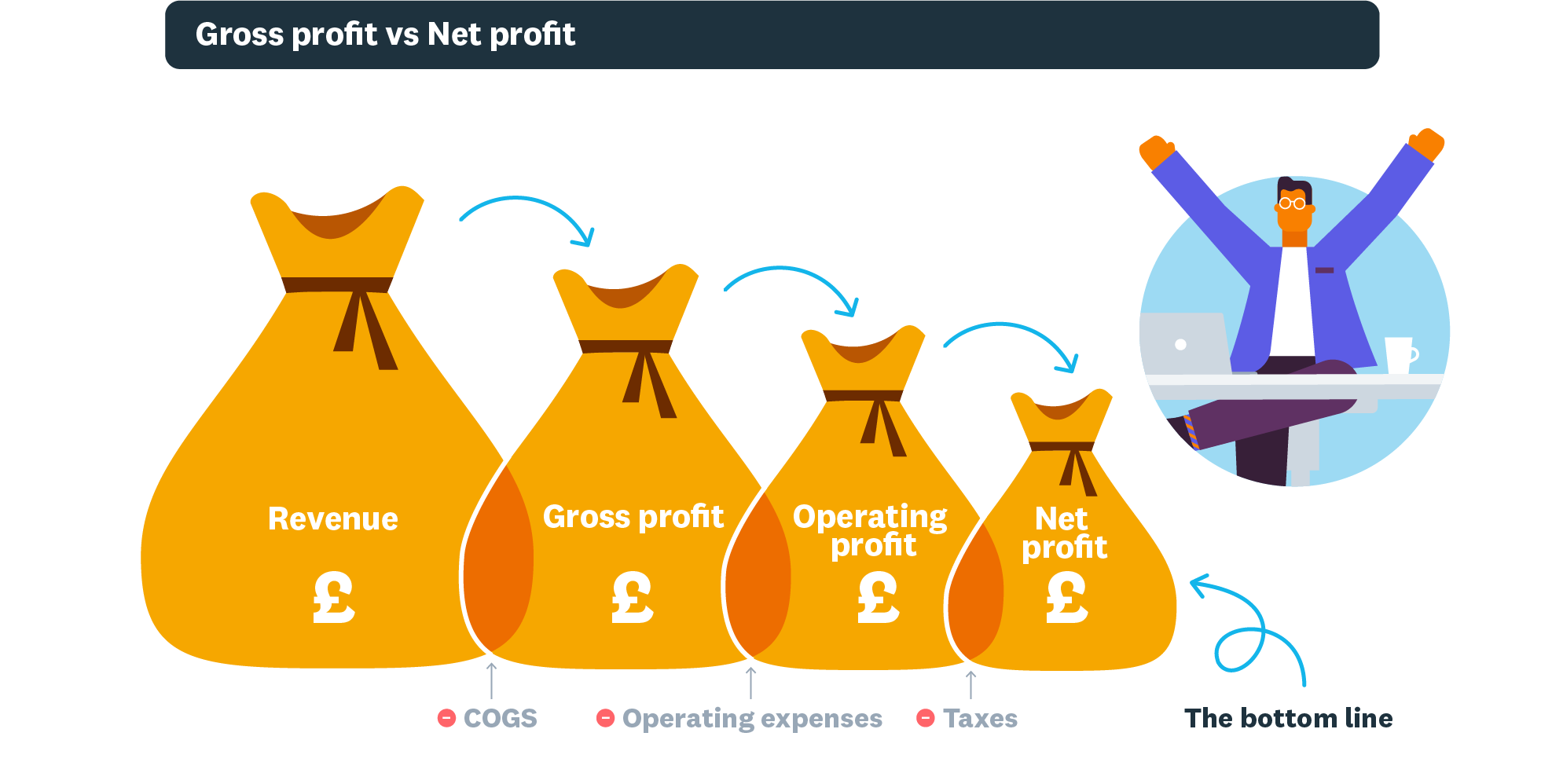
The difference between gross profit and net profit is operating expenses and taxes
Key takeaways
- Gross profit is your revenue minus the cost of goods sold (COGS), showing how much you earn from sales before other expenses are deducted.
- Net profit is what's left after all expenses, including operating costs, interest and tax, have been subtracted from your revenue.
- Both figures matter for different reasons: gross profit reveals how efficiently you produce or source goods, while net profit shows your overall profitability.
- UK businesses pay Corporation Tax on net profit, not gross profit, so understanding the difference helps you plan for your tax bill.
What is gross profit?
Gross profit is the amount of money your business keeps after subtracting the direct costs of producing or purchasing the goods and services you sell. It's one of the first profitability measures to check when reviewing your finances.
The direct costs subtracted are known as the cost of goods sold (COGS). COGS covers everything directly tied to making or delivering your product, such as raw materials, manufacturing labour and shipping fees.
What does gross profit include?
Gross profit accounts for the relationship between your sales revenue and the direct costs behind those sales. It includes:
- Total revenue from selling goods or services.
- Minus the cost of raw materials and components.
- Minus direct labour costs involved in production.
- Minus packaging, freight and delivery charges tied to sales.
It does not include indirect expenses such as rent, marketing, administrative salaries or loan interest. Those come out of net profit instead.
Gross profit formula and example
The formula for gross profit is straightforward:
Gross profit = revenue - COGS
Here's an example. Imagine you run a small bakery in Manchester. In a given month, your total revenue from sales is £20,000. Your COGS, including flour, butter, packaging and production staff wages, comes to £8,000.
Your gross profit for that month is £20,000 - £8,000 = £12,000.
This tells you that for every pound of revenue, you're keeping £0.60 before covering your other business expenses. A healthy gross profit gives you a solid foundation to pay rent, utilities, marketing costs and everything else needed to run the business.
What is net profit?
Net profit is the amount of money your business retains after deducting all expenses from your total revenue. It's often called the "bottom line" because it appears at the bottom of your profit and loss statement.
Where gross profit only subtracts COGS, net profit goes further by also removing operating expenses, interest payments and tax. It gives you the clearest picture of how much your business actually earns.
What does net profit include?
Net profit takes gross profit as its starting point and then subtracts every remaining cost. These additional costs typically include:
- Rent, utilities and office expenses.
- Salaries for administrative, sales and marketing staff.
- Marketing and advertising spend.
- Insurance premiums.
- Loan interest and bank charges.
- Depreciation and amortisation.
- Corporation Tax (or income tax for sole traders).
Net profit formula and example
The formula for net profit is:
Net profit = gross profit - operating expenses - interest - tax
Using the bakery example again, suppose your gross profit is £12,000 for the month. Your operating expenses break down as follows: rent is £2,000, staff salaries (non-production) are £3,000, marketing costs are £500, utilities are £300 and insurance is £200. You also pay £150 in loan interest. Your estimated Corporation Tax for the month is £1,168.
Your net profit is £12,000 - £6,000 - £150 - £1,168 = £4,682.
That £4,682 is what you can reinvest in the business, save or take as drawings. It's the truest measure of your business's financial health.
What is the difference between gross profit and net profit?
The core difference between gross profit and net profit comes down to which costs are subtracted from your revenue. Gross profit only removes the direct costs of producing your goods or services, while net profit removes every expense your business incurs.
Think of it this way: gross profit shows how profitable your products or services are on their own. Net profit shows how profitable your entire business is once all the bills are paid.
Here's a quick breakdown of how they compare:
- Gross profit = revenue minus COGS only.
- Net profit = revenue minus COGS, operating expenses, interest and tax.
- Gross profit is always higher than (or equal to) net profit.
- Gross profit helps you assess pricing and production efficiency.
- Net profit helps you assess overall business viability and cash available for growth.
Both metrics are valuable. If your gross profit is strong but your net profit is thin, it signals that your overhead or operating costs may be too high. If gross profit itself is low, you may need to revisit your pricing, suppliers or production methods.
What is a good gross profit margin?
A "good" gross profit margin depends heavily on your industry. Gross profit margin is expressed as a percentage and calculated by dividing your gross profit by your revenue, then multiplying by 100.
Gross profit margin = (gross profit / revenue) x 100
As a general guide, here are typical gross profit margins for common small business sectors in the UK:
- Retail: 25% to 50%, depending on product type.
- Food and hospitality: 60% to 70% on food, lower on beverages.
- Professional services (for example, consulting or accounting): 50% to 80%.
- Construction and trades: 15% to 30%.
- Manufacturing: 25% to 40%.
If your gross profit margin falls below the average for your sector, it could indicate that your COGS are too high relative to your prices. Reviewing supplier contracts, adjusting pricing or reducing waste can all help improve this figure.
What is a good net profit margin?
Net profit margin shows the percentage of revenue that remains as profit after all costs are paid. It's calculated the same way as gross profit margin, but uses net profit instead.
Net profit margin = (net profit / revenue) x 100
For most UK small businesses, a net profit margin between 5% and 20% is considered healthy. Here are some benchmarks by sector:
- Retail: 2% to 6%.
- Food and hospitality: 3% to 9%.
- Professional services: 15% to 25%.
- Construction and trades: 5% to 10%.
- Manufacturing: 5% to 12%.
A net profit margin below 5% means your business has very little financial cushion. Seasonal businesses may see wide swings from month to month, so it's best to track your net margin over a full year to get an accurate picture.
How to improve your gross profit
Improving gross profit means either increasing your revenue or reducing your COGS. Here are practical strategies that UK small businesses can put into action.
- Review your pricing. If your costs have risen but your prices haven't, your gross margin will shrink. Benchmark against competitors and consider a price adjustment.
- Negotiate with suppliers. Request volume discounts, compare quotes from alternative suppliers or renegotiate payment terms to lower your material costs.
- Reduce waste. Track inventory closely to avoid spoilage, overproduction or excess stock. Even small reductions in waste add up over time.
- Improve production efficiency. Streamline your processes, invest in training or adopt tools that help you produce more with fewer resources.
- Focus on higher-margin products. If some products or services deliver better margins than others, shift your sales focus towards those lines.
How to improve your net profit
Improving net profit involves managing all your costs, not just production expenses. These strategies target the overheads and operating costs that sit between gross and net profit.
- Cut unnecessary overheads. Audit your recurring expenses. Cancel unused subscriptions, renegotiate your lease or switch to more cost-effective service providers.
- Automate repetitive admin. Manual bookkeeping, invoicing and bank reconciliation eat into your time and increase staffing costs. Accounting software can handle these tasks faster and more accurately.
- Chase invoices promptly. Late payments from customers hurt your cash flow and can force you into costly overdrafts. Set up automated payment reminders to get paid on time.
- Review your staffing model. Consider whether freelancers, part-time staff or outsourced services might be more cost-effective than full-time hires for certain roles.
- Claim all eligible tax deductions. Make sure you're deducting every allowable business expense. Missed deductions directly reduce your net profit.
- Monitor your finances regularly. Reviewing your profit and loss statement monthly, rather than once a year, helps you spot problems early and make adjustments before they erode your margins.
Does a business pay tax on gross or net profit?
In the UK, businesses pay tax on net profit, not gross profit. The tax treatment depends on your business structure.
If you run a limited company, you'll pay Corporation Tax on your taxable profits. As of April 2024, the main Corporation Tax rate is 25% for companies with profits over £250,000, with a small profits rate of 19% for companies with profits of £50,000 or less. A marginal relief applies for profits between those 2 thresholds.
If you're a sole trader or in a partnership, you'll pay income tax on your net business profits through Self Assessment. National Insurance contributions also apply.
This is why tracking both gross and net profit matters. Your gross profit tells you whether your pricing and production costs are sustainable. Your net profit determines how much tax you'll owe and how much cash you'll have left to reinvest or take home.
Simplify your profit tracking with Xero
Keeping a clear view of your gross and net profit doesn't have to involve spreadsheets and guesswork. Cloud accounting software can automate the calculations, pull in real-time data from your bank and generate profit and loss reports whenever you need them.
With Xero, you can track your income and expenses in one place, reconcile bank transactions automatically and see your profitability at a glance. It's designed for small business owners who'd rather focus on running their business than wrestling with the numbers. Get one month free.
FAQs on gross profit vs net profit
Here are answers to frequently asked questions about gross profit vs net profit.
Does gross profit include wages?
It depends on the type of wages. Gross profit includes wages for staff directly involved in producing goods or delivering services, as these form part of COGS. It doesn't include wages for administrative, sales or other non-production staff; those are deducted when calculating net profit.
Can gross profit be negative?
Yes, gross profit can be negative if your COGS exceeds your revenue. This means you're spending more to produce your goods or services than you're earning from selling them, which isn't sustainable and typically signals a need to raise prices or reduce production costs.
What is the difference between gross profit and gross profit margin?
Gross profit is a currency amount (for example, £12,000), while gross profit margin is a percentage that shows gross profit as a proportion of revenue. Profit margins make it easier to compare profitability across time periods or against other businesses, even if revenue levels differ.
Why might a company have high gross profit but low net profit?
This usually happens when operating expenses are high relative to revenue. A business might produce goods cheaply but spend heavily on rent, marketing, staffing or debt repayments, leaving little profit after all costs are covered.
Handy resources
Advisor directory
You can search for experts in our advisor directory
Xero Small Business Guides
Discover resources to help you do better business
Financial reporting
Keep track of your performance with accounting reports
Disclaimer
This glossary is for small business owners. The definitions are written with their requirements in mind. More detailed definitions can be found in accounting textbooks or from an accounting professional. Xero does not provide accounting, tax, business or legal advice.