Marginal cost: formula, examples and how to calculate
Learn how to calculate marginal cost and use it to price smarter and protect your profits.

Written by Jotika Teli—Certified Public Accountant with 24 years of experience. Read Jotika's full bio
Published Monday 20 April 2026
Table of contents
Key takeaways
- Calculate your marginal cost by dividing the change in total production costs by the change in number of units produced, so you can see exactly what each extra unit costs to make.
- Compare marginal cost to average cost to guide production decisions: if marginal cost is lower than average cost, increase production to boost profits; if it's higher, keep production at its current level.
- Stop increasing production when marginal cost equals marginal revenue, as producing beyond this point means each extra unit costs more to make than it earns in sales.
- Recognise that both underproducing and overproducing hurt your profits: too little output means fixed costs are spread across fewer units, while too much output can push costs up faster than revenue grows.
What is marginal cost?
Marginal cost is the additional expense of producing one extra unit of a product or service. Understanding this figure helps you set prices that protect your margins (especially since research shows a 5% price increase increases EBIT by an average of 22%) and decide whether expanding production will boost or reduce your profits.
Marginal cost calculations help with key business decisions:
- Plan cash flow: determine if you can afford increased production
- Set pricing: establish prices that protect your profit margins
- Optimise production: find the right number of units to produce
- Evaluate expansion: assess whether growth opportunities are profitable
What are the main components of marginal cost?
Marginal cost components are the expenses that change when you produce additional units. Two main cost categories affect your calculation:
- Variable costs: expenses that rise with production volume, such as materials, hourly wages, utilities and shipping
- Fixed costs: expenses that stay constant regardless of volume, such as rent, equipment and salaried staff
Higher production spreads fixed costs across more units, reducing the cost per item.
How to calculate marginal cost
Here's how to work out your marginal cost step by step.
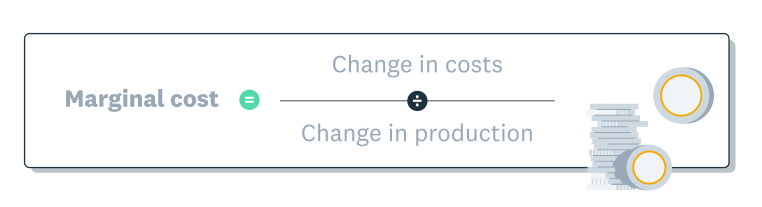
Marginal cost calculation shows you the exact expense of producing one more unit, so you can decide whether increasing output will boost or reduce your profits.
Marginal cost formula
The formula divides the change in costs by the change in quantity. Follow these two steps:
- Calculate the cost change: subtract your original total cost from your new total cost after producing extra units
- Divide by the quantity change: divide the cost difference by the number of additional units produced
Step-by-step calculation process
Follow these steps to find your marginal cost:
- Note your starting point: record your current total production cost and unit count
- Calculate the cost change: subtract your original total cost from the new total cost after producing additional units
- Calculate the quantity change: count the number of additional units you're producing
- Divide cost by quantity: divide the cost change by the quantity change to get your marginal cost per unit
Compare your marginal cost to your average cost to guide production decisions.
- Marginal cost below average cost: increase production to boost profits
- Marginal cost above average cost: maintain current production levels
- Marginal cost equals average cost: you've reached optimal production efficiency
Marginal cost examples for small businesses
Here's how marginal cost works for a small bakery.
Mohammed currently makes 100 cakes at a total cost of £1,000 (£10 per cake). Adding one more cake increases his total cost to £1,005.
- Change in cost: £1,005 – £1,000 = £5
- Change in quantity: 1 cake
- Marginal cost: £5 ÷ 1 = £5 per cake
Mohammed's marginal cost of £5 is lower than his average cost of £10 per cake. This means he should increase production, as each additional cake adds more to revenue than it costs to make.
Marginal revenue vs marginal cost
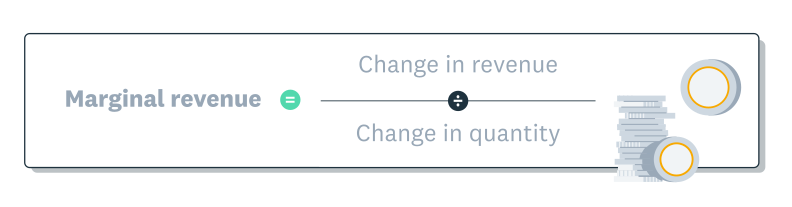
Marginal cost is the expense of producing one additional unit. Marginal revenue is the income from selling one additional unit.
Together, these metrics help you find the production level that maximises profits. The key principle: produce more units as long as marginal revenue exceeds marginal cost. Stop when they're equal.
For example, if your marginal cost is £65 and your marginal revenue equation shows declining returns, you might find that the optimal quantity is 2,875 units to be your profit-maximising quantity, as shown in this ACCA pricing analysis.
Here's how marginal revenue works in practice.
Alison sells wallets at a market stall for £30 each. She could supply surplus stock to another vendor for £20 per wallet. Her marginal revenue on this deal would be £20.
If her marginal cost is £22 per wallet, she'd lose £2 on each sale. To make the deal work, she needs to bring her marginal cost below £20.
Her options include:
- negotiating volume pricing: sell more wallets to reduce the cost per unit
- reducing transport costs: find a closer vendor or cheaper delivery method
- increasing the wholesale price: negotiate a higher rate for bulk orders
By comparing marginal revenue to marginal cost, Alison can decide whether the extra sales are worth pursuing.
Why marginal cost matters for your business decisions
Marginal cost helps you answer critical business questions:
- how many units should you produce? Find the output level that maximises profit
- when should you expand? Identify the right time to increase capacity
- what prices should you set? Balance competitiveness with profitability
- where should you invest? Allocate resources to the most profitable areas
Finding the right production level is crucial for profitability.
Too little production means you miss opportunities to spread fixed costs across more units.
Too much production can cause costs to spiral faster than revenue increases.
For example, one ACCA analysis showed that increasing production from 3,000 to 4,000 units generated only $40,000 in extra revenue against $65,000 in additional costs. The expansion was unprofitable.
Marginal cost calculations help you find the sweet spot that maximises profits.
How to use marginal cost for production planning
Accurate marginal cost calculations help you maximise profits through:
- setting optimal prices: find the price point that balances customer demand with revenue goals
- making smart production decisions: determine whether producing more units increases profitability
- allocating resources efficiently: invest time and money in your most profitable products and services
For example, once you know your optimal production quantity, you can use demand data to calculate the profit-maximising selling price, such as £122.50 per unit, as explained in this ACCA pricing guide.
Now that you understand marginal cost, you need the right tools to track your numbers.
Track your costs with Xero
Clear numbers help you run your business with confidence. Xero accounting software brings your key figures together in one place, with calculations that update automatically and reports that show your revenue and costs at a glance.
Because Xero runs in the cloud, you and your accountant can work from the same up-to-date data. No more jumping between tools.
Get one month free to see how Xero can simplify your cost tracking.
FAQs on marginal cost calculation
Here are answers to common questions about marginal cost analysis.
What causes marginal cost to increase?
Marginal cost typically increases when production pushes against capacity limits. Common causes include:
- labour costs: overtime pay and additional staffing requirements
- supply chain pressures: higher material costs or more expensive suppliers
- capacity constraints: need for new equipment, facilities or staff
- production inefficiencies: quality issues or process bottlenecks
How does marginal cost relate to supply and demand?
Marginal cost influences how much you produce based on market prices. When your marginal cost is lower than the selling price, you're incentivised to produce more. When marginal cost exceeds the selling price, you may reduce output to avoid losses.
This relationship helps explain why supply increases when prices rise and decreases when prices fall.
What's the relationship between marginal cost and contribution margin?
Contribution margin is the amount left from sales revenue after subtracting variable costs. It shows how much each unit contributes to covering fixed costs and generating profit. This is a critical metric, since a 30% contribution margin means a 10% price reduction would require an increase of 50% in sales just to keep overall profits constant, according to ICAEW pricing strategy research.
Here's the relationship: when your marginal cost is lower than your contribution margin, increasing production boosts profits. When marginal cost exceeds contribution margin, additional units reduce profitability.
What's the difference between marginal cost and average cost?
Average cost is your total production cost divided by the number of units produced. Marginal cost is the additional cost of producing one more unit.
Average cost tells you the overall efficiency of your production. Marginal cost tells you whether producing the next unit will improve or reduce that efficiency. When marginal cost is below average cost, producing more units brings your average cost down.
When should I stop increasing production?
You should stop increasing production when the cost of making one more item equals the revenue you get from selling it. If your marginal cost climbs higher than your marginal revenue, you'll start losing money on every extra item you produce. Keeping a close eye on these numbers helps you find the sweet spot where your business is most profitable. Learn more in our guide to measuring profitability.
Disclaimer
Xero does not provide accounting, tax, business or legal advice. This guide has been provided for information purposes only. You should consult your own professional advisors for advice directly relating to your business or before taking action in relation to any of the content provided.
Get one month free
Purchase any Xero plan, and we will give you the first month free.