What is an accounting period?
Learn what accounting periods are, how they work for UK tax, and key deadlines to know.
Published Thursday 23 July 2026
Table of contents
Key takeaways
- An accounting period is the timeframe your business uses to record transactions and prepare financial reports, typically running for 12 months.
- For Corporation Tax, HMRC sets strict rules: each accounting period can be no longer than 12 months, and you must file a separate CT600 return for each one.
- Key deadlines to track include filing your CT600 within 12 months of your period end and paying Corporation Tax within 9 months and 1 day.
- You can change your accounting period by filing form AA01 with Companies House, but there are limits on how often you can extend it.
What is an accounting period?
An accounting period is the set timeframe a business uses to record financial transactions, prepare accounts, and report to tax authorities. It defines the start and end dates for your financial statements, tax returns, and other statutory filings.
Most businesses use an annual accounting period of 12 months. However, you can also work with shorter periods, for example, quarterly or monthly, depending on your reporting needs. The length you choose affects when your tax returns and payments are due.
Your accounting period is central to how you track profitability, manage cash flow, and stay compliant with HMRC. Getting it right from the start saves time and helps you avoid penalties down the line.
Types of accounting periods
There are several types of accounting periods, and the one you use depends on your business structure and reporting requirements. Here are the most common options:
- Calendar year: runs from 1 January to 31 December, commonly used by businesses that align with the standard calendar
- Fiscal year: any 12-month period a business chooses for financial reporting, for example, 1 April to 31 March
- Quarterly: 3-month periods often used for internal management reporting and VAT returns
- Monthly: used for detailed internal tracking, particularly helpful for businesses with tight cash flow cycles
- UK tax year: runs from 6 April to 5 April the following year, relevant for sole traders and partnerships reporting to HMRC
Limited companies can choose their own year-end date, which doesn't have to match the UK tax year. Sole traders and partnerships, on the other hand, generally report based on the tax year running from 6 April to 5 April.
How accounting periods work for Corporation Tax
If you run a limited company, HMRC uses a specific definition of "accounting period" for corporation tax purposes. This is separate from your company's financial year or period of account, and it comes with its own rules.
The key rule is that a Corporation Tax accounting period can never be longer than 12 months. If your company's accounts cover a longer stretch, HMRC will split them into 2 separate accounting periods for tax purposes.
You must file a separate CT600 corporation tax return for each accounting period. Each return covers the profits, losses, and tax due for that specific period only.
When does an accounting period start and end?
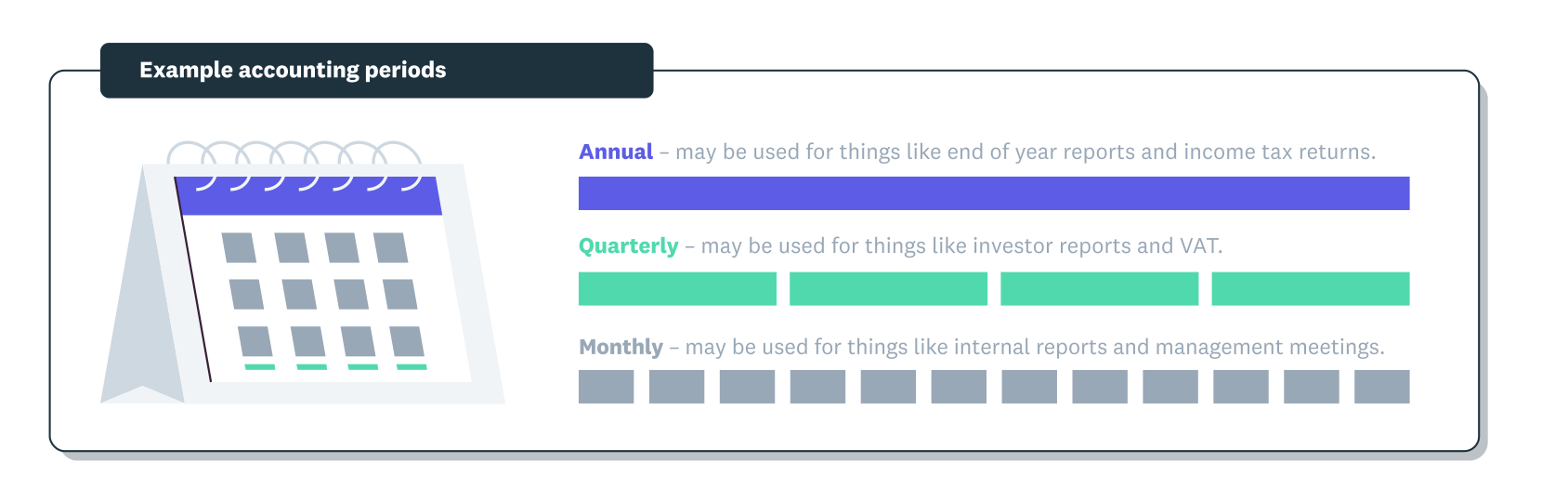
Annual accounting periods don’t have to start in January. Nor do monthly accounting periods have to start on the first of the month.
HMRC defines specific triggers for when a Corporation Tax accounting period begins and ends. Understanding these helps you stay on top of filing obligations.
An accounting period starts when any of the following happens:
- Your company begins trading
- Your company becomes UK tax resident
- Your company starts receiving taxable income
- The previous accounting period ends
An accounting period ends when any of these occur:
- 12 months have passed since the period started
- Your company's accounting reference date is reached
- Your company stops trading or is struck off
- Your company ceases to be UK tax resident
Your first accounting period
When you register a new company with Companies House, your first accounting period starts on the date of incorporation. This applies even if you don't begin trading straight away; HMRC considers your company active from that date.
Your first set of accounts can cover a period of up to 18 months from the date of incorporation. After that, each subsequent period is normally 12 months long, running to your accounting reference date.
Choosing the right year-end date matters. Here are some common options and why businesses pick them:
- 31 March: closely aligns with the UK financial year (1 April to 31 March), making tax calculations simpler
- 31 December: matches the calendar year, which is convenient if you work with international partners
- 5 April: aligns with the UK tax year, useful if directors also need to coordinate personal tax reporting
Long and short accounting periods
Sometimes your company's accounts cover more or fewer than 12 months. This creates what HMRC calls long or short accounting periods, and each has specific implications for your Corporation Tax.
If your accounts cover more than 12 months, HMRC splits them into 2 separate Corporation Tax accounting periods. The first covers 12 months, and the second covers the remaining time. You'll need to file a separate CT600 for each period.
When profits are split across 2 periods, you apportion them on a time basis. For example, if your accounts cover 15 months, the first 12 months' share of profits goes on 1 return, and the remaining 3 months' share goes on a second return.
Short accounting periods, those covering fewer than 12 months, can happen when a company changes its year-end date or stops trading partway through a year. You still file a CT600 for the shorter period, with profits calculated for that timeframe only.
How to change your accounting period
You can change your company's accounting reference date, which in turn changes your accounting period. To do this, you file form AA01 with Companies House.
There are different rules depending on whether you're shortening or lengthening your accounting period:
- Shortening: you can shorten your accounting period as many times as you like, with no restrictions
- Lengthening: you can only extend your accounting period once every 5 years, and the extended period can't exceed 18 months from the start of the current period
Keep in mind that changing your accounting period also shifts your Corporation Tax filing and payment deadlines. Make sure you know the new dates before making the change, so you don't miss a deadline.
Accounting period deadlines
Missing tax deadlines can lead to penalties and interest charges, so it's important to know the key dates tied to your accounting period.
Here are the 2 main deadlines for Corporation Tax:
- CT600 filing deadline: you must file your corporation tax return within 12 months of the end of your accounting period
- Corporation Tax payment deadline: you must pay any tax owed within 9 months and 1 day of the end of your accounting period
For example, if your accounting period ends on 31 March 2026, your CT600 is due by 31 March 2027, and your tax payment is due by 1 January 2027. Setting reminders well ahead of these dates helps you avoid late filing penalties.
Accounting period vs financial year
The terms "accounting period" and "financial year" are often used interchangeably, but they have different technical meanings in the UK.
An accounting period is the timeframe HMRC uses for Corporation Tax. It can be up to 12 months long and is tied to your company's accounting reference date. A financial year, by contrast, is a fixed period defined by the government: it always runs from 1 April to 31 March.
The distinction matters because Corporation Tax rates are set by financial year. If your accounting period spans 2 financial years with different tax rates, you'll need to apportion your profits across each financial year to calculate the correct amount of tax.
Simplify your accounting with Xero
Keeping track of accounting periods, deadlines, and tax obligations takes time, especially when you'd rather focus on running your business. Xero accounting software helps you stay organised by automating bank feeds, reconciling transactions, and generating reports aligned to your accounting period.
With real-time visibility into your finances, you can track profitability throughout the year and prepare for tax deadlines with confidence. Whether you're filing your first CT600 or managing a year-end change, Xero keeps your small business accounting on track. Get one month free.
FAQs on accounting periods
Here are answers to some frequently asked questions about accounting periods.
What is the difference between an accounting period and a financial year?
An accounting period is the timeframe your company uses for Corporation Tax reporting, lasting up to 12 months. The financial year is a fixed government-defined period running from 1 April to 31 March, used to set Corporation Tax rates.
Can I choose my accounting period dates?
Yes, when you incorporate a company, you choose an accounting reference date that determines your year end. You can change it later by filing form AA01 with Companies House, though lengthening is restricted to once every 5 years.
What happens if my accounts cover more than 12 months?
HMRC splits them into 2 separate Corporation Tax accounting periods. You file a CT600 for each period, with profits apportioned on a time basis between the 2 returns.
How do I check my accounting period dates?
You can find your accounting reference date on the Companies House register by searching for your company. HMRC's online services for Corporation Tax also show your current and previous accounting periods.
Does the accounting period affect marginal relief?
Yes, if your accounting period is shorter than 12 months, the upper and lower profit thresholds for marginal relief are reduced proportionally. This can affect whether your company qualifies and how much relief it receives.
Handy resources
Advisor directory
You can search for experts in our advisor directory
Xero Small Business Guides
Discover resources to help you do better business
Get one month free
Try Xero’s fast, simple, powerful online accounting software for your small business
Disclaimer
This glossary is for small business owners. The definitions are written with their requirements in mind. More detailed definitions can be found in accounting textbooks or from an accounting professional. Xero does not provide accounting, tax, business or legal advice.