Best dropshipping suppliers in the US: how to find them
Find trusted dropshipping suppliers fast to protect margins. Learn where to look and how to vet US partners.
Written by Jotika Teli—Certified Public Accountant with 24 years of experience. Read Jotika's full bio
Published Tuesday 20 October 2026
Table of contents
Key takeaways
- Order product samples before committing to any supplier to verify product quality, packaging standards, and actual shipping times to your target market.
- Prioritize US-based suppliers for American customers, since suppliers closer to your customers generally ship faster.
- Avoid suppliers who charge ongoing monthly fees without clear value, sell directly to consumers as your competitor, or set minimum order sizes your budget can't support.
- Verify platform compatibility between your chosen supplier and your ecommerce system to automate order processing and prevent manual errors that can damage customer relationships.
What are dropshipping suppliers and companies?
Dropshipping suppliers are businesses that store inventory and ship products directly to your customers when orders come in. Dropshipping companies are platforms that connect you with multiple suppliers and product catalogs in one place.
Here's how they differ:
- Suppliers handle inventory, packaging, and shipping for specific products
- Companies provide directories of suppliers and streamlined ordering systems
- You focus on marketing, customer service, and order management. This also includes financial responsibilities; according to the Internal Revenue Service (IRS), if you receive more than $20,000 across more than 200 transactions through an online marketplace or payment app in a year, you should receive a Form 1099-K. This threshold was retroactively reinstated by the One Big Beautiful Bill Act.
Understanding how supplier relationships work helps you build a successful dropshipping business and set clear expectations with your customers.
How dropshipping supplier relationships work
Dropshipping supplier relationships involve a clear division of responsibilities between you, your supplier, and your customers. Understanding this flow helps you set realistic expectations and avoid common pitfalls.
Here's how the responsibilities break down:
- Manufacturers or wholesalers produce or stock products and handle fulfillment
- Suppliers store inventory, package orders, and ship directly to your customers
- You manage your online store, marketing, customer service, and order processing
- Your customers place orders through your store and receive products from your supplier
This model lets you sell products without holding inventory, but your supplier's reliability directly affects your customer experience. Choose suppliers who communicate clearly, ship promptly, and maintain consistent product quality.
Dropshipping suppliers operate worldwide. If you choose an international supplier, verify their shipping options and delivery times to set clear expectations with your customers.
How to find dropshipping suppliers
Finding reliable dropshipping suppliers starts with using multiple sourcing methods to compare options and reduce risk. Because suppliers manage inventory, packing, and shipping, their reliability directly affects delivery times, product quality, and customer experience.
Use online dropshipping supplier directories
Online directories like SaleHoo, Spocket, and Wholesale2B can be a quick way to find dropshipping suppliers. SaleHoo says it vets 8,000+ suppliers, and Spocket focuses on US and EU suppliers. Shopify's guide to choosing suppliers notes many directories screen listings to confirm they're genuine wholesalers. These platforms also share product catalogs, shipping details, and ecommerce integrations.
While competition can be higher on popular directories, they reduce the risk of unreliable suppliers and simplify your initial research.
Contact manufacturers directly
Contacting manufacturers directly can result in better pricing, more consistent product quality, and stronger long-term relationships. Some manufacturers offer dropshipping fulfillment without their own branding on packages.
This approach works best for niche products or businesses planning to scale, though not all manufacturers support low-volume orders.
Research products and sellers on online marketplaces
Online marketplaces like Amazon, eBay, and Etsy help you identify products with proven demand. Many sellers on these platforms are manufacturers or authorized distributors handling large order volumes.
Analyze product performance and seller information to uncover potential dropshipping or wholesale partnerships.
Search for specialized dropshipping suppliers online
Search engines help you find specialized or region-specific suppliers not listed in major directories. Targeted searches often surface smaller suppliers with less competition, giving you more room to differentiate.
This method requires careful evaluation since supplier quality and fulfillment standards vary widely.
Network with suppliers at trade shows and industry events
Trade shows and wholesale events let you connect directly with manufacturers and distributors. You can discuss fulfillment capabilities, shipping expectations, and dropshipping support face-to-face.
These events work well for businesses looking to build stable supplier relationships or expand into new product categories.
Dropshipping directories vs. direct suppliers
Choosing between supplier directories, direct manufacturer relationships, and integrated apps affects your pricing, control, and workload. Each approach has distinct advantages depending on your business stage and goals.
Supplier directories
Supplier directories like SaleHoo, Spocket, and Worldwide Brands connect you with suppliers through searchable databases, and many directories screen their listings before adding a supplier. They simplify discovery and reduce the risk of unreliable partners.
- Benefits include access to suppliers the directory says it has screened, simpler initial research, and built-in platform integrations
- Drawbacks include access fees, higher competition, and less direct control over supplier relationships
Direct relationships
Direct supplier relationships involve contacting manufacturers or wholesalers without using a directory. This approach requires more effort but can yield better results.
- Benefits include better pricing, stronger partnerships, and a way to stand out from competitors using the same directories
- Drawbacks include more time spent vetting, potentially higher minimums, and managing relationships directly
Integrated dropshipping apps
Integrated apps like DSers or AutoDS connect directly to your ecommerce platform so you can automate or batch-process supplier orders and sync tracking. DSers handles AliExpress orders through bulk processing, while AutoDS can place orders with your chosen supplier and share tracking updates. Oberlo, an earlier app of this kind, closed on June 15, 2022 and partnered with DSers.
- Benefits include automated or batch-processed supplier orders, synced tracking, and less manual work
- Drawbacks include supplier choices limited to app partners and reliance on platform-specific tools
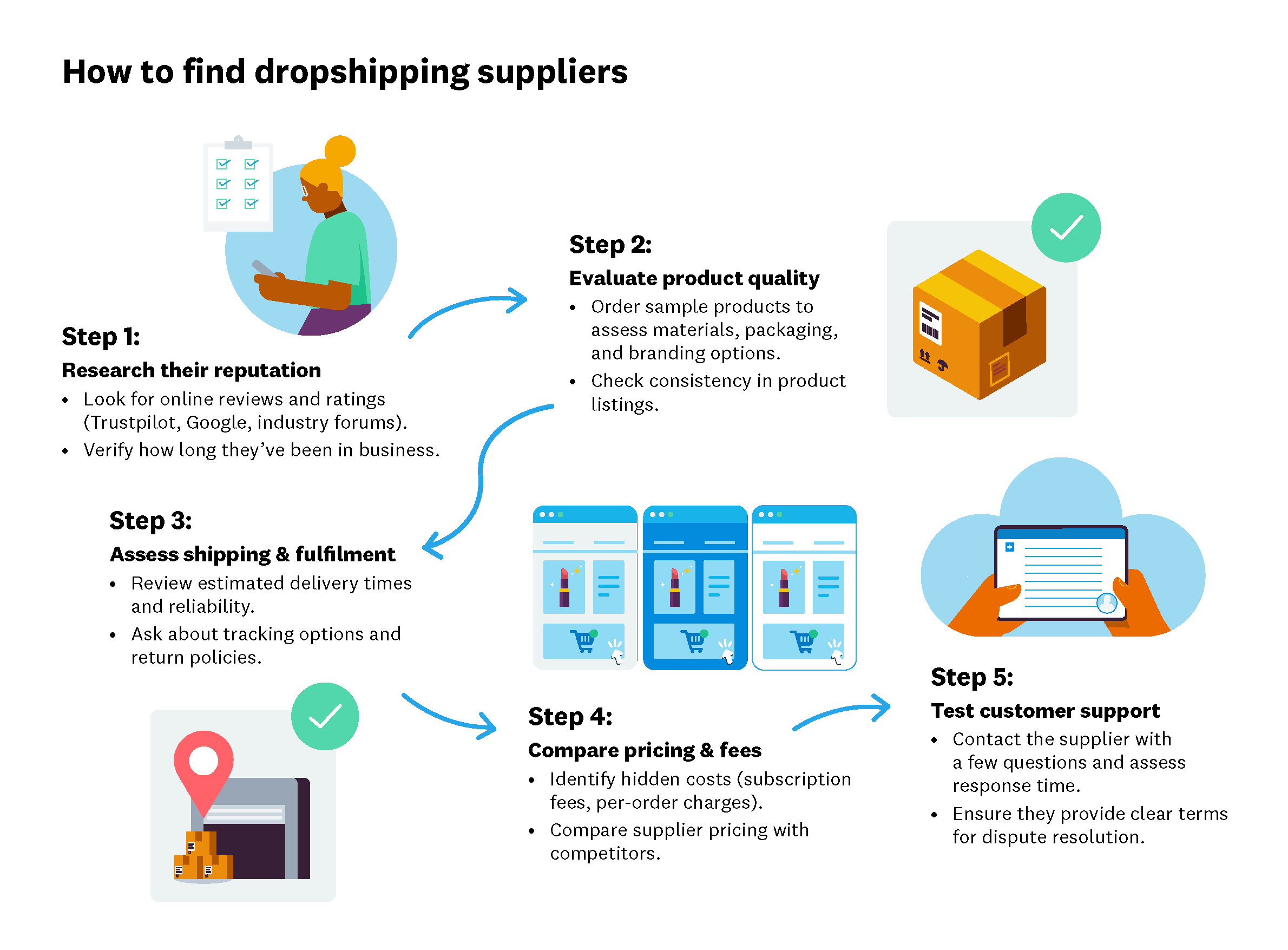
What to look for when vetting dropshipping suppliers
Vetting dropshipping suppliers means evaluating their reliability, product quality, and fulfillment capabilities before committing. A thorough vetting process protects your business and your customers. Here's what to look for:
Ordering product samples
Order samples before you commit to check product quality, packaging, and actual shipping times. Work with suppliers who provide samples willingly, as reluctance to send samples is often a warning sign.
Shipping speed and reliability
Ask about average shipping times to your target market. Fast, reliable shipping is key to customer satisfaction. Verify their shipping policies and tracking capabilities before committing.
Integration with your store
Check platform compatibility with your ecommerce system, whether Shopify, WooCommerce, or another platform. Smooth integration automates order processing, saves time, and prevents manual errors.
Return and refund policies
Review their return and refund policies for handling returns, damaged goods, and customer refunds. A clear, fair policy protects both you and your customers from disputes.
Customer support
Test their customer support by sending a few questions before you commit. Track how quickly and effectively they respond. Good communication becomes vital when order issues arise.
Red flags to avoid when choosing suppliers
Red flags in dropshipping suppliers are warning signs that indicate potential scams, poor service, or unreliable partnerships. Knowing what to avoid protects your business and your customers. Watch for these common warning signs:
Ongoing fees or monthly charges
According to Shopify's dropshipping help center, most legitimate suppliers don't charge monthly fees, though supplier directories may charge for access. Be wary of a supplier that asks for recurring payments just to see its catalog.
Selling directly to the public
Most wholesale suppliers sell only to businesses, not the general public. If a supplier also sells directly to consumers, they become your competitor, which creates a conflict of interest.
Poor communication
Slow or unprofessional communication during the vetting process signals how a supplier will handle urgent order issues. If they avoid answering direct questions, move on.
Lack of reviews or a poor reputation
Check online reviews on Google, Trustpilot, and social media before committing. No online presence or a pattern of negative feedback is a clear warning sign.
Minimum orders that exceed your budget
Minimum order sizes are common with wholesalers, and Shopify explains that suppliers set them to make each order worth their time. Check any minimum against your budget before you commit. If you'd rather skip minimums, some dropshipping apps don't require them.
Companies that offer dropshipping
Dropshipping companies like SaleHoo, Spocket, and Wholesale2B connect you with suppliers through searchable directories. SaleHoo says it lists 8,000+ vetted suppliers, while Spocket focuses on US and EU suppliers. Screening suppliers is a practice Shopify describes as common among directories. These platforms simplify supplier selection and often include integration tools for your online store.
You'll work with two main supplier types:
Manufacturers
Manufacturers produce products directly and may offer dropshipping services. They generally have the lowest per-item cost, which can mean higher profit margins. However, they usually require large orders that many small businesses can't afford. This approach works best for established businesses with proven products.
Wholesalers
Wholesalers buy from manufacturers and sell to retailers, including dropshippers. They typically allow smaller or no minimum orders, making it easier to test new products or markets. However, wholesalers sell to retailers at slightly higher prices than manufacturers. This option works best for new dropshippers or small stores.
Best dropshipping companies in the US
Before selecting a dropshipping supplier, read online reviews and customer feedback about product quality, shipping times, and service. Also verify platform compatibility since some suppliers work best with specific ecommerce platforms like Shopify or WooCommerce.
SaleHoo
SaleHoo offers two main tools for dropshippers: a supplier directory to source reliable partners, and a Shopify integration that lets you import products directly to your store.
Pros:
- Access 2.5 million products across multiple categories, according to SaleHoo's pricing page
- Connect with 8,000+ suppliers that SaleHoo says it has vetted
- Try it with a 60-day money-back guarantee
Cons:
- Import 200 products a month on Starter or 600 on Pro, with unlimited imports only on Enterprise
- Get a dedicated account manager only on the Enterprise plan
Spocket
Spocket connects sellers to a product library and supplier directory focused on US and EU suppliers. You pay no per-sale commission (0% transaction fee), only a monthly plan plus the cost of the products you sell.
Pros:
- Order product samples to verify quality meets your standards
- Integrate with Shopify, BigCommerce, WooCommerce, and Wix
- Source from suppliers based mainly in the US and EU
Cons:
- Start paid plans at $39.99/month after a 7-day trial (as of October 2026)
- Pay a separate subscription for each store you connect
- Pay subscription fees that increase with higher-tier plans
Grow your dropshipping business with Xero
Successful dropshipping depends on choosing reliable suppliers who deliver quality products on time. Focus on thorough supplier research, clear communication, and building long-term partnerships.
As your dropshipping business grows, it becomes more important to manage your finances closely. You need to track supplier costs, monitor profit margins, and keep accurate records for tax purposes.
Xero accounting software integrates with popular ecommerce platforms, so you can manage your dropshipping finances in one place.
Ready to streamline your business finances?
Get one month free and see how Xero can support your dropshipping success.
FAQs on dropshipping suppliers
Here are answers to common questions about finding and working with dropshipping suppliers.
How do I find legitimate dropshipping suppliers?
Use supplier directories like SaleHoo or Spocket to find suppliers the directories say they screen. You can also contact manufacturers directly, research sellers on online marketplaces, or attend trade shows to build direct relationships.
What's the difference between a dropshipping supplier and a dropshipping company?
A dropshipping supplier stores and ships products directly to your customers. A dropshipping company is a platform that connects you with multiple suppliers through a searchable directory.
Should I work with US-based dropshipping suppliers?
Suppliers closer to your customers generally ship faster, so US-based suppliers can shorten delivery times for US customers, which can help customer satisfaction.
How much does it cost to work with dropshipping suppliers?
Costs vary by supplier. Some charge monthly directory fees, while others have no upfront costs but higher per-product prices. Direct manufacturer relationships may require no fees but could have minimum order requirements.
What are red flags when choosing a dropshipping supplier?
Watch for suppliers who charge ongoing fees without clear value, sell directly to consumers, communicate poorly, have no online reviews, or set minimum orders your budget can't support.
Disclaimer
Xero does not provide accounting, tax, business or legal advice. This guide has been provided for information purposes only. You should consult your own professional advisors for advice directly relating to your business or before taking action in relation to any of the content provided.