Owner's equity: formula, examples and how to grow it
Learn what owner's equity is, how to calculate it, and practical ways to grow it.
Written by Lena Hanna—Trusted CPA Guidance on Accounting and Tax. Read Lena's full bio
Published Monday 15 June 2026
Table of contents
Key takeaways
- Owner's equity is the value of your business after subtracting total liabilities from total assets. Calculate it regularly to get an accurate picture of your net worth, making sure you include tangible assets, accounts receivable, intangible assets, loans, and tax obligations.
- Use owner's equity as a starting point for business valuation and funding conversations. Lenders and investors review this figure to assess risk, but it doesn't determine your final sale price.
- You can grow your owner's equity by increasing profitability, reinvesting earnings back into the business, reducing liabilities, and limiting personal withdrawals.
- Track changes in your equity over time using the statement of changes in equity, which shows how profits, capital contributions, withdrawals, and dividends affect your overall financial position across a given period.
What is owner's equity?
Owner's equity is the value of your business after subtracting what you owe from what you own. It's calculated as assets minus liabilities, giving you a clear measure of your net worth at any point in time.
Think of it as your ownership stake in the business. If you sold every asset and paid off every debt, the amount left over would be your owner's equity.
You can use owner's equity to:
- Value your business: establish a starting point for sale discussions (not the final sale price)
- Track your finances: monitor your net worth over time
- Measure performance: see how business decisions affect your financial position
What changes your equity
Your owner's equity isn't a fixed number. It changes with every financial transaction your business makes. Understanding your equity position helps you plan ahead.
Your equity increases when:
- Customers pay invoices
- Profits accumulate over time
- You invest more capital into the business
Your equity decreases when:
- You repay loans or settle debts
- You incur expenses that reduce profits
- You withdraw funds from the business

These changes appear in your statement of changes in equity. For UK businesses, Financial Reporting Standard (FRS) 102 Section 22 sets out specific requirements for classifying financial instruments as either liabilities or equity, following International Financial Reporting Standards.
Owner's equity doesn't predict your business's sale price, as that depends on negotiations with buyers. But it gives you a concrete measure of your financial position that you can calculate whenever you need it.
How to calculate owner's equity (or net worth)
Calculate owner's equity by subtracting your total liabilities from your total assets. The result shows how much of your business you truly own.
Owner's equity formula
The formula is straightforward:
Owner's equity = Assets - Liabilities
Add up everything your business owns (assets), then subtract everything you owe (liabilities). The remaining amount is your equity.
What to include when calculating owner's equity
Getting an accurate figure means counting all assets and liabilities correctly. Here's what to include on each side of the equation.
Assets to include:
- Tangible assets: equipment, property, inventory, and cash
- Accounts receivable: money your customers owe you
- Intangible assets: intellectual property and recognised brand value
Liabilities to include:
- Loans: money you owe to lenders
- Trade payables: amounts you owe to suppliers
- Employee obligations: wages and benefits due to staff
- Tax obligations: money you owe to HMRC and other tax authorities
Examples of owner's equity
Seeing the formula in action makes it easier to understand. Here are 2 examples showing how owner's equity works in practice.
Personal example of owner's equity
Here's a simple personal example to illustrate the concept. Imagine a house worth £300,000 with a £120,000 mortgage.
The calculation works like this:
- Asset: £300,000 (house value)
- Liability: £120,000 (mortgage debt)
- Owner's equity: £180,000 (£300,000 - £120,000)
Your equity in the house is £180,000. As you pay down the mortgage, your equity grows.
Business example of owner's equity
Now let's look at how the same calculation works for a business. Consider a repair shop with the following figures.
Assets:
- Garage: £600,000
- Machinery: £50,000
- Inventory: £50,000
- Total assets: £700,000
The business has one liability: a property loan of £300,000.
Owner's equity: £400,000 (£700,000 - £300,000)
The repair shop owner holds £400,000 in equity. If the business paid off its loan and sold all assets at their current values, £400,000 would remain.
How to increase your owner's equity
Growing your owner's equity strengthens your financial position and increases your business net worth. There are 4 practical ways to increase it.
1. Increase your profitability
Higher profits flow directly into your equity. Look for ways to grow revenue, whether that's raising prices, expanding your customer base, or introducing new products and services. At the same time, review your costs and cut any spending that isn't delivering value.
2. Reinvest earnings back into the business
When your business earns a profit, reinvesting those earnings rather than withdrawing them builds your equity over time. Retained earnings are one of the biggest drivers of equity growth for small businesses. Directing profits towards new equipment, marketing, or hiring helps your business grow while boosting your net worth.
3. Reduce your liabilities
Paying down debt directly increases your equity. Focus on clearing high-interest loans first, and avoid taking on new debt unless it will generate a return that outweighs the cost. Negotiating better payment terms with suppliers can also help you manage liabilities more effectively.
4. Limit owner withdrawals
Every time you withdraw money from the business, your equity decreases. Set yourself a consistent salary or drawing amount, and avoid taking out more than the business can comfortably afford. This keeps your equity stable and your business in a stronger financial position.
Why owner's equity matters for your business
Owner's equity shows your business's financial health at a glance. A positive and growing figure means your business is building value over time, while a declining figure signals that you may need to make changes.
Here's why it matters:
- Guides financial decisions: helps you decide whether to take on debt, fund growth from profits, or withdraw funds safely
- Attracts funding: lenders and investors review your equity to assess risk before providing loans or investment
- Tracks progress: shows whether your business is gaining or losing value over time, helping you spot trends early
Regularly reviewing your owner's equity alongside your profit and loss statement gives you a fuller picture of how your business is performing.
Where to find owner's equity
You'll find your owner's equity in your key financial statements. Each one gives you a different perspective on your equity position.
Your balance sheet shows your equity at a single point in time. Look for it listed after the assets and liabilities sections. The statement of changes in equity, on the other hand, shows how your equity has changed over a specific period, including the effects of profits, losses, contributions, and withdrawals.
Most accounting software, including Xero, generates both reports automatically from your financial data. You can pull up your balance sheet at any time to check your current equity position.
What is a statement of changes in equity?
A statement of changes in equity tracks how your business equity moves over a specific period. It connects your profit and loss statement to your balance sheet by showing how annual earnings, contributions, and withdrawals affect your total equity position.
The 4 essential financial reports
The statement of changes in equity is 1 of 4 essential financial statements that together give you a complete picture of your business finances.
- Profit and loss (P&L): shows your revenue and expenses
- Balance sheet: shows your assets, liabilities, and equity
- Cash flow statement: shows money coming in and going out
- Statement of changes in equity: shows how your equity moves over time
Statement of changes in equity by business structure
The format of your statement of changes in equity depends on your business structure. Here's what each one looks like.
Sole trader: closing equity equals opening equity, plus the year's net profit and any money introduced, minus owner withdrawals and taxes paid.
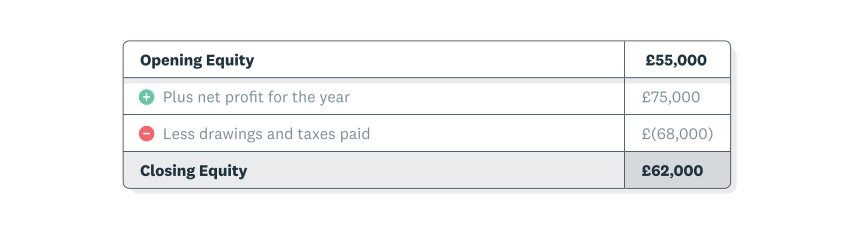
Statement shows closing equity is equal to the opening equity plus the year’s net profit, minus owner withdrawals and taxes.
Partnership: closing equity equals opening equity, plus the year's net profit and capital introduced by partners, minus any partner withdrawals and taxes paid. If a partner has loaned money to the partnership rather than introducing capital, the loan carries a 5% yearly interest charged in the income statement under the Partnership Act 1890.
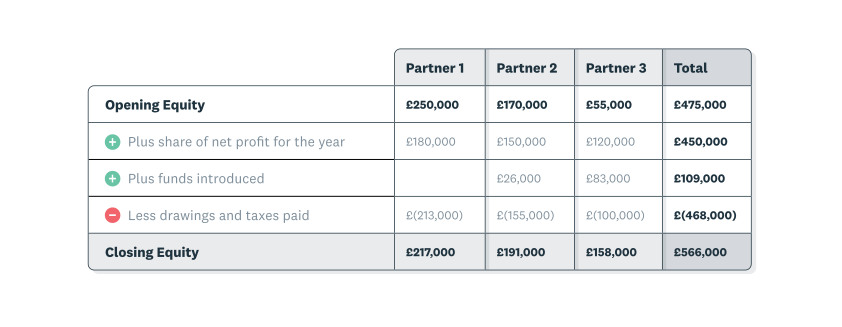
Statement shows closing equity is equal to the opening equity plus the year’s net profit and money introduced, minus owner withdrawals and taxes.
Company: closing equity equals opening equity, plus the year's profit and any share capital issued, minus dividends paid and taxes.
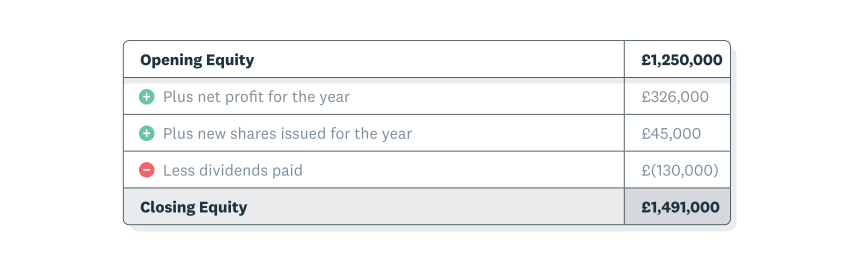
Statement shows closing equity is equal to the opening equity plus the year’s net profit and money from investors, minus owner withdrawals and taxes.
How the statement of changes in equity is used
The statement of changes in equity is most useful for understanding annual equity movements and strategic planning. Other reports help more with day-to-day management.
For day-to-day decisions, review your P&L statement to understand operational performance, check your balance sheet to see your overall financial position, and monitor your cash flow statement to confirm you have enough cash to meet your obligations.
For strategic planning, use the statement of changes in equity to understand whether your business is building or losing value over time. Many small business owners find that reviewing the P&L and balance sheet regularly, combined with a periodic equity review, gives them the clearest picture of their financial progress.
Track your business equity with confidence
Understanding your owner's equity helps you know exactly where your business stands financially. With Xero, you can track your assets and liabilities in real time, giving you a clear view of your net worth whenever you need it. Your balance sheet and equity reports update automatically as you reconcile transactions, so you always have accurate figures to work with.
Simplify your accounting and stay on top of your business finances with Xero. Get one month free.
FAQs on owner's equity
Here are answers to some frequently asked questions about owner's equity and how it applies to your business.
Is shareholder's equity the same as owner's equity?
Yes, they refer to the same thing. Sole traders and partnerships typically use the term "owner's equity", while companies and corporations use "shareholder's equity" to reflect that ownership is divided into shares.
Can owner's equity be negative?
Yes, owner's equity can be negative when your total liabilities exceed your total assets. This can happen if a business takes on significant debt or accumulates losses over time, and it's a signal to review your financial strategy and find ways to reduce liabilities or increase asset value.
What are retained earnings and how do they affect owner's equity?
Retained earnings are the portion of your business profits that you keep in the business rather than withdrawing or distributing as dividends. They're a key component of owner's equity; as retained earnings grow, your overall equity increases, making your business more financially resilient.
How do I calculate the owner's equity statement?
Start with your opening equity at the beginning of the period, then add net profit and any new capital contributions. Subtract owner withdrawals, dividends, and taxes paid to arrive at your closing equity figure.
Do all transactions affect owner's equity?
Not directly. Transactions that only rearrange assets and liabilities, such as paying a supplier with cash, don't change your equity because the decrease in one asset is offset by the decrease in a liability. Transactions that affect revenue, expenses, contributions, or withdrawals do change your equity position.
Disclaimer
Xero does not provide accounting, tax, business or legal advice. This guide has been provided for information purposes only. You should consult your own professional advisors for advice directly relating to your business or before taking action in relation to any of the content provided.
Get one month free
Purchase any Xero plan, and we will give you the first month free.