Gross profit margin: formula and ways to improve it
Learn how to calculate gross profit margin and improve your results.
Written by Lena Hanna—Trusted CPA Guidance on Accounting and Tax. Read Lena's full bio
Published Wednesday 27 May 2026
Table of contents
Key takeaways
- Gross profit margin shows the percentage of revenue left after subtracting your cost of goods sold, giving you a clear picture of how efficiently your business turns sales into profit.
- Calculate it by subtracting COGS from revenue, dividing by revenue, then multiplying by 100. Track the result monthly to catch rising costs or pricing problems early.
- Healthy margins vary by industry; UK service businesses typically achieve 50 to 70%, while retail grocery often sits at 30 to 35%. Benchmark against similar businesses to set realistic targets.
- You can improve your margin by renegotiating supplier costs, raising prices strategically, reducing waste, and streamlining your product or service mix.
What is gross profit margin?
Gross profit margin is the percentage of your sales revenue that remains after subtracting cost of goods sold (COGS). It tells you how efficiently your business converts sales into profit before accounting for operating expenses like rent, utilities and salaries.
COGS includes the direct costs of producing or delivering what you sell, such as materials, labour and shipping. A higher gross profit margin means you keep more of every pound earned, giving you greater flexibility to cover overheads, invest in growth and handle unexpected costs.
Gross profit margin vs gross profit
Gross profit and gross profit margin measure the same thing in different ways. Understanding both helps you track performance and compare your results against other businesses.
Gross profit is a pound amount. If your revenue is £20,000 and your COGS is £8,000, your gross profit is £12,000. It shows how much money you have left in absolute terms.
Gross profit margin is a percentage. Using the same figures, your gross profit margin is 60%. Percentages make it easier to compare performance across months, quarters or against competitors of different sizes.
Gross margin is another term for gross profit margin. It is the most commonly used business ratio in HM Revenue and Customs (HMRC) enquiries, so tracking it can help you stay prepared.
How to calculate gross profit margin
Calculating your gross profit margin takes just a few steps. Once you know the formula, you can track it monthly to spot trends and act on them quickly. You can also use a gross margin calculator to check your figures.
Gross profit margin formula

Use this formula to calculate what percentage of your sales revenue you keep after paying for the goods or services you sell:
Gross profit margin = (gross profit / revenue) x 100
- Gross profit: your revenue minus your cost of goods sold
- Revenue: your total sales income for the period
- Result: a percentage showing how efficiently you turn sales into profit
Gross profit margin formula explained
Follow these 3 steps to calculate your gross profit margin:
- Subtract your COGS from your revenue to get your gross profit in pounds.
- Divide your gross profit by your revenue, then multiply by 100 to get a percentage.
- Compare your result over time or against industry benchmarks. A higher percentage means you keep more of each pound earned.
Gross profit margin example calculation
Here is an example using a cleaning business:
- Revenue: £20,000 from cleaning offices
- COGS: £8,000 in direct costs to provide those services
- Gross profit: £20,000 - £8,000 = £12,000
- Gross profit margin: (£12,000 / £20,000) x 100 = 60%

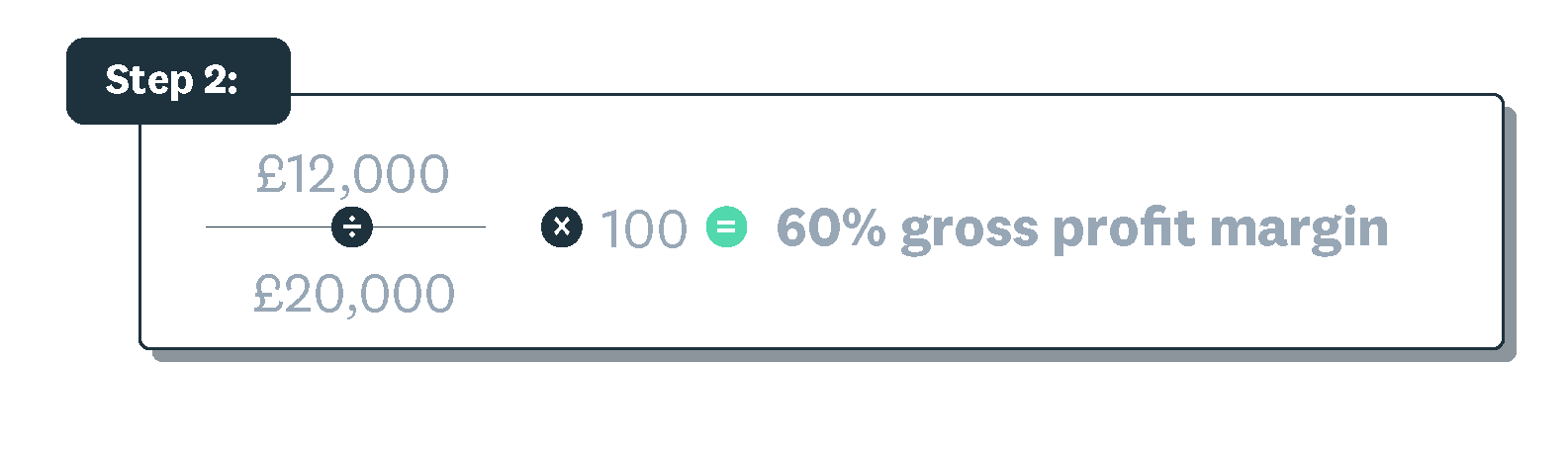
This means the business keeps 60p of every pound earned before paying operating expenses like rent, marketing and salaries.
Avoid common calculation mistakes
Accurate calculations depend on including the right costs and matching your time periods. Watch out for these common errors:
- include all direct costs: add materials, labour and shipping to your COGS
- exclude operating costs: keep rent, marketing and admin out of COGS
- match your time periods: make sure revenue and COGS cover the same dates
- calculate precisely: use exact figures before rounding the final percentage
- check your totals: missing £2,000 from £200,000 in sales changes your margin by 1%, and such omissions show a difference in the rate of gross profit
What is a good gross profit margin?
A good gross profit margin depends on your industry and business model. Most businesses aim for somewhere between 20% and 80%, with service businesses typically at the higher end and retail at the lower end.
Your margin needs to be high enough to cover operating expenses, fund growth, build a financial buffer and give you room to adjust prices when market conditions change.
Factors affecting your margins
Several factors determine what counts as a good margin for your business:
- industry type: service businesses typically achieve 50 to 80% margins, while retail often operates at 20 to 50%
- business model: online businesses generally maintain higher margins than physical shops
- market competition: highly competitive markets push margins lower to stay price-competitive
- geographic location: businesses in cities face higher costs, which can require stronger margins to stay profitable
Industry benchmarks for gross profit margin
Industry benchmarks vary widely across the UK. Here are typical ranges you can use as a starting point:
- SaaS and software: 70 to 85%
- professional services: 50 to 70%
- hospitality: 35 to 45%
- retail grocery: 30 to 35%
- construction: 15 to 25%
Your accountant or bookkeeper can help you find benchmarks specific to your industry and business size.
Benchmarking your gross profit margin
Compare your margin against similar-sized businesses in your industry and region. This gives you a realistic picture of how your business is performing relative to competitors.
Look at trends over several months rather than a single snapshot. A margin that is slightly below the industry average but steadily improving may be healthier than one that looks good today but is declining.
When to reassess your gross profit margin
Regular margin reviews help you respond quickly to changing conditions. Reassess your gross profit margin when:
- supplier costs change: rising material or labour costs squeeze your margins
- market conditions shift: economic changes affect what customers are willing to pay
- you miss growth targets: declining margins may explain underperformance
- you are planning major decisions: pricing changes, new products or expansion all depend on healthy margins
How to improve your gross profit margin
If your gross profit margin is lower than you would like, there are practical steps you can take to improve it. Focus on the areas that will have the biggest impact on your specific business.
- Renegotiate with suppliers: review your existing contracts and ask for better rates, bulk discounts or longer payment terms that reduce your cost of sales
- Raise prices strategically: test small price increases on your most popular products or services, and communicate the added value to your customers
- Reduce production waste: audit your processes to find materials, time or resources that are being used inefficiently
- Streamline your product or service mix: focus on your highest-margin offerings and consider dropping low-margin lines that drain resources
- Increase order value through upselling: encourage customers to buy complementary products or premium versions, which often carry higher margins
Analysing gross profit margin for business insights
Gross profit margin analysis reveals which products or services generate the strongest returns and where you need to make changes. Used consistently, it becomes one of the most useful tools you have to measure profitability across your business.
Interpreting gross profit margin trends
Track your gross margin over time to spot patterns in your business performance. You might notice seasonal dips, identify which products consistently underperform, or catch rising supplier costs before they seriously hurt your profits.
According to Xero Small Business Insights, UK small business margins are currently under pressure from rising energy and finance costs. The March quarter 2026 data from 440,000 small businesses on Xero shows owners responding with caution, delaying investment and preferring casual over permanent hires. Tracking your gross margin during periods of economic uncertainty like this helps you respond quickly rather than discovering problems too late.
External factors that affect your margins
Your gross profit margin does not exist in isolation. External forces can shift it in ways that are outside your direct control, which makes monitoring even more valuable.
Supply chain disruptions can increase the cost of materials or cause delays that force you to source from more expensive suppliers. Market competition may push you to lower prices to retain customers, reducing the gap between revenue and costs.
Inflation affects both your input costs and what customers are willing to pay. When costs rise faster than you can adjust prices, your margin shrinks. Reviewing your margin regularly helps you spot these pressures early and respond before they compound.
Gross profit margin compared with other metrics
Gross profit margin is one of several profitability metrics. Understanding how it relates to operating profit margin and net profit margin gives you a fuller picture of your financial health.
Gross profit margin vs operating profit margin
Operating profit margin measures what is left after paying both COGS and operating expenses like rent, utilities and salaries. It shows how efficiently you run your day-to-day operations, not just how well you price your products.
If your gross profit margin is healthy but your operating profit margin is low, your overheads may be too high relative to your revenue.
Gross profit margin vs net profit margin
Net profit margin shows what remains after all expenses, including taxes and interest. It is your true bottom-line profitability.
While gross profit margin focuses on product or service efficiency, net profit margin reveals your overall business health. Both metrics are useful; tracking them together helps you pinpoint exactly where profits are being lost.
Track your gross profit margin with Xero
Knowing your gross profit margin is only useful if you track it consistently. Accounting software can help by pulling your revenue and cost data together automatically, so you always have an up-to-date view of your margins.
Xero connects to your bank, tracks your income and expenses in real time, and generates reports that show your gross profit margin at a glance. You can compare periods, spot trends and share the numbers with your accountant without digging through spreadsheets.
If you are ready to take control of your profitability, Xero gives you the tools to track your margins and make confident decisions. Get one month free.
FAQs on gross profit margin
Here are answers to frequently asked questions about gross profit margin.
What's the difference between gross profit and gross profit margin?
Gross profit is the pound amount left after subtracting COGS from revenue. Gross profit margin expresses this as a percentage of revenue, making it easier to compare performance across time periods or against other businesses of different sizes.
What's a healthy gross profit margin?
A healthy margin depends on your industry. UK service businesses typically achieve 50 to 70%, while retail grocery often operates at 30 to 35%. Compare your margin to industry benchmarks and make sure it covers your operating expenses with room for growth.
How often should I calculate my gross profit margin?
Calculate your margin monthly to spot trends early. Monthly tracking helps you identify problems like rising supplier costs or underperforming products before they significantly affect your bottom line.
Can a gross profit margin be too high?
Very high margins might signal overpricing that could reduce sales volume or attract new competitors into your market. Balance your margin targets with your growth goals and customer expectations.
How can I improve my gross profit margin?
Focus on the levers you can control: negotiate better supplier terms, raise prices where the market supports it, cut production waste, and concentrate on your highest-margin products or services. Even small improvements across several areas can add up to a meaningful difference.
Does a business pay tax on gross or net profit?
Businesses in the UK pay tax on net profit, not gross profit. Net profit is what remains after deducting all allowable expenses from your revenue, including COGS and operating costs. Your gross profit margin is still important because it directly affects how much net profit you end up with.
Disclaimer
Xero does not provide accounting, tax, business or legal advice. This guide has been provided for information purposes only. You should consult your own professional advisors for advice directly relating to your business or before taking action in relation to any of the content provided.