What is profit?
Learn what profit means, the types of profit, and how to calculate it for your business.
Published Thursday 23 July 2026
Table of contents
Key takeaways
- Profit is the money your business keeps after subtracting all expenses from total revenue, and it's the clearest measure of whether your business is financially healthy.
- There are 3 main types of profit: gross profit, operating profit, and net profit, each giving you a different view of your business performance.
- Calculating your profit regularly helps you make confident decisions about pricing, spending, and growth.
- You can increase profit by raising revenue, reducing costs, reviewing your pricing strategy, or improving how productively your business operates.
What is profit?
Profit is the amount of money a business keeps after subtracting all its expenses from its total revenue. It's the simplest way to measure whether your business is making more money than it spends.
The basic formula is: Profit = Revenue - Expenses.
Revenue is the total income your business earns from selling goods or services. Expenses include everything you spend to run the business, from materials and wages to rent, utilities, and taxes. When revenue exceeds expenses, you've made a profit. When expenses exceed revenue, you've made a loss.
For small business owners, understanding profit isn't just an accounting exercise. It's the number that tells you whether your business model is working, whether you can afford to invest in growth, and whether you're building something sustainable over the long term.
Types of profit
There are 3 main types of profit, and each one tells you something different about how your business is performing. Looking at all 3 together gives you a complete picture of your financial health.
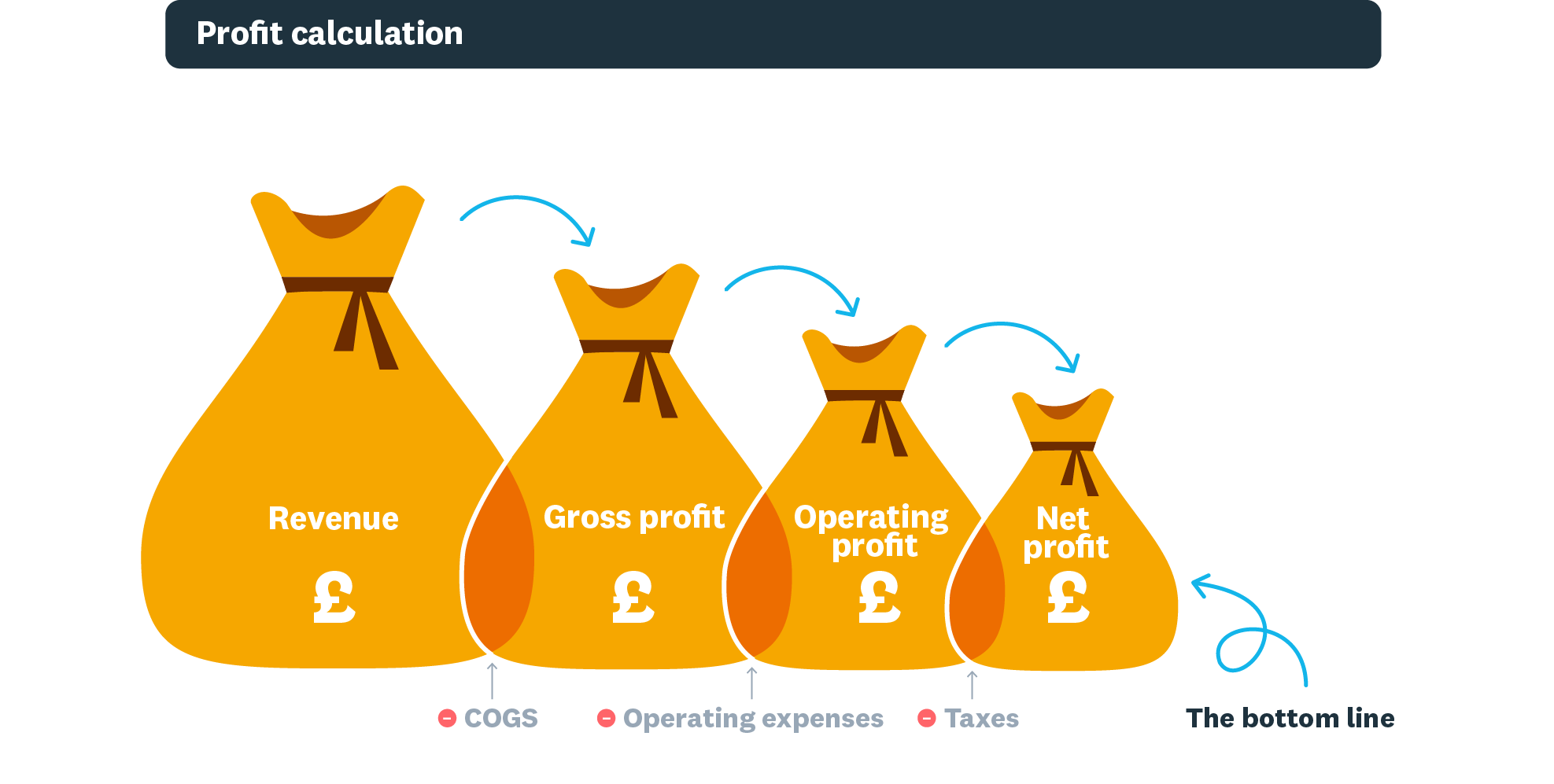
There are three types of profit. Net profit is what you get to keep.
Gross profit
Gross profit is the money left over after you subtract the direct costs of producing your goods or services from your revenue. These direct costs are often called cost of goods sold (COGS) or cost of sales.
The formula is: Gross profit = Revenue - Cost of goods sold.
For example, if you sell handmade candles and your revenue is £50,000, but the wax, wicks, jars, and packaging cost £20,000, your gross profit is £30,000. This number shows you how efficiently you're producing what you sell, before accounting for any other business costs.
Operating profit
Operating profit is what remains after you subtract your day-to-day operating expenses from your gross profit. Operating expenses include things like rent, salaries, marketing, insurance, and utilities.
The formula is: Operating profit = Gross profit - Operating expenses.
This is sometimes called earnings before interest and tax (EBIT). It's a useful measure because it shows how profitable your core business activities are, without being affected by how you've financed the business or your tax situation.
Net profit
Net profit is your bottom line. It's the amount left after deducting all costs, including operating expenses, interest on loans, and tax. This is the money you actually get to keep.
The formula is: Net profit = Operating profit - Interest - Tax.
As of Q2 2024, the average profit margin for a small business in the UK stood at 8.8%, down from 10.7% in Q1 2024. That gives you a benchmark to compare your own performance against. If your net profit margin sits below that average, it's worth looking at where costs could be trimmed or revenue boosted.
How to calculate profit
Calculating profit is straightforward once you have your numbers together. Here's a worked example using a UK-based business to show how the 3 types of profit connect.
Imagine you run a small graphic design agency. In the last financial year, your figures looked like this.
- Revenue: £120,000
- Cost of goods sold (freelancer fees, software licences): £35,000
- Operating expenses (rent, salaries, marketing, insurance): £55,000
- Interest on a business loan: £2,000
- Corporation Tax (25%): £7,000
Start with gross profit: £120,000 - £35,000 = £85,000. This tells you how much you earned above the direct cost of delivering your services.
Next, calculate operating profit: £85,000 - £55,000 = £30,000. This shows you what your core business operations generated before interest and tax.
Finally, work out net profit: £30,000 - £2,000 - £7,000 = £21,000. That's the amount you actually keep. Your net profit margin would be 17.5% (£21,000 / £120,000 x 100).
Why profit matters for your business
Profit is the foundation of a sustainable business. Without it, you can't reinvest, grow, or weather difficult periods. Here are the key reasons profit matters.
- Reinvestment: profit gives you the funds to invest in new equipment, hire staff, develop products, or expand into new markets.
- Cash reserves: a profitable business can build up savings to cover unexpected costs or quieter trading periods.
- Attracting investment: investors and lenders look at your profitability when deciding whether to back your business. A track record of profit makes it easier to secure funding.
- Business valuation: if you ever want to sell your business, its value is heavily influenced by how much profit it generates.
- Tax obligations: in the UK, your profit determines how much Corporation Tax you owe. From April 2023, the main rate is 25% for businesses with profits over £250,000, with a small profits rate of 19% for those under £50,000.
Tracking profit regularly, rather than just at year-end, helps you spot problems early and make confident decisions about spending, pricing, and growth.
Profit vs revenue
Revenue and profit are not the same thing, even though they're sometimes confused. Revenue is the total amount your business earns from sales. Profit is what's left after you've paid all your costs.
A business can have high revenue and still make a loss. If you're selling £200,000 worth of products but spending £210,000 to produce and sell them, you're losing £10,000 despite healthy sales figures.
This distinction matters because revenue alone doesn't tell you whether your business is financially healthy. You need to look at profit to understand whether your pricing, costs, and operations are working together effectively.
When reviewing your finances, pay attention to both numbers. Strong revenue with weak profit may signal that your costs are too high or your pricing is too low. Healthy profit on modest revenue could mean you're running a lean, efficient operation.
How to increase your profit
Increasing profit comes down to earning more, spending less, or a combination of both. Here are practical strategies that work for small businesses.
- Review your pricing: if your costs have gone up, your prices may need to follow. Research what competitors charge and make sure your pricing reflects the value you deliver.
- Reduce unnecessary costs: audit your expenses regularly. Cancel unused subscriptions, negotiate better deals with suppliers, and look for more cost-effective alternatives.
- Improve productivity: streamline repetitive tasks so you and your team spend more time on work that generates revenue. Automating bookkeeping and invoicing is a good starting point.
- Focus on high-margin products or services: identify which parts of your business generate the most profit and allocate more resources to them.
- Retain existing customers: it's typically cheaper to keep a customer than to acquire a new one. Strong relationships and consistent service encourage repeat business.
Small, consistent improvements across several areas often have a bigger impact than one dramatic change. Track your profit monthly, ideally with a small business budget, so you can see which strategies are making a difference.
What is a good profit margin?
A good profit margin depends on your industry, business model, and stage of growth. There's no single number that works for every business.
As a rough guide, a net profit margin of 10% is generally considered healthy for most small businesses. Margins above 20% are strong. If your margin is below 5%, it's worth investigating whether your costs are too high or your pricing too low.
Margins vary significantly by sector. Service-based businesses like consultancies or agencies often achieve higher margins because their costs of goods sold are lower. Retail and manufacturing businesses tend to operate on thinner margins because of higher material and production costs.
Rather than comparing yourself to businesses in completely different industries, look for benchmarks within your own sector. Your gross profit margin, operating profit margin, and net profit margin each tell you something different, so review all 3 to get a full picture of where your business stands.
Track your profit with Xero
Understanding profit is one thing; keeping track of it is another. With Xero's accounting software, you can monitor your revenue, expenses, and profit in real time from one place.
Xero's reporting tools let you generate profit and loss statements whenever you need them, so you're not waiting until year-end to see how your business is performing. You can break down your figures by month, quarter, or category to spot trends and make decisions with confidence.
Bank feeds automatically pull in your transactions, reducing manual data entry and helping you keep your books accurate and up to date. That means your profit figures reflect what's actually happening in your business, not what happened weeks ago. Get one month free.
FAQs on profit
Here are some frequently asked questions about profit.
What is the difference between gross profit and net profit?
Gross profit is your revenue minus the direct costs of producing your goods or services. Net profit is what remains after subtracting all expenses, including operating costs, interest, and tax.
How do you calculate profit margin?
Divide your profit by your revenue, then multiply by 100 to get a percentage. For example, if your net profit is £15,000 and your revenue is £100,000, your net profit margin is 15%.
Is profit the same as cash flow?
No. Profit is an accounting measure that shows revenue minus expenses over a period. Cash flow tracks the actual movement of money in and out of your business, including things like loan repayments and unpaid invoices that don't appear in your profit figure.
How is profit taxed in the UK?
Limited companies pay Corporation Tax on their profits. From April 2023, the main rate is 25% for profits over £250,000, with a small profits rate of 19% for profits under £50,000. Sole traders pay Income Tax on their profits through Self Assessment. An accountant can help you understand your tax obligations.
What is a break-even point?
Your break-even point is when your total revenue equals your total costs, meaning you're making neither a profit nor a loss. Knowing this figure helps you understand the minimum amount of sales you need to cover your expenses.
Handy resources
Advisor directory
You can search for experts in our advisor directory
How to manage your finances and cash flow
Learn about money management for your small business
Financial reporting
Keep track of your performance with accounting reports
Disclaimer
This glossary is for small business owners. The definitions are written with their requirements in mind. More detailed definitions can be found in accounting textbooks or from an accounting professional. Xero does not provide accounting, tax, business or legal advice.