How to calculate profit margin: formula and examples
Learn how to calculate profit margin with simple formulas, real examples, and UK industry benchmarks.
Written by Jotika Teli—Certified Public Accountant with 24 years of experience. Read Jotika's full bio
Published Friday 15 May 2026
Table of contents
Key takeaways
- Calculate your profit margin by dividing profit by revenue and multiplying by 100. This gives you a percentage showing how much money you keep from each pound of sales.
- Focus on three key margin types: gross profit margin (revenue minus cost of goods sold), operating profit margin (after operating costs but before taxes), and net profit margin (after all expenses and taxes).
- Improve your margins by controlling costs through regular expense audits, increasing efficiency with automation, and adjusting your pricing strategy based on value and market conditions.
- Track your margin trends monthly to spot whether your financial health is improving or declining, and compare your performance against industry benchmarks to identify opportunities for growth.
What is a profit margin?
A profit margin is the percentage of revenue your business keeps as profit after paying expenses. You calculate it by dividing profit by revenue, then multiplying by 100. The higher the percentage, the more money you retain from each sale.
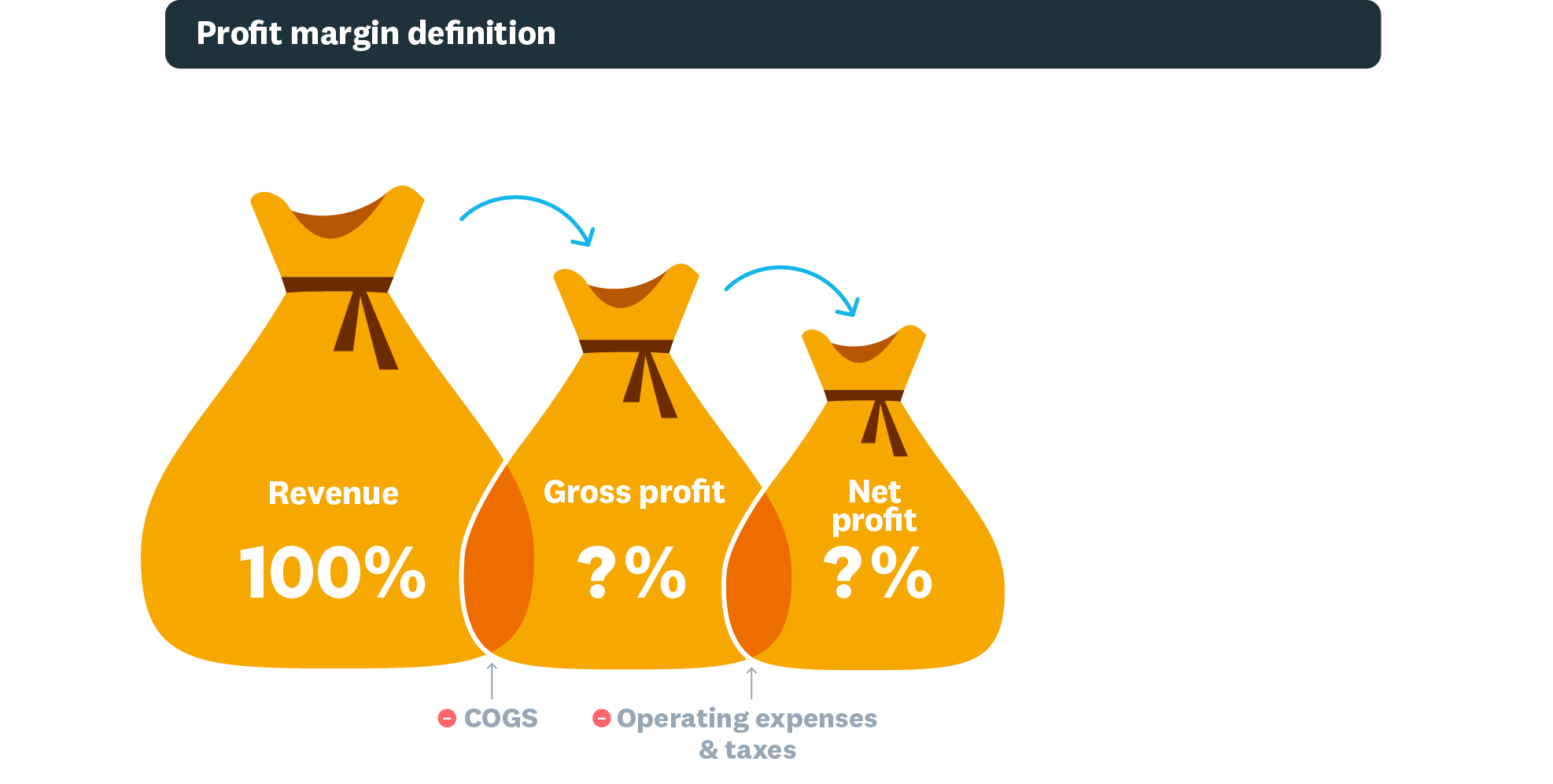
A strong profit margin signals financial health. It shows your business:
- Covers costs effectively. Revenue exceeds expenses with room to spare.
- Identifies performance gaps. Highlights which products or services deliver the best returns.
- Guides cost decisions. Reveals where to cut spending without hurting growth.
Profit margins vs net profit
Net profit and profit margin measure different things, and understanding the distinction helps you make better comparisons.
Net profit is a pound amount: the actual income left after deducting all expenses from revenue. Profit margin is a percentage: it shows what proportion of each pound earned you keep as profit.
This makes margins easier to compare across time periods or against other businesses, regardless of size. A business turning over £50,000 and one turning over £500,000 can both have a 15% margin, but their net profits will look very different.
Types of profit margins
There are four main types of profit margins, each offering a different view of your financial performance.
- Gross profit margin. The percentage of revenue remaining after subtracting the cost of goods sold (COGS). Use it to set pricing, spot inefficiencies, and compare performance across periods. Learn more about gross profit margin.
- Operating profit margin. The percentage of revenue left after paying production and operating costs (wages, materials, rent, utilities) but before taxes and interest. Use it to measure how profitable your core business operations are.
- Pretax profit margin. The percentage of revenue remaining after all operating costs, interest, and other expenses, but before tax. It's useful for comparing businesses with different tax situations.
- Net profit margin. The percentage of revenue remaining after all costs and taxes. Use it to assess overall financial health, as it accounts for every expense. Learn more about net profit margin.
How to calculate profit margins
The basic profit margin formula divides profit by revenue, then multiplies by 100. Expressing margin as a percentage makes it easy to compare your performance across different time periods or against competitors, regardless of business size.
Gross profit margin calculation
Gross profit margin shows how much revenue you keep after covering direct costs. Here's the formula and a worked example.
Gross profit margin formula: (Revenue - Cost of goods sold) / Revenue x 100
Follow these steps to calculate it:
- Start with your total revenue for the period. In this example, your cleaning business earns £20,000.
- Subtract your cost of goods sold (COGS). It costs £8,000 to deliver those services, so your gross profit is £20,000 - £8,000 = £12,000.
- Divide gross profit by revenue: £12,000 / £20,000 = 0.6.
- Multiply by 100 to get the percentage: 0.6 x 100 = 60%.
This means you keep 60p of every pound earned after covering direct costs. HMRC guidance shows that even a small omission in sales figures can create a noticeable difference in gross profit.
Try the Xero margin calculator to run your own numbers.
Operating profit margin calculation
Operating profit margin reveals how efficiently you run your day-to-day business, before taxes and interest come into play.
Operating profit margin formula: Operating profit / Revenue x 100
Continuing from the cleaning business example:
- Take your gross profit of £12,000.
- Subtract operating expenses (rent, utilities, admin). In this case, that's £3,000, leaving £9,000 operating profit.
- Divide operating profit by revenue: £9,000 / £20,000 = 0.45.
- Multiply by 100: 0.45 x 100 = 45%.
This example assumes operating expenses are separate from COGS. Your operating profit shows efficiency before taxes and interest are deducted.
Net profit margin calculation
Net profit margin gives you the clearest picture of your bottom line, because it accounts for every expense including taxes.
Net profit margin formula: Net profit / Revenue x 100
Continuing from the same example:
- Take your operating profit of £9,000.
- Subtract taxes. After paying £4,000 in taxes, your net profit is £8,000. (This simplified example excludes interest for clarity.)
- Divide net profit by revenue: £8,000 / £20,000 = 0.4.
- Multiply by 100: 0.4 x 100 = 40%.
This means you keep 40p of every pound earned after all expenses and taxes.
Try the Xero net profit margin calculator to calculate yours.
What is a good profit margin?
A good profit margin depends on your industry, business model, and stage of growth. There's no single number that works for every business, but benchmarks can help you gauge where you stand.
As a general rule of thumb:
- 5% or below is considered a low margin
- 10% is a healthy margin for most industries
- 20% or above is a high margin
Average profit margins by industry
Profit margins vary significantly across sectors. UK data from the Office for National Statistics (ONS) shows the average net profit margin for private non-financial businesses is around 9.3%.
Here's how margins typically break down by industry:
- Software and SaaS: 70%+ gross margins, with net margins often above 20%
- Professional services (consulting, legal, accounting): 15–30% net margins
- Online retail: 10–20% net margins, higher than traditional retail
- Construction and trades: 5–10% net margins
- Hospitality and food service: 3–9% net margins
- General retail: 2–5% net margins, relying on high volume
Low-end retail typically operates on thin margins with high volume, while luxury goods and software often achieve margins of 20% or higher. The type of margin matters too: gross margins are naturally higher than net margins because they exclude operating costs and taxes.
For the clearest picture of your financial health, focus on your operating and net profit margins, and compare them against businesses in your specific sector.
Why do profit margins matter?
Profit margins reveal your business's financial health by showing how much income you retain relative to expenses. Tracking them consistently helps you make informed decisions about pricing, spending, and growth.
Your profit margins help you:
- Set prices that cover costs and deliver adequate returns.
- Control costs by identifying where spending cuts would have the biggest impact.
- Allocate resources by prioritising investment in higher-margin products or services.
- Secure funding, as banks and investors examine margins when assessing loan or investment applications.
- Spot trends, with rising margins indicating improved efficiency and falling margins flagging rising costs.
Margin data also supports better budgeting and investment planning. Rising margins over time point to improved efficiency. Falling margins suggest costs are growing faster than revenue. Flat margins may signal stability or missed opportunities to optimise.
Benefits of high profit margins for growth
High profit margins typically signal a business that can invest and adapt. Businesses with strong margins can:
- Attract investment, as healthy margins signal financial stability to lenders and investors.
- Reinvest in growth, using more retained profit as capital for expansion.
- Experiment with pricing, with enough room to test competitive strategies without risking the bottom line.
Compare your margins against industry benchmarks and competitors to spot trends and opportunities for improvement.
Do high profit margins guarantee growth?
High profit margins don't guarantee growth. Research from Yale Insights found that margins don't necessarily rise as businesses expand.
Rapid growth can actually reduce margins if short-term costs (hiring, inventory, equipment) outpace revenue increases. Prioritise sustainable growth and monitor how expansion affects your margins before scaling further.
Factors affecting profit margins
Profit margins vary based on factors both within and outside your control. Understanding them helps you set realistic expectations and respond to changes.
- Industry. Retail and hospitality face higher overheads and tighter margins than consultancies or software businesses.
- Economic conditions. Inflation raises costs across the board. If you've borrowed to fund operations, rising interest rates directly reduce your margins.
- Location. Rent and local taxes vary significantly. A London-based business faces different cost pressures than one in Manchester or a rural area.
- Business model. Subscription-based businesses often achieve more predictable margins than those relying on one-off sales.
- Scale. Larger businesses may benefit from economies of scale, but rapid growth can temporarily compress margins.
Account for these factors when setting prices and assessing whether your margins are healthy for your specific situation.
How to increase your profit margins
Improving your profit margins comes down to three areas: reduce costs, improve operational efficiency, and adjust pricing. Each one affects your bottom line differently, and combining all three delivers the strongest results.
Control your costs
Review your expenses regularly to find savings that don't compromise quality or output.
- Audit subscriptions. Cancel software or services you no longer use.
- Negotiate with suppliers. Request better rates or explore alternative vendors.
- Manage labour costs. Align staffing levels with demand and reduce overtime where possible.
- Reduce waste. Track inventory to minimise spoilage or obsolete stock.
Make your operations more efficient
Improving how your business operates helps you get more from existing resources.
- Automate repetitive tasks. Use software for invoicing, scheduling, and inventory management.
- Streamline workflows. Identify bottlenecks that slow down delivery or service.
- Train your team. Well-trained staff make fewer errors and work more productively.
- Encourage ideas. Ask employees for suggestions on improving processes.
Adjust your pricing
A strong pricing strategy maximises revenue without losing customers. Consider these approaches:
- Dynamic pricing. Adjust prices based on demand, seasonality, or competitor activity.
- Premium tiers. Offer higher-priced options with added features or faster service.
- Bundling. Combine products or services at a slight discount to increase average order value.
- Build loyalty. Invest in loyalty programmes to increase repeat purchases and customer lifetime value.
- Regular reviews. Reassess prices annually to account for rising costs.
Track your profit margins with Xero
Understanding your profit margins is only the first step. Tracking them consistently gives you the insight to make confident decisions about pricing, spending, and growth.
Xero's accounting software helps you monitor your margins in real time with automated reports and dashboards. You can track gross, operating, and net profit margins across different time periods, compare performance month by month, and spot trends before they become problems. For deeper analysis, explore how to measure profitability using Xero's reporting tools.
FAQs on profit margins
Here are answers to frequently asked questions about profit margins.
What's the difference between profit margin and markup?
Profit margin is profit as a percentage of the selling price. Markup is profit as a percentage of the cost. For example, if you buy an item for £50 and sell it for £100, your markup is 100% but your profit margin is 50%. Use the Xero markup calculator to convert between the two, or learn more about how to calculate markup.
How do I calculate what selling price gives me a 30% profit margin?
Divide your cost by (1 minus your desired margin as a decimal). For a 30% margin on an item costing £70: £70 / 0.70 = £100 selling price. This ensures the £30 difference represents 30% of the final price.
Can my profit margin be negative?
Yes. A negative profit margin means your costs exceed your revenue on each sale. This requires immediate attention to your pricing, costs, or both. Review your expense structure and consider whether your prices adequately reflect the true cost of delivery.
How often should I calculate my profit margins?
Review margins monthly for a clear picture of trends. Calculate them after any significant change to pricing, costs, or product mix. Accounting software like Xero can track margins automatically, giving you up-to-date figures without manual calculations.
What is a good profit margin for a small business in the UK?
For UK small businesses, a net profit margin of around 10% is generally considered healthy. The ONS reports that private non-financial businesses in the UK average roughly 9.3%. However, this varies widely by sector, so compare your margins against benchmarks for your specific industry rather than aiming for a single number.
Is profit margin the same as return on investment?
Profit margin and return on investment (ROI) measure different things. Profit margin shows how much of each pound of revenue you keep as profit. ROI measures the return generated relative to the amount invested. Both are useful, but profit margin focuses on operational efficiency while ROI evaluates the effectiveness of a specific investment.
Disclaimer
Xero does not provide accounting, tax, business or legal advice. This guide has been provided for information purposes only. You should consult your own professional advisors for advice directly relating to your business or before taking action in relation to any of the content provided.