Gross profit margin: what it is, how to calculate it and how to improve it
Learn what gross profit margin is, how to calculate it with a worked example, and how to improve yours.
Written by Lena Hanna—Trusted CPA Guidance on Accounting and Tax. Read Lena's full bio
Published Tuesday 6 October 2026
Table of contents
Key takeaways
- Gross profit margin is gross profit as a percentage of revenue. It shows how much of each pound of sales is left after direct costs.
- Use the formula (revenue − COGS) ÷ revenue × 100, and track the result monthly to spot changes early.
- A good margin depends on your industry. Indicative UK ranges include 50–70% for professional services and 30–35% for grocery retail.
- You can lift your margin by negotiating with suppliers, pricing with care, cutting waste and focusing on your best-selling products.
What is gross profit margin?
Gross profit margin is gross profit (revenue minus cost of goods sold) shown as a percentage of revenue. The formula is (revenue − COGS) ÷ revenue × 100.
Cost of goods sold (COGS) covers the direct costs of making or buying what you sell, such as materials, direct labour, packaging and delivery. UK accounts often label this line “cost of sales”.
The margin shows how efficiently you turn sales into profit before operating expenses such as rent, utilities, marketing and office salaries. With a 60% margin, you keep 60p of every pound of sales to cover those overheads.
Gross profit margin vs gross profit
The two terms are closely linked, but one is an amount and the other is a ratio. Gross profit is the pound figure left after you subtract COGS from revenue.
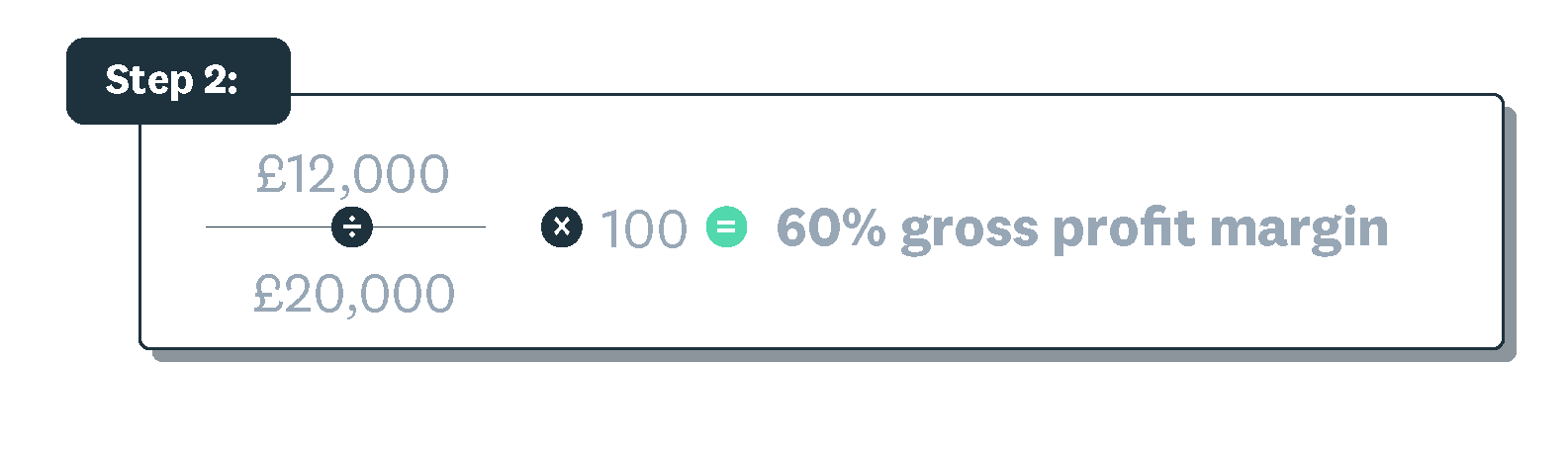
Say a cleaning business earns £20,000 in revenue and spends £8,000 on COGS. Its gross profit is £12,000, and its gross profit margin is 60% (£12,000 ÷ £20,000 × 100).
You’ll also see the margin called “gross margin”. HM Revenue & Customs (HMRC) describes gross profit rate as its most commonly used business ratio when examining accounts, so accurate figures matter.
How to calculate gross profit margin
You need two figures from the same period: revenue and COGS. Work it out by hand with the steps below, or check your numbers with the free margin calculator.
Gross profit margin formula

The formula is gross profit ÷ revenue × 100. In this formula:
- gross profit is revenue minus COGS for the period
- revenue is your sales after returns and discounts, excluding value added tax (VAT) if you’re VAT-registered
- COGS is the direct cost of making or buying what you sold
- the result is your gross profit margin as a percentage
If you’re VAT-registered, leave VAT out of both sales and costs. VAT you collect belongs to HMRC, and VAT you pay on purchases is usually reclaimable.
The formula explained in 3 steps
Once you have your figures, the calculation takes a few minutes. Follow these steps:
- Subtract COGS from revenue to find your gross profit.
- Divide gross profit by revenue, then multiply by 100 to get a percentage.
- Compare the result with previous periods to see which way your margin is moving.
Worked example for an online candle shop
Here’s how the steps work for a small UK product business. This online candle shop is VAT-registered, so every figure excludes VAT, and it covers one quarter.
- Work out revenue: gross sales of £31,200 less £1,200 in returns and discounts gives revenue of £30,000.
- Work out stock costs: opening stock of £4,000 plus purchases of £10,500, minus closing stock of £3,500, gives £11,000.
- Add other direct costs: direct labour of £2,400 and packaging and postage of £1,100 bring COGS to £14,500.
- Find gross profit: £30,000 minus £14,500 gives a gross profit of £15,500.
- Calculate the margin: £15,500 ÷ £30,000 × 100 gives a gross profit margin of 51.7%.
- Interpret the result: the shop keeps 51.7p of every £1 of sales to cover overheads and profit.

Prices have a strong effect on margin. Say the shop raises prices by 5% and COGS stays the same. Revenue rises to £31,500 and gross profit to £17,000, lifting the margin to about 54.0%.
The same starting figures give a markup of 106.9% (£15,500 ÷ £14,500 × 100). Markup measures profit against cost, so it always reads higher than margin.
Avoid common calculation mistakes
Small errors in your inputs can shift your margin and send you in the wrong direction. Check your workings against these points:
- Include every direct cost, such as materials, direct labour, packaging and delivery
- Keep operating costs like rent and admin salaries out of COGS
- Match revenue and costs to the same time period
- Round only at the final step so small differences don’t add up
Leaving out £2,000 of direct costs on £200,000 of sales overstates your margin by one percentage point. That gap can hide a pricing problem and raise questions if HMRC reviews your accounts.
What is a good gross profit margin?
A good gross profit margin depends on your industry and business model. At a minimum, it should cover your operating expenses and leave something over.
A healthy margin lets you fund growth and build a cash buffer for quieter months. It also gives you room to adjust prices when competitors do.
An unusually high margin is worth checking too. It can mean direct costs are sitting in your overheads by mistake, or that your prices are high enough to put some customers off.
Factors affecting your margins
Several things shape the margin you can realistically reach. The main ones are:
- Industry type, since professional services firms often reach 50–70% while construction firms typically sit at 15–25%
- Business model, since online sellers avoid shop rent but often pay more for postage and packaging
- Competition, since crowded markets limit how much you can charge
- Location, since supplier and labour costs vary across the UK
Industry benchmarks for gross profit margin
Benchmarks give you a rough idea of where you stand. Treat these ranges as indicative guides rather than official statistics:
- 70–85% for software as a service (SaaS) businesses
- 50–70% for professional services
- 35–45% for hospitality
- 30–35% for grocery retail
- 15–25% for construction
Your accountant can help you find benchmarks closer to your niche and size. Recent trading data also shows how conditions differ between sectors.
According to Xero Small Business Insights, UK small retail trade sales rose 2.0% year on year in the June quarter 2026. Hospitality sales fell 0.5%, while retail jobs grew 3.5% and hospitality jobs fell 0.7%.
When sales slow and staff numbers hold up, direct labour takes a bigger share of revenue. That makes it worth checking your margin more closely.
Benchmarking against similar businesses
Benchmarks work best when you compare like with like. Look at businesses of a similar size and model, as a local café and a national chain buy on very different terms.
Your own trend matters more than a single snapshot. A margin that climbs steadily from 38% to 42% over a year tells you more than one month above the sector average.
When to reassess your margin
Your margin needs a fresh look whenever your costs or market change. Review it when:
- suppliers change their prices or terms
- customer demand or competitor pricing shifts
- you miss your sales or profit targets
- you’re planning a big decision, such as hiring or launching a product
According to Xero Small Business Insights, UK small business sales growth slowed again in the June quarter 2026. A slowdown like this is a good prompt to recheck your prices and supplier costs.
How to improve your gross profit margin
You can raise your margin by lowering direct costs, raising prices or changing what you sell. These moves help most:
- Renegotiate with suppliers, using your cost of sales figures to show where savings would help
- Raise prices in small, planned steps, starting with products customers value most
- Reduce waste and errors that push up direct costs
- Focus your product mix on items with the strongest margins
- Upsell add-ons or premium versions that cost little extra to deliver
The candle shop example shows how far a small change goes: a 5% price rise lifted its margin from 51.7% to about 54.0%. A healthier margin also gives you more room to increase profits across the business.
Gross profit margin for startups and new businesses
New businesses often start with lower margins. You buy in smaller quantities at higher unit costs, and your processes are still bedding in.
If you make or deliver the product yourself, count that direct labour in COGS. Leaving it out makes your margin look healthier than it is and can lead to underpricing.
Margins usually improve as you grow, buy in bulk and refine how you work. Tracking from your first month gives you a baseline to measure that progress against.
Analysing gross profit margin for business insights
Your margin tells you more when you track it over time. Pair it with other measures to measure profitability across the whole business.
Interpreting margin trends
Month-to-month changes point to what’s happening underneath your sales figures. A falling margin can signal:
- seasonal dips in demand or pricing
- underperforming products dragging down the average
- rising supplier or material costs
- heavier discounting to win sales
According to Xero Small Business Insights, UK small business sales grew 3.6% year on year in the June quarter 2026. That’s down from 4.2% in the March quarter and 5.5% in the December quarter, and well below the 8.5% historical average.
Jobs growth also slowed, to 1.7% year on year from 2.4% in the March quarter. If your sales growth is slowing too, watch your margin monthly rather than quarterly.
External factors that affect your margins
Some pressures come from outside your business. Watch for:
- supply chain delays that raise material or delivery costs
- new competitors that push prices down
- inflation that lifts your input costs faster than your prices
- energy and fuel costs that feed into production and delivery
According to Xero Small Business Insights, higher-than-normal fuel prices hit household budgets and discretionary spending in the June quarter 2026. It expects margins and cash flow to stay under pressure as small businesses are squeezed between rising input costs and hesitant customers.
Gross profit margin compared with other metrics
Gross profit margin is one of several profitability ratios, and each one captures a different layer of costs. You’ll find the figures for all of them in your profit and loss statement.
Gross profit margin vs operating profit margin
Your operating profit margin goes a step further and subtracts operating expenses such as rent, marketing, insurance and office salaries. It shows how well you run the business day to day, while gross margin focuses on production and buying.
A strong gross margin paired with a weak operating margin usually points to high overheads.
Gross profit margin vs net profit margin
Net profit margin is the share of revenue left after every cost, including operating expenses, interest, depreciation and tax. It’s the clearest view of your bottom line.
You can work it out quickly with the net profit margin calculator.
Gross profit margin vs markup
Margin and markup use the same profit figure but measure it against different bases. Margin divides profit by the selling price, while markup divides profit by the cost.
Say a product costs £40 and sells for £60, leaving £20 of profit. The margin is 33.3% (£20 ÷ £60 × 100), and the markup is 50% (£20 ÷ £40 × 100).
Mixing the two up can lead to underpricing. Adding a 33.3% markup to cost gives you a 25% margin, which may leave too little to cover overheads.
Limitations of gross profit margin
Gross profit margin is a useful measure, but it only covers part of the picture. Keep these limits in mind:
- It ignores operating expenses, so a healthy margin can sit alongside a loss
- It varies widely by industry, so 25% is good in construction but low for professional services
- It says nothing about cash flow timing, such as when customers pay
- It averages across products, so strong sellers can mask weak ones
Track your gross profit margin with Xero
Keeping a close eye on your margin helps you price with confidence and act early when costs rise. Xero connects to your bank, so transactions flow into your accounts without manual entry.
Your profit and loss report then shows revenue, cost of sales and gross profit in one place, ready to compare month by month. Start tracking today and get one month free.
FAQs on gross profit margin
Here are quick answers to common questions about gross profit margin.
Is a 30% gross profit margin good?
It’s solid for grocery retail and strong for construction. For a professional services or SaaS business, 30% would be low and worth investigating.
How do you calculate gross profit margin from cost and selling price?
Subtract the cost from the selling price, divide by the selling price and multiply by 100. An item that costs £15 and sells for £25 has a 40% margin.
Should you include VAT when calculating gross profit margin?
If you’re VAT-registered, exclude VAT from both sales and costs. If you’re not registered, the VAT you pay on purchases is part of your cost, so include it in COGS.
Do wages count towards cost of goods sold?
Only wages for people who directly make or deliver what you sell count towards COGS. Office, admin, sales and marketing staff wages are operating expenses.
Can gross profit margin be negative?
Yes, it turns negative when COGS is higher than revenue, which means you’re selling below cost. This can happen briefly during clearance sales, but a lasting negative margin needs urgent action on prices or costs.
Do you pay tax on gross profit or net profit?
UK businesses are taxed on taxable profit, which is income less allowable expenses, not on gross profit or turnover. Limited companies pay Corporation Tax on it, while sole traders pay Income Tax through Self Assessment.
Disclaimer
Xero does not provide accounting, tax, business or legal advice. This guide has been provided for information purposes only. You should consult your own professional advisors for advice directly relating to your business or before taking action in relation to any of the content provided.