Difference between bookkeeping and accounting
Find out how bookkeeping and accounting differ, and which your business needs.
Published Wednesday 17 June 2026
Table of contents
Key takeaways
- Bookkeepers handle daily financial record-keeping such as recording transactions, reconciling bank accounts and processing invoices, while accountants analyse that data to provide strategic advice, tax planning and compliance support.
- With 5.6 million small businesses in the UK, getting the right financial support matters: start with a bookkeeper for organised records and add an accountant as your finances grow more complex or you need strategic planning.
- UK bookkeepers typically hold Association of Accounting Technicians (AAT) or Institute of Certified Bookkeepers (ICB) qualifications and cost £120 to £300 per month, while accountants hold chartered designations such as ACA, ACCA or CIMA and charge £250 to £500 per month.
- Using both professionals together, alongside cloud accounting software like Xero, gives you accurate day-to-day records and the strategic insights you need to grow.
Bookkeeping vs accounting
Understanding the difference between bookkeeping and accounting helps you choose the right financial support for your business. Both are essential, but they serve different purposes.
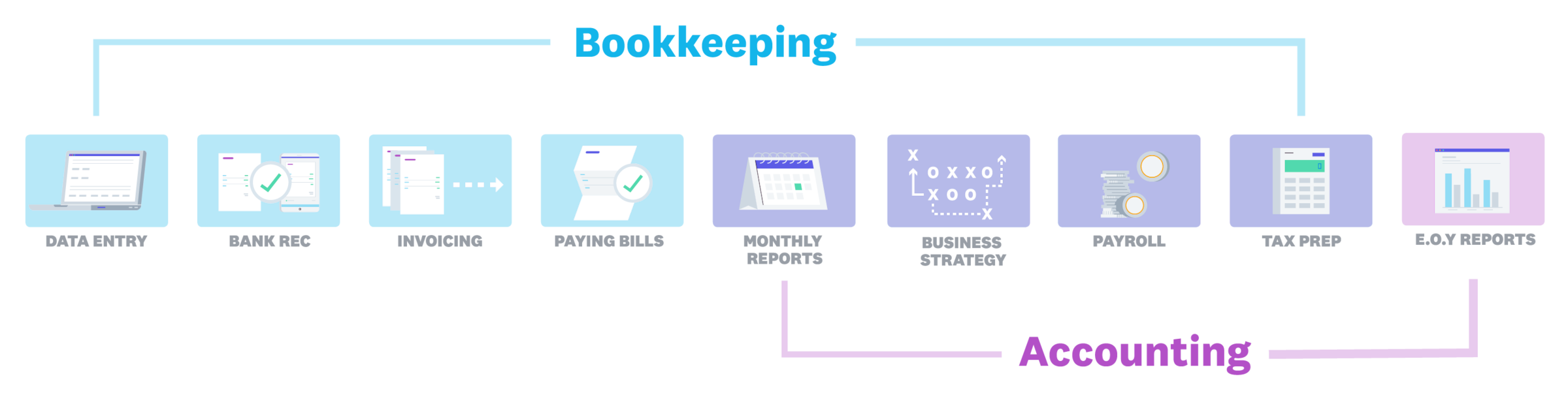
Bookkeeping is the day-to-day recording and organising of your financial transactions. It covers tasks like entering sales and expenses, reconciling bank statements and processing invoices. Bookkeeping keeps your financial data accurate and up to date.
Accounting takes that organised data and uses it to analyse your business performance, prepare financial reports and plan for tax. Accountants interpret the numbers to help you make informed decisions about growth, cash flow and compliance.
According to the Federation of Small Businesses (FSB), there are 5.6 million small businesses in the UK contributing £2.8 trillion to the economy. Whether you run a sole trader operation or a growing limited company, understanding where bookkeeping ends and accounting begins helps you invest in the right support at the right time. The Xero guide to small business accounting covers the broader fundamentals.
What bookkeepers do
Bookkeepers manage the financial record-keeping that keeps your business organised and your data reliable. Their work forms the foundation that accountants build on when preparing reports and offering advice.
On a daily basis, bookkeepers handle tasks such as:
Handy resources
Advisor directory
You can search for experts in our advisor directory
When you should hire a bookkeeper
Find out all the things bookkeepers can do for your business
Xero dashboard
See your key information on the business dashboard
Disclaimer
This glossary is for small business owners. The definitions are written with their requirements in mind. More detailed definitions can be found in accounting textbooks or from an accounting professional. Xero does not provide accounting, tax, business or legal advice.
- Recording and categorising all business transactions, including sales, purchases and expenses
- Managing accounts payable and accounts receivable
- Processing invoices and tracking payments
- Reconciling bank accounts to catch errors early
- Filing receipts and maintaining organised financial records
Each month, bookkeepers also take care of broader tasks:
- Preparing profit and loss reports so you can see how your business is performing
- Reconciling supplier statements against your records
- Reviewing outstanding invoices and chasing late payments
- Processing payroll or preparing payroll data for your provider
On a quarterly and annual basis, bookkeepers support compliance by:
- Preparing VAT returns for submission through Making Tax Digital (MTD) compatible software
- Organising records ahead of your accountant's year-end review
- Archiving financial documents in line with HMRC record-keeping requirements
For many small businesses and sole traders, a reliable bookkeeper saves hours of admin each week and ensures your records are always ready when your accountant needs them.
What accountants do
Accountants are qualified financial professionals who interpret your business data to provide strategic advice and ensure you meet your legal obligations. In the UK, most practising accountants hold a professional designation such as ACA (from ICAEW), ACCA or CIMA.
Core accounting services include:
- Preparing statutory financial statements, including profit and loss accounts, balance sheets and cash flow statements
- Filing Self Assessment tax returns, Corporation Tax returns and managing HMRC compliance
- Advising on tax efficiency, including allowable expenses, capital allowances and dividend strategies
- Conducting financial analysis and forecasting to support business planning
Beyond compliance, accountants also provide strategic support:
- Business planning and budgeting for growth or new ventures
- Cash flow forecasting to help you manage seasonal fluctuations
- Advising on business structure, for example whether to operate as a sole trader or limited company
- Preparing for audits and representing you in dealings with HMRC
Some accounting firms also offer bookkeeping services, so you can manage your day-to-day records and strategic planning in one place. If you're using cloud accounting software like Xero, your accountant can access your live financial data directly, which makes collaboration more efficient.
Difference between bookkeepers and accountants
While bookkeeping and accounting are closely connected, there are clear differences in scope, timing and cost. Understanding these helps you decide how to structure your financial support.
In terms of focus and scope:
- Bookkeepers focus on recording, organising and maintaining accurate financial data
- Accountants focus on analysing, interpreting and reporting on that data to guide business decisions
The timing of their work also differs:
- Bookkeeping is ongoing: daily and weekly tasks that keep records current
- Accounting is periodic: monthly, quarterly or annual work such as financial reporting, tax filing and year-end reviews
Bookkeepers and accountants also differ in their qualifications:
- Bookkeepers typically hold AAT (Association of Accounting Technicians) or ICB (Institute of Certified Bookkeepers) qualifications
- Accountants hold chartered designations such as ACA, ACCA or CIMA, which typically require degree-level study or equivalent professional examinations and supervised experience
Cost is often a deciding factor for small businesses. UK bookkeepers typically charge between £120 and £300 per month, while accountants tend to charge between £250 and £500 per month depending on the complexity of your needs. These figures can vary by location, transaction volume and complexity.
Many small businesses use both: a bookkeeper for day-to-day financial management and an accountant for strategic planning, tax compliance and year-end accounts. This gives you comprehensive support without paying for services you don't need.
When to hire a bookkeeper vs an accountant
Your business stage and needs determine which professional to bring in first. Your business stage and needs determine which professional to bring in first.
Consider hiring a bookkeeper when you:
- Have regular transactions that need recording and organising
- Spend more than 5 hours a week on financial admin
- Need help with invoicing, bill payments and bank reconciliations
- Want monthly reports so you can track how your business is performing
Consider hiring an accountant when you:
- Need strategic financial advice for major business decisions
- Have complex tax situations, multiple revenue streams or employees
- Are planning significant changes such as expansion, investment or taking on loans
- Need to ensure full compliance with HMRC requirements, including MTD for VAT
Consider hiring both when you:
- Have growing turnover and increasingly complex financial needs
- Operate across multiple locations or need both daily record-keeping and strategic planning
- Want to focus entirely on running your business rather than managing finances
Cash flow management is another important factor. Data from the Xero Small Business Insights index shows that UK small businesses wait an average of 29 days to be paid, with invoices arriving 8.2 days late. A bookkeeper can help you stay on top of outstanding invoices, while an accountant can advise on broader cash flow strategies to keep your business healthy.
Most small businesses start with a bookkeeper and add an accountant as they grow and need more strategic financial guidance.
UK qualifications for bookkeepers and accountants
Understanding professional qualifications helps you assess a financial professional's expertise and find the right fit for your business.
UK bookkeeper qualifications include:
- AAT (Association of Accounting Technicians) Levels 2 to 4, one of the most widely recognised bookkeeping qualifications in the UK
- ICB (Institute of Certified Bookkeepers) certification, which focuses specifically on practical bookkeeping skills
- Foundation degrees or HNDs in accounting and finance
- On-the-job training combined with bookkeeping software proficiency
UK accountant qualifications include:
- ACA (Associate Chartered Accountant) from ICAEW, requiring a degree and 3 years of supervised training
- ACCA (Association of Chartered Certified Accountants), an internationally recognised qualification with flexible entry routes
- CIMA (Chartered Institute of Management Accountants), which focuses on management accounting and business strategy
- Specialised certifications in areas such as tax, forensic accounting or business valuation
In terms of typical UK salaries, bookkeepers earn between £22,000 and £32,000 per year depending on experience and location, while qualified accountants earn between £35,000 and £60,000 or more in senior roles. These figures can vary significantly based on region, sector and whether the professional works in practice or in-house.
Higher qualifications usually mean higher fees, but you also get a broader range of services. Choose a professional whose qualifications and experience match your business needs and budget. The Xero guide on how to choose an accountant covers what to look for in more detail.
Simplify your bookkeeping and accounting with Xero
The right tools make bookkeeping and accounting simpler, whether you manage your own finances or work alongside a professional.
Xero's cloud accounting software automates routine tasks like bank reconciliation, invoicing and expense tracking, helping you spend less time on admin and more time growing your business. Your bookkeeper and accountant can access your live financial data anytime, which makes collaboration straightforward and keeps everyone working from the same numbers.
Whether you're a sole trader keeping on top of your own books or a growing business working with both a bookkeeper and an accountant, Xero brings everything together in one place. Get one month free.
FAQs on bookkeeping vs accounting
Here are some frequently asked questions about bookkeeping vs accounting.
Can a bookkeeper handle my accounting needs?
A bookkeeper can manage your day-to-day financial records, invoicing and bank reconciliations. However, for tax planning, statutory accounts preparation and strategic financial advice, you'll need a qualified accountant.
How much does a bookkeeper cost in the UK?
UK bookkeepers typically charge between £120 and £300 per month for small business services. The exact cost depends on the volume of transactions and complexity of your financial records.
What UK qualifications should I look for in a bookkeeper?
Look for AAT (Association of Accounting Technicians) or ICB (Institute of Certified Bookkeepers) qualifications. AAT Levels 2 to 4 are the most widely recognised bookkeeping credentials in the UK.
Is accounting software like Xero a replacement for a bookkeeper or accountant?
Accounting software handles many bookkeeping tasks automatically, such as bank feeds and transaction categorisation. It doesn't replace professional expertise, but it makes both your bookkeeper's and accountant's work more efficient.
Do I need both a bookkeeper and an accountant?
If your business is relatively small and your tax affairs are straightforward, a bookkeeper may be all you need initially. As your business grows or your finances become more complex, adding an accountant for strategic advice and tax compliance is a worthwhile investment.
Handy resources
Advisor directory
You can search for experts in our advisor directory
When you should hire a bookkeeper
Find out all the things bookkeepers can do for your business
Xero dashboard
See your key information on the business dashboard
Disclaimer
This glossary is for small business owners. The definitions are written with their requirements in mind. More detailed definitions can be found in accounting textbooks or from an accounting professional. Xero does not provide accounting, tax, business or legal advice.