Solvency vs Liquidity: The Difference for Your Business
Learn the difference between solvency and liquidity to protect cash flow, cut risk, and make better money decisions.

Written by Lena Hanna—Trusted CPA Guidance on Accounting and Tax. Read Lena's full bio
Published Tuesday 6 January 2026
Table of contents
Key takeaways
- Monitor both solvency and liquidity ratios regularly to assess your business's ability to meet long-term debts (solvency ratio of 20% or above is generally healthy) and short-term obligations (current ratio above 1.0 indicates good liquidity).
- Strengthen your solvency by attracting investors to improve your asset-to-debt ratio, restructuring existing debt for better terms, and optimising operations to reduce long-term costs.
- Improve your liquidity by accelerating customer collections through easier payment methods, building cash reserves for unexpected expenses, and closely monitoring cash flow to avoid payment shortfalls.
- Recognise that poor liquidity creates immediate cash flow problems while poor solvency threatens long-term survival, so both metrics require attention for sustainable business growth and financial stability.
What does solvency mean in business?
Solvency shows whether your business can survive and pay its debts over time. A solvent business has total assets worth more than its total liabilities. Officially, the solvency test has two parts: the liquidity (or cash flow) test and the balance sheet test.
This positive net equity means you can meet long-term financial commitments and continue operating.
What factors affect your solvency?
To maintain solvency, you can:
- maintain consistent profits by keeping your total assets above your total liabilities through steady revenue
- manage debt strategically by negotiating lower repayments and understanding collateral loan terms
- optimise asset returns by ensuring your inventory and equipment generate enough income to cover debts
What is solvency vs profitability?
Solvency measures your ability to pay long-term debts, while profitability measures how much money you make versus your costs.
A profitable business earns more than it spends on producing goods or services. Good profits boost your chances of staying solvent.
However, poor debt management can lead to insolvency. Taking new loans without paying existing ones can make your liabilities exceed your assets.
How does solvency affect your business growth?
If you stay solvent, you can more easily:
- borrow money from banks and lenders who feel confident you can pay them back
- attract potential investors who bring more resources and expertise to your business
- get better deals with suppliers by using cash reserves to buy in bulk and lower your cost per unit
- keep your business running smoothly and make plans for the future
What does liquidity mean in business?
Liquidity measures your business's ability to pay bills and loan repayments in the coming months. Higher liquidity means better short-term financial flexibility.
Liquidity compares current liabilities (debts due within a year) with current assets (cash, inventory and quickly sellable assets). You express this comparison as ratios, such as the cash ratio or quick ratio.
Other liquidity ratios
Three main liquidity ratios help measure your short-term financial health:
- Current ratio: Current assets divided by current liabilities
- Quick ratio: Cash and easily convertible assets divided by current liabilities (excluding inventory)
- Cash ratio: Only cash and cash equivalents divided by current liabilities
The quick ratio is the most conservative measure as it excludes inventory that might be hard to sell quickly.
How liquid are your assets?
Asset liquidity determines how quickly you can convert assets to cash. Different assets have varying levels of liquidity.
More liquid assets:
- Cash: Immediately available funds in accounts
- Accounts receivable: Money owed by customers (liquidity decreases with longer payment terms)
Less liquid assets:
- Physical assets: Buildings and equipment that can take months to sell
Understanding asset liquidity helps you plan cash flow and meet short-term obligations.
Liquidity vs other financial concepts
You might hear about liquidity in relation to other terms, like cash flow. Here's roughly how they compare.
If liquidity shows how easily your business can cover its upcoming costs:
- Cash flow refers to the general availability of cash
- Working capital shows how much money you have left after covering these upcoming costs
- Free cash flow is the amount of cash left after making capital investments
How does liquidity affect business growth?
High liquidity supports business growth in three key ways:
- Seize opportunities: Launch new products or hire staff when cash is readily available
- Handle unexpected costs: Cover emergency expenses like equipment repairs or facility damage
- Maintain operational stability: Avoid disrupting operations to find alternative suppliers or lenders
The main differences between solvency and liquidity
Solvency takes a long-term view of your financial health, while liquidity focuses on the short term. This table outlines other differences.
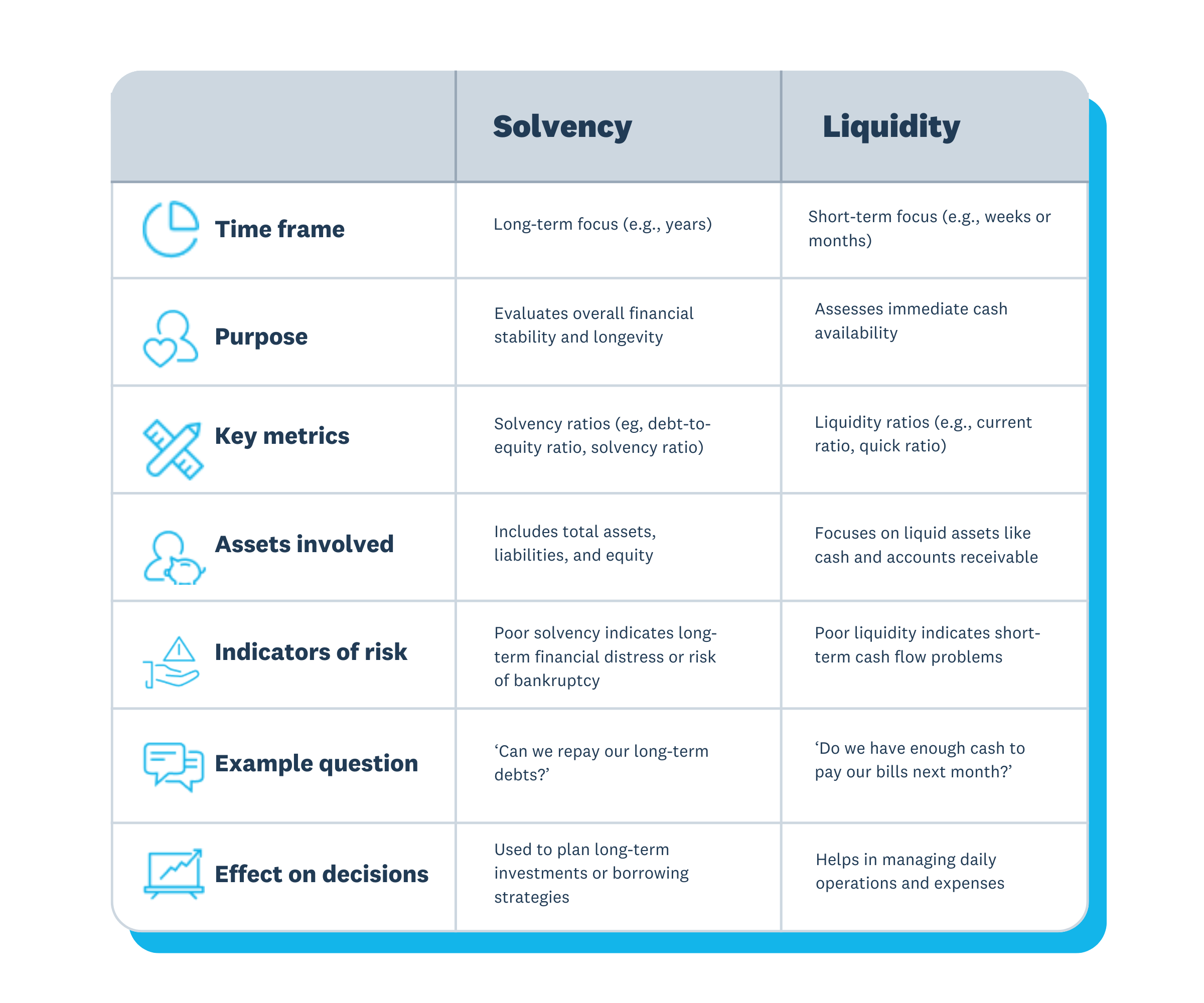
Table of the difference between solvency and liquidity
Keep a steady eye on both your business's liquidity and solvency to stay on top of your financial picture.
How to measure solvency and liquidity in your business
To calculate solvency ratio, first look at the ratios that measure solvency and liquidity.
Solvency ratio formula
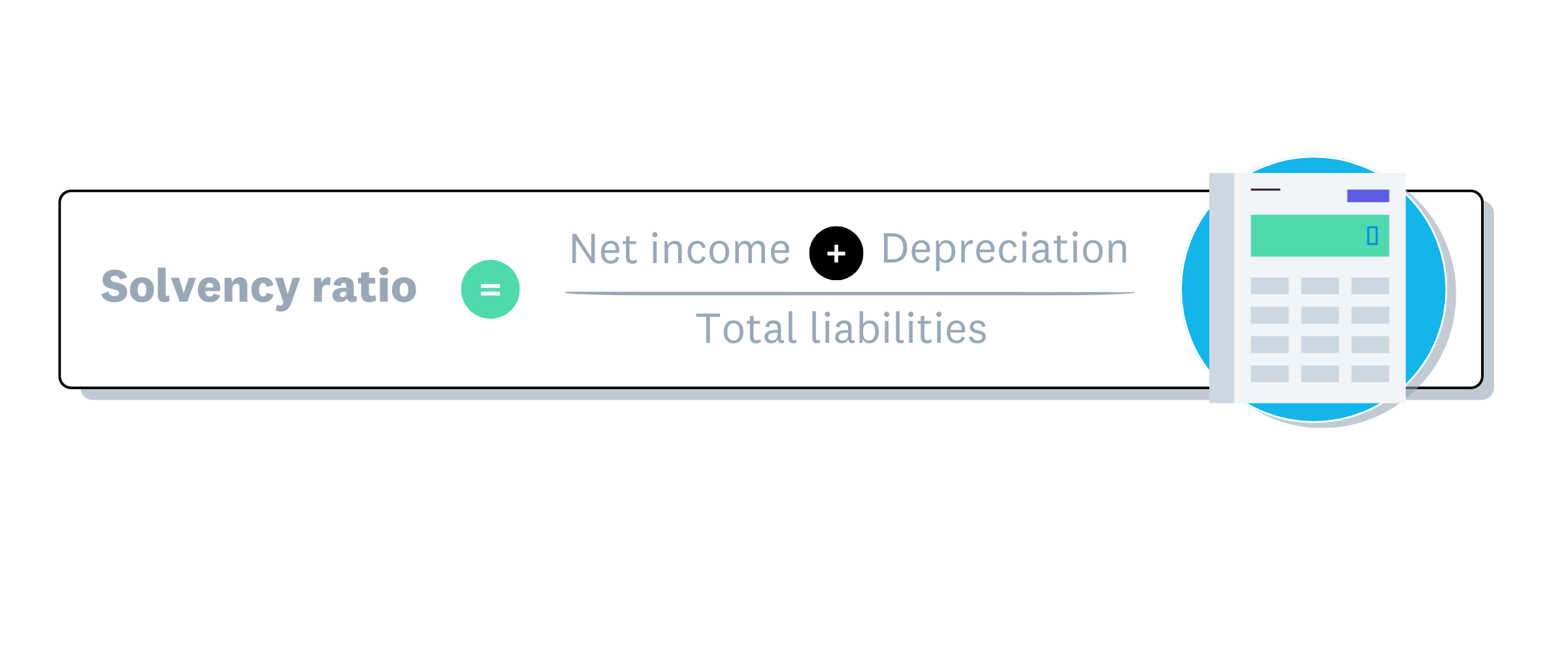
Solvency ratio formula
Let's look at a solvency ratio calculation example.
Martha owns a cafe that has:
- A net income of $50,000
- Asset depreciation* of $10,000
- Total liabilities of $300,000
To work out her solvency, she divides 60,000 (50,000 + 10,000) by 300,000, which equals 20%.
Many lenders and advisers view a ratio of 20% or above as healthy, so Martha's business has a good chance of paying its debts over the years. This is a crucial metric, as the Companies Act 1993 requires directors to apply the solvency test before making decisions like shareholder distributions or share repurchases.
*Depreciation is the decrease of the value of your assets over time from normal wear and tear, which is entered on your balance sheet as a deduction from the assets value.
Liquidity ratio formula
There are several liquidity ratios, such as the cash ratio, quick ratio and the working capital ratio, which is a useful long-term measure of liquidity.
Here's the formula for the working capital ratio:

Now let's look at a liquidity ratio calculation example.
Sadiq runs a sports shop that has:
- Current assets of $120,000
- Current liabilities of $80,000
To work out his liquidity (using the current ratio), he must divide 120,000 by 80,000 to equal 1.5. Since this is above 1.0, his liquidity is good and it's likely he can meet his short-term financial commitments.
Why solvency and liquidity matter for your small business
Poor liquidity creates immediate cash flow problems. You'll struggle to pay staff and suppliers, often due to late customer payments.
Poor solvency threatens long-term survival. If a business is no longer deemed a 'going concern,' its financial statements must be prepared on a different basis, such as a liquidation basis. If debts exceed assets and a business becomes insolvent, it may need to enter bankruptcy or another formal process. You can find more detail in the New Zealand government’s information on insolvency.
Strong liquidity and solvency provide:
- Immediate benefits: You can pay suppliers and staff on time
- Risk protection: You can handle market changes and unexpected costs; for example, the Reserve Bank of New Zealand stress-tests major banks against severe New Zealand recessions
- Better decision-making: You can plan both daily operations and long-term strategy
Tips to improve your financial solvency and liquidity
Improve your financial health with targeted strategies for both short- and long-term stability.
Strengthen solvency (long-term health):
- Attract investors: Bring in capital to improve your asset-to-debt ratio
- Restructure debt: Renegotiate, refinance, or consolidate loans for better terms
- Optimise operations: Consider staff restructuring to reduce long-term costs
Boost liquidity (short-term cash flow):
- Monitor cash flow: Track and plan payments to avoid shortfalls
- Benchmark performance: Compare your ratios to industry standards
- Accelerate collections: Make it easier for customers to pay their invoices
- Build cash reserves: Maintain funds for unexpected expenses
Take control of your business finances
Understanding the difference between solvency and liquidity is a great first step. The next is to track them. With a clear view of your short-term cash and long-term stability, you can make smarter decisions and run your business with confidence.
Xero accounting software gives you the real-time insights you need to stay on top of your numbers. See your financial health at a glance and plan for a more profitable future. Get one month free.
FAQs on solvency and liquidity
Here are some common questions about solvency and liquidity and how they affect your business.
What does it mean to provide liquidity?
To provide liquidity is to make sure your business has enough cash to pay its bills and obligations in the short term. For example, you might provide your business with liquidity by finding ways to improve its cash flow, such as by offering a discount to get paid sooner.
Can my business have good solvency but poor liquidity?
Definitely. Your business might struggle with liquidity if its cash flow is weak (there's not much cash in the bank), yet it's solvent because it has valuable fixed assets, like land and buildings. It can therefore pay its long-term debts.
Is solvency good or bad?
Solvency is good. The financial solvency definition is being able to meet your long-term financial obligations.
What is a good solvency ratio for my small business?
It depends on your industry. In general, a ratio of 20% or more indicates you can meet your long-term financial obligations.
What is employee liquidity?
This relates to how easily your employees can access their salary or otherwise manage their money; for example, whether they have the freedom to receive their salary in advance, or how freely they can convert their stocks and shares to cash.
High employee liquidity helps boost morale in your workplace.
Get one month free
Purchase any Xero plan, and we will give you the first month free.