Gross profit vs net profit: what's the difference?
Learn how gross profit and net profit differ, and why both matter for your business.
Published Thursday 23 July 2026
Table of contents
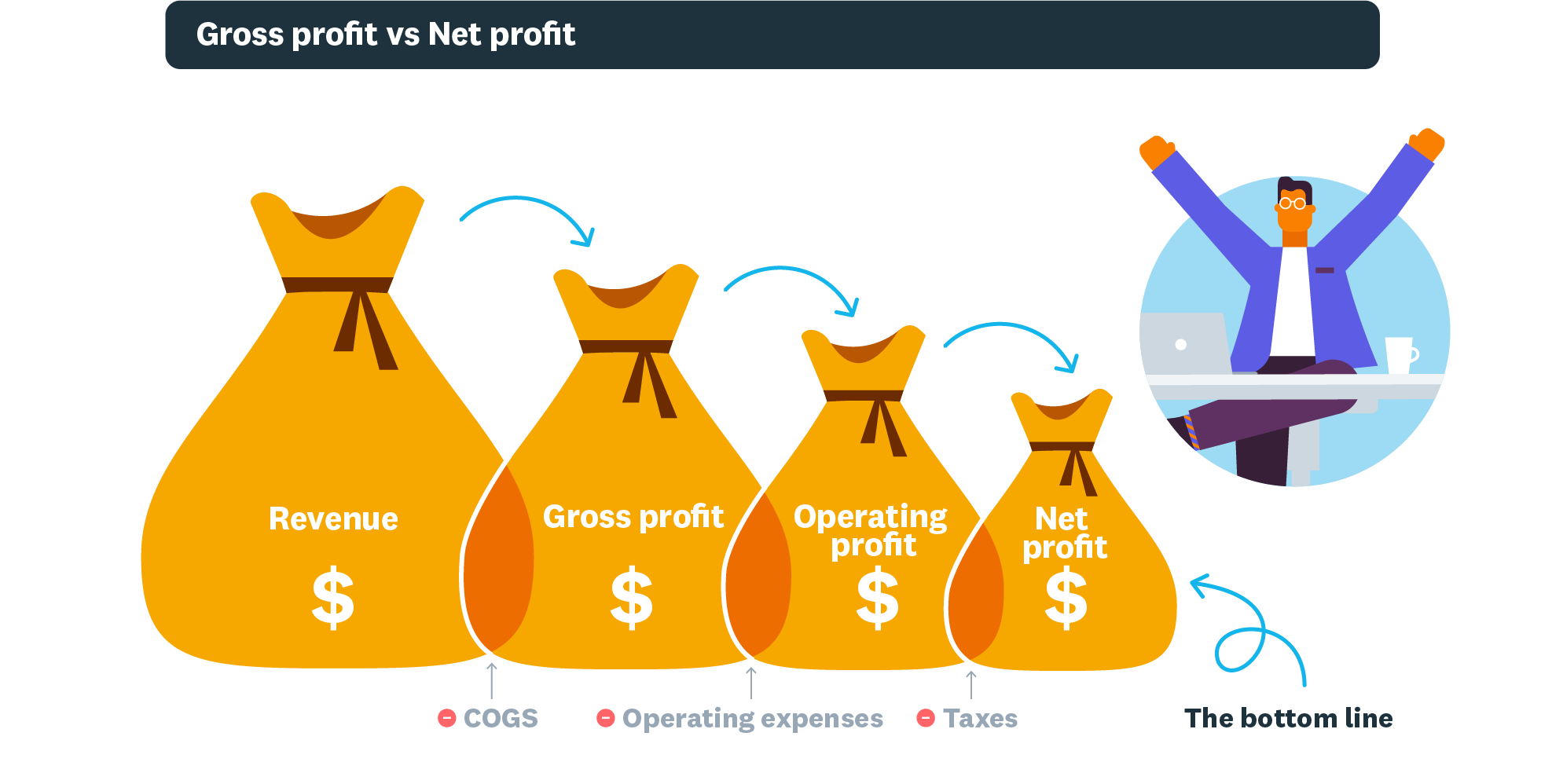
The difference between gross profit and net profit is operating expenses and taxes
Key takeaways
- Gross profit shows how much you earn after covering the direct costs of making or delivering your product. Net profit shows what's left after all expenses, including rent, wages, and tax.
- Both figures come from the same income statement, but they tell you different things about your business's financial health.
- Tracking gross and net profit together helps you spot where money is going, so you can make smarter decisions about pricing, spending, and growth.
- You can calculate both in a few steps using your revenue and expense data, or pull them straight from a profit and loss report in your accounting software.
What is gross profit?
Understanding gross profit is the first step toward getting a clear picture of your business's finances. It tells you whether you're making enough on each sale to cover your other costs and still turn a profit.
Gross profit is the amount of money left over after you subtract the direct costs of producing or delivering your goods and services from your total revenue. These direct costs are often called cost of goods sold (COGS).
COGS includes expenses that are directly tied to what you sell. For a retail business, that's the wholesale price of your stock. For a bakery, it's the flour, butter, and packaging. For a service business, it could be the labour costs directly involved in delivering the service.
What gross profit doesn't cover is everything else it takes to run your business. Rent, utilities, marketing, insurance, and office supplies aren't included. That means a healthy gross profit doesn't automatically mean your business is profitable overall.
Gross profit formula
Once you know what gross profit is, calculating it is straightforward. Here's the formula and a worked example to show how it plays out for a real business.
Gross profit = Revenue - Cost of goods sold (COGS)
Say you run a small bakery in Melbourne. In a given month, your total revenue from sales is $25,000. Your COGS, which includes ingredients, packaging, and the wages of your baking staff, comes to $10,000.
Your gross profit for that month is $25,000 - $10,000 = $15,000.
That $15,000 is what you have available to cover all your other business expenses and, ideally, still have something left over as net profit.
What is net profit?
While gross profit gives you a snapshot of your production efficiency, net profit shows you the full picture. It's the number that tells you whether your business is truly making money after everything is paid for.
Net profit is what remains after you subtract all your business expenses from your total revenue. That includes COGS, but also operating expenses like rent, utilities, marketing, insurance, loan repayments, and tax.
Net profit is sometimes called your "bottom line" because it sits at the bottom of your profit and loss statement. It's the figure that lenders, investors, and the Australian Taxation Office (ATO) are most interested in.
If your net profit is positive, your business is earning more than it spends. If it's negative, you're operating at a loss, even if your gross profit looks healthy.
Net profit formula
Continuing with the bakery example, here's how to take your gross profit and work out what's actually left at the end of the month.
Net profit = Revenue - Total expenses (COGS + operating expenses + tax)
Your Melbourne bakery earned $25,000 in revenue with $10,000 in COGS, giving you a gross profit of $15,000. Now factor in your other monthly costs:
- Rent: $3,000
- Utilities: $500
- Marketing: $800
- Insurance: $400
- Admin wages: $4,000
- Loan repayment: $600
- Tax: $1,200
That's $10,500 in additional expenses. Your net profit is $15,000 - $10,500 = $4,500.
So while the bakery's gross profit was a solid $15,000, the actual profit after all costs is $4,500. That's the real measure of how the business is performing.
Key differences between gross profit and net profit
Gross profit and net profit are related, but they measure different things. Here's a clear breakdown of how they compare, so you can see exactly where each one fits into your financial picture.
What they measure:
- Gross profit measures how efficiently you produce or deliver your product
- Net profit measures overall business profitability after all costs
Which expenses they include:
- Gross profit subtracts only direct costs (COGS) from revenue
- Net profit subtracts all expenses from revenue, including COGS, operating costs, interest, and tax
What they tell you:
- Gross profit tells you whether your pricing covers production costs
- Net profit tells you whether your business is genuinely profitable
Where they appear:
- Gross profit appears partway down your profit and loss statement
- Net profit sits at the bottom of your profit and loss statement
Why gross profit and net profit both matter for your business
It's tempting to focus on just 1 number, but gross profit and net profit each play a different role in helping you make good decisions. Together, they give you a much clearer view of where your money is going.
Gross profit helps you evaluate your pricing strategy and production costs. If your gross profit is shrinking, it could mean your suppliers have raised prices, your product mix has shifted, or you need to rethink what you charge.
Net profit, on the other hand, shows whether your business model is sustainable. You might have strong gross margins but still struggle if your overheads are too high. Tracking net profit helps you spot those issues early.
If you're applying for a business loan or seeking investment, lenders and investors will look at both figures. Gross profit shows the strength of your core offering. Net profit shows whether the whole operation is financially sound.
How to calculate gross and net profit
You don't need an accounting degree to work out your gross and net profit. Here's a step-by-step approach you can follow using your own business numbers.
1. Add up your total revenue
Start with all the income your business earned during the period. This includes sales of products or services, and any other business income. If you're unsure what revenue means for your business, it's worth getting clear on this first.
2. Calculate your cost of goods sold
Add up the direct costs involved in producing or delivering what you sell. This typically includes raw materials, direct labour, and packaging or shipping costs tied to your product.
3. Subtract COGS from revenue to get gross profit
This gives you the amount left over before you account for operating expenses. If this number is low or negative, your pricing or production costs need attention.
4. Add up all remaining expenses
List out everything else: rent, utilities, marketing, insurance, wages for non-production staff, loan interest, depreciation, and tax.
5. Subtract total expenses from revenue to get net profit
This final figure tells you what your business actually earned after every cost has been covered.
If you use Xero, you can pull both figures directly from your profit and loss report. It breaks down your revenue, COGS, and expenses automatically, so you can see your gross and net profit without manual calculations.
Gross profit margin vs net profit margin
Profit figures tell you the dollar amount you're earning, but profit margins show you the percentage. Margins make it easier to compare performance over time or against other businesses in your industry.
Gross profit margin = (Gross profit / Revenue) x 100
Using the bakery example: ($15,000 / $25,000) x 100 = 60%. That means 60 cents of every dollar earned goes toward covering the rest of your business costs.
Net profit margin = (Net profit / Revenue) x 100
For the bakery: ($4,500 / $25,000) x 100 = 18%. So 18 cents of every dollar is actual profit after all expenses.
Margins are useful for benchmarking. A 60% gross margin might be strong for a bakery, but you'd expect different numbers in retail or consulting. You can learn more about how to calculate and improve profit margins for your specific industry. Tracking both margins over time helps you see whether your business is becoming more or less efficient.
How to improve your gross profit
If your gross profit is lower than you'd like, there are practical steps you can take. These strategies focus on either increasing what you earn per sale or reducing the direct costs behind each product.
- Review your pricing. If your costs have risen but your prices haven't, your gross margin will shrink. Regularly check that your pricing reflects your current COGS.
- Negotiate with suppliers. Even small savings on raw materials or wholesale stock add up over time. Ask for bulk discounts or explore alternative suppliers.
- Reduce waste and spoilage. For product-based businesses, wasted materials eat directly into gross profit. Tighter inventory management can make a noticeable difference.
- Improve production efficiency. Look for ways to speed up how you produce or deliver your product without sacrificing quality. Streamlining processes saves on direct labour costs.
- Focus on higher-margin products. If some of your products or services deliver better margins than others, consider shifting your sales mix toward those offerings.
How to improve your net profit
Net profit can be harder to shift because it involves so many different expenses. But even small changes across several areas can add up to a meaningful improvement.
- Cut unnecessary overheads. Review subscriptions, services, and recurring costs you're paying for but not fully using. Cancel or downgrade anything that isn't delivering value.
- Automate repetitive tasks. Manual bookkeeping, invoicing, and bank reconciliation take time and can lead to errors. Using accounting software to automate these tasks frees up your time and reduces admin costs.
- Monitor expenses regularly. Don't wait until the end of the financial year to review your spending. Monthly expense reviews help you catch issues before they grow.
- Manage your tax obligations. Work with a registered tax agent or accountant to make sure you're claiming all eligible deductions and structuring your business tax-efficiently. The ATO offers resources for small businesses that can help.
- Increase revenue without increasing costs. Upselling to existing customers, raising prices strategically, or expanding into a new market can boost your top line without proportionally increasing expenses.
Track your profitability with Xero
Knowing your gross and net profit is only useful if you can track them consistently. Xero's accounting software gives you real-time profit and loss reports, so you can see exactly where your money is going and make confident decisions about your business. Get one month free.
FAQs on gross profit vs net profit
Here are answers to some frequently asked questions about gross profit and net profit.
Can gross profit be higher than net profit?
Yes, gross profit is almost always higher than net profit. That's because net profit accounts for all the additional expenses that gross profit doesn't, such as rent, marketing, wages, and tax.
Does gross profit include wages?
It depends on the role. Wages for staff directly involved in producing your product or delivering your service are included in COGS and affect gross profit. Wages for admin, sales, or management staff are operating expenses and only affect net profit.
Do you pay tax on gross or net profit in Australia?
In Australia, income tax is generally calculated on your taxable income, which is closer to net profit. The ATO allows you to deduct eligible business expenses from your revenue before calculating what you owe.
What is a good gross profit margin?
It varies by industry. A service-based business might see margins of 50% to 70%, while retail businesses often sit between 20% and 50%. You can find a more detailed breakdown in our guide on how to calculate gross profit margin.
Can gross profit be negative?
Yes. If your COGS exceeds your revenue, your gross profit will be negative. This means you're spending more to produce your goods or services than you're earning from selling them, which isn't sustainable long-term.
Handy resources
Advisor directory
You can search for experts in our advisor directory
Xero Small Business Guides
Discover resources to help you do better business
Financial reporting
Keep track of your performance with accounting reports
Disclaimer
This glossary is for small business owners. The definitions are written with their requirements in mind. More detailed definitions can be found in accounting textbooks or from an accounting professional. Xero does not provide accounting, tax, business or legal advice.