What is revenue? Definition, calculation and examples
Learn what revenue is, how to calculate it, and why it matters for your small business.

Written by Jotika Teli—Certified Public Accountant with 24 years of experience. Read Jotika's full bio
Published Monday 15 June 2026
Table of contents
Key takeaways
- Revenue is the total amount of money your business earns from selling goods or services before any expenses are deducted.
- There are 2 main types of revenue: operating revenue from your core business activities and non-operating revenue from secondary sources like interest or asset sales.
- Tracking your revenue regularly helps you spot trends, plan ahead, and make informed decisions about growing your business.
- Gross revenue is your total earnings, while net revenue is what remains after subtracting discounts, returns, and allowances.
- Revenue is different from profit because profit is what's left after you subtract all your business expenses from your revenue.
What is revenue in accounting?
Revenue is the total amount of money your business earns from selling goods or providing services during a specific period. It's also commonly referred to as sales or turnover. Revenue sits at the top of your income statement and is used to calculate your business's profit.
Revenue can come from a range of sources depending on your business model. These include selling physical products, providing professional services, earning subscription fees, or collecting commissions. Whatever your business does to generate income, that's your revenue.
Types of business revenue
Understanding the different types of revenue helps you get a clearer picture of where your money is coming from and how your business is performing.
Operating revenue
Operating revenue is the income your business earns from its core activities. This is the money that comes in from doing what your business was set up to do.
Operating revenue generally falls into 3 categories:
- Selling products, such as a retailer selling clothing or a bakery selling bread
- Providing services, such as a plumber completing a job or an accountant preparing tax returns
- Recurring payments, such as monthly subscriptions or ongoing retainer agreements
Non-operating revenue
Non-operating revenue is income your business earns from activities outside its core operations. While it's not your main source of earnings, it still counts toward your total revenue and may need to be reported to the Australian Taxation Office (ATO).
Common sources of non-operating revenue include:
- Interest income earned on savings or investments
- Dividend income from shares your business holds
- Rental income from leasing out property or equipment
- Gains on the sale of business assets
- Licensing or franchise fees
- Advertising revenue from your website or platform
The ATO provides guidance on what income to include in your tax return, including isolated transactions that fall outside your usual trade. If you're unsure whether a non-operating item counts as assessable income, it's worth checking with your accountant or tax adviser.
For businesses that need to follow Australian Accounting Standards, AASB 15 sets out the rules for how and when to recognise different types of revenue.
Why tracking revenue is important for your small business
Your revenue figure tells you how much money is flowing into your business. Keeping a close eye on it helps you understand whether your business is heading in the right direction.
There are several reasons why tracking revenue matters:
- Monitoring progress toward your financial goals
- Forecasting trends and planning for seasonal changes
- Making strategic decisions about pricing, staffing, and growth
- Spotting early warning signs before cash flow problems develop
Drive business growth
Steady revenue growth gives you the confidence and cash to reinvest in your business. Whether that means hiring new staff, expanding your product range, or upgrading equipment, knowing your revenue is trending upward helps you plan with certainty.
When you can see consistent revenue patterns, you're better positioned to take calculated risks that move your business forward.
Measure performance
Tracking revenue lets you measure how your business is performing against targets you've set. You can compare month-on-month or year-on-year figures to see if you're improving.
According to Xero Small Business Insights, Australian small businesses recorded varied sales growth across states in the December quarter 2025; Queensland led at +8.3% year-on-year, while Victoria rebounded to +4.7%.
You can also benchmark your performance against industry averages. The ASBFEO Small Business Data Portal is a useful resource for comparing your numbers with other Australian small businesses in your sector.
Gain insights and identify trends
Looking at your revenue over time reveals patterns you might otherwise miss. You might notice that certain products sell better in particular months, or that a new service is gaining traction faster than expected.
These insights help you focus on what's working and change what isn't. Spotting trends early means you can act on them before your competitors do.
Make informed business decisions
Revenue data gives you the foundation for making sound business decisions. From setting prices to deciding whether to expand into a new market, your revenue numbers help you weigh up the options.
If you're thinking about growing your business, having clear revenue data makes it easier to build a case for funding, attract investors, or simply feel confident that the timing is right.
How to calculate revenue
Calculating your revenue doesn't have to be complicated. Follow these steps to work out how much your business is bringing in.
1. Use the basic revenue formula
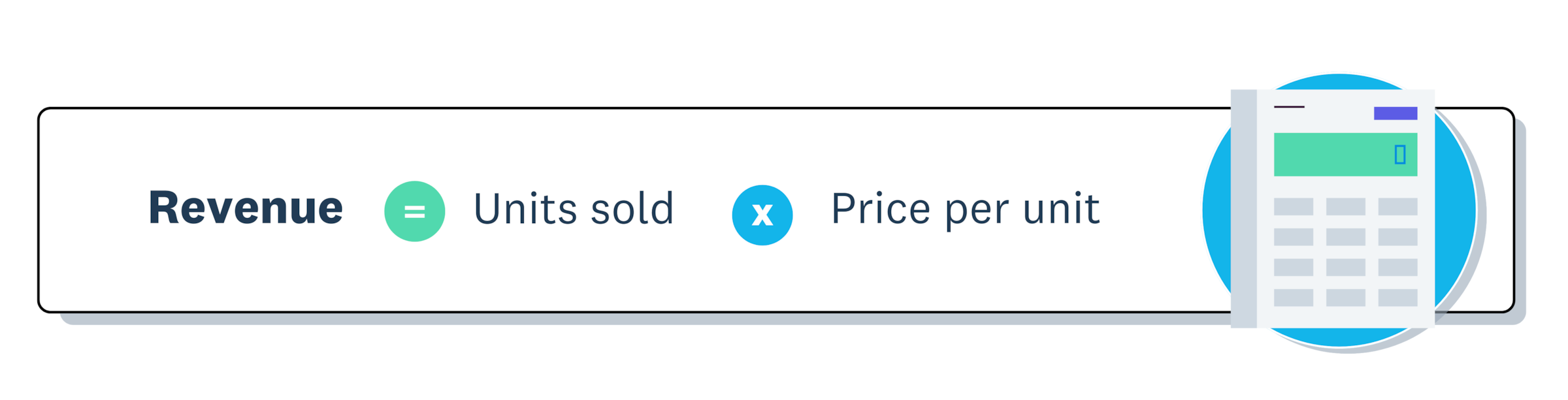
The simplest way to calculate revenue is with this formula:
Revenue = Units sold x Price per unit
For example, if your bakery sells 500 loaves of bread in a month at $6 each, your revenue for that month is $3,000. This formula works well for businesses that sell a single product or a limited range of products at set prices.
2. Adjust for different business models
Not every business sells products by the unit. If you run a service-based business, you might calculate revenue using your hourly rate multiplied by the hours billed. A consultant charging $150 per hour who bills 80 hours in a month earns $12,000 in revenue.
For subscription businesses, revenue is typically the number of active subscribers multiplied by the subscription fee. If you run an ecommerce business, your revenue comes from the total value of orders placed during a period.
If you earn income primarily from your personal skills or efforts, the ATO has specific rules around personal services income (PSI) that may affect how your revenue is taxed.
3. Calculate net revenue
Once you have your gross revenue, you can calculate your net revenue by subtracting certain deductions. The formula is:
Net revenue = Gross revenue - Discounts - Returns - Allowances
For example, if your bakery earned $3,000 in gross revenue but gave $200 in discounts and had $50 in returns, your net revenue would be $2,750. Net revenue gives you a more accurate picture of the money your business actually keeps.
4. Track your revenue
The easiest way to stay on top of your revenue is to use accounting software or a point-of-sale system that records every transaction automatically. This saves you from manually adding up sales and reduces the risk of errors.
With the right tools in place, you can pull up your revenue figures at any time and see exactly how your business is tracking.
Gross revenue vs net revenue
Understanding the difference between gross revenue and net revenue is important for making sound business decisions.
Gross revenue is the total amount of money your business earns from sales before any deductions. It shows how much demand there is for your products or services. Net revenue is what's left after you subtract discounts, returns, and allowances from your gross revenue.
The distinction matters because gross revenue alone can be misleading. If your business brings in $50,000 in a month but gives back $5,000 in refunds and discounts, your net revenue of $45,000 is the more accurate figure for planning and measuring performance.
You can learn more about calculating net profit to see what you keep after all expenses.
What is revenue recognition?
Revenue recognition is the accounting principle that determines when you record revenue in your books. Under accrual accounting, you recognise revenue when it's earned, not when the cash lands in your bank account.
For example, if your bakery delivers a $500 catering order on 15 March but doesn't receive payment until 30 March, you'd still record the revenue on 15 March. That's because the service was completed and the customer's obligation to pay was established on that date.
In Australia, the standard governing revenue recognition is IFRS 15, which is adopted locally as AASB 15. It uses a 5-step model to determine when and how much revenue to recognise. You can find a practical guide to the five-step model from CPA Australia.
If your business uses cash accounting instead of accrual accounting, you record revenue only when payment is received. The ATO explains the differences between cash and accrual accounting methods and which one your business may be required to use.
Accrued vs deferred revenue
Accrued revenue and deferred revenue are closely related concepts. Understanding both helps you keep your books accurate.
Accrued revenue is money you've earned but haven't yet received. For example, if you complete a consulting project in June but your client doesn't pay until July, that income is accrued revenue in June. You recognise it as revenue when the work is done, even though the cash hasn't arrived yet.
Deferred revenue is the opposite: it's money you've received before you've delivered the goods or services. If a customer pays upfront for a 12-month subscription, you can only recognise one month's worth of revenue each month. The rest sits on your balance sheet as a liability until you've fulfilled the obligation.
Revenue vs profit: key differences
Revenue and profit are related but they measure very different things. It's important not to confuse the two when assessing your business's financial health.
Revenue is the total amount of money your business brings in from sales and other income sources. Profit is what remains after you subtract all your expenses, including costs of goods sold, wages, rent, utilities, and taxes. A business can have strong revenue and still make a loss if its expenses are too high. Understanding how to increase profit is just as important as growing your revenue.
High revenue doesn't guarantee profitability. That's why it's essential to track both figures. Revenue tells you how much demand there is for what you offer, while profit tells you whether your business model is financially sustainable. Learn more about how to calculate profitability for your business.
Track your revenue with Xero
Keeping track of your revenue shouldn't take up hours of your week. With Xero's accounting software, you can see your revenue in real time, spot trends as they happen, and make confident decisions about your business's future. Get one month free.
FAQs on revenue
Here are answers to frequently asked questions about revenue.
What's the difference between revenue and income?
Revenue refers to the money your business earns from its primary activities, like selling products or services. Income is a broader term that can include revenue plus other earnings such as interest, investments, and gains from selling assets.
How do I increase my business revenue?
You can increase revenue by raising your prices, expanding your customer base, introducing new products or services, or improving your marketing. Focusing on customer retention and upselling to existing customers is often one of the most cost-effective approaches.
Is revenue the same as cash flow?
No. Revenue is the total amount earned from sales, while cash flow is the actual movement of money in and out of your business. You can record revenue before the cash arrives, especially if you use accrual accounting.
How often should I track my revenue?
At a minimum, review your revenue monthly so you can spot trends and catch issues early. Many small business owners find that weekly or even daily tracking helps them stay on top of their finances and make quicker decisions.
Are revenue and sales the same?
In most contexts, yes. Sales and revenue are often used interchangeably to describe the money earned from your core business activities. However, total revenue can also include non-operating income like interest or rental earnings.
Can revenue be negative?
Revenue itself can't be negative, but net revenue can dip below zero in rare cases. This could happen if returns, refunds, and discounts in a given period exceed the gross revenue earned during that same period.
Disclaimer
Xero does not provide accounting, tax, business or legal advice. This guide has been provided for information purposes only. You should consult your own professional advisors for advice directly relating to your business or before taking action in relation to any of the content provided.
Get one month free
Purchase any Xero plan, and we will give you the first month free.