Cash flow
Cash flow is the money moving in and out of your business. Learn how to calculate and improve it.
Published Wednesday 30 September 2026
Table of contents
Key takeaways
- Cash flow is the money moving in and out of your business over a period, and it shows whether you can pay bills on time
- Profit and cash flow measure different things, so a profitable business can still run short of cash when customers pay late
- You calculate net cash flow by subtracting the cash you paid out from the cash you received
- Regular forecasting and prompt invoicing help you spot shortfalls early and plan confidently for quieter months
What is cash flow?
Cash flow is the movement of money into and out of your business over a given period. It shows whether the cash coming in covers what goes out to suppliers, staff, lenders and yourself.
Think of your bank account as a water tank. Sales pour water in while bills and wages drain it, and the level stays healthy when inflows keep pace with outflows.
You can express this as a simple formula:
Net cash flow = total cash inflows − total cash outflows
When more money flows in than out, you have positive cash flow. When more flows out, the result is negative.
Cash covers more than the balance in your bank account. Under International Accounting Standard 7 (IAS 7), cash equivalents are short-term, highly liquid investments with little risk of changing in value. You can readily convert them into a known amount of cash when you need it.
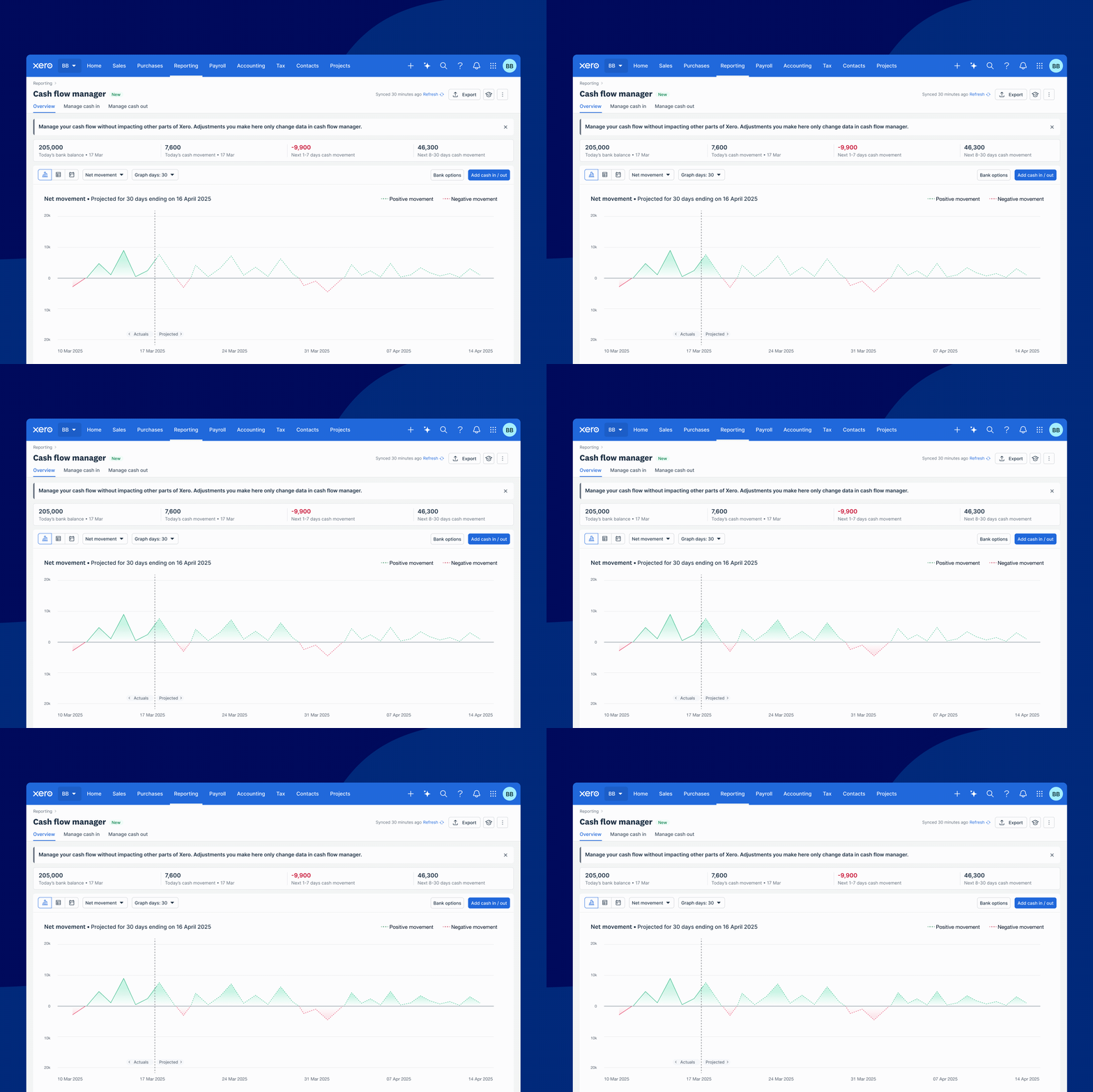
Small businesses can get a picture of future cash flow by accounting for upcoming bills and payments (example from Xero dashboard).
Cash flow vs profit
Net profit is what’s left from revenue after you subtract all your costs and taxes. Cash flow tracks the actual money moving through your bank account, and the two often differ because of timing.
Profit is usually calculated using accrual accounting. This method counts income when you earn it and costs when you incur them, even if no cash has changed hands yet.
Your bank balance only changes when money is received or paid. If you invoice S$50,000 in a month but customers have paid only S$20,000 so far, your profit looks healthy while your cash position is tight.
That’s why it pays to watch both numbers. Profit tells you whether your business model works, and cash flow tells you whether you can cover this month’s bills.
Why is cash flow important?
Cash on hand decides whether you can pay your bills and wages on time, however profitable your business looks on paper. Spare cash also gives you room to act when a new opportunity comes up.
Slow-paying customers are a common source of pressure, because every late invoice is money you’ve earned but can’t spend yet. These ways to shorten the wait for payment can help you bring that money in sooner.
When cash is tight over several months, it can lead you to:
- take on more work than your cash can fund, which is known as overtrading
- commit to expenses before the money to cover them arrives
- fall behind on supplier invoices or loan repayments
- turn down growth opportunities because the cash isn’t there
Types of cash flow
IAS 7 groups cash flows into three activities: operating, investing and financing. Looking at each one separately shows you where your money comes from and where it goes.
The examples below follow a small Singapore café through one month, so you can see how the three add up.
Operating activities
Operating cash flow is the money your core business brings in from sales, minus the day-to-day costs of delivering them. For most small businesses it’s the most telling type, because it shows whether everyday trading pays for itself.
Say the café collects S$30,000 from customers and pays S$22,000 for stock, wages, rent and utilities. Its operating cash flow for the month is S$8,000.
Investing activities
This category covers money spent on or received from longer-term assets such as equipment or property. Buying an asset is an outflow, and selling one is an inflow.
If the café buys a new coffee machine for S$6,000, its investing cash flow is −S$6,000. A negative figure here often means you’re building future capacity.
Financing activities
This category tracks money moving between your business and its lenders or owners. New loans and owner investment are inflows, while loan repayments and dividends are outflows.
If the café takes out a S$10,000 bank loan and repays S$2,000 on an older loan, its financing cash flow is S$8,000. Added together, the café’s net cash flow for the month is S$8,000 − S$6,000 + S$8,000 = S$10,000.
Healthy growth usually rests on strong trading income, with financing there to support it.
What affects cash flow
A handful of factors shape how much cash you have on hand at any time. Watching them helps you see a shortfall coming while you still have time to act.
- Payment timing: the gap between paying your costs and collecting your accounts receivable, which is the money customers owe you
- Seasonal patterns: quieter months when sales dip but fixed costs such as rent and wages stay the same
- Tax payments: goods and services tax (GST) at the current 9% rate, which registered businesses pay to the Inland Revenue Authority of Singapore (IRAS)
- Large or unexpected costs: equipment repairs or one-off bills that can drain your reserves quickly
- Growth: hiring staff or buying stock before the extra revenue arrives
How to calculate cash flow
To calculate net cash flow, add up the cash that came into your business over a period and subtract the cash that went out. These four steps keep it simple:
- Choose a period, such as a month or a quarter
- Add up every payment you received, including customer payments and any GST refunds
- Add up every payment you made, including supplier bills, wages, rent and GST paid to IRAS
- Subtract your total outflows from your total inflows
Here’s how that looks for a small Singapore business over one month. It receives S$19,200 from customers and pays out S$16,000 in total.
That S$16,000 is made up of S$7,500 to suppliers, S$5,000 in wages, S$1,500 in rent, S$1,200 in GST to IRAS and S$800 in other costs. Its net cash flow is S$19,200 − S$16,000 = S$3,200, a positive result.
A positive result means you brought in more than you spent. If the result stays negative for several months, it’s a signal to take a closer look at your costs and collections.
To run your own numbers in a few minutes, try this online cash flow calculator. For a fuller picture, you can also work out the two measures below.
Operating cash flow (indirect method)
The indirect method starts with net profit and adjusts it for items that affect profit but not cash. It’s useful because it links the profit on your profit and loss statement to the cash in your bank.
Operating cash flow = net profit + non-cash expenses ± changes in working capital
Depreciation is a typical non-cash expense. If customers owe you more at the end of the period, subtract the increase; if you owe suppliers more, add it.
Take a business with S$12,000 net profit and S$2,000 of depreciation. Customers owe it S$5,000 more than last month, and it owes suppliers S$1,000 more. Its operating cash flow is S$12,000 + S$2,000 − S$5,000 + S$1,000 = S$10,000.
Free cash flow formula
Free cash flow is the cash left after you’ve paid for day-to-day operations and investment in long-term assets. Corporate Finance Institute calculates it as operating cash flow minus capital expenditure.
Free cash flow = operating cash flow − capital expenditure
If that same business spends S$6,000 on new equipment, it has S$10,000 − S$6,000 = S$4,000 left. That’s the money available to repay debt or reinvest in the business.
Cash flow ratios to track
Ratios turn your raw figures into signals you can compare month to month. Two are especially useful for small businesses:
- Operating cash flow margin: operating cash flow divided by revenue, which shows how much cash each dollar of sales brings in
- Cash conversion cycle: the number of days it takes to turn money spent on stock back into cash from customers
If the business above had S$50,000 in revenue, its S$10,000 of operating cash gives a margin of 20%. A higher margin means more of your sales turn into spendable cash.
Following the formula set out by Corporate Finance Institute, the cycle equals days inventory outstanding plus days sales outstanding, minus days payables outstanding. If you hold stock for 30 days, customers pay in 45 days and you pay suppliers in 30 days, your cycle is 45 days. A shorter cycle means cash returns to your business sooner.
Balance sheet measures such as the current ratio add another view of your short-term health. You can compare them in this overview of liquidity ratios.
Cash flow statements and forecasts
A statement looks back at what already happened, while a forecast predicts the cash you’ll have in the weeks ahead. Used together, they show both your recent track record and your likely position.
What is a cash flow statement?
A cash flow statement is a financial report showing how cash came in and went out over a past month, quarter or year. It groups the figures into operating, investing and financing activities.
This breakdown shows whether your cash comes from trading or from borrowing and selling assets. A strong statement shows most of your cash coming from everyday trading.
Cash flow statement vs balance sheet and profit and loss
It’s one of three core financial statements, and each answers a different question. Here’s how they compare:
- A balance sheet shows what your business owns and owes at a single point in time
- A profit and loss statement shows revenue and expenses over a period, including amounts not yet paid
- A cash flow statement shows the actual cash that moved in and out over that same period
What is a cash flow forecast?
A cash flow forecast maps your expected payments in and out on a timeline to predict your cash in the coming weeks or months. It helps you spot shortfalls early and time big purchases.
Scenario planning makes a forecast more useful. Build a best-case, likely and worst-case version, then check you can cover your commitments in each. This guide to building a forecast walks you through the process.
Xero’s analytics tools project your cash position and show how upcoming quotes, invoices and bills will affect your bank balance.
How to manage your cash flow
Good cash management means keeping track of what’s coming in, what’s going out and when. These seven steps help keep your bank balance healthy.
1. Invoice promptly and follow up
Send invoices as soon as you finish the work or deliver the goods, with clear payment terms. Online invoices with automatic reminders nudge customers when payment is due, so you spend less time chasing.
2. Monitor your cash position regularly
Check your balance weekly instead of waiting for month-end. Automated bank reconciliation matches your bank transactions to your records, so your figures stay current and you can act early.
3. Build a cash buffer
Set aside a reserve to cover unexpected costs or quiet months. Even a modest buffer gives you breathing room when sales dip.
4. Review your payment terms
Compare the terms you offer customers with the terms suppliers give you. If you pay suppliers in 14 days but give customers 30 days, you fund that 16-day gap from your own cash. Negotiate closer terms where you can.
5. Forecast ahead
Map out expected cash in and out over the coming weeks and months. Include large outgoings like GST payments and stock purchases, plus seasonal slowdowns, and update your forecast as things change.
6. Manage payables and stock
Pay suppliers on their due date, or earlier when an early payment discount makes it worthwhile. Keep stock levels close to what you sell, so more cash stays free for other costs. Leasing equipment instead of buying it outright can also spread the cost over time.
7. Line up financing before you need it
Arrange a credit line or other funding while your finances are strong, so it’s ready for a slow month or a big order. Invoice financing lets you borrow against unpaid invoices to bring cash forward.
Cash flow vs free cash flow, working capital, and liquidity
Cash flow is one of several measures of your business’s spending power, and each looks at a different angle. Here’s how they compare:
- Cash flow is the movement of money into and out of your business over a period
- Free cash flow is the cash left after operating costs and capital spending, available to repay debt or reinvest
- Working capital is current assets minus current liabilities, or what’s left after covering short-term obligations
- Liquidity is how easily you can cover upcoming costs, usually expressed as a ratio
All four help you judge your financial position. Of the four, cash flow is usually the starting point, because it reflects what’s happening in your bank account right now.
Manage your cash flow with Xero
Knowing where your cash stands lets you pay bills on time and plan growth with confidence. With Xero, invoice reminders from step 1 help you collect what you’re owed, and bank reconciliation from step 2 keeps your weekly figures current.
Xero’s analytics tools, covered in the forecast section, project your cash position, so you can prepare for upcoming bills before they land. Try Xero today and get one month free.
FAQs on cash flow
Here are quick answers to common questions about managing business cash.
What’s the difference between cash flow and revenue?
Revenue is the total you’ve earned from sales, whether or not customers have paid. Cash flow counts only money actually received or spent, so high revenue can sit alongside a thin bank balance when customers pay slowly.
How often should you review your cash position?
Review it at least monthly. If your margins are tight or your sales vary, a weekly check gives you more time to act on a shortfall.
How much cash reserve should a small business keep?
The right amount depends on your fixed costs and how predictable your sales are. Add up your fixed monthly costs, then decide how many months of cover you’d want through a quiet spell.
Why do startups struggle with cash flow?
Startups often pay for equipment and stock before regular sales arrive. With a short trading history, they can also find credit harder to secure, so early forecasting matters even more.
What’s the easiest way to track cash flow?
Accounting software like Xero connects to your bank and updates your cash position automatically. You get an up-to-date view whenever you need it, without updating spreadsheets by hand.
Related terms
Learn more about cash flow
Handy resources
Advisor directory
You can search for experts in our advisor directory
Cash flow forecast template
Download our free template to help predict cash flow for your business
Business analytics with Xero
See future cash flow, check financial health and track metrics
Disclaimer
This glossary is for small business owners. The definitions are written with their requirements in mind. More detailed definitions can be found in accounting textbooks or from an accounting professional. Xero does not provide accounting, tax, business or legal advice.