Owner’s equity: What it means and how to calculate it
Learn what owner's equity shows about your business and how to calculate it.

Written by Lena Hanna—Trusted CPA Guidance on Accounting and Tax. Read Lena's full bio
Published Monday 29 June 2026
Table of contents
Key takeaways
- Calculate your owner's equity by subtracting total liabilities from total assets — this simple formula gives you a clear snapshot of your business's net worth at any point in time.
- Track your owner's equity regularly using your balance sheet and statement of changes in equity, so you can make confident decisions about taking on debt, investing in equipment, or withdrawing funds.
- Recognise that owner's equity reflects book value, not market value — it shows what your business is worth on paper based on financial records, not what a buyer might actually pay for it.
- Use accounting software to automatically calculate and update your owner's equity in real time, reducing manual errors and giving lenders and investors an accurate view of your financial position.
What is owner's equity?
Owner's equity is the value of what you own in your business after paying all debts. It equals your total assets minus total liabilities, showing your business's book value or net worth at any point in time.
This figure is different from the price you might sell your business for, as a statement of financial position does not purport to be a direct valuation of the company, as explained in CPA Australia's guide to annual reporting. Sale price depends on negotiations with buyers. Owner's equity gives you a clear financial snapshot you can calculate anytime.
A company's book value of equity explains 60 per cent of its share price on average, according to CPA Australia research.
What's included in owner's equity
Owner's equity includes four main components. These elements change based on the flow of money in and out of your business.
For a sole trader, the components that affect equity are:
How to calculate owner's equity (or net worth)
The owner's equity formula is: total assets − total liabilities = owner's equity.
To calculate your owner's equity:
- Add all assets (everything your business owns)
- Subtract all liabilities (everything your business owes)
- Record the result as your owner's equity (what's left belongs to you)
Owner's equity formula
The following diagram illustrates the owner's equity formula.

When calculating owner's equity
Accurate calculation requires counting all assets and liabilities correctly.
Assets to include:
- tangible assets: equipment, real estate, inventory, cash
- accounts receivable: money customers owe you
- intangible assets: intellectual property, brand value
Liabilities to include:
- loans: money owed to lenders
- accounts payable: money owed to suppliers
- employee obligations: wages and benefits owed
- tax obligations: money owed to tax authorities
Examples of owner's equity
Owner's equity works the same way for personal and business assets. Here's a simple example:
A house worth $300,000 with a $120,000 mortgage gives you $180,000 in equity.
Calculation breakdown:
- asset: $300,000 house value
- liability: $120,000 mortgage debt
- owner's equity: $300,000 − $120,000 = $180,000
Business example of owner's equity
The following statement shows how owner's equity is calculated for a business.
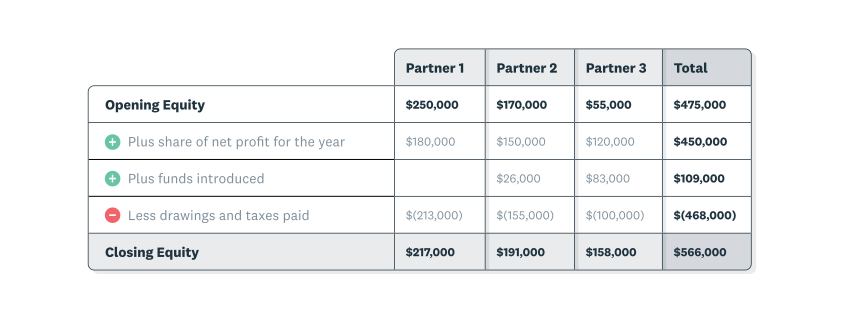
Statement shows closing equity is equal to the opening equity plus the year’s net profit and money introduced, minus owner withdrawals and taxes.
Statement shows closing equity is equal to the opening equity plus the year's net profit and money introduced, minus owner withdrawals and taxes.
The same formula applies to business calculations.
A repair shop with $700,000 in assets and $300,000 in debt has $400,000 in owner's equity.
Calculation breakdown:
- total assets: $600,000 garage + $50,000 machinery + $50,000 inventory = $700,000
- total liabilities: $300,000 owed on premises
- owner's equity: $700,000 − $300,000 = $400,000
Why owner's equity matters for your business
Owner's equity matters because it shows your business's financial health at a glance. A clear picture of your net worth helps you make confident decisions about growth, funding, and withdrawals.
Understanding your owner's equity helps you:
- measure performance: track whether your business is becoming more valuable over time
- secure funding: demonstrate financial stability to lenders and investors assessing risk
- make informed decisions: determine if you can afford to take on debt, invest in equipment, or withdraw funds
How to increase owner's equity
You can increase owner's equity by boosting profits, retaining more earnings, adding capital, or reducing debt. Each approach improves your net worth by either increasing assets or decreasing liabilities.
Here are five ways to build your owner's equity:
- Increase profitability: boost revenue and reduce operating costs to generate more profit that flows into equity
- Retain more earnings: reinvest profits back into the business rather than taking large distributions
- Add capital contributions: invest additional personal funds into the business when possible
- Pay down debt: reduce liabilities to increase the gap between assets and what you owe
- Monitor changes regularly: track your statement of changes in equity to spot trends and adjust your approach
Growing your owner's equity strengthens your financial position for future funding, expansion, or eventual sale.
Where to find owner's equity
You can find owner's equity on your balance sheet and statement of changes in equity. These two financial statements show your ownership value and how it changes.
Owner's equity appears on:
- balance sheet: listed after the assets and liabilities sections
- statement of changes in equity: detailed to show how equity changed over a period
What is a statement of changes in equity?
A statement of changes in equity tracks how your ownership value changes over time. It reports all changes to equity during a financial period, including transactions with owners, as detailed in CPA Australia's guide to annual reporting.
This statement connects your profit and loss to your balance sheet by showing how earnings affect equity.
The four basic financial statements are:
- profit and loss (P&L): reports earnings and expenses
- balance sheet: reports assets, liabilities, and equity
- cash flow statement: reports money in and out
- statement of changes in equity: reports how ownership value changes
The equity change formula shows how your ownership value moves over a period:
Closing equity = opening equity + net profit − owner withdrawals − taxes
This formula accounts for every dollar that increases or decreases your business ownership.
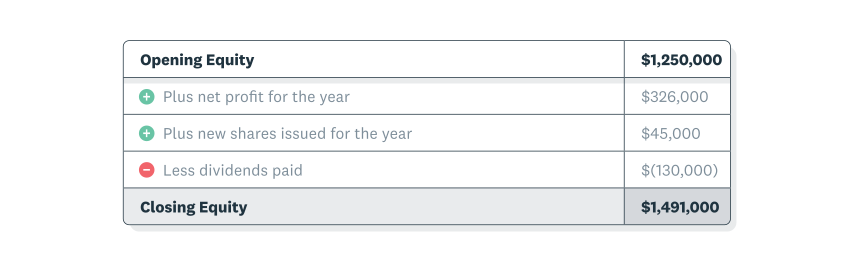
Statement shows closing equity is equal to the opening equity plus the year’s net profit and money from investors, minus owner withdrawals and taxes.
Statement shows closing equity is equal to the opening equity plus the year's net profit and money from investors, minus owner withdrawals and taxes.
Example of a statement of changes in equity for a sole trader
The following diagram shows a statement of changes in equity for a sole trader.
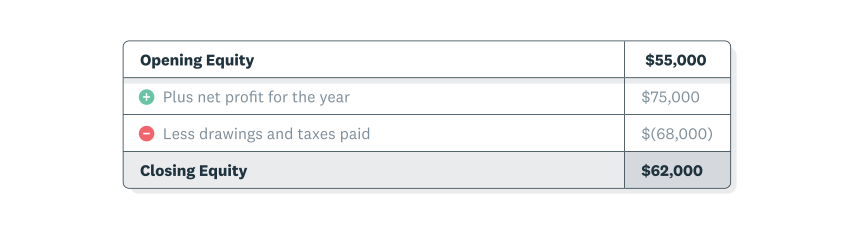
Statement shows closing equity is equal to the opening equity plus the year’s net profit, minus owner withdrawals and taxes.
Statement shows closing equity is equal to the opening equity plus the year's net profit, minus owner withdrawals and taxes.
Keep track of your owner's equity with the right tools
Accounting software calculates owner's equity automatically by tracking your assets, liabilities, and equity changes in real time. This reduces errors and saves time on manual calculations.
With a real-time view of your business's net worth, you can spend less time on bookkeeping and more time focusing on growth. View Xero pricing plans and see how you can run your business, not your books.
FAQs on owner's equity
Here are some common questions small business owners have about owner's equity.
Is shareholder's equity the same as owner's equity?
Yes, they represent the same concept. Owner's equity applies to sole traders and partnerships, while shareholder's equity (or stockholder's equity) applies to companies. Both measure the net worth of the business.
Does owner's equity tell me what my business is worth?
Owner's equity tells you book value, not market value. Book value is based on your financial records (assets minus liabilities). Market value is the price someone would actually pay, which depends on factors like brand reputation, customer base, and future potential.
Research shows book value explains less of a company's actual worth than it once did. By 2013, net profit and shareholders' equity could only explain about 50% of share prices, down from over 90% in the 1950s, according to CPA Australia research.
Can owner's equity be negative?
Yes, owner's equity can be negative. This happens when total liabilities exceed total assets, meaning the business owes more than it owns. A negative equity position signals the need to review costs, funding, and growth plans.
How often should I calculate owner's equity?
Review your owner's equity at least monthly or quarterly. Your balance sheet shows equity as a snapshot at a specific point in time. With accounting software, this figure updates in real time, making regular monitoring straightforward.
What's the difference between owner's equity and cash flow?
Owner's equity measures net worth at a single point in time, while cash flow measures money movement over a period. Both metrics are vital for investors, with operating cash flows shown to explain 49 per cent of a company's share price, according to CPA Australia research. A business can be profitable with positive equity but still face cash flow problems if customers pay late.
Disclaimer
Xero does not provide accounting, tax, business or legal advice. This guide has been provided for information purposes only. You should consult your own professional advisors for advice directly relating to your business or before taking action in relation to any of the content provided.
Get one month free
Purchase any Xero plan, and we will give you the first month free.