Online business ideas: Find and launch your best business
Learn how to compare online business ideas, choose the right fit, and start your business with confidence.

Written by Lena Hanna—Trusted CPA Guidance on Accounting and Tax. Read Lena's full bio
Published Wednesday 22 April 2026
Table of contents
Key takeaways
- Prioritise a niche market over a broad audience, as the internet connects you to customers worldwide who share specialised interests, making it easier to stand out and attract loyal buyers.
- Validate your business idea with real customers before investing heavily by building a simple website, testing with a small group, and tracking sign-ups or pre-orders to confirm demand exists.
- Differentiate your brand from larger competitors by sharing your personal story, adding thoughtful touches like handwritten notes, and building genuine customer relationships, since a minor increase in customer retention can significantly boost profits.
- Start with the business model that matches your budget, as most online businesses launch for under $1,000, with service-based businesses requiring the least upfront investment because you sell skills you already have.
Waiting for a Eureka moment
Online business ideas are concepts for ventures you can run entirely over the internet, from selling products to offering services remotely. Many aspiring entrepreneurs struggle to identify profitable models that match their skills and resources.
The key is knowing where to look and how to evaluate opportunities systematically, rather than waiting for inspiration to strike.
Why start an online business
An online business lets you earn income with lower startup costs and the flexibility to work from anywhere. Because there is no minimum income level required to be officially in business, you can start small and scale at your own pace. This appeals to people seeking more control over their time, finances, and career direction.
Common reasons to start a business online include:
- Flexibility: Set your own hours and work from any location
- Lower costs: Skip the expense of physical premises and reduce overheads
- Wider reach: Sell to customers anywhere, not just locally
- Independence: Be your own boss and pursue work you care about
- Financial control: Build an asset that grows with your effort
What type of online business could you set up?
The four main types of online business are product-based retail, service-based consulting, software solutions, and content monetisation. Each model has different startup requirements and revenue potential.
- Product-based retail: Sell physical or digital products through online shops or marketplaces
- Service-based consulting: Provide remote services such as training, teaching, consulting, or project management
- Software solutions: Develop apps or software sold through one-time purchases or subscriptions
- Content monetisation: Create podcasts, videos, blogs, or books that generate revenue through ads, subscriptions, or sales
The software model is one of the fastest-growing, projected to reach $1.5 trillion in value by 2026.
Online retail business ideas
Handmade products let you earn money from skills you already have. This approach works best when you have expertise or passion in a specific craft.
- Photography monetisation: Create online galleries, sell printed cards and calendars, or license images for commercial use
- Craft specialisation: Target niche markets such as custom pet clothing, personalised home décor, or speciality accessories
Private label manufacturing lets you sell custom products without making them yourself. This model requires higher upfront investment but offers better profit margins and brand control.
- Product customisation: Modify existing products with your branding or specifications through manufacturer partnerships
- Original design development: Create entirely new products from concept through to production
- Small batch production: Start with minimum orders of 50–500 units, typically costing $500–$5,000 depending on complexity
You can also take the more traditional retail model and buy products from others to resell. Put your spin on it to stand out from competitors selling the same products. You might create a cool brand for your shop, or increase your marketing so you become the first stop for certain types of customer.
Resell products
Dropshipping is a retail model where you sell products without holding inventory. When customers order from your store, you forward orders to suppliers who ship directly to customers.
This model offers low startup costs and simpler shipping and fulfilment. Success depends heavily on marketing skills, customer service, and finding reliable suppliers with quality products.
How to compete with big brands
Small businesses compete with big brands by offering authentic stories, personal service, and unique experiences that large retailers can't replicate. Focus on what makes your brand stand out rather than trying to undercut on price.
Marc McKeown of FortBrave recommends finding something unique about your brand and shouting about it.
'Put as much of your own story into your product and branding as you can,' he says. 'Customers will gravitate to you because of your authentic story, even if they have to pay a little bit more.'
Ways to differentiate from large retailers:
- Tell your story: Share the personal journey behind your products
- Add personal touches: Include handwritten notes or custom packaging
- Build relationships: Respond personally to customer questions and feedback
'Differentiate yourself from the corporate experience. Package products nicely and put a personal note in. Amazon can't compete with that.'
That kind of loyalty matters. A 5% increase in customer retention can boost profits by 25%–95%.
You can learn more about e-commerce, shipping, and marketing in the Xero guide to starting an online business.
Niche down
Niching down means focusing on a specific, narrow market rather than trying to appeal to everyone. Online businesses thrive with this approach because the internet connects you to customers worldwide who share specialised interests.
You're not restricted to selling locally. Something that might not fly in your town could soar online.
McKeown says online shopping habits have given new life to unusual business ideas. 'Niche shopping has been enabled by the internet. It's much easier to find out-of-the-ordinary products online than to traipse around town for it, so that's what people do.'
Online services business ideas
Service-based online businesses let you sell your professional skills remotely. This approach typically requires the lowest startup costs because you're selling knowledge you already possess.
Common service business categories include:
- Administrative skills: Offer virtual assistant services, project management, or customer support
- Teaching expertise: Provide online tutoring, create courses, or deliver educational consulting
- Technical abilities: Deliver web design, software development, or digital marketing services
Growing an online service business out of your day-to-day
Most online service businesses start with one or two foundation clients and grow from there. This mirrors how traditional service businesses develop.
Olivia Park moved her personal training business online using this approach. She had been an in-person trainer in Taiwan but agreed to work virtually with clients after moving to South Korea. At the same time, her health and wellness content on social channels grew in popularity.
She was soon able to market online group programmes through Olivia Park Coaching.
'It's allowed me to create more products with different tiers of service. Some people are happy to do the online courses on their own. Others ask for customised routines. And others want one-to-one time.'
'The upshot is that I'm able to deliver twice as much service online as I could when limited to in-person training.'
Building your reputation works the same online
Referrals drive most new business for online service providers, just like traditional service businesses. Building your reputation online follows the same principles as offline.
Michael Yared says referrals drive most of the new business at his fully online app development agency, Echobind.
'We spun off with one anchor client and built up from there. It was tough for the first couple of years because we never knew if the projects would keep coming.'
'But we just kept asking for referrals and it's still our biggest source of new work.'
Echobind eventually grew to 40 fully remote staff.
Online app and software business ideas
Software businesses create digital tools, apps, or platforms that solve specific problems for people or other businesses. This model can scale quickly because you build once and sell many times, but it usually requires strong technical skills or investment in developers.
Consumer apps and business apps serve different audiences and have distinct characteristics. Consumer apps focus on entertainment, social connection, or personal productivity, while business apps streamline operations and solve workplace challenges.
Types of apps
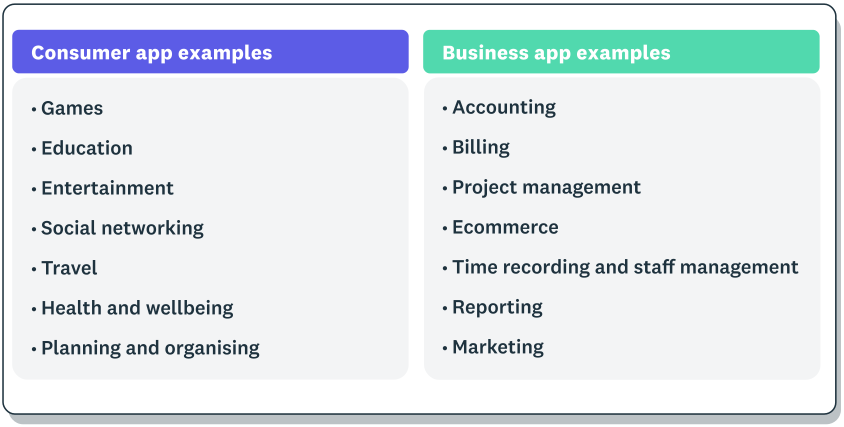
There are dozens of categories of consumer apps inside big app stores. On the business side, Xero accounting software integrates with over 1000 business apps, which do everything from tracking overdue bills for gyms to figuring out which cows are most productive on a farm.
The app market is competitive, so marketing needs to be a core part of your plan. The app development agency Echobind shares more tips in the Xero guide to making money from an app.
Online content and media business ideas
Content monetisation means earning income from podcasts, videos, blogs, or other media you create. Revenue comes through advertising, sponsorships, subscriptions, affiliate marketing, or direct sales.
Key points about content businesses:
- High-performing formats: Gaming videos, how-to tutorials, product reviews, and educational content consistently attract sponsors
- Revenue timeline: Most creators need six to 12 months to build audiences large enough for meaningful income
- Competition reality: Treat content creation as a long-term investment rather than immediate income replacement
Affiliate marketing is when an online retailer pays you commission for traffic or sales generated from your referrals. This works well alongside advertising and sponsorships.
Success depends on excellent marketing, a compelling niche, and often a strong personality to attract and retain an audience.
Budget and costs for online businesses
Most online businesses can launch for under $1,000, especially service-based businesses, dropshipping, or content creation. Product-based businesses typically need more for initial inventory.
Common startup costs include:
- Website hosting: $50–$300 per year for basic plans
- Software subscriptions: $20–$100 per month for essential tools
- Marketing: The average startup spends 11.2% of revenue on marketing
- Inventory: Variable depending on your product and supplier minimums
Planning your expenses from the start helps you stay in control of your cash flow.
Where to find online business ideas and inspiration
The best places to find online business ideas are marketplaces, social media platforms, crowdfunding sites, app stores, and popular content channels. Each reveals what customers are already buying or engaging with.
Proven sources to research:
- Market research platforms: Browse trending items on Amazon, Etsy, eBay, Google Shopping, Facebook Marketplace, and AliExpress to identify demand patterns
- Social media discovery: Search hashtags on Instagram, Facebook, and Pinterest within your interest areas to spot emerging trends
- Innovation tracking: Monitor Indiegogo and Kickstarter campaigns to find successful ideas you could improve or adapt
- Problem identification: Review top-selling apps and new releases to understand what customer problems generate revenue
- Content analysis: Study popular YouTube channels and podcasts to identify topics that attract engaged audiences
How to start an online business
Starting an online business involves five main steps: defining your idea, creating a plan, handling legal requirements, setting up finances, and launching your presence. Here's how to work through each.
- Refine your idea: Identify your target customer and what problem you solve for them
- Create a business plan: Outline your goals, strategy, and how you'll make money
- Handle legal requirements: Register your business name and structure; in most cases, the cost to register will be less than $300
- Set up finances: Open a separate bank account and choose accounting software. This helps you track when your revenue crosses the $60,000 annual turnover threshold, at which point you must register and charge 15% GST on your sales.
- Launch your presence: Build your online store or website and start marketing to customers
Once you've completed these steps, you're ready to test your idea with real customers.
Turn your online business idea into reality
Validation means testing your business idea with real customers before investing heavily. This helps you prove demand exists and avoid costly mistakes.
Steps to validate your online business idea:
- Research the market: Check if similar products or services already sell successfully
- Create a basic presence: Build a simple website or social media page to gauge interest
- Test with a small group: Offer your product or service to a limited audience and gather feedback
- Measure demand: Track sign-ups, enquiries, or pre-orders before scaling up
Focus on proving demand before investing in infrastructure or inventory. You can read more in the Xero guide to starting an online business.
Get your online business finances sorted
Organised finances help you make confident decisions as your online business grows. Simple, intuitive software can manage invoicing, track expenses, and show your cash flow in real time.
This lets you focus on growing your business.
Ready to take the next step? See how easy it can be to manage your business finances. Get one month free.
FAQs on online business ideas
Here are answers to some common questions about starting an online business.
Which online business is most profitable?
Service-based businesses like consulting or coaching are often the most profitable online businesses because they have low overhead and high margins. Niche e-commerce stores with unique products can also generate strong returns.
Profitability depends more on your business model and execution than the industry itself. The key is finding a balance between what you're passionate about and what the market will pay for.
What business can I start with $1,000?
With $1,000, you can start a freelance service business, dropshipping store, digital product shop, or content channel. Service-based businesses using skills you already have typically require the least upfront investment.
Low-cost options include:
- Freelance services: Writing, graphic design, virtual assistance, or consulting
- Dropshipping: Sell products without holding inventory
- Digital products: Create and sell ebooks, templates, or online courses
- Content creation: Start a blog or YouTube channel focused on a specific niche
How long does it take to start making money online?
Most online businesses take three to 12 months to generate meaningful income. Some service-based businesses can earn money within weeks if you have existing skills and contacts, while content-based businesses typically take six to 12 months to build an audience.
The timeline depends on your business model, how much time you invest, and how effectively you market. Consistency is often the most important factor.
Do I need special skills to start an online business?
You can start an online business with the skills you already have. Many successful entrepreneurs learn as they go, and you can outsource tasks or learn new skills online to fill gaps.
The most important attributes are:
- Willingness to learn: Pick up new skills as your business requires them
- Problem-solving ability: Find solutions when challenges arise
- Persistence: Keep going and maintain momentum over time
What are the biggest challenges of online business?
Strong financial management is essential for online business success. Effective cash flow management was a key factor in 82% of business outcomes in recent years.
Other common challenges include:
- Customer acquisition: Attracting your first customers takes time and effort
- Time management: Balancing business tasks with other responsibilities
- Competition: Standing out in a crowded market
- Independence: Building your own support network and community
Building a network of other business owners and staying organised can help you succeed.
Disclaimer
Xero does not provide accounting, tax, business or legal advice. This guide has been provided for information purposes only. You should consult your own professional advisors for advice directly relating to your business or before taking action in relation to any of the content provided.
Get one month free
Purchase any Xero plan, and we will give you the first month free.