Break-even point formula
Learn the break-even point formula, work out sales targets, and see two worked NZ examples.
November 2023 | Published by Xero
Published Thursday 23 July 2026
Table of contents
Key takeaways
- Your break-even point is the level of sales where total revenue covers total costs, so you make neither a profit nor a loss
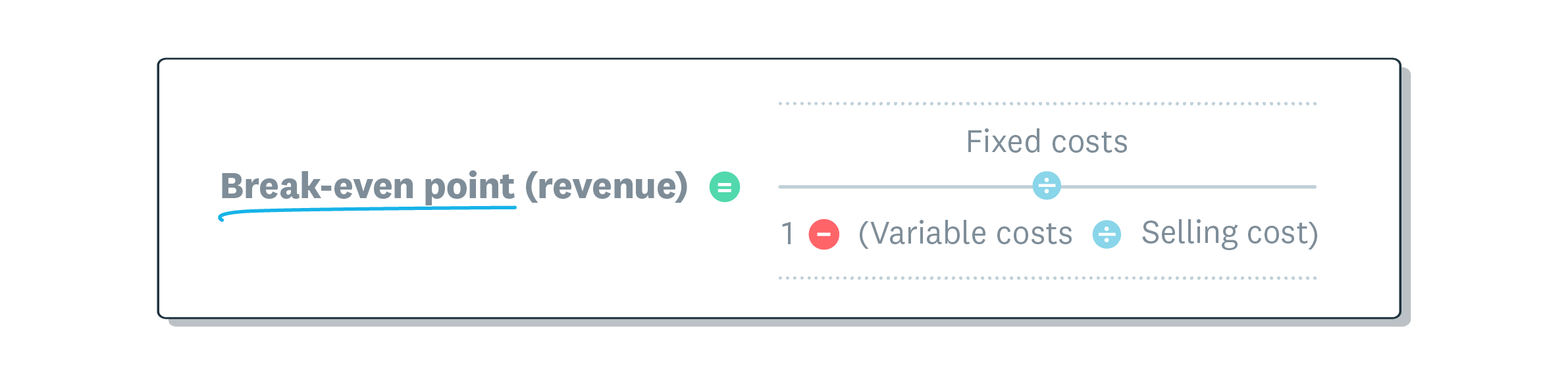
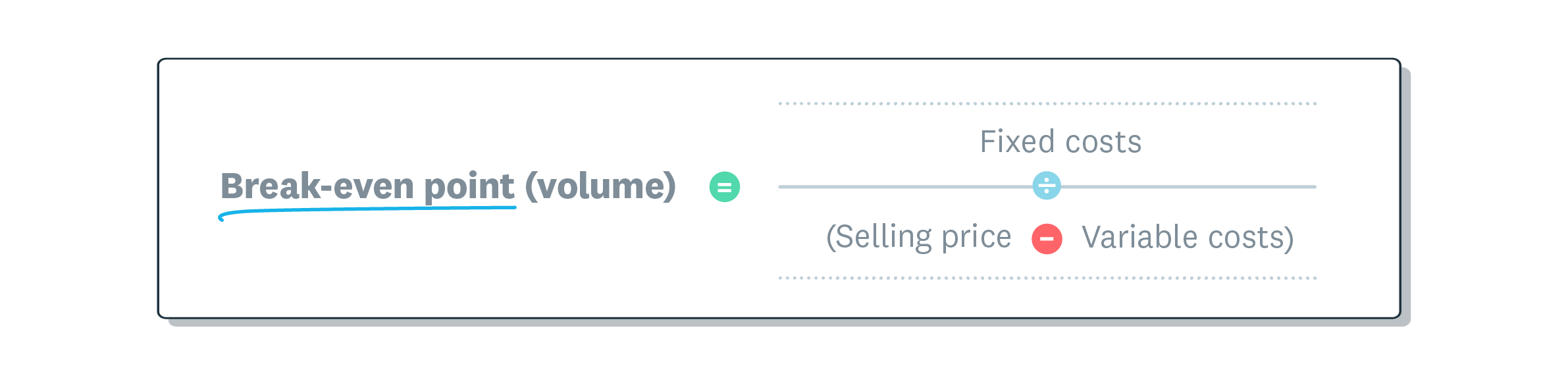
- You can work it out two ways: revenue break-even = fixed costs / (1 - (variable costs / selling price)), and volume break-even in units = fixed costs / (selling price - variable costs)
- Contribution margin, your selling price minus variable cost per unit, is the amount each sale puts towards covering fixed costs, and it drives both formulas
- Knowing your break-even point helps you set prices, plan realistic sales targets, and judge whether a product or service is worth running
Before you can grow profit, you need to know the point where your business starts making money. That starting point is your break-even point.
What is the break-even point?
Your break-even point is the level of sales at which your total revenue exactly covers your total costs, so you make neither a profit nor a loss. It's a big milestone, because every sale past that point starts to turn a profit.
Businesses often use break-even calculations to set baseline productivity and sales targets. Once you know the figure, you can see exactly how much you need to sell before the money you bring in outweighs what you spend.
To calculate your break-even point, you first need to understand contribution margin, which is the piece of each sale that goes towards covering your costs.
What is contribution margin?
Contribution margin is your selling price minus the variable cost of producing one unit. It's the amount each sale contributes towards paying off your fixed costs, and once those costs are covered, towards profit.
Contribution margin sits at the heart of both break-even formulas. The volume formula divides your fixed costs by the contribution margin per unit, while the revenue formula uses the same idea expressed as a percentage of your selling price.
There are two ways to calculate your break-even point, and each answers a slightly different question about your sales.
The two break-even point formulas
One formula tells you the value of sales (revenue) you need to break even, and the other tells you the number of sales (volume) you need. The revenue version gives you a dollar figure to beat, while the volume version tells you how many units or hours you need to sell.
The revenue break-even formula is fixed costs / (1 - (variable costs / selling price)). The volume break-even formula in units is fixed costs / (selling price - variable costs).
The volume formula works well for a business that sells one type of product, or a service business with a single hourly rate. It gets trickier when you sell lots of things at different prices, so the revenue formula is often easier to use.
Here's what each part of the formulas means:
- Fixed costs are expenses that stay the same no matter how much you sell, such as rent and insurance
- Variable costs are expenses that change with how much you produce or sell, such as raw materials or hourly wages
- Selling price is what you charge a customer for your goods or services
Sorting your costs into fixed and variable is the first step in any break-even calculation, so it helps to see which is which.
Fixed costs vs variable costs
Fixed costs stay steady month to month, whether you make one sale or one hundred. Common fixed costs for a New Zealand small business include:
- Rent for your premises or workshop
- Insurance premiums
- Accounting fees
Variable costs rise and fall with how much you produce or sell. Common variable costs include:
- Materials that go into your product
- Packaging
- Freight and delivery
- Merchant fees on card payments
Seeing the formulas applied to real numbers makes them easier to follow. Here are two worked examples, one for a product business and one for a service business.
Break-even calculation examples
These examples show the revenue and volume break-even point for a product-based business and a service-based business. Follow each calculation step by step to see how the figures come together.
A product business sells physical goods, so its variable costs sit in materials and production. Here's how a kombucha brewery works out its break-even point.
Break-even example for a product-based business
A kombucha brewery has fixed monthly costs of $6,000 for rent, utilities, insurance and advertising. Their variable costs are $2 per bottle for packaging, ingredients and labour, and they sell each bottle for $7.
To find the revenue break-even, divide fixed costs by 1 minus (variable costs / selling price):
- Revenue required = $6,000 / (1 - ($2 / $7))
- = $6,000 / (1 - 0.286)
- = $6,000 / 0.714
- = $8,403
To break even, the kombucha brewery needs to bring in $8,403 each month.
To find the volume break-even, divide fixed costs by selling price minus variable costs:
- Volume required = $6,000 / ($7 - $2)
- = $6,000 / $5
- = 1,200
To break even, the kombucha brewery needs to sell 1,200 bottles each month.
A service business charges for time rather than physical goods, so its variable cost is often labour. Here's how a graphic designer works out their break-even point.
Break-even example for a service-based business
A graphic designer has fixed monthly costs of $2,700 for utilities, hardware leases, software subscriptions and advertising. Their variable costs are $35 per hour to hire a contractor, and they charge clients $75 per hour.
To find the revenue break-even, divide fixed costs by 1 minus (variable costs / selling price):
- Revenue required = $2,700 / (1 - ($35 / $75))
- = $2,700 / (1 - 0.467)
- = $2,700 / 0.533
- = $5,064
To break even, the graphic designer needs to earn $5,064 each month.
To find the volume break-even, divide fixed costs by selling price minus variable costs:
- Volume required = $2,700 / ($75 - $35)
- = $2,700 / $40
- = 67.5
To break even, the graphic designer needs to bill 67.5 hours each month.
Your break-even point does more than tell you when you stop losing money. It shapes several everyday decisions about how you run your business.
Why your break-even point matters
Knowing your break-even point helps you set prices with confidence. If your current price leaves you needing an unrealistic number of sales to break even, that's a signal to review your pricing or your costs. You can explore this further in Xero's guide to pricing strategies and cost of goods sold.
It also turns vague goals into concrete sales targets. Once you know you need to sell 1,200 bottles or bill 67.5 hours a month, you can plan your marketing, staffing and stock around a clear number.
Finally, it helps you judge whether a product or service is viable. A break-even point that sits well above your realistic sales gives you an early warning, and comparing it against your gross profit margin shows how much room you have to grow profit. For a wider view, see how to measure profitability across your business.
A break-even figure is only as accurate as the numbers you put into it. A few common slip-ups can leave you with a target that's too low.
Common mistakes when calculating your break-even point
The most frequent mistake is leaving out some fixed costs. Small recurring expenses like software subscriptions, bank fees and accounting fees add up, and missing them makes your break-even point look lower than it really is.
Another common error is confusing fixed and variable costs. Putting a variable cost in the fixed column, or the other way round, throws out your contribution margin and your final result.
It's also easy to ignore seasonality and price changes. If your sales rise and fall through the year, or your supplier prices shift, a single break-even figure can quickly go out of date, so review it whenever your costs or prices change.
Working out your break-even point is far simpler when your costs and sales sit in one place. Good accounting software keeps those numbers current so your calculations stay accurate.
Manage your profitability with Xero
When your income and expenses are tracked and up to date, you can see your fixed and variable costs clearly and rework your break-even point as things change. Xero brings your finances together in one place, with reports that help you spot how close you are to profitability and where you can improve. To keep on top of your numbers and grow with confidence, get one month free.
Here are answers to some frequently asked questions about break-even point that build on the detail above.
FAQs on break-even point
What is the break-even point formula?
The break-even point formula divides your fixed costs by your contribution margin, either per unit or as a share of your selling price. It shows the sales you need before revenue starts to outweigh costs.
How do you calculate break-even in units vs revenue?
For units, divide fixed costs by selling price minus variable costs to get the number of sales you need. For revenue, divide fixed costs by 1 minus (variable costs / selling price) to get the dollar value of sales you need.
What is a good break-even point and what does it tell you?
A good break-even point is one you can realistically reach well within your normal sales, leaving room for profit. It tells you how much cushion you have and how sensitive your business is to a drop in sales.
What are the limitations of break-even analysis?
Break-even analysis assumes your costs and selling price stay constant, which rarely holds over a full year. It also treats every sale the same, so it's less precise when you sell many products at different prices and margins.
Related terms
To keep building on what you've learnt about break-even point, explore these Xero guides.
Learn more about break-even point
Handy resources
Advisor directory
You can search for experts in our advisor directory
How to increase revenue
Find out how businesses grow their sales income.
Stay on top of your numbers with Xero
Accounting software tracks your performance while you sleep.
Disclaimer
This glossary is for small business owners. The definitions are written with their requirements in mind. More detailed definitions can be found in accounting textbooks or from an accounting professional. Xero does not provide accounting, tax, business or legal advice.