What is dropshipping? How it works and how to start in Canada
Learn how dropshipping works, weigh its pros and cons, and follow the steps to start a store in Canada.
Written by Jotika Teli—Certified Public Accountant with 24 years of experience. Read Jotika's full bio
Published Tuesday 6 October 2026
Table of contents
Key takeaways
- Dropshipping lets you sell products online without holding inventory, because your supplier ships each order directly to your customer
- Startup costs are lower than traditional retail, but typical profit margins sit at 15%–20%, so careful pricing and supplier choice matter
- Canadian dropshippers register their business, collect goods and services tax/harmonized sales tax (GST/HST) once revenue exceeds $30,000, and follow consumer protection rules
- Tracking supplier costs, shipping fees, and tax obligations from day one helps you stay profitable as you grow
What is dropshipping?
Dropshipping is an ecommerce business model where you sell products online without buying or storing inventory. When a customer orders from your store, you pass the order to a third-party supplier, who ships the product straight to the customer.
You and your supplier split the work. You own the storefront, pricing, marketing, and customer service, and you’re the seller of record, so the sale, refunds, and disputes are yours. The supplier holds the stock and fulfils each order.
Because the product never passes through your hands, you can put your time into running your store, marketing your products, and tracking your metrics.
Here’s an illustrative example with made-up numbers. Say you run an online pet accessories store from Calgary and sell a dog harness for $40. Your supplier charges $20 for the harness and $6 to ship it to the buyer, which leaves you $14 in gross profit.
After about $2 in platform and payment fees, you keep $12 before advertising and income tax. Once you’re registered, you charge GST/HST on top of the $40, based on where your buyer lives.
Dropshipping sits close to several other retail models. Here’s how it compares with each one:
- Wholesale reselling means you buy stock in bulk and ship orders yourself, while a dropshipping supplier ships each order for you
- Print on demand is a type of dropshipping where the supplier makes each item after the customer orders it
- Third-party fulfilment means you buy and own the stock, and a warehouse stores and ships it for a fee
- Affiliate marketing means you refer buyers to another seller for a commission, while dropshipping makes you the seller of record
The dropshipping market is growing fast, with global sales estimated at about US$464 billion in 2025. Grand View Research projects growth of around 21% a year. Startup costs are low and it’s easy to begin, but competition is fierce and profit margins can be tight.
Here’s how dropshipping works
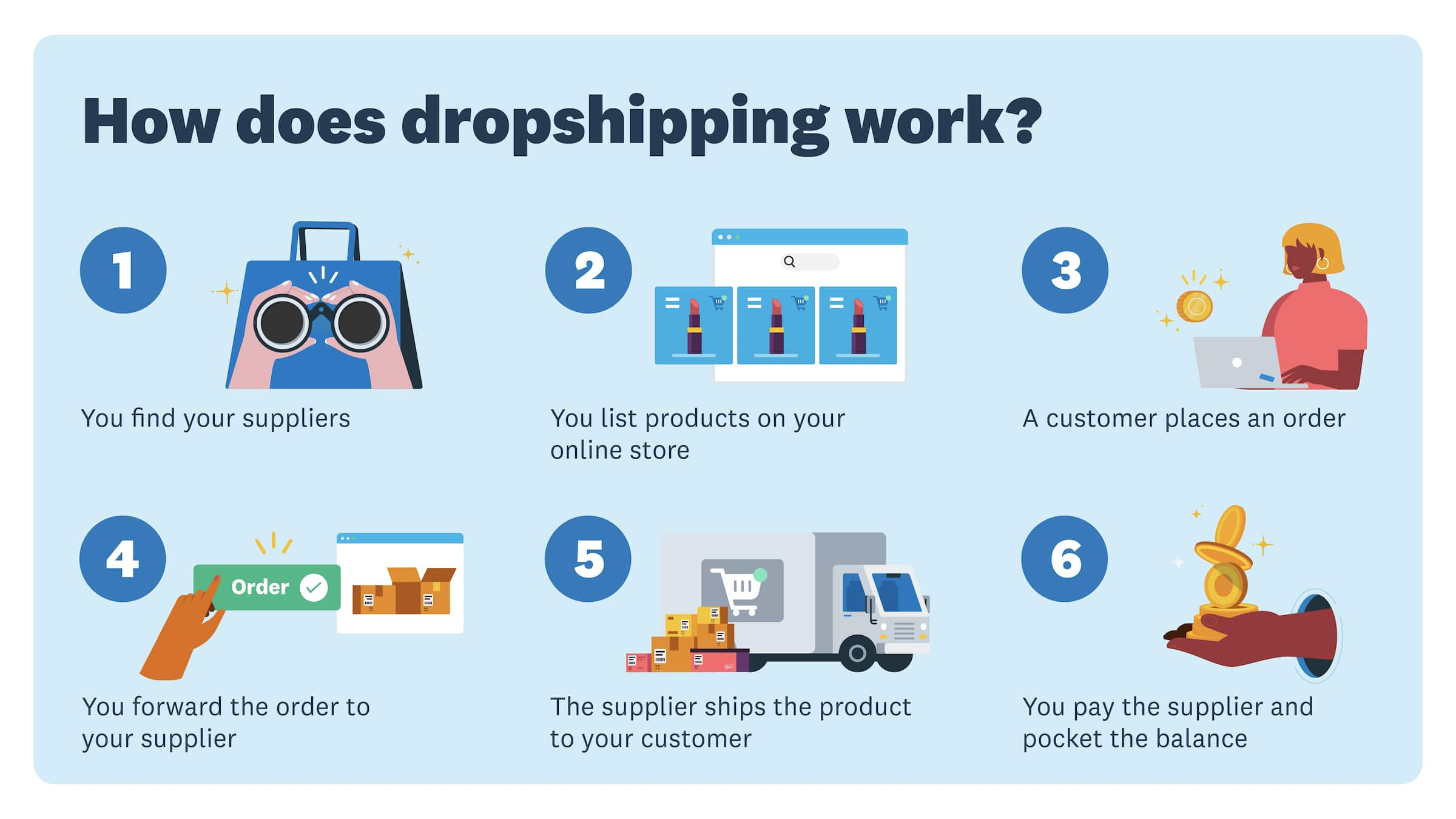
The dropshipping process has six steps, starting with finding suppliers and ending with collecting your profit. Here’s how each step works.
1. You find your suppliers
Only some suppliers work with dropshippers. Once you’ve found a supplier, check them against these standards:
- Product samples that meet your quality standards before you list anything
- Wholesale prices that leave room for your markup
- Reliable shipping, with reasonable average delivery times and tracking options
- Clear terms on pricing, return policies, and restocking fees, agreed upfront
Give priority to suppliers that offer white-labelling, which adds your branding to products and packaging. Automated integration is worth looking for too, because it connects their system directly to your store for faster ordering.
2. You list products on your online store
List your products with detailed descriptions, high-quality images, and accurate specs. Your supplier may provide these, or you can create branded versions.
Set your prices with a markup for profit, but stay competitive, since customers compare prices in seconds. Factor in hidden costs like platform fees and transaction charges when you calculate your final price.
3. A customer places an order
When a customer orders, the payment goes directly to you. As the seller of record, you handle refunds and resolve any disputes.
4. You forward the order to your supplier
Next, you pass the order details to your supplier so they can fulfil it. Send them this information:
- The customer’s shipping address
- The product specifications, such as size, colour, and quantity
- Any special requests or gift messaging
5. The supplier ships the product to your customer
The supplier packages and ships the product directly to your customer. You may receive a tracking number to share with the buyer.
6. You pay the supplier and pocket the balance
Once the order is fulfilled, pay the supplier the agreed wholesale cost and any shipping fees. The difference between what the customer paid and those costs is your gross profit on the order.
Your role continues after the package ships. As the seller of record, you answer customer service enquiries, process returns, and resolve any issues with the order. A clear returns policy and prompt communication help protect your reputation.
Dropshipping vs traditional retail
Dropshipping and traditional retail differ mainly in who holds the stock and who carries the risk. Knowing how they compare helps you decide which model suits your goals and budget.
Dropshipping differs from traditional retail in four key ways:
- Dropshippers hold no stock, while traditional retailers store and secure their own inventory
- Dropshippers avoid upfront inventory costs, while traditional retailers invest heavily before they sell
- Dropshippers depend on suppliers for quality and shipping, while traditional retailers face unsold stock, theft, and damage
- Dropshippers hand packing and shipping to the supplier, while traditional retailers fulfil orders themselves
Some products work better with dropshipping than with traditional retail. These categories are a good fit:
- Niche products, such as eco-friendly supplies or vegan skincare, that you can test without large stock orders
- High-value items, such as designer bags or luxury watches, that you can sell without upfront inventory or insurance costs
- Trendy or seasonal items, such as fashion accessories or holiday decor, that you can offer without risking unsold stock
Testing niche products without stock risk is also a practical way to compete with larger retailers that carry broad, general ranges.
What are the pros and cons of dropshipping?
Dropshipping’s biggest advantages are low startup costs and the freedom to run your store from anywhere. Its biggest drawbacks are thin profit margins and heavy reliance on suppliers.
Dropshipping benefits
Most of the benefits come from handing inventory and logistics to your supplier. Here’s what that gives you:
- Room to scale, because you can focus on your product range, marketing, and customer service
- Location flexibility to monitor sales, process orders, and coordinate with suppliers from anywhere with an internet connection
- Lower startup costs, because you pay suppliers only after you make a sale
- Low overheads without warehousing or stock handling, which helps you reach profitability sooner on limited startup funds
- Better cash flow, because customers pay you before you pay suppliers, so your money stays out of unsold inventory
- Lower environmental impact, with less wasted stock and fewer transportation steps
Dropshipping drawbacks
Shipping gets complex with several suppliers, since exact delivery times are harder to promise and one order may arrive in separate parcels. International orders can also bring delays and fees that hurt your reputation. Review your shipping strategy to set clear expectations with customers.
Profit margins are lower because you buy items one at a time and miss out on bulk discounts. Typical dropshipping profit margins sit between 15% and 20%. Some suppliers also charge extra for small orders, and tight margins leave a smaller budget for marketing and growth.
Low barriers to entry attract many sellers, which leads to price wars that squeeze margins further. You can stand out with unique products, a strong brand, and exceptional customer service.
Your customers also hold you responsible for problems your supplier causes, including inconsistent quality, shipping delays, and damaged packaging. Branding takes more work too, because many suppliers skip white-labelling. Generic packaging that doesn’t match your store makes customer loyalty harder to build.
Is dropshipping profitable?
Yes, dropshipping can be profitable, but margins are thin, so your profit depends on keeping costs per order under control. Printful puts typical dropshipping margins at 15%–20%, which leaves little room for waste.
Your gross profit on each order is the sale price minus the product and shipping costs you pay the supplier. Your net profit is what remains after you also subtract advertising, platform and payment fees, returns, and taxes.
Advertising often decides the result. In the Calgary example above, spending $15 on ads to win that $40 sale would turn your $12 into a $3 loss. Returns also cut into profit, because a refunded order can still leave you paying for the product and shipping.
Build every cost into your pricing before you list a product. Here’s what to factor in:
- Wholesale cost of each product
- Supplier shipping and handling fees
- Ecommerce platform subscription and app fees
- Payment processing fees on every transaction
- Advertising spend to win each customer
- Returns, refunds, and chargebacks
- GST/HST you collect, which you pass on to the government rather than keep
Tracking these numbers for each product shows you which items earn their place in your store and which ones to drop.
Legal considerations for dropshipping in Canada
Running a dropshipping business in Canada comes with legal and tax obligations. Knowing them before you launch helps you avoid costly mistakes.
Business registration
Register your business with your provincial or territorial government. You also need a business number from the Canada Revenue Agency (CRA). If you plan to operate under a name other than your own legal name, register that business name as well.
GST/HST obligations
Once your annual revenue exceeds $30,000, you must register for and collect GST/HST on sales. Taxable supplies in Canada are subject to GST at a rate of 5%, or HST at 13%–15% in participating provinces.
Below the $30,000 threshold, registering voluntarily lets you claim input tax credits on business expenses. For filing details, read the full GST/HST guide for small businesses.
Intellectual property risks
Selling branded or trademarked products without authorization can lead to legal action. Verify that your suppliers have the rights to sell the products they offer. Steer clear of counterfeit or replica items, which violate Canadian trademark laws and can result in fines or store shutdowns.
Supplier contracts
A written agreement with each supplier protects both parties. Your contract should cover pricing, shipping timelines, return and refund procedures, and liability for damaged or lost goods. Clear terms help you resolve disputes quickly and set expectations for your customers.
Consumer protection
Canadian consumer protection laws apply to online sellers. You must provide accurate product descriptions, honour your stated return policies, and deliver orders within the timeframes you advertise. Get familiar with your province’s consumer protection legislation to stay compliant.
Dropshipping business models
Dropshipping business models vary based on how you source products. Grand View Research sizes the global dropshipping market at about US$464.4 billion in 2025 and expects a compound annual growth rate of 20.7% between 2026 and 2033.
That rapid expansion creates opportunity whichever model you choose. Here are the three main options:
- Wholesale dropshipping connects you with wholesalers who ship directly to your customers, giving you wide product ranges and low-risk product testing
- Print on demand makes each product after it’s ordered, which suits custom designs on t-shirts, mugs, and phone cases, but means longer shipping times
- Retail dropshipping resells products from retailers, giving you instant access to stock, but retail prices keep margins tight and rule out white-labelling
Retail dropshipping works best as a way to test demand or take advantage of price differences between markets.
How do you start dropshipping in Canada?
You start dropshipping in Canada by choosing a niche, lining up suppliers, registering your business, and building and marketing your store on a set budget. North America is the fastest-growing dropshipping region, with the US market alone reaching US$48.2 billion in 2025.
Canadian sellers are well placed to tap into this momentum. For a detailed walkthrough, see the full guide on how to dropship in Canada. Here’s how to launch your store in six steps.
1. Find your market niche
Choose a niche that matches your interests and meets market demand. Research your options with these tools:
- Google Trends to spot growing product categories
- Amazon and eBay to identify in-demand products
- Competitor analysis to find gaps where you can offer unique items
You can dig deeper with this guide to doing market research.
2. Choose reliable suppliers
Your suppliers shape your delivery times and margins. Evaluate potential suppliers on these factors:
- Location, since closer suppliers mean faster shipping
- Reputation, based on reviews and ratings
- Pricing and fees, to confirm the margins work for your business
- Minimum orders, to make sure requirements fit your volume
- Dispatch times, to verify they meet customer expectations
Platforms like Spocket, Modalyst, and DSers connect you with vetted suppliers. They let you browse catalogues, import products with auto-filled descriptions, and customize details to fit your brand.
3. Register your business and tax accounts
Before you take your first order, set up the accounts that make your business official. Start by taking the time to register your business with your provincial or territorial government. Then get a business number from the CRA.
Once your revenue exceeds $30,000, you’ll need to register for GST/HST and charge it on your sales. Registering sooner is optional, and it lets you claim input tax credits on business expenses from the day you register.
4. Create your online store
Your store is where customers browse and buy, so make it easy to use. Follow these steps to build it:
- Choose a platform like Shopify, WooCommerce, BigCommerce, or Wix
- Set up a payment processor such as Stripe or PayPal
- Add products with detailed descriptions, clear images, and accurate specs
- Customize your site design to reflect your brand
5. Plan your marketing strategy
Marketing brings customers to your store, so plan it before you launch. Focus on these channels:
- Build a social media presence where your audience is: TikTok for younger customers, Instagram for visual products. Post regularly to showcase products and share tutorials.
- Run pay-per-click (PPC) campaigns on Google, Facebook, and Instagram. Target specific interests to reach your ideal customers.
- Collect customer reviews by offering small discounts, then display them on your site. Use the feedback to improve your service.
6. Budget for startup costs
You can launch a dropshipping store on a modest budget. Here’s a typical cost breakdown:
- A domain name at $15–$20 per year
- An ecommerce platform at $30–$80 per month
- Initial marketing at $200–$500
- Product samples at $50–$150 for quality checks
- Accounting software on a monthly subscription, so you track finances from day one
Keep a cash reserve for unexpected costs like supplier price changes or platform upgrades. For a detailed breakdown of launch costs, see the guide on startup business costs in Canada. Starting lean and reinvesting profits is a practical approach for most new dropshippers.
Choosing reliable dropshipping suppliers
Your suppliers directly affect your customer experience, so choosing the right partners is one of your most important decisions. A thorough vetting process saves you from costly problems later.
Where to find suppliers
Start your search on established supplier directories and platforms. These three are popular with dropshippers:
- Spocket connects you with suppliers in North America and Europe for faster shipping to Canadian customers
- Modalyst offers a wide range of products, including unique brands and print-on-demand items
- DSers is the official AliExpress partner for accessing low-cost suppliers and bulk orders
You can also find suppliers at trade shows, through industry associations, or by contacting manufacturers directly.
Red flags to watch for
Some warning signs suggest a supplier could cause problems later. Be cautious of suppliers who show any of these:
- No verifiable business address or contact information
- Unusually low prices that seem too good to be true
- No return or refund policy
- Poor communication or slow response times
- Requests for large upfront payments before any orders
Questions to ask before committing
Clear answers now prevent disputes later. Before you sign an agreement, ask these questions:
- What are your average shipping times to Canada?
- Do you offer white-labelling or branded packaging?
- What is your process for handling returns and defective products?
- Can you provide references from other dropshipping partners?
- Do you offer automated integration with ecommerce platforms?
Order product samples before you list anything in your store. Test the product quality, packaging, and delivery times yourself so you know exactly what your customers will receive.
Top 5 dropshipping tips
Dropshipping offers flexibility and agility, but success takes attention to detail. These five tips help you build a profitable business:
- Know your customer and cater to their specific needs, so you become the store they think of first in your niche
- Answer enquiries promptly, keep clear return policies, and handle complaints professionally to build trust
- Request samples before listing, monitor customer feedback, and work with suppliers who resolve issues quickly
- Keep accurate financial records, manage cash flow, and stay on top of your taxes
- Stay passionate about your products, because enthusiasm keeps you motivated and customers notice when you genuinely care
Simplify your dropshipping business with Xero
Well-managed finances give your dropshipping business room to grow. The right tools keep you on top of supplier payments, margins, and tax time, so you can spend more time on your store.
Xero’s accounting software is built for small businesses like yours. With Xero, you can:
- integrate with ecommerce platforms like Shopify and WooCommerce
- forecast cash flow in real time so you can make confident decisions
- work in multiple currencies for international supplier payments and sales
- automate bank reconciliation to save hours of manual work
When you’re ready to expand, find more tools in the Xero App Store. You can also get one month free and see how Xero fits your dropshipping business.
FAQs on dropshipping
Here are quick answers to common questions about dropshipping in Canada.
Is dropshipping legal in Canada?
Yes, dropshipping is legal in Canada when you meet your registration, tax, and consumer protection obligations. Check your provincial requirements for any additional licensing your products or business need.
Is dropshipping good for beginners?
Yes, it’s one of the most accessible ecommerce models because it needs little upfront investment and no inventory. If you’re still weighing your options, compare it with other online business ideas that suit your skills.
Can I start dropshipping with $1,000?
Yes, $1,000 covers a basic launch, including a domain name, your first month on an ecommerce platform, and initial marketing. Even at the top of those cost ranges, you’d still have about $400 left for product samples and platform upgrades.
What is the best dropshipping platform?
The best choice depends on your needs and budget, and you’ll usually pair a store builder such as Shopify or WooCommerce with a supplier app. Pick Spocket for North American and European suppliers, Modalyst for unique brands and print on demand, or DSers for low-cost AliExpress suppliers.
How long does it take to make money with dropshipping?
There’s no fixed timeline, because your niche, marketing budget and pricing all affect how quickly profit arrives. According to Printful, only about 10%–20% of new dropshipping stores turn a steady profit within their first year.
Disclaimer
Xero does not provide accounting, tax, business or legal advice. This guide has been provided for information purposes only. You should consult your own professional advisors for advice directly relating to your business or before taking action in relation to any of the content provided.
Start using Xero for free
Access Xero features for 30 days, then decide which plan best suits your business.