What is accumulated depreciation? Formula and examples
Learn what accumulated depreciation is, how to calculate it, and how it affects your small business.

Written by Jotika Teli—Certified Public Accountant with 24 years of experience. Read Jotika's full bio
Published Monday 15 June 2026
Table of contents
Key takeaways
- Accumulated depreciation is a contra asset account, not a liability. It sits on your balance sheet alongside your assets and reduces their value from the original purchase price to show a realistic book value.
- Use the straight-line depreciation formula, which is the cost of the asset minus the salvage value divided by its useful life, to calculate your annual depreciation expense and build a schedule that tracks how your asset's book value changes each year.
- Depreciation expenses lower your taxable income, which reduces your tax bill and keeps more cash in your business. Depreciation is a non-cash expense, so it gets added back to net income on your cash flow statement.
- Choose a depreciation method that matches how your asset loses value. Use straight-line for assets that wear evenly over time, and declining balance or double-declining balance for technology or equipment that loses value faster in its early years.
What is accumulated depreciation?
Accumulated depreciation is the total amount an asset has decreased in value since you bought it. It shows the cumulative wear, tear, and ageing of your business assets over time.
This tracking helps you understand the carrying amount of your assets on your financial statements, which is the amount recognised after deducting any accumulated depreciation and impairment losses.
The calculation is simple:
Book value = asset cost – accumulated depreciation
Here are some examples:
- Office furniture: Costs $5,000 and depreciates by $1,000 each year. After 3 years, accumulated depreciation totals $3,000, leaving a book value of $2,000.
- Machinery: Costs $25,000 and depreciates by $2,500 each year. After 6 years, accumulated depreciation totals $15,000, leaving a book value of $10,000.
Depreciation vs accumulated depreciation
Depreciation is a single period's expense, while accumulated depreciation is the running total of all those expenses over time. Understanding the difference between these 2 terms is essential for accurate financial reporting.
Depreciation is the annual expense showing how much an asset loses value each year. Accumulated depreciation is the running total of all depreciation expenses for that asset since you bought it.
The key difference:
- Depreciation: Records the annual expense on your income statement.
- Accumulated depreciation: Tracks the cumulative total on your balance sheet.
Is accumulated depreciation an asset or a liability?
Accumulated depreciation is neither an asset nor a liability. It's classified as a contra asset account, which means it reduces the value of the asset it's paired with on your balance sheet.
Here's why it's not a liability:
- Liabilities represent money you owe or obligations to fulfil.
- Accumulated depreciation doesn't create a debt to repay.
- It simply tracks how much value your asset has lost over time.
Contra asset accounts work differently from regular assets. They have 3 key characteristics:
- Reduce asset totals with negative values.
- Show realistic asset values rather than original purchase prices.
- Appear alongside assets on the balance sheet but subtract from their value.
While you record the contra asset alongside your other assets, it always has a credit balance, showing how accumulated depreciation reduces an asset's value from its original cost. This gives you the asset's carrying amount or book value.
Why understanding accumulated depreciation matters for a business
Tracking accumulated depreciation gives you valuable insights for business planning and financial management. Here's how it helps your business in practice.
Understanding accumulated depreciation helps you:
- Plan ahead: Track asset values over time to schedule replacements, upgrades and maintenance.
- Reduce taxes: Lower your taxable income with depreciation expenses, as eligible small businesses may be able to instantly write off assets costing less than $20,000 each or claim accelerated depreciation deductions, which can reduce your tax bill and keep more cash in your business. According to PwC Australia, the instant asset write-off currently lets eligible small businesses with turnover under $10 million immediately deduct assets costing less than $20,000 each, making it important to understand which assets qualify for immediate write-off versus standard accumulated depreciation.
- Access finance: Show lenders and investors the value of your assets to improve your chances of getting approved.
How does accumulated depreciation affect financial statements?
Accumulated depreciation appears on 3 key financial statements, each serving a different purpose. Here's how it shows up on each one.
Accumulated depreciation on the balance sheet
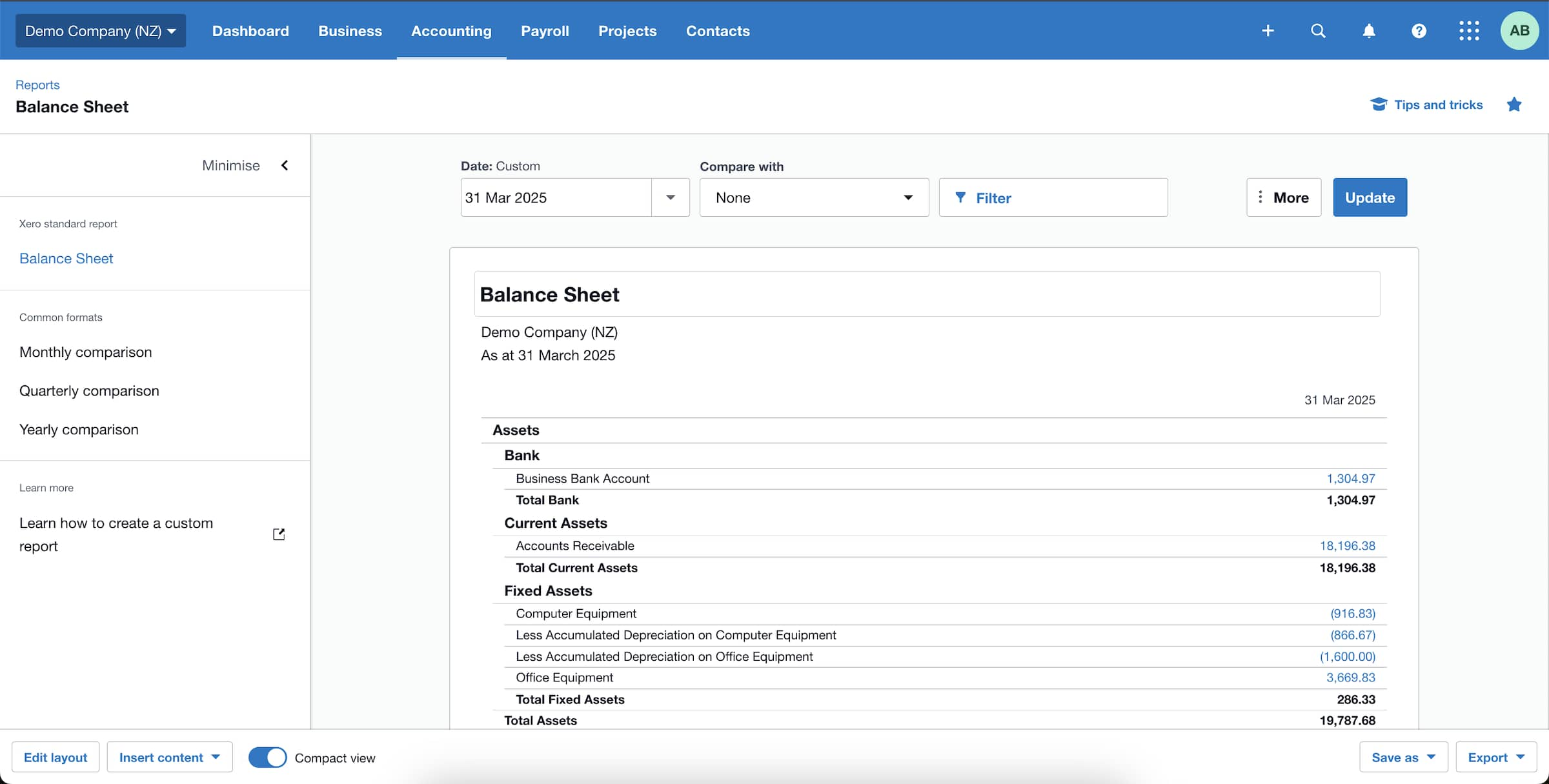
Your balance sheet lists the asset's original cost, and accumulated depreciation adjusts this value downwards. The result is the asset's carrying amount under the cost model.
Accumulated depreciation reduces an asset's book value on the balance sheet. Although the original cost stays the same, the contra asset balance grows each year, giving you a more realistic picture of what your assets are worth. You can use a balance sheet template to see how this looks in practice.
Accumulated depreciation on the income statement
You record depreciation as an expense on your income statement, which reduces your taxable income. For tax purposes, deductions depend on tax rules and may differ from accounting depreciation.
As a non-cash expense, depreciation does not directly use cash, although it can affect cash flow indirectly through tax. Research from the Tax Foundation shows that across the OECD, businesses recover an average of 85.3% of machinery investment costs through depreciation, compared to just 47.6% for industrial buildings. This means the type of asset your business invests in can significantly affect the tax benefit you receive from depreciation.
Accumulated depreciation on the cash flow statement
Depreciation doesn't involve actual cash leaving your business, so you add it back to net income on the cash flow statement. This adjustment reflects that depreciation is an accounting expense, not a cash outflow.
Learn more about how the ATO treats depreciation.
How to calculate accumulated depreciation
The most common way to calculate accumulated depreciation is using the straight-line method. It spreads an asset's depreciable amount evenly across its useful life, making it the simplest approach for small businesses.
The straight-line depreciation calculation
Here's the formula you'll use to work out your annual depreciation expense.
Formula: Annual depreciation expense = (cost of asset – salvage value) / useful life
Key terms explained:
- Cost of asset: The purchase price and directly attributable costs necessary to bring the asset into use.
- Salvage value: The estimated resale or scrap value when the asset is no longer useful.
- Useful life: The expected years the asset will function before becoming obsolete.
To maintain accuracy, Australian Accounting Standards require you to review an asset's useful life and residual value at least annually, specifically at each financial year-end.
An asset with a short useful life spreads depreciation over fewer years, resulting in a higher annual depreciation expense. If an asset holds its value well and has a relatively high salvage value, it will depreciate less each year.
Calculate straight-line depreciation
Here's a worked example. Say you buy office equipment for $1,000, expect to use it for 5 years, and estimate a salvage value of $100.
Annual depreciation expense = ($1,000 – $100) / 5 = $180 per year
After year 1, accumulated depreciation is $180 and book value is $820. After year 2, accumulated depreciation is $360 and book value is $640. After year 3, accumulated depreciation is $540 and book value is $460. After year 4, accumulated depreciation is $720 and book value is $280. After year 5, accumulated depreciation is $900 and book value equals the $100 salvage value.
Other depreciation methods
While the straight-line method is popular for its simplicity, other methods might suit your business better. This is especially true for assets that lose value faster in their early years.
Accounting standards require you to use a depreciation method that reflects how you consume the asset's future economic benefits.
Declining balance method
This method applies a constant depreciation rate to the asset's book value each year. It results in higher depreciation expenses in the early years and lower expenses later on.
Use this method for assets that are more productive when they're new.
Double-declining balance method
This approach doubles the straight-line depreciation rate, making it a more accelerated version of the declining balance method. It significantly speeds up depreciation in the first few years.
Use this method for technology or equipment that quickly becomes outdated.
Units of production method
This method bases depreciation on actual usage rather than time. You calculate a per-unit rate and multiply it by the number of units produced or hours used each period.
Use this method for manufacturing equipment or vehicles where wear depends on how much you use the asset rather than how long you've owned it.
Common misconceptions about accumulated depreciation
There are several common myths about accumulated depreciation that can lead to mistakes in your financial reporting. Here are the ones you should watch out for.
Myth: accumulated depreciation means you need to replace the asset
A fully depreciated asset can still work perfectly well. Accumulated depreciation reflects an accounting allocation of cost, not the physical condition of the asset. Many businesses continue using assets long after they've been fully depreciated.
Myth: accumulated depreciation reduces the cash in your business
Depreciation is a non-cash expense. It reduces your profit on paper, but no money actually leaves your bank account. In fact, the tax deduction from depreciation can improve your cash position by lowering your tax bill.
Myth: accumulated depreciation tracks the market value of an asset
Book value and market value are 2 different things. Accumulated depreciation shows the accounting value based on a formula, not what the asset would actually sell for on the open market. A piece of machinery might have a book value of $5,000 but be worth $15,000 to a buyer.
Myth: you can only use one depreciation method
You can use different depreciation methods for different assets, as long as each method reflects how you consume that asset's economic benefits. You might use straight-line for office furniture and declining balance for computer equipment.
What happens when you dispose of or sell a depreciated asset?
When you sell or dispose of an asset, you need to remove both the asset's original cost and its accumulated depreciation from your balance sheet. This process is called derecognition, and it's similar to the process used for amortisation of intangible assets.
Under Australian Accounting Standards, depreciation of an asset ceases when you classify it as held for sale or derecognise it. Depreciation stops at the earlier of the date you classify the asset as held for sale or the date you derecognise it from the books.
To work out whether you've made a gain or loss on disposal, compare the sale price with the asset's book value at that point.
- Gain on disposal: The sale price is higher than the book value. For example, you sell equipment with a book value of $2,000 for $3,500, recording a $1,500 gain.
- Loss on disposal: The sale price is lower than the book value. For example, you sell that same equipment for $1,200, recording an $800 loss.
- Scrapping an asset: If the asset has no sale value, the remaining book value is written off as a loss.
Any gain or loss on disposal is recorded on your income statement for that period. If you're discarding a fully depreciated asset with zero book value and no sale proceeds, there's no gain or loss to record.
Simplify your accounting with Xero
Managing depreciation, adjusting entries, and calculating accumulated depreciation quickly gets complicated, especially as your business grows. You don't have to do it all manually.
Xero streamlines your accounting processes and helps you manage and track your assets. You can create detailed depreciation schedules that give you a clear view of fixed asset values and make your financial reporting more accurate. Xero's fixed asset management tools handle depreciation calculations automatically, so you can focus on running your business. Learn how Xero supports your business or Get one month free.
FAQs on accumulated depreciation
Here are answers to common questions about accumulated depreciation.
How does accumulated depreciation affect cash flow?
Accumulated depreciation doesn't directly affect cash flow because it's a non-cash expense. However, the depreciation deduction lowers your taxable income, which reduces your tax bill and keeps more cash in your business. Learn more about tracking business expenses to maximise your deductions.
Can you reverse accumulated depreciation?
You don't reverse accumulated depreciation under normal circumstances. If an asset increases in value, you may recognise a revaluation increment under the revaluation model, but the previously recorded accumulated depreciation isn't undone.
What's the difference between accumulated depreciation and impairment?
Accumulated depreciation is a gradual, scheduled allocation of an asset's cost over its useful life. Impairment is a separate, one-off write-down that happens when an asset's recoverable amount drops below its carrying amount due to unexpected events.
Does land have accumulated depreciation?
Land doesn't depreciate because it has an unlimited useful life. Only assets with a finite useful life, such as buildings, vehicles, and equipment, accumulate depreciation over time.
How often should you review your depreciation schedule?
Australian Accounting Standards require you to review each asset's useful life and residual value at least at each financial year-end. You should also review your schedule if there's a significant change in how you use the asset. Keeping accurate bookkeeping records makes this review straightforward.
Disclaimer
Xero does not provide accounting, tax, business or legal advice. This guide has been provided for information purposes only. You should consult your own professional advisors for advice directly relating to your business or before taking action in relation to any of the content provided.
Get one month free
Purchase any Xero plan, and we will give you the first month free.