Cash vs accrual accounting
Compare cash and accrual accounting and find the right method for your Australian small business.
Published Thursday 23 July 2026
Table of contents
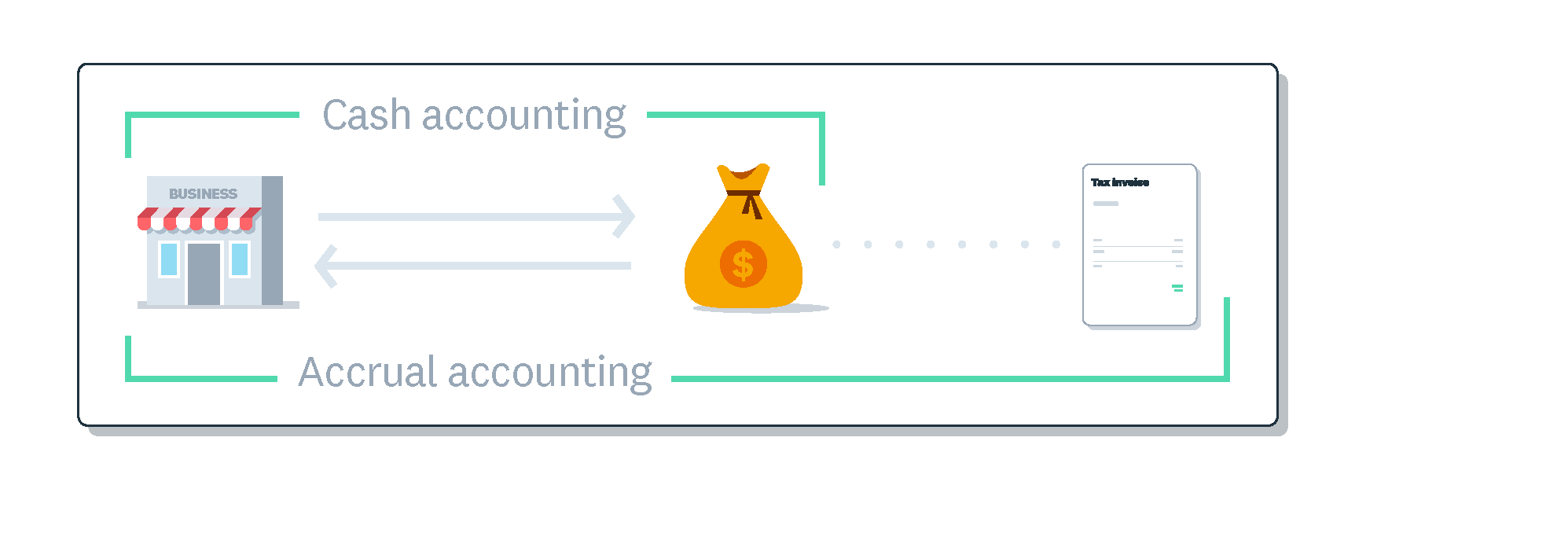
Cash accounting focuses only on cash changing hands, not outstanding bills or invoices.
Key takeaways
- Cash accounting records income when money reaches your account and expenses when you pay them, which keeps your books simple and shows real-time cash.
- Accrual accounting records income when you earn it and expenses when you incur them, giving a fuller picture of profit but taking more effort.
- In Australia you make two separate choices: an income-tax method (cash or accruals) and a goods and services tax (GST) method (cash or non-cash), and the ATO says not to confuse the two.
- Small business entities with an aggregated turnover under $10 million can usually pick either GST method, while carrying stock or planning to grow often points towards accrual accounting.
What is cash basis accounting?
Cash basis accounting is the simplest way to track money in your business. You record income when a payment lands in your account, and you record an expense when the money actually leaves it.
Say you send a client an invoice in June 2025, and they pay you in July 2025. Under cash accounting, that income belongs to the 2025–26 financial year, because that's when the payment arrived. The same logic applies to bills you pay.
This method suits many sole traders and service businesses. It gives you a clear view of the cash you can actually spend right now.
What is accrual accounting?
Accrual accounting records transactions when they happen, not when the cash moves. You count income when you earn it and expenses when you incur them, even if payment comes later.
Using the same example, that June 2025 invoice counts as income in the 2024–25 financial year, because that's when you did the work. Money owed to you sits as accounts receivable, and money you owe sits as accounts payable.
Accrual accounting underpins formal financial reporting in Australia. Large proprietary and public companies must prepare reports under the Australian Accounting Standards set by the Australian Accounting Standards Board (AASB) and applied through the Corporations Act 2001.
Cash vs accrual accounting: key differences
Both methods track the same transactions, but the timing and the detail differ. The four areas below show where cash and accrual accounting part ways.
Timing of revenue and expense recognition
The core difference is when you recognise a transaction. This affects which financial year your income and expenses land in.
- Cash accounting recognises revenue and expenses only when money changes hands
- Accrual accounting recognises revenue when earned and expenses when incurred
- Accrual accounting can show profit in a period before any cash arrives
Financial accuracy
Each method gives you a different kind of accuracy. One tracks your cash position, the other tracks your true profitability.
- Cash accounting reflects exactly how much money you have on hand
- Accrual accounting matches income to the expenses that earned it
- Accrual accounting gives a clearer view of long-term performance
Complexity
The methods also differ in how much work they take to maintain. This matters when you weigh up your day-to-day small business bookkeeping.
- Cash accounting is straightforward and easy to run on your own
- Accrual accounting tracks receivables, payables and adjustments
- Accrual accounting often benefits from software or an adviser
Meeting reporting standards
Your method can affect whether you meet formal reporting rules. Larger companies in Australia face obligations that cash accounting can't satisfy.
- Cash accounting is fine for many small businesses and simple tax reporting
- Accrual accounting supports reports prepared under AASB standards
- Accrual accounting aligns with obligations under the Corporations Act 2001
Cash vs accrual accounting for GST and income tax
In Australia, cash versus accrual isn't a single decision. You make two separate choices, and the ATO warns you not to confuse them.
The first is your income-tax method. The Australian Taxation Office (ATO) explains that a cash basis reports income when you receive payment, while an accruals basis reports income when you earn it. You must use the same method for all transactions within a financial year.
The ATO adds that you should generally only report on a cash basis if your business income is principally a result of your own labour. That guidance points many sole traders towards the cash basis.
The second choice is your GST method, which is separate again. The ATO sets out two GST accounting methods: cash and non-cash (accruals).
Businesses with an aggregated turnover under $10 million count as a small business entity and can choose either GST method. Most larger businesses must use the non-cash method. For a plain-English overview, business.gov.au explains how to choose between cash and accrual accounting.
Pros and cons of cash accounting
Cash accounting works well for many small businesses, though it has trade-offs. Here's what to weigh up.
Advantages
Cash accounting is popular because it's simple and shows your real cash position. These are its main strengths.
- Keeps bookkeeping simple and easy to manage yourself
- Shows exactly how much cash you have available
- Delays GST payable until customers actually pay you
- Suits sole traders whose income comes from their own labour
Disadvantages
The simplicity comes at a cost when your business grows. Watch for these limits.
- Hides money owed to you and bills you still owe
- Can distort profit across financial years
- Makes it harder to plan for future commitments
- Falls short of formal reporting obligations for larger companies
Pros and cons of accrual accounting
Accrual accounting gives a fuller financial picture, but it asks more of you. Consider both sides before you commit.
Advantages
Accrual accounting shines when you need accuracy and a long-term view. These are the key benefits.
- Matches income to the costs that earned it
- Reveals what you're owed and what you owe
- Supports reports prepared under Australian Accounting Standards
- Gives lenders and investors a reliable view of performance
Disadvantages
The richer detail brings more work and complexity. Keep these drawbacks in mind.
- Takes more time and effort to maintain
- Can show a profit while your bank balance stays low
- Often needs accounting software or an adviser
- Requires tracking receivables, payables and adjustments
How to choose the right accounting method
The right method depends on your size, your stock and your reporting needs. These factors will guide your small business accounting choice.
Business size and growth plans
Your current size and where you're heading both matter. Think about the next few years, not just today.
- Cash accounting suits smaller, simpler businesses
- Accrual accounting scales better as transactions grow
- Fast growth plans often make accrual the safer starting point
Inventory
Carrying stock is a common sign that accrual accounting will suit you better. The way you handle inventory can shape your choice.
- Stock-heavy businesses usually lean towards accrual accounting
- The ATO offers simplified trading stock rules for small business entities
- Service businesses with little stock often manage well on cash accounting
ATO rules and turnover thresholds
ATO thresholds shape which options are open to you. Your aggregated turnover is the figure to watch.
- Small business entities under $10 million turnover can choose either GST method
- Most businesses above that threshold must use the non-cash GST method
- You must apply one income-tax method consistently across a financial year
Financing and investor expectations
Outside money often comes with reporting expectations. Lenders and investors tend to want detail.
- Banks and investors usually prefer accruals-based financial statements
- Accrual accounting shows profitability and commitments more clearly
- Cash accounting can understate the health of a growing business
Reporting obligations
Some businesses have no choice because of their legal structure. Check your obligations early.
- Large proprietary and public companies must report on an accruals basis
- These reports follow Australian Accounting Standards and the Corporations Act 2001
- Smaller businesses generally have more freedom to pick a method
When to switch from cash to accrual accounting
Many businesses start with cash accounting and move to accrual as they grow. Knowing when and how to switch keeps the change smooth.
Signs you've outgrown cash accounting
A few clear signals suggest it's time to move to accrual accounting. Look out for these as your business expands.
- Your aggregated turnover nears $10 million, the ATO small business threshold
- You start carrying significant stock or offer customer credit terms
- Lenders or investors ask for accruals-based financial statements
- Cash timing keeps distorting your view of profit
How to make the switch
Australia has no Form 3115 and no Section 481(a) adjustment. You change your method through the ATO, and these steps keep it simple.
- Choose the start of a new financial year, which runs 1 July to 30 June
- Talk to a registered tax or business activity statement (BAS) agent about your options
- Update your accounting software so it records income and expenses on an accruals basis
- Review your first accrual reports to check receivables and payables look right
Track your finances with confidence using Xero
Whichever method you choose, the right tools make it easier to stay accurate and on top of the ATO's rules. Xero records your income and expenses, tracks what you're owed and owe, and produces clear reports on either a cash or accrual basis.
That means less manual admin and more time to run your business, so you can make confident decisions all year round. Get one month free.
FAQs on cash vs accrual accounting
Here are answers to some frequently asked questions about cash vs accrual accounting in Australia.
Do Australian Accounting Standards require accrual or cash accounting?
Australian Accounting Standards are built around accrual accounting. Large proprietary and public companies must prepare formal reports on an accruals basis under the Corporations Act 2001.
Can you switch from cash to accrual accounting?
Yes, and there's no US-style form to file in Australia. You change your method through the ATO, ideally from the start of a new financial year, with help from a registered tax or BAS agent.
What is modified cash basis accounting?
Modified cash basis blends the two methods, recording most transactions on a cash basis while treating some items, like stock or assets, on an accruals basis. It aims to keep things simple while capturing a bit more detail.
Does the ATO require accrual accounting?
Not for everyone, as the ATO says you should generally use the cash basis only if your income is principally from your own labour. Small business entities under $10 million aggregated turnover can choose either method for GST.
Do banks prefer cash or accrual accounting?
Banks generally prefer accrual accounting because it shows a fuller picture of profitability and commitments. Accruals-based statements make it easier for lenders to assess a growing business.
Handy resources
Advisor directory
You can search for experts in our advisor directory
Xero Small Business Guides
Discover resources to help you do better business
Financial reporting
Keep track of your performance with accounting reports
Disclaimer
This glossary is for small business owners. The definitions are written with their requirements in mind. More detailed definitions can be found in accounting textbooks or from an accounting professional. Xero does not provide accounting, tax, business or legal advice.