What is an accounting period? Definition, types and examples
Learn what an accounting period is, the main types, and how they work for Australian small businesses.
Published Thursday 23 July 2026
Table of contents
Key takeaways
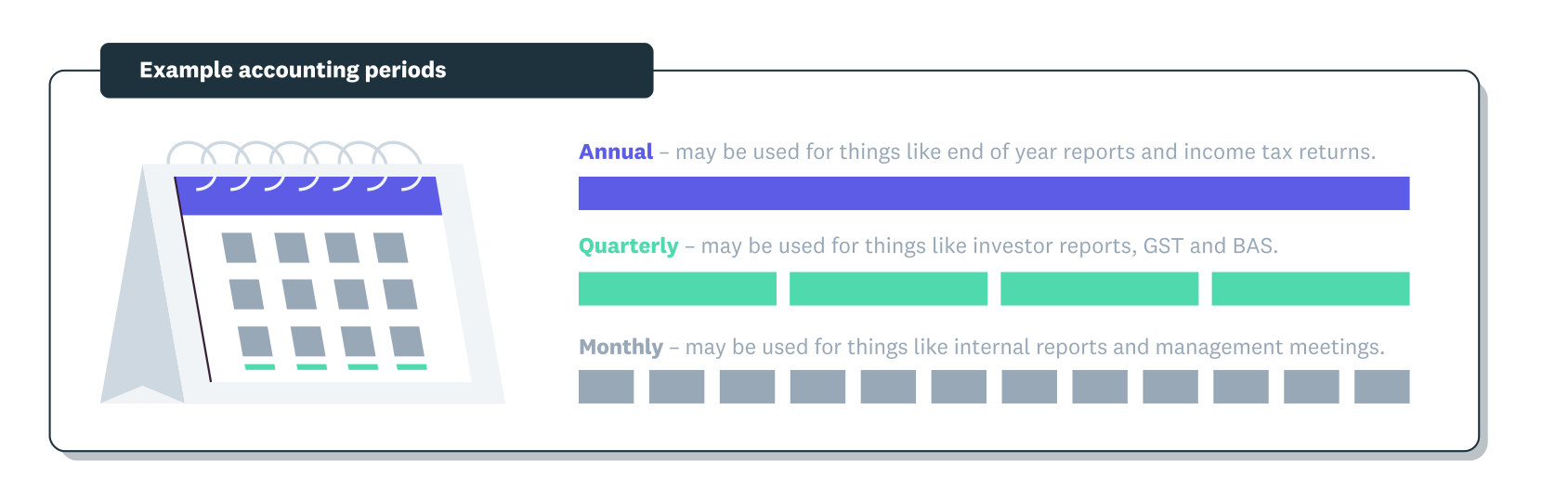
Annual accounting periods don’t have to start in January. Nor do monthly accounting periods have to start on the first of the month.
- An accounting period is the time frame you use to group transactions for financial reporting, and it's often 12 months long.
- In Australia, the standard financial year for income tax runs from 1 July to 30 June.
- You can report GST monthly, quarterly or annually, depending on your circumstances.
- Keeping organised, up-to-date records makes closing each accounting period much simpler.
What is an accounting period?
An accounting period is any time frame you use to group and report your business finances.
Every transaction that falls within a set date range becomes part of that period's financial statements, such as your profit and loss and balance sheet. This gives you a clear snapshot of how your business performed over that stretch of time.
Handy resources
Advisor directory
You can search for experts in our advisor directory
Xero Small Business Guides
Discover resources to help you do better business
Get one month free
Try Xero’s fast, simple, powerful online accounting software for your small business
Disclaimer
This glossary is for small business owners. The definitions are written with their requirements in mind. More detailed definitions can be found in accounting textbooks or from an accounting professional. Xero does not provide accounting, tax, business or legal advice.
An accounting period is often 12 months, but it doesn't have to be. You might use one period for income tax, another for GST reporting, and shorter periods for your own internal reviews. Getting the basics right is a core part of good business accounting.
Handy resources
Advisor directory
You can search for experts in our advisor directory
Xero Small Business Guides
Discover resources to help you do better business
Get one month free
Try Xero’s fast, simple, powerful online accounting software for your small business
Why accounting periods matter
Accounting periods give your finances structure, so you can track performance and stay on top of your obligations. They turn a stream of daily transactions into reports you can actually use.
Here's why they matter for your business:
- Consistent reporting: you produce statements over set, comparable time frames
- Budgeting and forecasting: you plan ahead using reliable historical figures
- Comparing performance: you measure one period against another to spot trends
- Meeting deadlines: you keep tax and compliance dates on track
Types of accounting periods
Businesses use different accounting periods depending on their reporting needs. Here are the most common types you'll come across:
- Calendar year: runs from 1 January to 31 December
- Financial year: in Australia, runs from 1 July to 30 June
- Quarterly: covers a three-month block, often used for GST and activity statements
- Monthly: covers a single calendar month, useful for close tracking
- 4-4-5 period: splits each quarter into two four-week months and one five-week month, common in retail
How transactions are assigned to an accounting period
Transactions are usually recorded in the period they're earned or incurred, not simply when cash lands in or leaves your account. That way, your income and the expenses tied to it show up in the same period.
Say you complete a job in June but the customer pays in July. Under this approach, you record the income in June, alongside the costs you spent to do the work. This keeps each period's picture accurate, and it's a habit that sits at the heart of solid bookkeeping.
Accounting periods and tax in Australia
Your accounting periods often line up with the tax reporting you need to do. In Australia, a couple of key dates shape how most businesses report.
The Australian income tax year, also called the financial year, runs from 1 July to 30 June. Most businesses use this period to prepare their income tax return.
You report GST to the Australian Taxation Office (ATO) on a business activity statement (BAS). Depending on your circumstances, you lodge your BAS monthly, quarterly or annually.
Example accounting periods
Accounting periods are more flexible than they first appear. An annual period doesn't have to start in January, and a monthly period doesn't have to start on the 1st.
Take a simple monthly example. In one month, your business records $10,000 in revenue and $5,000 in expenses. That gives you a $5,000 snapshot for the period, which you can compare against the month before to see how you're tracking. Pulling numbers like these together is the everyday work of financial reporting.
Can you change your accounting period?
You can apply to change the accounting period you use for income tax, though it isn't automatic. There's a set process to follow with the ATO.
Most Australian businesses use the standard 1 July to 30 June year. To use a different period for income tax, known as a substituted accounting period (SAP), you need to apply for and receive ATO approval. Approval is granted at the ATO's discretion, so it helps to understand the requirements before you plan around a change, especially as you approach a new financial year.
Simplify your accounting periods with Xero
Closing an accounting period is far easier when your records are organised and up to date. Cloud-based accounting keeps your transactions in one place, so your reports are ready when you need them.
With everything captured as you go, there's less scrambling at the end of a period and fewer manual tasks to chase down. You can see where things stand at any time and prepare for tax with confidence. Ready to get started? Get one month free.
FAQs on accounting periods
Here are some frequently asked questions about accounting periods to help you tie it all together.
Is an accounting period always 12 months?
No, an accounting period can be any length that suits your reporting needs. Many are 12 months, but monthly and quarterly periods are common too.
What is the accounting period for tax in Australia?
The Australian income tax year runs from 1 July to 30 June. Most businesses use this financial year to prepare their income tax return.
What is the difference between a calendar year and a financial year?
A calendar year runs from 1 January to 31 December, while the Australian financial year runs from 1 July to 30 June. Businesses here typically report income tax against the financial year.
Can I change my accounting period?
You can apply to use a different period for income tax, called a substituted accounting period. It's granted at the ATO's discretion, so you need approval first.